New Brunswick · For parents

What your child learns in Grade 6 in New Brunswick

Every subject, unit by unit, from New Brunswick’s curriculum: 122 skills in plain words.

Subjects
5
Skills
122
Provincial exams
4
Official curriculum
gnb.ca

Math in Grade 6

Mathematics, Grade 6

4 units · 40 skills

  1. Unit 1

    Number

    Place value continues past the millions period into ten- and hundred-millions.

    • Place value greater than one million
    • Place value less than one thousandth
    • Large numbers with technology
    10 more skills
    • Factors and multiples
    • Prime and composite numbers
    • Problems involving multiples
    • Improper fractions and mixed numbers
    • Understanding ratio
    • Understanding percent
    • Understanding integers
    • Multiplying decimals
    • Dividing decimals
    • Order of operations
  2. Unit 2

    Patterns and Relations

    A table pairs input values with output values by a rule.

    • Relationships in tables of values
    • Patterns with graphs and tables
    • Equations with letter variables
    1 more skill
    • Preservation of equality
  3. Unit 3

    Shape and Space

    Angles are found where two lines meet, like a corner.

    • Identifying and classifying angles
    • Estimating angles with reference angles
    • Measuring and drawing angles
    12 more skills
    • Angle sum of a triangle
    • Angle sum of a quadrilateral
    • Perimeter of polygons
    • Area of rectangles
    • Volume of right rectangular prisms
    • Constructing triangles
    • Comparing triangles
    • Sides and angles of polygons
    • Combining transformations on one shape
    • Successive transformations to create a design
    • Plotting points in the first quadrant
    • Transforming a shape on the Cartesian plane
  4. Unit 4

    Statistics and Probability

    A line graph shows how something changes over time.

    • Line graphs
    • Collecting data by questionnaires and experiments
    • Collecting data from databases and electronic media
    5 more skills
    • Graphing and analyzing data
    • Listing possible outcomes
    • Experimental versus theoretical probability
    • Determining theoretical probability
    • Determining experimental probability and comparing
Science in Grade 6

Science, Grade 6

4 units · 18 skills

  1. Unit 1

    Behaviour and Properties of Light

    Visible light is one part of the electromagnetic spectrum (EMS).

    • Light and the electromagnetic spectrum
    • Sound and how it travels
    • Smell receptors
  2. Unit 2

    Biological Forms and Processes

    Vision is the detection of and response to visible light.

    • Seeing: vision
    • Hearing: the ear
    • Touch, taste, and smell
    2 more skills
    • Balance and body position
    • The nervous system
  3. Unit 3

    Technological Applications

    Some technologies extend our senses beyond their natural limits.

    • Wayfinding technologies
    • Corrective technologies
    • Adaptive technologies
  4. Unit 4

    Learning and Living Sustainably

    Safety glasses protect the eyes from splashes and flying bits.

    • Protecting the sense organs
    • Keeping our senses healthy
    • Empathy and sensory impairments
    4 more skills
    • Careers in sensory science
    • Science and the UN Sustainable Development Goals
    • Design an accessibility device
    • The life cycle of what we make

English in Grade 6

English Language Arts, Grade 6

3 units · 33 skills

  1. Unit 1

    Speaking and Listening

    Contributing adds thoughts, ideas, AND questions.

    • Contributing and comparing ideas with others
    • Asking questions to seek clarification or explanation
    • Defending and supporting opinions with evidence
    8 more skills
    • Listening critically to ideas and points of view
    • Responding constructively in discussion
    • Using word choice and emphasis for a desired effect
    • Giving and following varied instructions
    • Engaging, responding to, and evaluating a variety of presentations
    • Listening attentively and being aware of others
    • Detecting prejudice and using bias-free language
    • Consciously considering audience needs
  2. Unit 2

    Reading and Viewing

    A range of interests means many topics and kinds of texts.

    • Selecting texts for a range of interests
    • Reading widely with emphasis on genre and authors
    • Using a wider range of text features to reinforce understanding
    8 more skills
    • Integrating cueing systems with increasing independence
    • Reflecting on and discussing your reading process
    • Answering questions with increasing independence
    • Explaining why texts matter and connecting among them
    • Reflecting on and giving reasons for interpretations
    • Recognizing purpose in facts and alternative perspectives
    • Identifying conventions and structure of texts and genres
    • Responding critically by analysing and evaluating
  3. Unit 3

    Writing and Other Ways of Representing

    A repertoire is your collection of note-making strategies.

    • Using strategies to frame questions and design investigations
    • Selecting note-making strategies from a repertoire
    • Making language choices for interesting effects
    8 more skills
    • Creating texts in an increasing variety of forms
    • Making informed choices for varied purposes and audiences
    • Inviting responses and reflecting on final drafts
    • Selecting from a range of writing process strategies
    • Using conventions of written language in final products
    • Using technology to create, revise, edit, and publish
    • Committing to shaping pieces of writing
    • Combining information from three to five sources

French in Grade 6

Post-Intensive French, Grade 6

3 units · 13 skills

  1. Unit 1

    Oral Communication

    A real exchange goes both ways: you ASK ('Quel est ton...?') and you PROVIDE ('Mon... est...').

    • Asking for and providing information
    • Providing and comparing information
    • Describing people, objects, places, and events
    2 more skills
    • Arguing for and against a topic
    • Narrating an event from your life
  2. Unit 2

    Reading and Viewing

    Text-structure words: 'le titre' (title), 'le sous-titre' (heading), 'la legende' (caption).

    • Learning the structure of an informative text
    • Comprehending short texts on new topics (guided)
    • Viewing and responding to media at school
  3. Unit 3

    Writing and Representing

    Write what you first said out loud - speaking prepares the writing.

    • Writing information on a topic
    • Comparing information in writing
    • Describing in writing
    2 more skills
    • Presenting arguments for and against in bullet form
    • Writing about an event in your life

Social studies in Grade 6

Social Studies, Grade 6

6 units · 18 skills

  1. Unit 1

    An Introduction to Culture

    Culture is the shared way of life of a group of people.

    • The concept of culture
    • The role of culture in our lives
    • Mapping the world's cultural regions
    2 more skills
    • The importance of cross-cultural understanding
    • Factors creating a more global culture
  2. Unit 2

    Environment and Culture

    Physical regions differ in climate (temperature and precipitation).

    • Comparing climate and vegetation
    • Culture and environment in a region
    • Resources and sustainability
  3. Unit 3

    Some Elements of Culture

    Traditions are customs passed down over time.

    • How traditions influence culture
    • How government influences culture
    • How economic systems influence cultures
  4. Unit 4

    Expressions of Culture

    The arts include painting, sculpture, music, and dance.

    • How the arts reflect beliefs and values
    • Language, literature, and theatre
    • Sports and games as culture
  5. Unit 5

    World Issues

    Wealth is not shared equally around the world.

    • The distribution of wealth
    • Human rights issues around the world
    • Acting as a global citizen
  6. Unit 6

    Canada: Reflections on a Multicultural Mosaic

    A mosaic is a whole made of many distinct pieces kept together.

    • Building Canada's multicultural mosaic

Provincial exams in Grade 6

MapleMind

See Grade 6 in MapleMind

Real screens from the app your child would use.

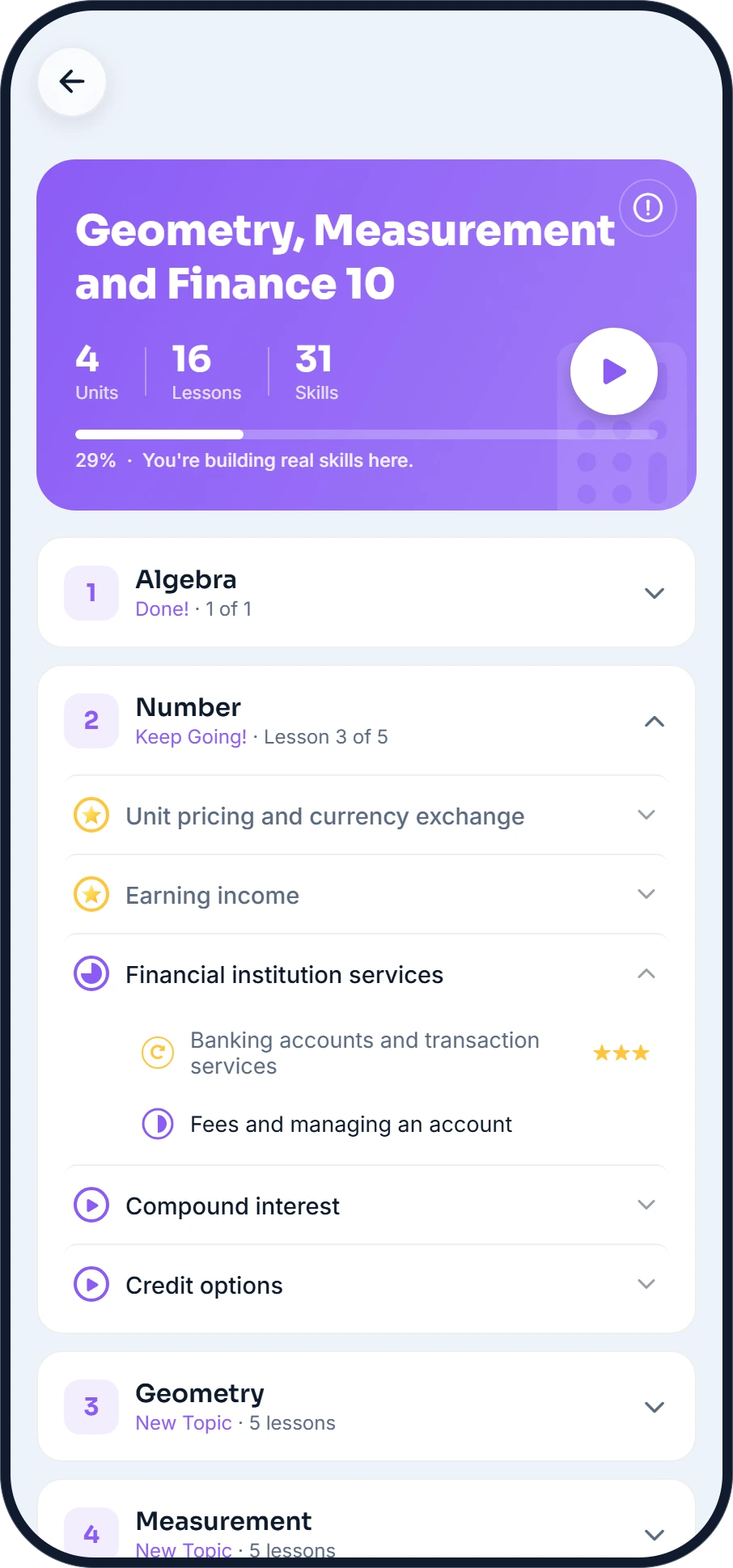
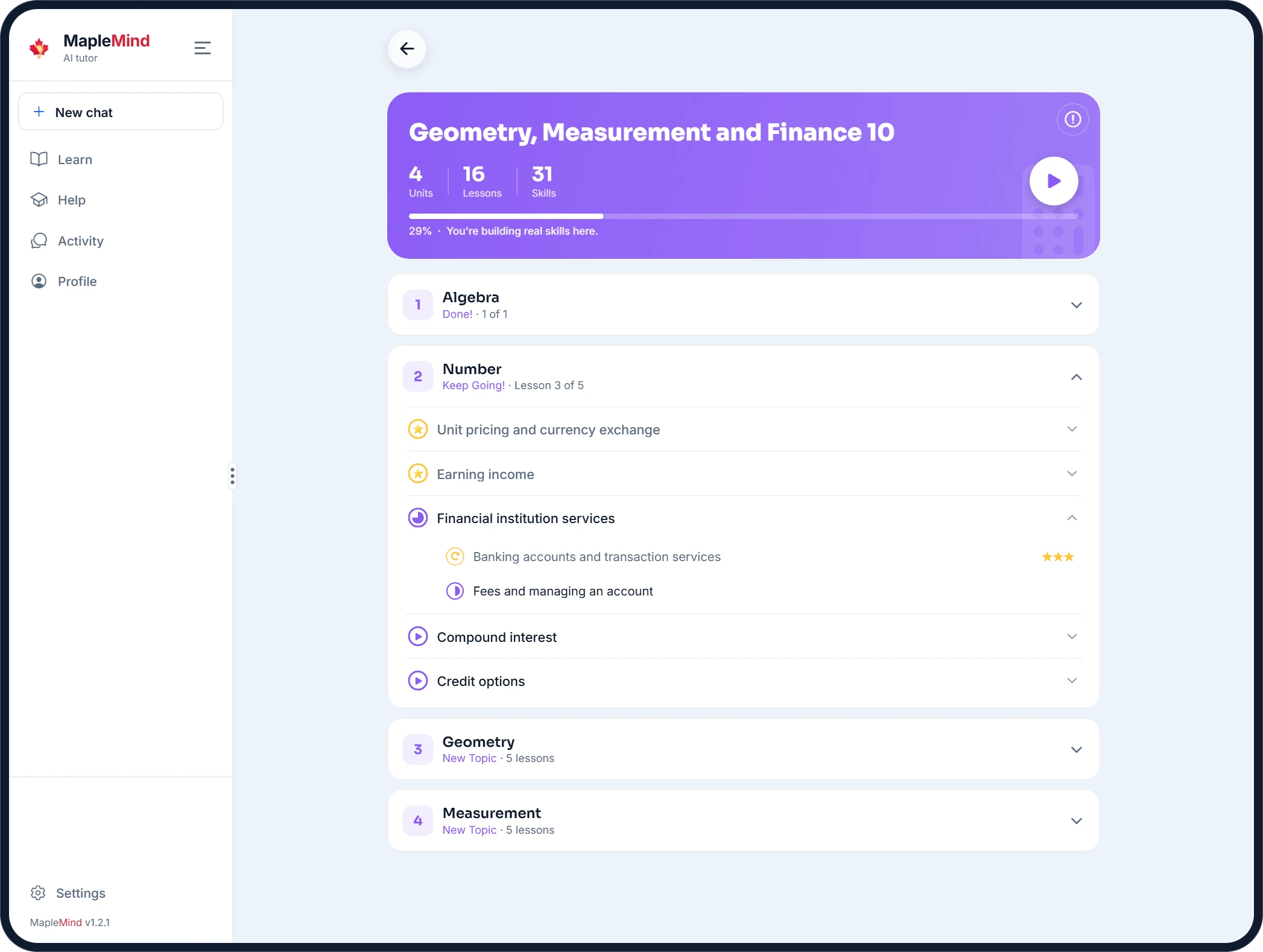
Geometry, Measurement and Finance 10 in MapleMind on a tablet: its units and lessons in order, a student partway through.Geometry, Measurement and Finance 10 in MapleMind on a phone: its units and lessons in order, a student partway through.
Their course, unit by unit, the way New Brunswick teaches it.Shown: Geometry, Measurement and Finance 10
Homework Help on a tablet: a photo of a worksheet, the tutor’s worked example of a two-step equation, and a question back to the student.Homework Help on a phone: a photo of a worksheet, the tutor’s worked example of a two-step equation, and a question back to the student.
Homework Help: they take a photo of the question, and the tutor works through it with them.
The Parent Dashboard on a tablet: a student’s days studied, streak, lessons, quiz average and recent activity.The Parent Dashboard on a phone: a student’s days studied, streak, lessons, quiz average and recent activity.
The Parent Dashboard: how each child’s week went, in lessons, quizzes and days studied.
A Grade 9 provincial mathematics exam on a tablet: a readiness score, the exam’s time and its next sitting.A Grade 9 provincial mathematics exam on a phone: a readiness score, the exam’s time and its next sitting.
A provincial exam: a practice sitting under the real time, and how ready they are.
The Learn tab on a tablet: a four-day streak, the week’s days, Homework Help, the next lesson and a review.The Learn tab on a phone: a four-day streak, the week’s days, Homework Help, the next lesson and a review.
The Learn tab: their week so far, and the next thing to do.

Help at home

Questions parents ask

What will my child learn in Grade 6 in New Brunswick?

Math: Mathematics, Grade 6. Science: Science, Grade 6. English: English Language Arts, Grade 6. French: Post-Intensive French, Grade 6. Social studies: Social Studies, Grade 6. That’s 122 skills in all, from New Brunswick’s curriculum.

When is the French Second Language Oral Proficiency Assessment?

It’s written November 16, 2026 to December 11, 2026, and March 8, 2027 to April 9, 2027, and April 12, 2027 to May 11, 2027.

Where does this list come from?

From New Brunswick’s official curriculum, the documents its education ministry publishes for each course. Each skill here is one of their expectations, written in plain words.

Can MapleMind help my child in Grade 6?

Yes. Every course on this page is in MapleMind, with lessons, practice and a tutor that works through each step with them. A free account gets 30 messages and 4 activities a day.

Help with Grade 6, one skill at a time.

Every course on this page is in MapleMind, free with daily limits.