New Brunswick · For parents

What your child learns in Grade 11 in New Brunswick

Every subject, unit by unit, from New Brunswick’s curriculum: 368 skills in plain words.

Subjects
5
Skills
368
Provincial exams
3
Official curriculum
gnb.ca

Math in Grade 11

3 courses. Choose the one your child takes.

Financial and Workplace Mathematics 110

4 units · 30 skills

  1. Unit 1

    Geometry

    The Pythagorean theorem finds a missing side of a right triangle.

    • Solving a single right triangle
    • Chaining two and three right triangles
    • Angles of elevation and depression
    6 more skills
    • Working with scale drawings
    • Scale, area, and material estimates
    • Modelling and drawing 3-D objects and their views
    • Isometric drawings of 3-D objects
    • Exploded views and scale diagrams
    • Describing component parts for assembly
  2. Unit 2

    Number

    Many games have a repeatable strategy hidden in the numbers.

    • Finding a strategy in a number game
    • Explaining why a strategy works
    • Comparing the costs of renting, leasing, and buying
    5 more skills
    • Making the rent-lease-buy decision
    • Analyzing an investment portfolio
    • Comparing investments and weighing risk
    • Building a personal budget
    • Adjusting a budget to reach a goal
  3. Unit 3

    Algebra

    Rate of change = change in output divided by change in input.

    • Slope and rate-of-change formulas
    • The Rule of 72
    • Finance charges
    6 more skills
    • Pythagorean and trigonometric formulas
    • Slope as rise over run
    • Slope as a rate of change
    • Solving problems with slope on cost graphs
    • Proportional reasoning and unit analysis
    • Unit pricing and best-buy decisions
  4. Unit 4

    Statistics

    A bar graph compares separate categories with bars of equal width.

    • Creating and interpreting bar graphs
    • Creating and interpreting histograms
    • Creating and interpreting line graphs
    1 more skill
    • Creating and interpreting circle graphs
Foundations of Mathematics 110

4 units · 28 skills

  1. Unit 1

    Logical Reasoning

    Inductive reasoning moves from specific observed cases to a general conjecture.

    • Making conjectures by inductive reasoning
    • Proving conjectures deductively
    • Finding the error in a false proof
    2 more skills
    • Finding a strategy in a number puzzle or game
    • Justifying a puzzle solution
  2. Unit 2

    Geometry

    Vertically opposite angles are equal because each is supplementary to the same angle.

    • Proving angle relationships
    • Proving triangle properties
    • Structuring a formal geometric proof
    6 more skills
    • Solving angle problems
    • Solving triangle problems
    • Multi-step angle and triangle problems in context
    • Solving triangles with the sine law
    • Solving triangles with the cosine law
    • The ambiguous case of the sine law
  3. Unit 3

    Relations and Functions

    The boundary line is solid for ≤ or ≥ and dashed for < or >.

    • Graphing a single linear inequality
    • Solving a system of linear inequalities
    • Modelling a real situation with inequalities
    4 more skills
    • Vertex and axis of symmetry
    • Intercepts and roots
    • Domain and range
    • Modelling with quadratic functions
  4. Unit 4

    Number

    Total cost includes all payments plus fees, minus any resale or equity value.

    • Comparing the costs of renting, leasing and buying
    • Justifying a rent-lease-buy decision
    • Interest rate, rate of return, and total return
    4 more skills
    • Evaluating a portfolio's performance
    • Diversifying a portfolio
    • Building a personal budget
    • Adjusting a budget to meet a goal

Pre-Calculus 110

3 units · 30 skills

  1. Unit 1

    Algebra and Number

    Absolute value is a number's distance from zero, always non-negative.

    • Understanding absolute value
    • Simplifying radical expressions
    • Operations on radicals and rationalizing
    6 more skills
    • Solving radical equations
    • Equivalent forms of rational expressions
    • Non-permissible values
    • Multiplying and dividing rational expressions
    • Adding and subtracting rational expressions
    • Solving rational equations
  2. Unit 2

    Trigonometry

    An angle in standard position has its vertex at the origin and initial arm on the positive x-axis.

    • Angles in standard position and reference angles
    • Trig ratios and their signs by quadrant
    • Solving trigonometric problems
  3. Unit 3

    Relations and Functions

    Decompose the middle term using factors of a·c that add to b.

    • Factoring the general trinomial form
    • Factoring a difference of squares
    • Factoring a trinomial in a function of x
    15 more skills
    • Factoring a difference of squares in functions
    • Graphing absolute value functions
    • Solving with absolute value functions
    • Vertex, direction, and symmetry from vertex form
    • Domain, range, and intercepts from vertex form
    • Characteristics from standard form
    • Solving problems with quadratic functions
    • Solving quadratics by factoring
    • Completing the square and the quadratic formula
    • Applications of quadratic equations
    • Linear-quadratic systems
    • Quadratic-quadratic systems
    • Linear and quadratic inequalities in two variables
    • Quadratic inequalities in two variables
    • Solving quadratic inequalities in one variable

Science in Grade 11

3 courses. Choose the one your child takes.

Biology 11

3 units · 68 skills

  1. Unit 1

    The Cell

    Abiogenesis (spontaneous generation) claimed living things arise from non-living matter.

    • Discrediting spontaneous generation
    • The development of cell theory
    • How the microscope advanced science
    16 more skills
    • Bias in the abiogenesis debate
    • Using the light microscope
    • Preparing a wet mount
    • Recording microscope observations
    • Prokaryotic vs eukaryotic cells
    • Plant vs animal cells
    • Eukaryotic organelles and their jobs
    • Light vs electron microscope images
    • Mitochondria and chloroplasts
    • Photosynthesis vs respiration
    • Complementary energy processes
    • Investigating photosynthesis and respiration
    • Importance to human enterprises
    • Transport across the membrane
    • Osmosis and cells
    • Surface area and cell size
  2. Unit 2

    Biodiversity

    Taxonomy is the science of naming and grouping organisms by shared, heritable characteristics.

    • Principles of taxonomy
    • Limits of classification systems
    • Binomial nomenclature
    20 more skills
    • Levels of classification
    • How classification changes
    • Modern classification techniques
    • Characteristics of living things
    • Characteristics of the kingdoms
    • Diversity within the kingdoms
    • Viruses and their reproduction
    • Major plant groups
    • Flower and seed structure
    • Dissecting plant phyla
    • Dissecting flowers
    • Plant homeostasis and tropisms
    • Experiments on plant tropisms
    • Plant hormones
    • Invertebrate phyla
    • Arthropod success
    • Classes of chordates
    • NB biodiversity and sustainability
    • New Brunswick eco-regions
    • Human impact on biodiversity
  3. Unit 3

    Maintaining Dynamic Equilibrium

    Homeostasis is the maintenance of a stable internal environment despite external change.

    • The concept of homeostasis
    • Responding to the environment
    • The macromolecules of life
    23 more skills
    • Nutrition, fitness, and homeostasis
    • Eating and digestive disorders
    • The digestive system
    • Glands of digestion
    • The urinary system
    • The kidney as an excretory organ
    • The nephron
    • Investigating enzyme activity
    • Designing an enzyme experiment
    • Circulation and respiration together
    • Blood flow through the heart
    • Arteries, veins, and capillaries
    • Components of blood
    • Respiratory system mechanics
    • Investigating cardiac and respiratory function
    • Circulatory and respiratory disorders
    • Adaptations for gas exchange
    • Environmental factors and homeostasis
    • How the immune system works
    • Forms of acquired immunity
    • Allergens and antibodies
    • Autoimmune diseases
    • The AIDS epidemic
See the course: Biology 11

Chemistry 11

2 units · 36 skills

  1. Unit 1

    From Structures to Properties

    Different properties need different instruments: a balance for mass, a thermometer for melting point, a conductivity tester for conduction.

    • Selecting instruments and processes
    • A theory-based prediction and hypothesis
    • Evaluating processes for problem-solving
    14 more skills
    • Using instruments accurately
    • Researching and integrating information
    • Selecting and integrating information
    • Limits of a classification system
    • Displaying evidence and information
    • Naming molecular compounds
    • Naming ionic compounds
    • Acids, bases, and salts
    • Forming ionic, covalent, and metallic bonds
    • Hydrogen bonds and van der Waals forces
    • Properties of ionic, molecular, and metallic substances
    • Forces explain properties
    • Classifying substances by properties
    • The structural model of a substance
  2. Unit 2

    Stoichiometry

    Identify the independent variable (changed), dependent variable (measured), and controlled variables (kept constant).

    • Designing a controlled experiment
    • Stating a prediction and hypothesis
    • Estimating quantities
    16 more skills
    • Compiling and organizing data
    • Using apparatus and materials safely
    • Error and uncertainty in measurement
    • Do the data support the prediction?
    • Correcting problems in a technological device
    • Communicating ideas and results
    • Representing reactions and conservation of mass
    • Neutralization
    • Molar mass and mole-mass conversions
    • Solubility and equilibrium
    • Why solubility varies
    • Predicting precipitates
    • Mole ratios from balanced equations
    • Performing stoichiometric calculations
    • Applications of stoichiometry
    • Maximizing yield

Physics 11

4 units · 51 skills

  1. Unit 1

    Kinematics

    A good investigable question is specific, measurable, and about a relationship between variables.

    • Questions from motion problems
    • Frame of reference
    • Vectors for motion
    10 more skills
    • Displacement, velocity, and time
    • Designing a motion experiment
    • Selecting instruments and processes
    • Carrying out procedures
    • Using instruments accurately
    • Displaying motion data
    • Interpreting patterns in data
    • Theoretical vs empirical values
    • Displaying evidence (second investigation)
    • Interpreting patterns (extended)
  2. Unit 2

    Dynamics

    A force has magnitude and direction, drawn as an arrow.

    • Representing forces as vectors
    • Newton's laws of motion
    • Impulse and momentum
    4 more skills
    • Using instruments accurately (forces)
    • Displaying force data
    • Interpreting force-data patterns
    • Stating a conclusion
  3. Unit 3

    Work and Energy

    Work W = F d, done only when a force moves an object along its direction.

    • Work: force and distance
    • Power: work and time
    • Conservation of energy
    16 more skills
    • Mechanical energy
    • Energy in kinematics and dynamics
    • The work-energy theorem
    • Efficiency of energy transformations
    • Longitudinal and transverse waves
    • The wave equation
    • Reflection and refraction
    • Interference and diffraction
    • EM radiation and sound properties
    • Producing and transmitting wave energy
    • Designing an energy experiment
    • Operational definitions
    • Sampling procedures
    • Selecting and integrating information
    • Evaluating data quality
    • Building and testing a prototype
  4. Unit 4

    Waves

    A mechanical wave needs a medium and is produced by a vibrating source.

    • Mechanical waves
    • The universal wave equation
    • Reflection and refraction of waves
    9 more skills
    • Interference and diffraction of waves
    • Interference and diffraction applications
    • EM radiation and sound as waves
    • Producing and transmitting wave energy
    • Operational definitions (waves)
    • Selecting and integrating information (waves)
    • Sampling and evaluating wave data
    • Building and testing a wave device
    • Predicting and hypothesizing about waves
See the course: Physics 11

English in Grade 11

English 11

3 units · 42 skills

  1. Unit 1

    Speaking and Listening

    Following up on an idea means doing something with it: restating it, testing it, or adding the part nobody has said yet.

    • Following up on and extending others' ideas
    • Asking perceptive and probing questions
    • Defending and modifying positions on complex issues
    8 more skills
    • Listening critically for ambiguities and fallacies
    • Interacting in formal and structured situations
    • Adapting language and delivery to reach a goal
    • Asking and answering questions in a range of situations
    • Evaluating others' language to improve your own
    • Sensitivity and respect in formal and informal talk
    • Language features that influence and persuade
    • Adapting language and style to the situation
  2. Unit 2

    Reading and Viewing

    Wide reading is chosen, not assigned: texts picked by ease keep you inside the culture you already know.

    • Reading texts relevant to your life and community
    • Comparing and analysing media and visual texts
    • Synthesizing meaning from differing perspectives
    17 more skills
    • Strategies for complex print and multimedia texts
    • Author's purpose and the impact of devices
    • Acquiring, selecting and synthesizing information
    • What triggers a personal response
    • Connecting texts to your own experiences
    • Connecting themes, issues and ideas across texts
    • Exploring multiple perspectives on a text
    • Justifying points of view on texts
    • Ambiguities in complex texts
    • Commonalities and differences across texts
    • How language and genre influence readers
    • Language, topic, purpose, context and audience
    • Relationships among elements within and across texts
    • Analysing the merits of texts and genres
    • Responding critically to complex print and media texts
    • The diverse ways texts reveal and produce ideologies
    • Responses shaped by social and cultural contexts
  3. Unit 3

    Writing and Representing

    Interpreting an experience means saying what it meant, a step past describing it and past saying how it felt.

    • Writing to interpret, monitor and reflect
    • Note-making strategies for reconstructing knowledge
    • Informed choices for imaginative impact
    8 more skills
    • Constructing complex texts in a range of forms
    • Coherent structure and informed choices of form
    • Using audience feedback to improve a product
    • Strategies for constructing complex texts
    • Control of written conventions
    • Informed choices about technology
    • Commitment to crafting a range of work
    • Combining sources to construct meaning
See the course: English 11

French in Grade 11

Post-Intensive French, Grade 11

3 units · 37 skills

  1. Unit 1

    Unité 1 : C'est injuste!

    Injustice vocabulary: une injustice, injuste, les droits, l'égalité.

    • Reporting cases of social injustice
    • Proposing a solution to an injustice
    • Weighing the pros and cons of a law
    10 more skills
    • Debating rules teens find unjust
    • Presenting a serious injustice rationally
    • Reading about injustices and solutions
    • Reading about human rights and laws
    • Reading reactions to serious injustices
    • Reading opinion writing on injustice
    • Writing a critique on social injustice
    • Writing the pros and cons of regulating a law
    • Writing about rules teens find unjust
    • Writing a solution to an injustice
  2. Unit 2

    Unité 2 : Le pouvoir de la photo

    Photo genres: le portrait, le paysage, la photo d'action, le selfie.

    • Talking about photos you would take
    • Explaining why we take photos
    • Giving opinions on photos
    11 more skills
    • Talking about a photo's emotions
    • Discussing a photo's social power
    • Reading about photography and genres
    • Reading about why we photograph
    • Reading critical evaluations of photos
    • Reading about photos through history
    • Writing about photos you like to take
    • Writing reasons for photos and their uses
    • Describing photo emotions in writing
    • Writing a photo critique
    • Writing about photography's social impact
  3. Unit 3

    Unité 3 : C'est un mystère

    Genre vocabulary: une série policière, une enquête, un détective.

    • Discussing police dramas and preferences
    • Identifying what makes a good police drama
    • Forming a hypothesis to solve a mystery
    7 more skills
    • Using proper language in a board game
    • Explaining a mystery and judging suspects
    • Creating a mystery scenario
    • Reading about mysteries and enigmas
    • Reading about crimes and investigations
    • Writing your opinion on hypotheses
    • Writing an evaluation of the investigation

Social studies in Grade 11

Modern History 11

3 units · 46 skills

  1. Unit 1

    Rights and Revolution

    Revolutions tend to share categories of causes: new ideas, social conflict, political factors, and economic conditions.

    • The general causes of revolutions
    • The ideas of the Enlightenment
    • Social conflict in 18th-century France
    12 more skills
    • Absolute government without consent
    • Economic conditions of the Revolution
    • Criteria for historical significance
    • Assessing the significance of the French Revolution
    • Comparing the Revolution to modern events
    • Ideas and innovations of the Industrial Revolution
    • Social change and conflict in the Industrial period
    • How governments and workers responded
    • Economic conditions of industrialization
    • The impact of urbanization
    • The evolution of workers' rights
    • Comparing the Industrial period to today
  2. Unit 2

    War and Violence

    By 1914 Europe was divided into two rival alliance systems (the Triple Alliance and the Triple Entente).

    • Power, rivalries, and the causes of the First World War
    • How power is exercised
    • The ingredients of power potential
    7 more skills
    • Ethnic nationalism and the exercise of power
    • Nationalism in modern conflict
    • Mechanized warfare and destruction
    • The effects of war on individuals and societies
    • Negotiating the treaties of 1919
    • The Treaty of Versailles and collective security
    • Comparing the quest for collective security
  3. Unit 3

    Triumph and Tragedy

    Liberal democracy rests on elections, individual rights, and limited government.

    • Interwar political ideologies
    • Why some European governments failed
    • The effects of totalitarian governance
    18 more skills
    • The concept of total war
    • The causes of the Second World War
    • Comparing the consequences of the two world wars
    • Which world war was more significant for Canada
    • Defining anti-Semitism
    • The progression of the Holocaust, 1933-1945
    • The international response to Jewish refugees
    • Human-rights action after the Holocaust
    • Investigating the Holocaust with sources
    • Genocide beyond the Holocaust
    • Cold War, containment, and the arms race
    • The nuclear threat as the defining element
    • Western society's response to the nuclear threat
    • The anti-nuclear and peace movement
    • The Cuban Missile Crisis
    • McCarthyism and anti-communism
    • Comparing McCarthyism and the 'war on terror'
    • The nuclear threat after the Cold War

Provincial exams in Grade 11

MapleMind

See Grade 11 in MapleMind

Real screens from the app your child would use.

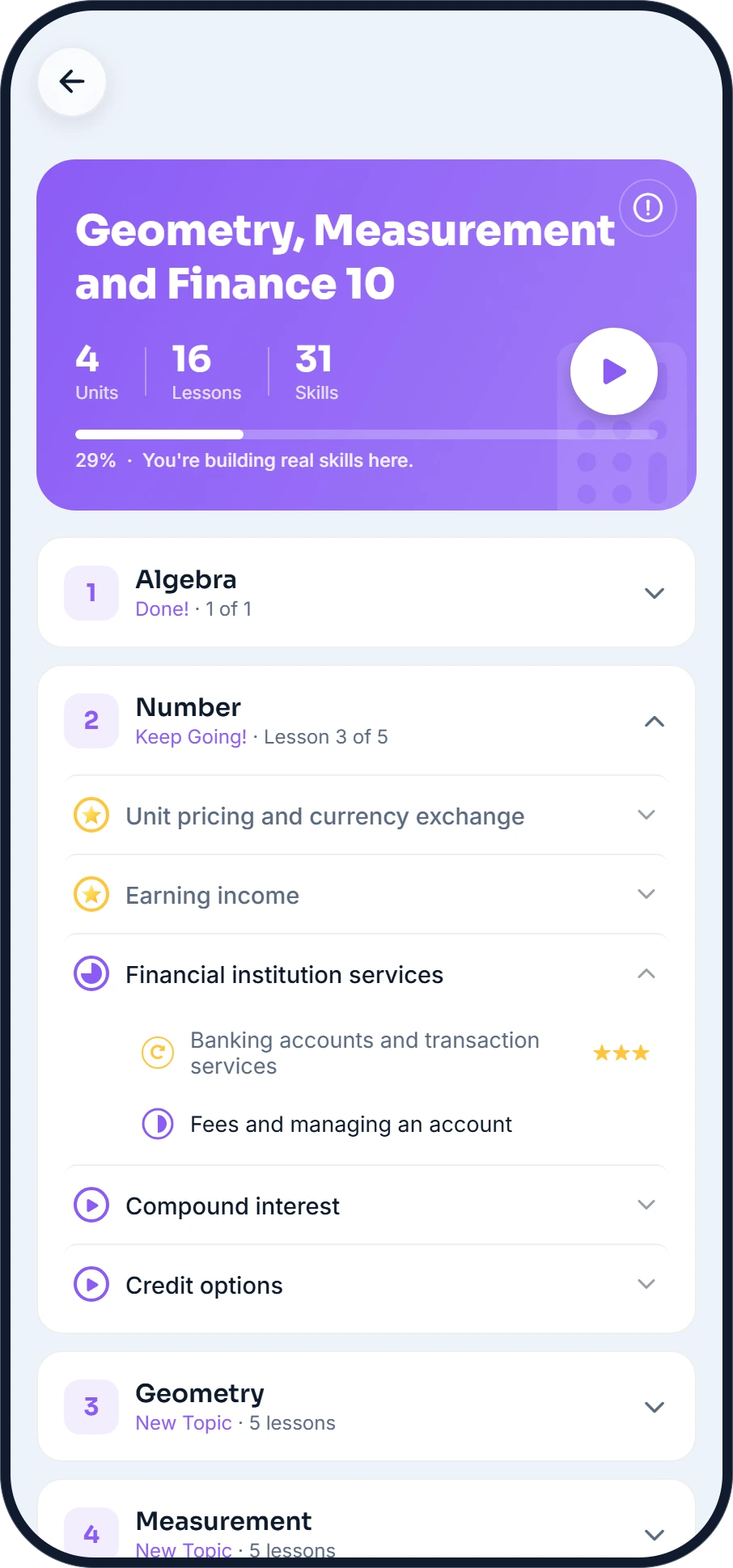
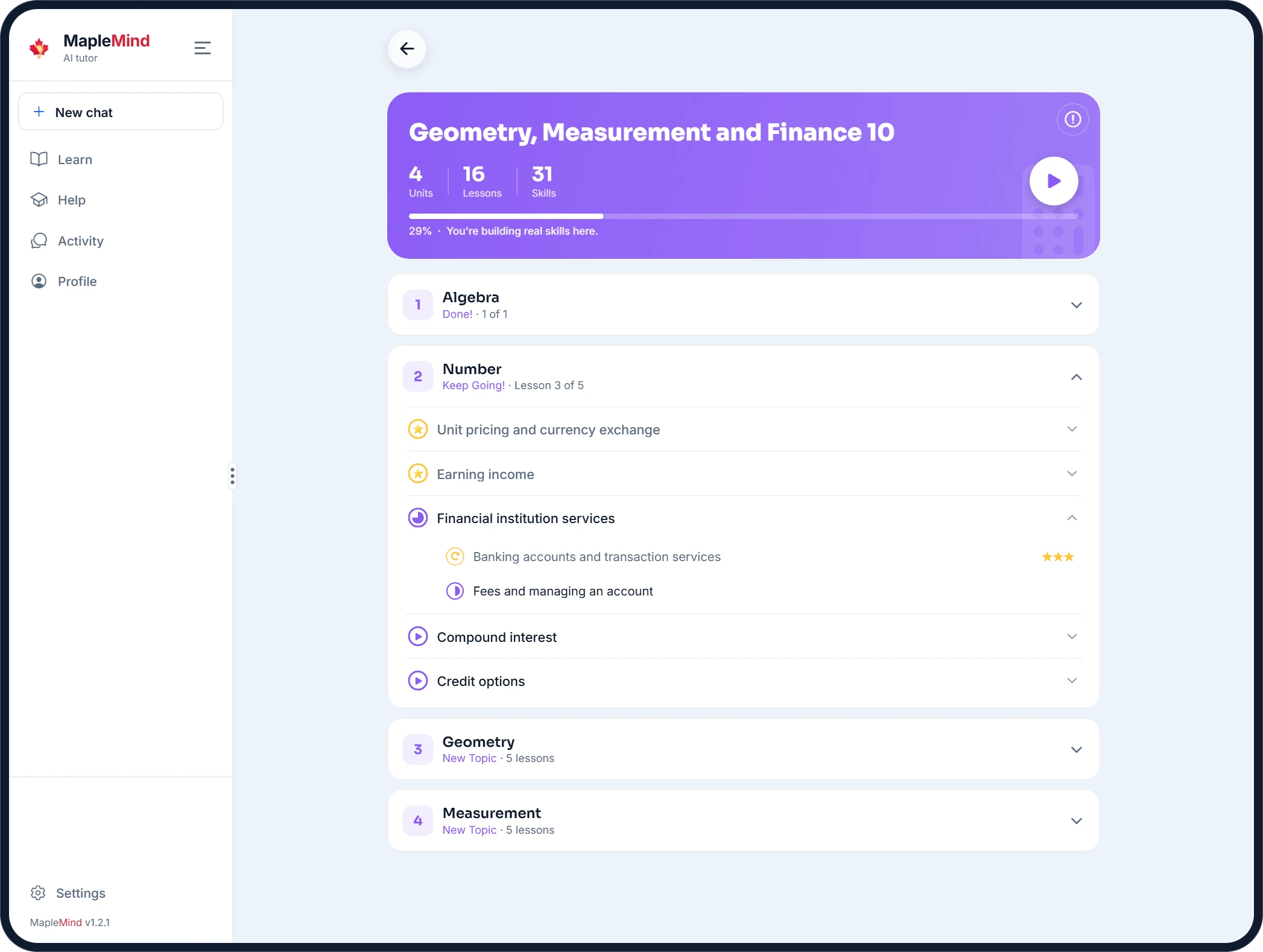
Geometry, Measurement and Finance 10 in MapleMind on a tablet: its units and lessons in order, a student partway through.Geometry, Measurement and Finance 10 in MapleMind on a phone: its units and lessons in order, a student partway through.
Their course, unit by unit, the way New Brunswick teaches it.Shown: Geometry, Measurement and Finance 10
Homework Help on a tablet: a photo of a worksheet, the tutor’s worked example of a two-step equation, and a question back to the student.Homework Help on a phone: a photo of a worksheet, the tutor’s worked example of a two-step equation, and a question back to the student.
Homework Help: they take a photo of the question, and the tutor works through it with them.
The Parent Dashboard on a tablet: a student’s days studied, streak, lessons, quiz average and recent activity.The Parent Dashboard on a phone: a student’s days studied, streak, lessons, quiz average and recent activity.
The Parent Dashboard: how each child’s week went, in lessons, quizzes and days studied.
A Grade 9 provincial mathematics exam on a tablet: a readiness score, the exam’s time and its next sitting.A Grade 9 provincial mathematics exam on a phone: a readiness score, the exam’s time and its next sitting.
A provincial exam: a practice sitting under the real time, and how ready they are.
The Learn tab on a tablet: a four-day streak, the week’s days, Homework Help, the next lesson and a review.The Learn tab on a phone: a four-day streak, the week’s days, Homework Help, the next lesson and a review.
The Learn tab: their week so far, and the next thing to do.

Help at home

Questions parents ask

What will my child learn in Grade 11 in New Brunswick?

Math: Financial and Workplace Mathematics 110, Foundations of Mathematics 110 and Pre-Calculus 110. Science: Biology 11, Chemistry 11 and Physics 11. English: English 11. French: Post-Intensive French, Grade 11. Social studies: Modern History 11. That’s 368 skills in all, from New Brunswick’s curriculum.

When is the English Language Proficiency Assessment?

It’s written January 18, 2027 to January 29, 2027.

Where does this list come from?

From New Brunswick’s official curriculum, the documents its education ministry publishes for each course. Each skill here is one of their expectations, written in plain words.

Can MapleMind help my child in Grade 11?

Yes. Every course on this page is in MapleMind, with lessons, practice and a tutor that works through each step with them. A free account gets 30 messages and 4 activities a day.

Help with Grade 11, one skill at a time.

Every course on this page is in MapleMind, free with daily limits.