

Get help with Post-Intensive French, Grade 11
Most tutoring makes you sit through material you already know. MapleMind flips that: pick the exact skill that's causing trouble — any of the 37 below — and the tutor teaches just that one, step by step, as many times as it takes. Ask questions in plain words, any time of day, in English, French, or 12 other languages.
The official New Brunswick Post-Intensive French, Grade 11 curriculum
New Brunswick defines Post-Intensive French, Grade 11 by strands and outcomes. MapleMind teaches the same curriculum reorganized for one-skill-at-a-time tutoring — the table shows exactly where every official strand lands, and the ministry's own wording is quoted under each unit below.
Official source New Brunswick's official K-12 education resourcesRead it on the government site — www2.gnb.ca ↗| Official strand | Outcomes | Where MapleMind teaches it |
|---|---|---|
| Strand U1 | 13 | Unité 1 : C'est injuste! |
| Strand U2 | 14 | Unité 2 : Le pouvoir de la photo |
| Strand U3 | 10 | Unité 3 : C'est un mystère |
Every skill below, taught one on one.
 Try the first session free
How MapleMind teaches Post-Intensive French, Grade 11 — every unit, lesson, and skill
Every skill below runs as a short session: a plain-words lesson, a worked example, solving it together, then a five-question skill check that earns up to three stars. Guided Mode keeps it teaching instead of answer-handing — turning it off needs a parent's password.
Unit 1Unité 1 : C'est injuste!Official strand · Strand U1
Social justice in French — reporting injustices, weighing laws, debating rules, and writing to be heard.
Speaking Up About Injustice
- Proposing a solution to an injusticeNB.PIF11.13 — Propose a solution in French to a case of injustice, using future tenses and strong verb choices.
- Weighing the pros and cons of a lawNB.PIF11.14 — Weigh the pros and cons of a regulation or a law aloud in French.
- Debating rules teens find unjustNB.PIF11.15 — Debate in French about laws or rules that some teenagers consider unjust, defending a position respectfully.
- Presenting a serious injustice rationallyNB.PIF11.16 — React to and present a serious case of injustice in a rational, structured manner in French.
Reading About Justice and Rights
- Reading about injustices and solutionsNB.PIF11.17 — Read French texts about social injustices and the solutions people propose for them.
- Reading about human rights and lawsNB.PIF11.18 — Read French texts about human rights and the laws that protect them.
- Reading reactions to serious injusticesNB.PIF11.19 — Read French accounts of how people have reacted to serious cases of injustice.
- Reading opinion writing on injusticeNB.PIF11.20 — Read a French article that carries a meaningful opinion responding to a serious case of injustice.
Writing to Be Heard
- Writing the pros and cons of regulating a lawNB.PIF11.22 — Write in French about the pros and cons of regulating a law, presenting both sides.
- Writing about rules teens find unjustNB.PIF11.23 — Discuss in writing the rules and laws that teenagers find unjust, explaining the objections.
- Writing a solution to an injusticeNB.PIF11.24 — Propose a solution to a case of injustice in writing, using future-tense proposal structures.
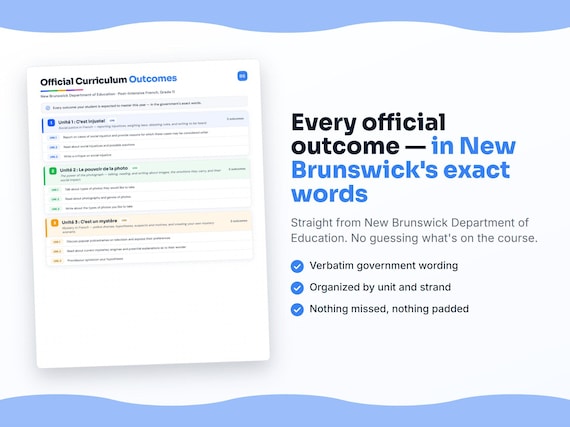
The official wording — 13 outcomes in this unit
- NB.PIF11.12
Report on cases of social injustice and provide reasons for which these cases may be considered unfair
- NB.PIF11.13
Propose a solution to a case of injustice
- NB.PIF11.14
Weigh the pros and cons of a regulation or a law
- NB.PIF11.15
Debate laws or rules that some teenagers find unjust
- NB.PIF11.16
React and present a serious case of injustice in a rational manner
- NB.PIF11.17
Read about social injustices and possible solutions
- NB.PIF11.18
Read about human rights and laws
- NB.PIF11.19
Read about reactions to serious cases of injustice
- NB.PIF11.20
Read an article with a meaningful opinionin response to a serious case of injustice
- NB.PIF11.21
Write a critique on social injustice
- NB.PIF11.22
Write about the pros and cons to regulating a law
- NB.PIF11.23
Discuss rules and laws that teens find unjust
- NB.PIF11.24
Propose a solution to a case of injustice.
Unit 2Unité 2 : Le pouvoir de la photoOfficial strand · Strand U2
The power of the photograph — talking, reading, and writing about images, the emotions they carry, and their social impact.
Talking About Photos
- Talking about photos you would takeNB.PIF11.25 — Talk in French about the types of photos you would like to take.
- Explaining why we take photosNB.PIF11.26 — Provide reasons in French for taking photos.
- Giving opinions on photosNB.PIF11.27 — Provide opinions in French on photos.
- Talking about a photo's emotionsNB.PIF11.28 — Talk in French about the emotions that a photo may raise.
Reading About Photography
- Reading about photography and genresNB.PIF11.30 — Read French texts about photography and the genres of photos.
- Reading about why we photographNB.PIF11.31 — Read French texts about the reasons people take photos.
- Reading critical evaluations of photosNB.PIF11.32 — Read French texts about critically evaluating photographs.
- Reading about photos through historyNB.PIF11.33 — Read French texts about the impact of photos, including through history.
Writing About Photos
- Writing about photos you like to takeNB.PIF11.34 — Write in French about the types of photos you like to take.
- Writing reasons for photos and their usesNB.PIF11.35 — Provide written reasons in French for taking photos and explain what to do with them.
- Describing photo emotions in writingNB.PIF11.36 — Describe in writing the emotions related to photos.
- Writing a photo critiqueNB.PIF11.37 — Provide a written critique of a photo in French.
The official wording — 14 outcomes in this unit
- NB.PIF11.25
Talk about types of photos they would like to take
- NB.PIF11.26
Provide reasons for taking photos
- NB.PIF11.27
Provideopinions on photos
- NB.PIF11.28
Talk about emotions that may arise from a photo
- NB.PIF11.29
Discuss the power and social impact of a photo
- NB.PIF11.30
Read about photography and genres of photos
- NB.PIF11.31
Read about reasons why we take photos
- NB.PIF11.32
Read about critically evaluating photos
- NB.PIF11.33
Read about the impact of photos, also through history
- NB.PIF11.34
Write about the types of photos you like to take
- NB.PIF11.35
Providewritten reasons fortaking photos and explain what to do with them
- NB.PIF11.36
Describe the emotions related to photos
- NB.PIF11.37
critique of a photo
- NB.PIF11.38
Write about social impact with regards to photography
Unit 3Unité 3 : C'est un mystèreOfficial strand · Strand U3
Mystery in French — police dramas, hypotheses, suspects and motives, and creating your own mystery scenario.
Talking Mystery
- Discussing police dramas and preferencesNB.PIF11.39 — Discuss popular police dramas on television in French and express your preferences.
- Identifying what makes a good police dramaNB.PIF11.40 — Identify in French the important elements of a good police drama.
- Forming a hypothesis to solve a mysteryNB.PIF11.41 — Formulate a hypothesis in French to resolve a mystery.
- Using proper language in a board gameNB.PIF11.42 — Use proper French language when playing a board game like Clue.
- Explaining a mystery and judging suspectsNB.PIF11.43 — Explain a mystery in French and evaluate the credibility of suspects and their motives.
- Creating a mystery scenarioNB.PIF11.44 — Create a French mystery scenario with your group and present or act it out.
Reading Mysteries
- Reading about mysteries and enigmasNB.PIF11.45 — Read French texts about current mysteries, enigmas, and the potential explanations for them.
- Reading about crimes and investigationsNB.PIF11.46 — Read French texts about crimes, murder mysteries, and police investigations.
Writing the Case
- Writing your opinion on hypothesesNB.PIF11.47 — Provide your written opinion in French on your hypotheses about a mystery.
- Writing an evaluation of the investigationNB.PIF11.48 — Write an evaluation in French of how the crime investigation went.
The official wording — 10 outcomes in this unit
- NB.PIF11.39
Discuss popular policedramas on television and express their preferences
- NB.PIF11.40
Identify the important elements of agood police drama
- NB.PIF11.41
Formulate an hypothesis to resolve a mystery
- NB.PIF11.42
Use proper language when playing a board game
- NB.PIF11.43
Explain a mystery and evaluate the credibility of suspects and theirmotives
- NB.PIF11.44
Create a mystery scenario
- NB.PIF11.45
Read about current mysteries, enigmas and potential explanations as to their wonder
- NB.PIF11.46
Read about crimes, murder mysteries and police investigations
- NB.PIF11.47
Provideyour opinionon your hypotheses
- NB.PIF11.48
Write an evaluation on how the crime investigation went
Printable workbook · A keepsake of the year
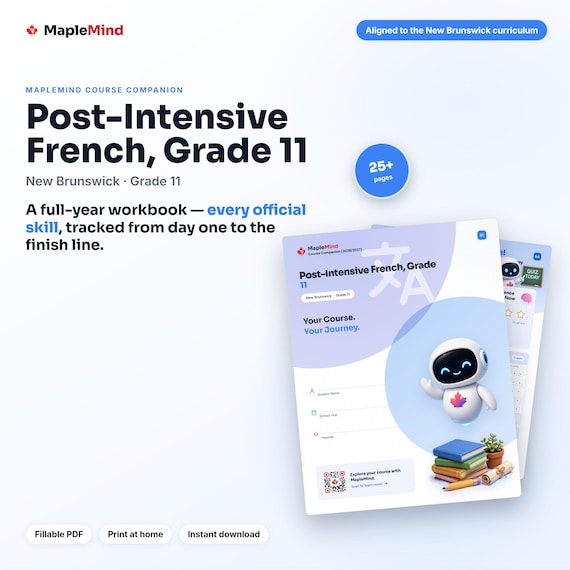
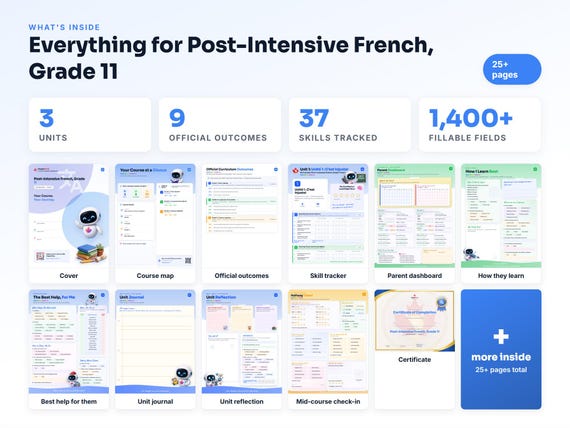
A Post-Intensive French, Grade 11 workbook worth keeping
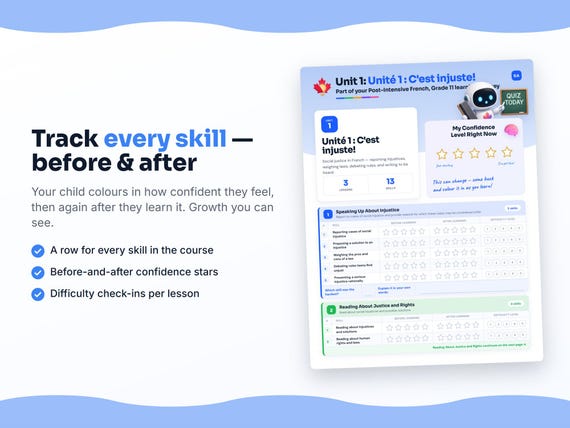
Built from the same official curriculum as this page. Before and after each skill above, your student colours in how sure they feel — so the two of you can see, on one page, what's clicking and what needs another look. It's a quiet way to follow how the year is really going.
By June it's full of their own handwriting: units worked through, confidence grown, a mid-year check-in, notes from parent-teacher night, and a certificate at the end. Less a worksheet, more a record of the year worth keeping on the shelf.
Instant download · see every page, reviews and the full description · five or more workbooks are $2.99 each
What it looks like in the app



Common questions
Can MapleMind help me with Post-Intensive French, Grade 11?
Yes. MapleMind's AI tutor covers all 37 skills in New Brunswick's Post-Intensive French, Grade 11 — you pick the exact skill, and the tutor teaches it step by step: a short lesson, a worked example, solving together, then a skill check to show it stuck.
Is MapleMind aligned to New Brunswick's official curriculum?
Yes. Every skill in this course maps to an official outcome code from New Brunswick's Grade 11 French curriculum, and the ministry's own wording is quoted under each unit on this page — with the official government source linked so you can check it yourself.
What does MapleMind cost?
It's free to start — 5 tutoring chats and a practice quiz every day, no credit card. A Pro subscription ($9.99/month or $49.99/year CAD, 7-day free trial) unlocks unlimited tutoring, practice, and exam simulations.
What if I'm stuck on just one topic?
That's the point of skill-level tutoring: open Post-Intensive French, Grade 11 in the app, tap the exact skill from the list on this page, and the tutor teaches just that — no wading through lessons you don't need.
Does MapleMind work in French or other languages?
Yes — 14 languages, including French. Both the app and the tutor's explanations switch to the language you choose.
Where can I see the official New Brunswick curriculum for Post-Intensive French, Grade 11?
The official source is linked on this page — New Brunswick's official K-12 education resources. The outline here follows it: every MapleMind skill carries its official outcome code, and the ministry's own wording is quoted under each unit.
Keep exploring
Ready when you are
Pick a skill from this page and see it taught properly — free, in the browser, in under a minute.