Get help with Post-Intensive French, Grade 10
Most tutoring makes you sit through material you already know. MapleMind flips that: pick the exact skill that's causing trouble — any of the 41 below — and the tutor teaches just that one, step by step, as many times as it takes. Ask questions in plain words, any time of day, in English, French, or 12 other languages.
The official New Brunswick Post-Intensive French, Grade 10 curriculum
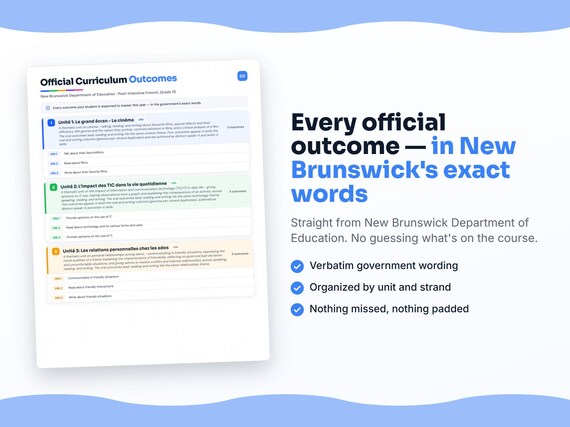
New Brunswick defines Post-Intensive French, Grade 10 by strands and outcomes. MapleMind teaches the same curriculum reorganized for one-skill-at-a-time tutoring — the table shows exactly where every official strand lands, and the ministry's own wording is quoted under each unit below.
Official source New Brunswick's official K-12 education resourcesRead it on the government site — www2.gnb.ca ↗| Official strand | Outcomes | Where MapleMind teaches it |
|---|---|---|
| Strand U1 | 17 | Unité 1: Le grand écran – Le cinéma |
| Strand U2 | 9 | Unité 2: L’impact des TIC dans la vie quotidienne |
| Strand U3 | 15 | Unité 3: Les relations personnelles chez les ados |
Every skill below, taught one on one.
 Try the first session free
How MapleMind teaches Post-Intensive French, Grade 10 — every unit, lesson, and skill
Every skill below runs as a short session: a plain-words lesson, a worked example, solving it together, then a five-question skill check that earns up to three stars. Guided Mode keeps it teaching instead of answer-handing — turning it off needs a parent's password.
Unit 1Unité 1: Le grand écran – Le cinémaOfficial strand · Strand U1
A thematic unit on cinema - talking, reading, and writing about favourite films, special effects and their efficiency, film genres and the values they portray, commercialization in films, and a critical analysis of a film. The oral outcomes lead; reading and writing tile the same cinema theme. Four outcomes appear in both the oral and writing columns (genuine per-strand duplicates) and are authored as distinct speak-it and write-it skills.
Talking About Film
- Talking about favourite filmsNB.PIF10.14 — Talk in French about your favourite films - what they are and why you like them.
- Explaining your point of view on special effectsNB.PIF10.15 — Explain your point of view in French about special effects in films.
- Commenting on the efficiency of special effects (speaking)NB.PIF10.16 — Comment orally in French on the efficiency of different special effects - how well they work.
- Talking about film genres and the values they portrayNB.PIF10.17 — Talk in French about your favourite types of film and the values they portray.
- Judging the value of commercialization in filmsNB.PIF10.18 — Bring judgement in French on the value of commercialization, both internal and external, in films.
- Expressing opinions on commercialization in filmsNB.PIF10.19 — Express opinions in French on commercialization in films.
- Providing a critical analysis of a film (speaking)NB.PIF10.20 — Provide a spoken critical analysis of a film in French, evaluating its strengths and weaknesses.
Reading About Film
- Reading about filmsNB.PIF10.21 — Read French texts about films and understand them.
- Reading about special effects in filmsNB.PIF10.22 — Read French texts about special effects in films and understand them.
- Reading about genres of filmsNB.PIF10.23 — Read French texts about genres of films and understand them.
- Reading about commercialization of filmsNB.PIF10.24 — Read French texts about the commercialization of films and follow the argument.
Writing About Film
- Writing about favourite filmsNB.PIF10.25 — Write in French about your favourite films, with reasons.
- Explaining your point of view on special effects in writingNB.PIF10.26 — Explain in writing your point of view in French about special effects in films.
- Commenting on the efficiency of special effects (writing)NB.PIF10.27 — Comment in writing in French on the efficiency of different special effects.
- Writing about film genres and the values they portrayNB.PIF10.28 — Write in French about your favourite types of films and the values they portray.
- Explaining and expressing opinions on commercialization in filmsNB.PIF10.29 — Explain and express in writing opinions in French on commercialization in films.
- Providing a critical analysis of a film (writing)NB.PIF10.30 — Provide a written critical analysis of a film in French, evaluating its strengths and weaknesses.
The official wording — 17 outcomes in this unit
- NB.PIF10.14
Talk about their favoritefilms.
- NB.PIF10.15
Explain their point of view about special effects in films.
- NB.PIF10.16
Comment on the efficiency of different special effects.
- NB.PIF10.17
Talk about their favoritetypes of film and values they portray.
- NB.PIF10.18
Bring judgment on the value of commercialization (bothinternal and external) in films.
- NB.PIF10.19
Express opinions oncommercialization in films.
- NB.PIF10.20
Provide a critical analysis of a film.
- NB.PIF10.21
Read about films.
- NB.PIF10.22
Read about special effects in films.
- NB.PIF10.23
Read about genres of films.
- NB.PIF10.24
Read about commercialization of films.
- NB.PIF10.25
Write about their favorite films.
- NB.PIF10.26
Explain their point of viewabout special effects in films.
- NB.PIF10.27
Comment on the efficiency of different special effects.
- NB.PIF10.28
Write about their favorite types of films and the values they portray.
- NB.PIF10.29
Explain and express opinions on commercialization in films.
- NB.PIF10.30
Provide a critical analysis of a film.
Unit 2Unité 2: L’impact des TIC dans la vie quotidienneOfficial strand · Strand U2
A thematic unit on the impact of information and communication technology (TIC/IT) in daily life - giving opinions on IT use, making observations from a graph, and explaining the consequences of an activity, across speaking, reading, and writing. The oral outcomes lead; reading and writing tile the same technology theme. Two outcomes appear in both the oral and writing columns (genuine per-strand duplicates), authored as distinct speak-it and write-it skills.
Talking About Technology's Impact
- Providing opinions on the use of IT (speaking)NB.PIF10.31 — Provide opinions orally in French on the use of information technology (IT).
- Making observations from a graph (speaking)NB.PIF10.32 — Provide observations orally in French based on understanding a graph.
- Explaining the consequences of an activityNB.PIF10.33 — Explain in detail in French the consequences of an activity.
Reading About Technology
- Reading about technology's forms and usesNB.PIF10.34 — Read French texts about technology and its various forms and uses.
- Reading a graph on technology useNB.PIF10.35 — Read a French graph indicating time spent using technology and interpret it.
- Reading about consequences of excessive technology useNB.PIF10.36 — Read French texts about the consequences of excessive technology use and follow the reasoning.
Writing About Technology
- Providing opinions on the use of IT (writing)NB.PIF10.37 — Provide opinions in writing in French on the use of information technology (IT).
- Making observations from a graph (writing)NB.PIF10.38 — Provide observations in writing in French based on understanding a graph.
- Explaining in detail the consequences of technology useNB.PIF10.39 — Explain in detail in writing in French the consequences of technology use.
The official wording — 9 outcomes in this unit
- NB.PIF10.31
Provide opinions on the use of IT.
- NB.PIF10.32
Provideobservations based on understanding a graph.
- NB.PIF10.33
Explain in detail the consequences of an activity.
- NB.PIF10.34
Read about technology and its various forms and uses.
- NB.PIF10.35
Read a graph indicating time spent using technology.
- NB.PIF10.36
Read about consequences of excessive technology use.
- NB.PIF10.37
Provide opinions on the use of IT.
- NB.PIF10.38
Provideobservations based on understanding a graph.
- NB.PIF10.39
Explain in detail the consequences of technology use.
Unit 3Unité 3: Les relations personnelles chez les adosOfficial strand · Strand U3
A thematic unit on personal relationships among teens - communicating in friendly situations, expressing the moral qualities of a friend, explaining the characteristics of friendship, reflecting on good and bad decisions and uncomfortable situations, and giving advice to resolve conflict and improve relationships, across speaking, reading, and writing. The oral outcomes lead; reading and writing tile the same relationships theme.
Talking About Friendship and Relationships
- Communicating in friendly situationsNB.PIF10.40 — Communicate in French in friendly situations - the everyday give and take between friends.
- Expressing the moral qualities of a friendNB.PIF10.41 — Express orally in French the moral qualities of a friend.
- Explaining the characteristics of friendshipNB.PIF10.42 — Explain in French the characteristics of friendship - what makes a friendship work.
- Reflecting on good and bad decisionsNB.PIF10.43 — Express orally in French reflections upon situations where you made a good and a bad decision.
- Expressing characteristics of uncomfortable situationsNB.PIF10.44 — Express orally in French the characteristics of situations where you felt uncomfortable.
- Giving advice to resolve conflictNB.PIF10.45 — Give advice in French to resolve conflict.
- Giving advice to improve relationshipsNB.PIF10.46 — Give advice in French to improve personal relationships among friends.
Reading About Relationships
- Reading about friendly interactionsNB.PIF10.47 — Read French texts about friendly interactions and understand them.
- Reading and inferring qualities of friends and friendshipsNB.PIF10.48 — Read French texts and infer the moral qualities of a friend and the characteristics of friendships.
- Reading about giving and receiving feedbackNB.PIF10.49 — Read French texts about positive ways to give and receive feedback.
Writing About Relationships
- Writing about friendly situationsNB.PIF10.50 — Write in French about friendly situations among teens.
- Writing about qualities and characteristics of friendshipNB.PIF10.51 — Write in French about the moral qualities of a friend and explain the characteristics of friendship.
- Writing a reflection on uncomfortable situations and decisionsNB.PIF10.52 — Write in French a reflection on situations where you felt uncomfortable and the decisions that were made, good or bad.
- Proposing a plan to resolve conflictNB.PIF10.53 — Propose in writing in French a plan to resolve conflict.
- Proposing a solution to improve relationshipsNB.PIF10.54 — Propose in writing in French a solution to improve personal relationships among friends.
The official wording — 15 outcomes in this unit
- NB.PIF10.40
Communicates in friendly situations
- NB.PIF10.41
Express orally the moral qualities of a friend
- NB.PIF10.42
Explain the characteristics of friendship
- NB.PIF10.43
Express orally reflections upon situations where you made a good and bad decision
- NB.PIF10.44
Express orally characteristics of situations where you felt uncomfortable
- NB.PIF10.45
Give advice to resolve conflict
- NB.PIF10.46
Give advice to improve personal relationships among friends
- NB.PIF10.47
Read about friendly interactions
- NB.PIF10.48
Read about and able to inference moral qualities of a friend and characteristics of friendships
- NB.PIF10.49
Read about positive ways to give and receive feedback
- NB.PIF10.50
Write about friendly situations
- NB.PIF10.51
Write about the moral qualities found of a friend and explain the characteristics of friendship
- NB.PIF10.52
Write a reflection of situations where you have felt uncomfortable and decisions that were made, good or bad.
- NB.PIF10.53
Propose a plan to resolve conflict
- NB.PIF10.54
Propose a solution to improve personal relationships among friends
Printable workbook · A keepsake of the year
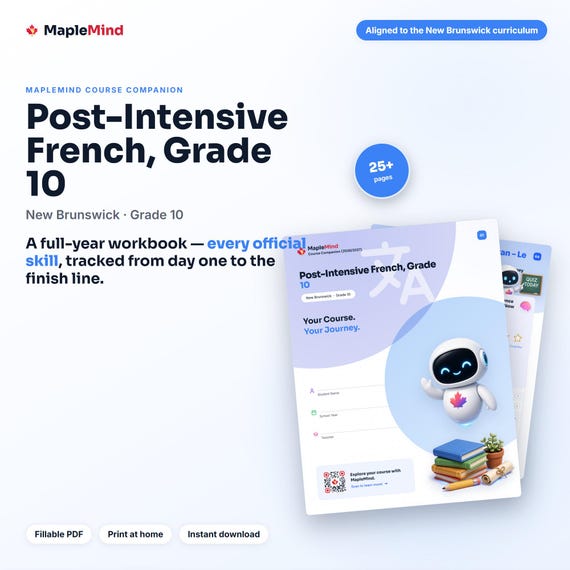
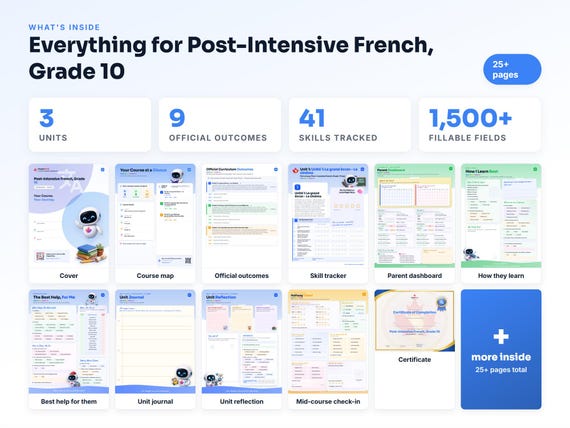
A Post-Intensive French, Grade 10 workbook worth keeping
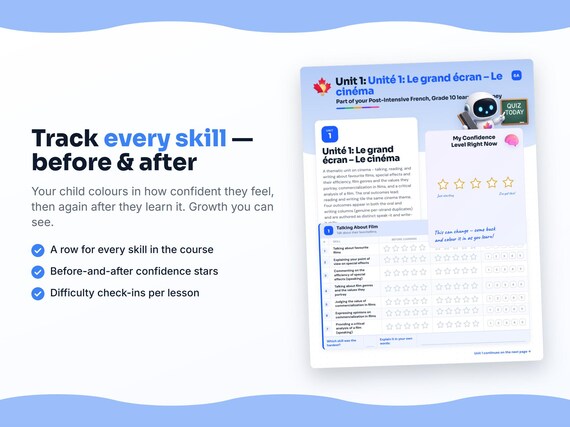
Built from the same official curriculum as this page. Before and after each skill above, your student colours in how sure they feel — so the two of you can see, on one page, what's clicking and what needs another look. It's a quiet way to follow how the year is really going.
By June it's full of their own handwriting: units worked through, confidence grown, a mid-year check-in, notes from parent-teacher night, and a certificate at the end. Less a worksheet, more a record of the year worth keeping on the shelf.
Instant download · see every page, reviews and the full description · five or more workbooks are $2.99 each
What it looks like in the app



Common questions
Can MapleMind help me with Post-Intensive French, Grade 10?
Yes. MapleMind's AI tutor covers all 41 skills in New Brunswick's Post-Intensive French, Grade 10 — you pick the exact skill, and the tutor teaches it step by step: a short lesson, a worked example, solving together, then a skill check to show it stuck.
Is MapleMind aligned to New Brunswick's official curriculum?
Yes. Every skill in this course maps to an official outcome code from New Brunswick's Grade 10 French curriculum, and the ministry's own wording is quoted under each unit on this page — with the official government source linked so you can check it yourself.
What does MapleMind cost?
It's free to start — 5 tutoring chats and a practice quiz every day, no credit card. A Pro subscription ($9.99/month or $49.99/year CAD, 7-day free trial) unlocks unlimited tutoring, practice, and exam simulations.
What if I'm stuck on just one topic?
That's the point of skill-level tutoring: open Post-Intensive French, Grade 10 in the app, tap the exact skill from the list on this page, and the tutor teaches just that — no wading through lessons you don't need.
Does MapleMind work in French or other languages?
Yes — 14 languages, including French. Both the app and the tutor's explanations switch to the language you choose.
Where can I see the official New Brunswick curriculum for Post-Intensive French, Grade 10?
The official source is linked on this page — New Brunswick's official K-12 education resources. The outline here follows it: every MapleMind skill carries its official outcome code, and the ministry's own wording is quoted under each unit.
Keep exploring
Ready when you are
Pick a skill from this page and see it taught properly — free, in the browser, in under a minute.