Get help with Post-Intensive French, Grade 9
Most tutoring makes you sit through material you already know. MapleMind flips that: pick the exact skill that's causing trouble — any of the 37 below — and the tutor teaches just that one, step by step, as many times as it takes. Ask questions in plain words, any time of day, in English, French, or 12 other languages.
The official New Brunswick Post-Intensive French, Grade 9 curriculum
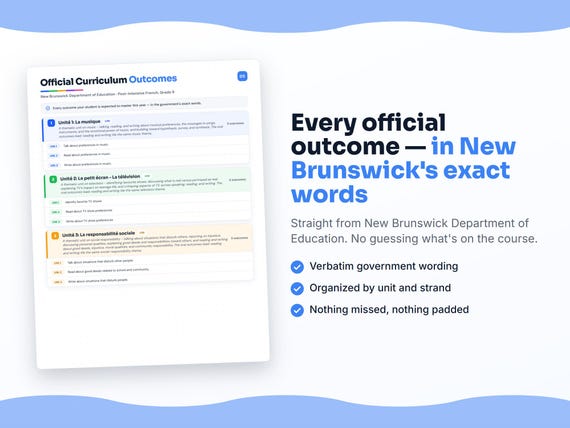
New Brunswick defines Post-Intensive French, Grade 9 by strands and outcomes. MapleMind teaches the same curriculum reorganized for one-skill-at-a-time tutoring — the table shows exactly where every official strand lands, and the ministry's own wording is quoted under each unit below.
Official source New Brunswick's official K-12 education resourcesRead it on the government site — www2.gnb.ca ↗| Official strand | Outcomes | Where MapleMind teaches it |
|---|---|---|
| Strand U1 | 15 | Unité 1: La musique |
| Strand U2 | 10 | Unité 2: Le petit écran – La télévision |
| Strand U3 | 12 | Unité 3: La responsabilité sociale |
Every skill below, taught one on one.
 Try the first session free
How MapleMind teaches Post-Intensive French, Grade 9 — every unit, lesson, and skill
Every skill below runs as a short session: a plain-words lesson, a worked example, solving it together, then a five-question skill check that earns up to three stars. Guided Mode keeps it teaching instead of answer-handing — turning it off needs a parent's password.
Unit 1Unité 1: La musiqueOfficial strand · Strand U1
A thematic unit on music - talking, reading, and writing about musical preferences, the messages in songs, instruments, and the emotional power of music, and building toward hypothesis, survey, and synthesis. The oral outcomes lead; reading and writing tile the same music theme.
Talking About Music
- Talking about preferences in musicNB.PIF9.11 — Talk in French about your preferences in music - what you like and why.
- Presenting the message in a favourite songNB.PIF9.12 — Present in French the message conveyed in your favourite song.
- Talking about musical instrumentsNB.PIF9.13 — Talk in French about musical instruments you play or would like to play.
- Discussing music and emotions in mediaNB.PIF9.14 — Talk in French about the links between music performed in the media and the emotions it creates.
- Presenting a personal hypothesisNB.PIF9.15 — Present a personal hypothesis in French, using conditional/hypothetical structures.
- Carrying out a survey orallyNB.PIF9.16 — Carry out a survey orally in French, asking questions and recording responses.
- Presenting a synthesis of informationNB.PIF9.17 — Present in French a synthesis of various items of information - hypothesis, phenomena, survey results, and a conclusion.
Reading About Music
- Reading about preferences in musicNB.PIF9.18 — Read French texts about preferences in music and understand them.
- Reading about messages in favourite songsNB.PIF9.19 — Read French texts about the messages in favourite songs and interpret them.
- Reading about musical instrumentsNB.PIF9.20 — Read French texts about musical instruments that people play or want to play.
- Reading about music and emotions in mediaNB.PIF9.21 — Read French texts about the links between media music and the emotions it creates.
Writing About Music
- Writing about preferences in musicNB.PIF9.22 — Write in French about your preferences in music, with reasons.
- Writing about musical instrumentsNB.PIF9.23 — Write in French about musical instruments you play or would like to play.
- Visually representing an emotionNB.PIF9.24 — Visually represent an emotion in French, using a representation with French labels or captions.
- Writing a summary of informationNB.PIF9.25 — Prepare a written summary in French of various items of information - hypothesis, phenomena, survey results, and a conclusion.
The official wording — 15 outcomes in this unit
- NB.PIF9.11
Talk about preferences in music.
- NB.PIF9.12
Present the message in their favorite song.
- NB.PIF9.13
Talk about musical instruments that they play or would like to play.
- NB.PIF9.14
Talk about the links between music performed in the media and the emotions they create.
- NB.PIF9.15
Present a personal hypothesis.
- NB.PIF9.16
Carry out a survey orally.
- NB.PIF9.17
Present a synthesis of various items of information: hypothesis, phenomena, results of asurvey and a conclusion.
- NB.PIF9.18
Read about preferences in music.
- NB.PIF9.19
Read about messages in their favorite songs.
- NB.PIF9.20
Read about musical instruments that they play or want to play.
- NB.PIF9.21
Read about the links between music performed in the media and the emotions they create.
- NB.PIF9.22
Write about preferences in music.
- NB.PIF9.23
Write about musical instruments that they play or would like to play.
- NB.PIF9.24
Visually represent an emotion.
- NB.PIF9.25
Prepare a summary in writing of various items of information: hypothesis, phenomena, results of a survey and a conclusion.
Unit 2Unité 2: Le petit écran – La télévisionOfficial strand · Strand U2
A thematic unit on television - identifying favourite shows, discussing what is real versus portrayed as real, explaining TV's impact on teenage life, and critiquing aspects of TV, across speaking, reading, and writing. The oral outcomes lead; reading and writing tile the same television theme.
Talking About Television
- Identifying favourite TV showsNB.PIF9.26 — Identify and talk about your favourite TV shows in French.
- Discussing what is real versus portrayed on TVNB.PIF9.27 — Discuss in French the differences between what is real and what is portrayed as real on TV.
- Explaining TV's impact on teenage lifeNB.PIF9.28 — Explain in French how TV impacts the diverse aspects of teenage life.
- Critiquing different aspects of TVNB.PIF9.29 — Critique different aspects of TV in French, giving a supported judgement.
Reading About Television
- Reading about TV show preferencesNB.PIF9.30 — Read French texts about TV show preferences and understand them.
- Reading about reality and false realities on TVNB.PIF9.31 — Read French texts about reality and false realities on television.
- Reading about influences from TV viewingNB.PIF9.32 — Read French texts about the influences that come from watching TV.
Writing About Television
- Writing about TV show preferencesNB.PIF9.33 — Write in French about your TV show preferences, with reasons.
- Writing about reality and false realities on TVNB.PIF9.34 — Write in French about reality and false realities on television.
- Writing about influences from TV viewingNB.PIF9.35 — Write in French about the influences that come from watching TV.
The official wording — 10 outcomes in this unit
- NB.PIF9.26
Identify favorite TV shows
- NB.PIF9.27
Discuss the differences between what is real and what is portrayed as real on TV
- NB.PIF9.28
Explain how TV impacts the diverse aspects of teenage life
- NB.PIF9.29
Critique different aspects of TV
- NB.PIF9.30
Read about TV show preferences
- NB.PIF9.31
Read about reality and false realities on television
- NB.PIF9.32
Read about influences from TV viewing
- NB.PIF9.33
Write about TV show preferences
- NB.PIF9.34
Write about reality and false realities on television
- NB.PIF9.35
Write about influences from TV viewing
Unit 3Unité 3: La responsabilité socialeOfficial strand · Strand U3
A thematic unit on social responsibility - talking about situations that disturb others, reporting on injustice, discussing personal qualities, explaining good deeds and responsibilities toward others, and reading and writing about good deeds, injustice, moral qualities, and community responsibility. The oral outcomes lead; reading and writing tile the same social-responsibility theme.
Talking About Social Responsibility
- Talking about situations that disturb othersNB.PIF9.36 — Talk in French about situations that disturb other people.
- Reporting on injustice with reasonsNB.PIF9.37 — Report on cases of injustice in French and provide reasons why a situation may be considered unjust.
- Discussing personal qualitiesNB.PIF9.38 — Discuss personal qualities in French - the qualities that matter in people.
- Explaining a good deed and responsibilities to othersNB.PIF9.39 — Explain a good deed in French and talk about your social responsibilities towards others.
Reading About Social Responsibility
- Reading about good deedsNB.PIF9.40 — Read French texts about good deeds related to school and community.
- Reading advice columns on student issuesNB.PIF9.41 — Read French advice columns related to student issues and understand them.
- Reading about responsibility to family, school, and communityNB.PIF9.43 — Read French texts about the importance and responsibility people have to their families, schools, and communities.
Writing About Social Responsibility
- Writing about situations that disturb peopleNB.PIF9.44 — Write in French about situations that disturb people.
- Reporting an injustice in writing with reasonsNB.PIF9.45 — Report on cases of injustice in writing and provide reasons why a situation may be considered unjust.
- Writing about personal qualitiesNB.PIF9.46 — Write in French about personal qualities and why they matter.
The official wording — 12 outcomes in this unit
- NB.PIF9.36
Talk about situations that disturb other people.
- NB.PIF9.37
Report on cases of injustice and providereasons for which a situation may be considered unjust.
- NB.PIF9.38
Discuss personal qualities.
- NB.PIF9.39
Explain a good deed and talk about their social responsibilities towards others.
- NB.PIF9.40
Read about good deeds related to school and community.
- NB.PIF9.41
Read advice columns related to student issues.
- NB.PIF9.42
Read about social injustices and moral qualities.
- NB.PIF9.43
Read about the importance and responsibility people have to their families, schools and communities.
- NB.PIF9.44
Write about situations that disturb people.
- NB.PIF9.45
Report on cases of injusticeand provide reasons for which a situation may be considered unjust.
- NB.PIF9.46
Write about personal qualities.
- NB.PIF9.47
Describe a good deed and the social responsibility towards others.
Printable workbook · A keepsake of the year
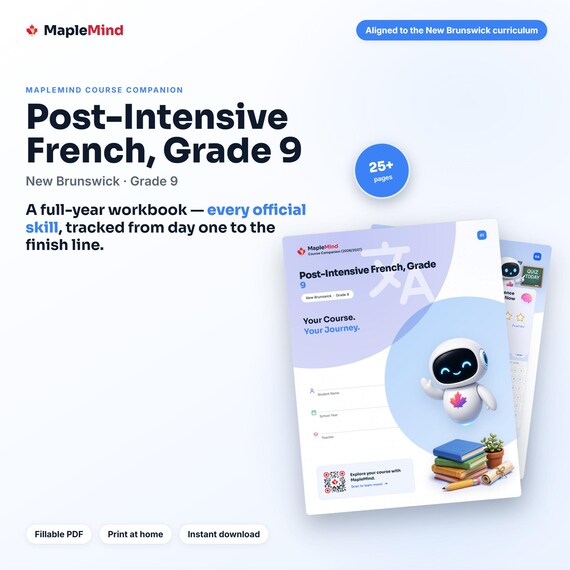
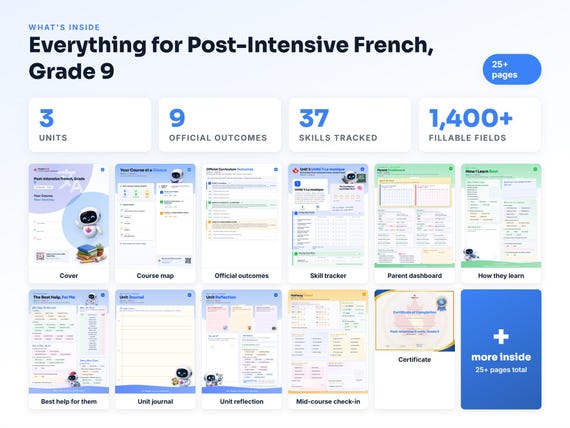
A Post-Intensive French, Grade 9 workbook worth keeping
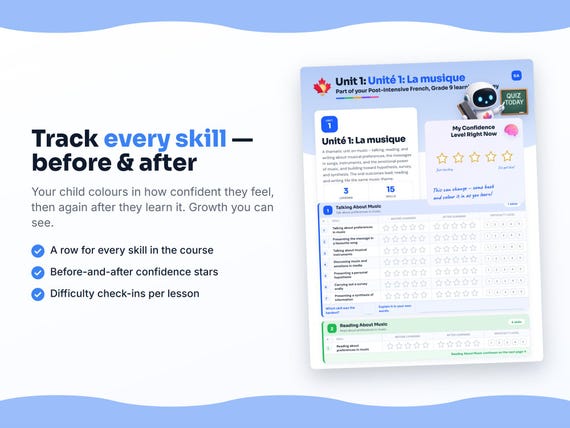
Built from the same official curriculum as this page. Before and after each skill above, your student colours in how sure they feel — so the two of you can see, on one page, what's clicking and what needs another look. It's a quiet way to follow how the year is really going.
By June it's full of their own handwriting: units worked through, confidence grown, a mid-year check-in, notes from parent-teacher night, and a certificate at the end. Less a worksheet, more a record of the year worth keeping on the shelf.
Instant download · see every page, reviews and the full description · five or more workbooks are $2.99 each
What it looks like in the app
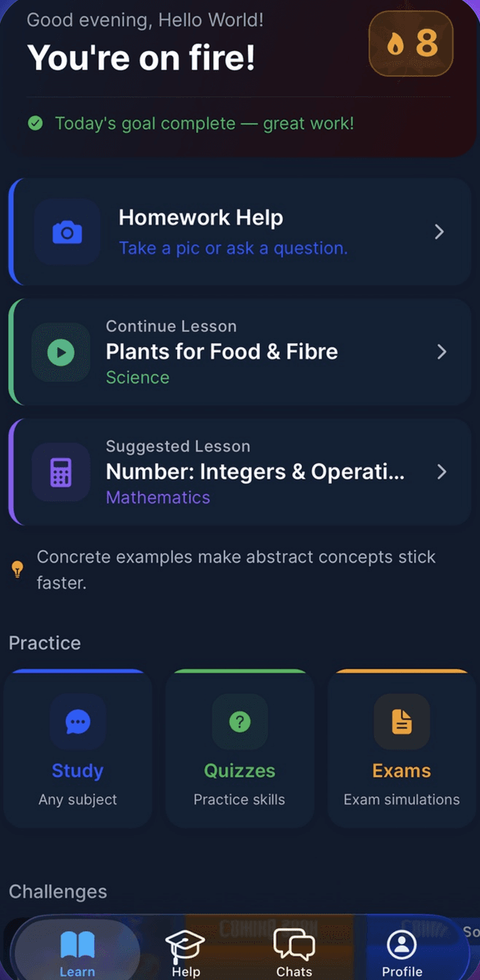
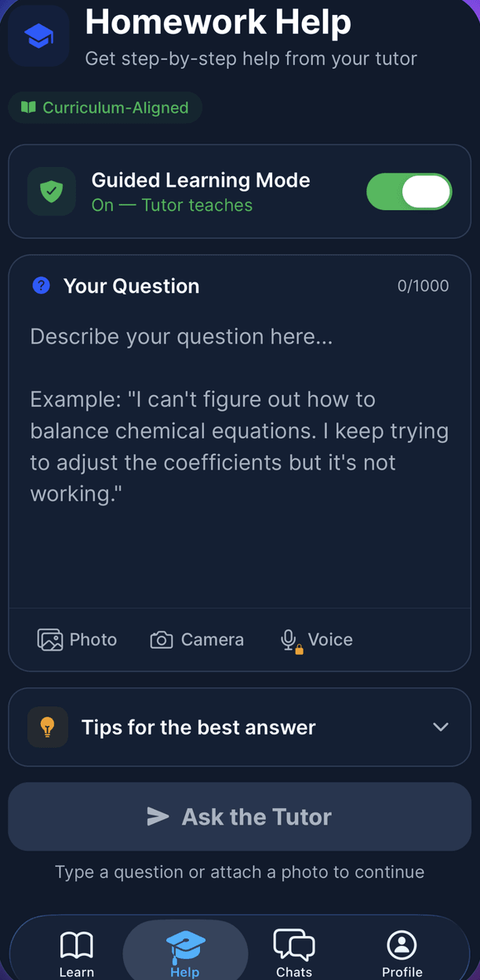
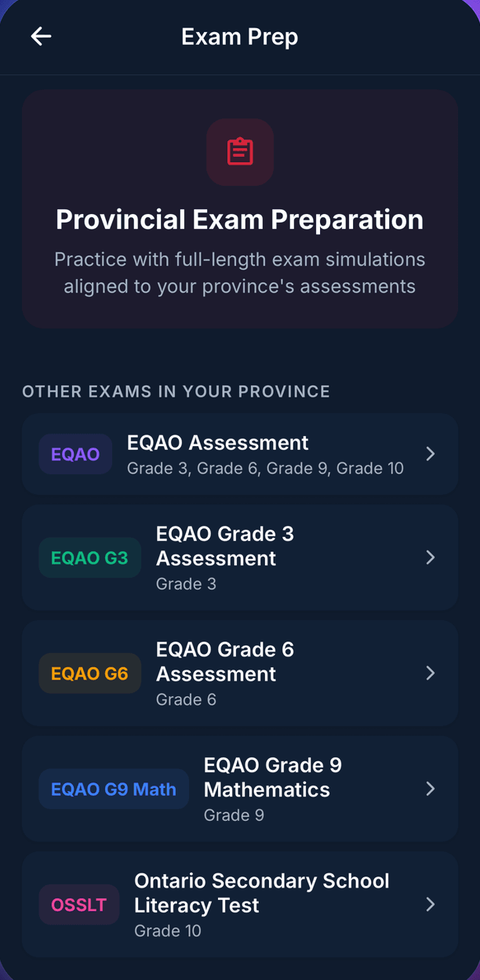
Common questions
Can MapleMind help me with Post-Intensive French, Grade 9?
Yes. MapleMind's AI tutor covers all 37 skills in New Brunswick's Post-Intensive French, Grade 9 — you pick the exact skill, and the tutor teaches it step by step: a short lesson, a worked example, solving together, then a skill check to show it stuck.
Is MapleMind aligned to New Brunswick's official curriculum?
Yes. Every skill in this course maps to an official outcome code from New Brunswick's Grade 9 French curriculum, and the ministry's own wording is quoted under each unit on this page — with the official government source linked so you can check it yourself.
What does MapleMind cost?
It's free to start — 5 tutoring chats and a practice quiz every day, no credit card. A Pro subscription ($9.99/month or $49.99/year CAD, 7-day free trial) unlocks unlimited tutoring, practice, and exam simulations.
What if I'm stuck on just one topic?
That's the point of skill-level tutoring: open Post-Intensive French, Grade 9 in the app, tap the exact skill from the list on this page, and the tutor teaches just that — no wading through lessons you don't need.
Does MapleMind work in French or other languages?
Yes — 14 languages, including French. Both the app and the tutor's explanations switch to the language you choose.
Where can I see the official New Brunswick curriculum for Post-Intensive French, Grade 9?
The official source is linked on this page — New Brunswick's official K-12 education resources. The outline here follows it: every MapleMind skill carries its official outcome code, and the ministry's own wording is quoted under each unit.
Keep exploring
Ready when you are
Pick a skill from this page and see it taught properly — free, in the browser, in under a minute.