Get help with Post-Intensive French, Grade 8
Most tutoring makes you sit through material you already know. MapleMind flips that: pick the exact skill that's causing trouble — any of the 18 below — and the tutor teaches just that one, step by step, as many times as it takes. Ask questions in plain words, any time of day, in English, French, or 12 other languages.
The official New Brunswick Post-Intensive French, Grade 8 curriculum
New Brunswick defines Post-Intensive French, Grade 8 by strands and outcomes. MapleMind teaches the same curriculum reorganized for one-skill-at-a-time tutoring — the table shows exactly where every official strand lands, and the ministry's own wording is quoted under each unit below.
Official source New Brunswick's official K-12 education resourcesRead it on the government site — www2.gnb.ca ↗| Official strand | Outcomes | Where MapleMind teaches it |
|---|---|---|
| Strand 1 | 7 | Oral Communication |
| Strand 2 | 7 | Reading and Viewing |
| Strand 3 | 3 | Writing and Representing |
Every skill below, taught one on one.
 Try the first session free
How MapleMind teaches Post-Intensive French, Grade 8 — every unit, lesson, and skill
Every skill below runs as a short session: a plain-words lesson, a worked example, solving it together, then a five-question skill check that earns up to three stars. Guided Mode keeps it teaching instead of answer-handing — turning it off needs a parent's password.
Unit 1Oral CommunicationOfficial strand · Strand 1
Speaking and listening in French with more ease - exploring and clarifying thoughts, conversing adequately in daily situations, holding conversations with sensitivity, comparing former and today's lifestyles, describing an object's characteristics, summarizing an interview on life in the past, and expressing feelings about music from earlier centuries. The oral spine, pitched to the A2.2 key-stage bar.
Speaking to Explore and Conversing With Ease
- Speaking to explore and clarify thinkingNB.PIF8.10 — Speak and listen in French to explore, deepen, and clarify your thoughts, ideas, feelings, and experiences.
- Conversing adequately in daily situationsNB.PIF8.11 — Communicate efficiently in French and converse adequately across a range of daily situations.
- Holding conversations with ease and sensitivityNB.PIF8.12 — Hold a French conversation with more ease, sustaining the exchange smoothly across several turns.
- Conversing with sensitivity for the audienceNB.PIF8.12 — Adapt a French conversation to the situation, audience, and intention, showing sensitivity and respect.
Talking About the Past, Objects, and Music
- Comparing former and today's lifestylesNB.PIF8.13 — Compare former lifestyles with today's lifestyle in spoken French, using past-tense description.
- Describing an object's characteristicsNB.PIF8.14 — Talk in French about the aesthetic and practical characteristics of an object, such as a car.
- Summarizing an interview about the pastNB.PIF8.15 — Summarize the essential points of a French interview about life in the past.
- Expressing feelings about music from earlier centuriesNB.PIF8.16 — Express your feelings in French with respect to music from previous centuries.
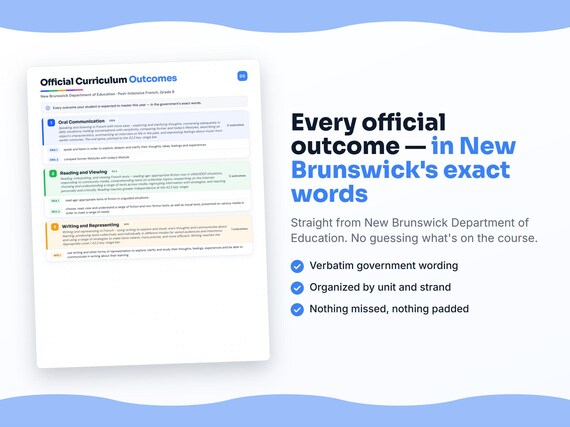
The official wording — 7 outcomes in this unit
- NB.PIF8.10
speak and listen in order to explore, deepen and clarify their thoughts, ideas, feelings and experiences
- NB.PIF8.11
communicate efficiently in French and converse adequately in a range of daily situations
- NB.PIF8.12
hold conversations with more ease
- NB.PIF8.13
compare former lifestyles with today’s lifestyle
- NB.PIF8.14
talk about the aesthetic and practical characteristics of an object (a car)
- NB.PIF8.15
summarize the essential points of an interview on life in the past
- NB.PIF8.16
express their feelings with respect to music from previous centuries
Unit 2Reading and ViewingOfficial strand · Strand 2
Reading, interpreting, and viewing French texts - reading age-appropriate fiction now in UNGUIDED situations, responding to community media, comprehending texts on unfamiliar topics, researching on the Internet, choosing and understanding a range of texts across media, regrouping information with strategies, and reacting personally and critically. Reading reaches greater independence at the A2.2 key-stage.
Reading Fiction On Your Own and Researching Online
- Reading fiction independentlyNB.PIF8.17 — Read age-appropriate French fiction in unguided situations, following the story on your own.
- Responding to community mediaNB.PIF8.18 — View and respond to a variety of representations and media in the context of the community, in French.
- Comprehending texts on unfamiliar topicsNB.PIF8.19 — Comprehend and interpret a variety of French texts on unfamiliar topics in guided situations.
- Researching information on the InternetNB.PIF8.20 — Comprehend and select information found on the Internet that relates to your own interests, in French.
Reading Widely, Regrouping, and Reacting Critically
- Choosing and understanding a range of textsNB.PIF8.21 — Choose, read, view, and understand a range of fiction, non-fiction, and visual texts across various media to meet a range of needs, in French.
- Interpreting and regrouping informationNB.PIF8.22 — Interpret, choose, and regroup information using a number of strategies and resources, in French.
- Reacting personally and critically to textsNB.PIF8.23 — React personally and in a critical way to various French texts, giving a supported response.
The official wording — 7 outcomes in this unit
- NB.PIF8.17
read age-appropriate texts of fiction in unguided situations
- NB.PIF8.18
view and respond to a variety of representations and media in the context of community
- NB.PIF8.19
comprehend and interpret a variety of texts on unfamiliar topics in guided situations
- NB.PIF8.20
comprehend and select information found on Internet that relates to their own interests
- NB.PIF8.21
choose, read, view and understand a range of fiction and non-fiction texts, as well as visual texts, presented on various media in order to meet a range of needs
- NB.PIF8.22
interpret, choose, and regroup information using a number of strategies and resources
- NB.PIF8.23
react personally and in a critical way to various texts
Unit 3Writing and RepresentingOfficial strand · Strand 3
Writing and representing in French - using writing to explore and study one's thoughts and communicate about learning, producing texts collectively and individually in different modes for varied audiences and intentions, and using a range of strategies to make texts clearer, more precise, and more efficient. Writing reaches the Appropriate Level / A2.2 key-stage bar.
Writing to Explore, Produce, and Refine
- Writing to explore and communicate learningNB.PIF8.24 — Use writing and other forms of representation to explore, clarify, and study your thoughts, feelings, and experiences, and communicate in writing about your learning, in French.
- Producing texts for varied audiences and intentionsNB.PIF8.25 — Produce texts collectively and individually, applying different modes, for a range of audiences and a variety of intentions, in French.
- Using strategies to make texts clearer and more preciseNB.PIF8.26 — Use a range of strategies to create texts that are clearer, more precise, and more efficient, in French.
The official wording — 3 outcomes in this unit
- NB.PIF8.24
use writing and other forms of representation to explore, clarify and study their thoughts, feelings, experiences and be able to communicate in writing about their learning
- NB.PIF8.25
produce texts collectively and individually, applying different modes, for a range of audiences and for a variety of intentions
- NB.PIF8.26
use a range of strategies to create texts in order to make their texts clearer, more precise and more efficient
Printable workbook · A keepsake of the year
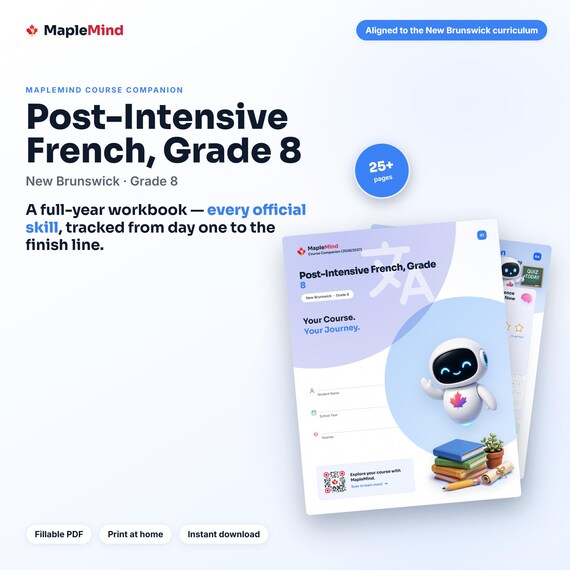
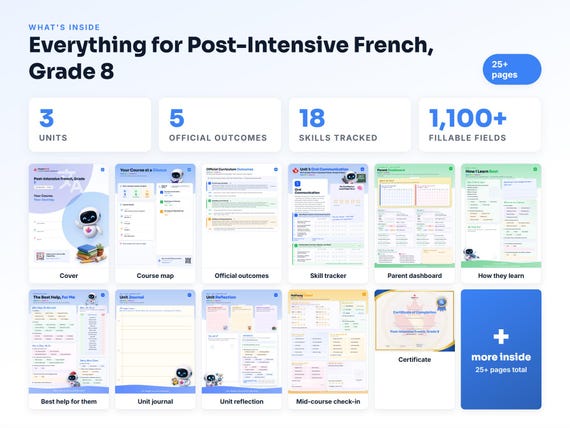
A Post-Intensive French, Grade 8 workbook worth keeping
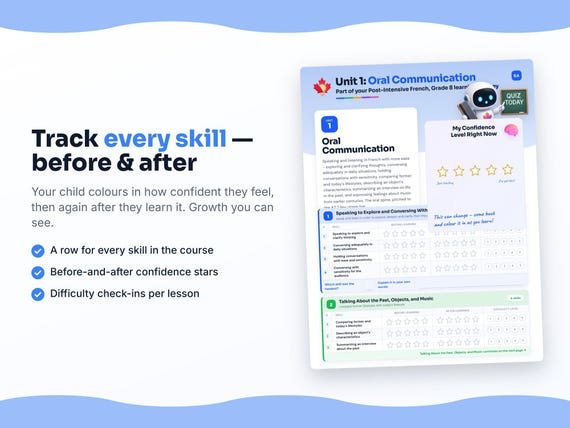
Built from the same official curriculum as this page. Before and after each skill above, your student colours in how sure they feel — so the two of you can see, on one page, what's clicking and what needs another look. It's a quiet way to follow how the year is really going.
By June it's full of their own handwriting: units worked through, confidence grown, a mid-year check-in, notes from parent-teacher night, and a certificate at the end. Less a worksheet, more a record of the year worth keeping on the shelf.
Instant download · see every page, reviews and the full description · five or more workbooks are $2.99 each
What it looks like in the app
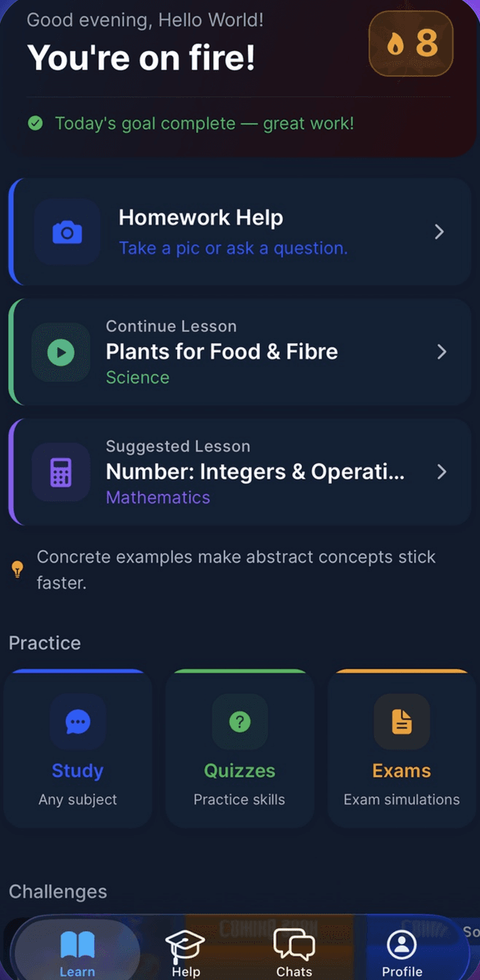
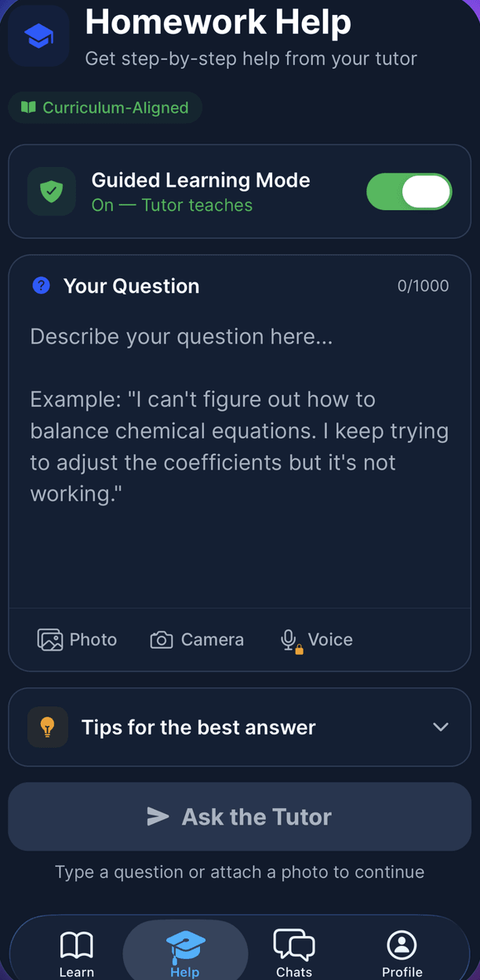
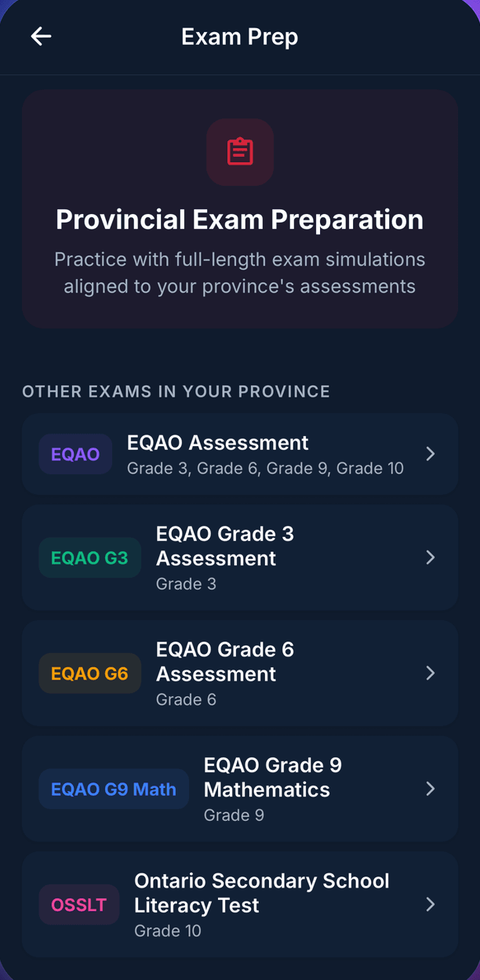
Common questions
Can MapleMind help me with Post-Intensive French, Grade 8?
Yes. MapleMind's AI tutor covers all 18 skills in New Brunswick's Post-Intensive French, Grade 8 — you pick the exact skill, and the tutor teaches it step by step: a short lesson, a worked example, solving together, then a skill check to show it stuck.
Is MapleMind aligned to New Brunswick's official curriculum?
Yes. Every skill in this course maps to an official outcome code from New Brunswick's Grade 8 French curriculum, and the ministry's own wording is quoted under each unit on this page — with the official government source linked so you can check it yourself.
What does MapleMind cost?
It's free to start — 5 tutoring chats and a practice quiz every day, no credit card. A Pro subscription ($9.99/month or $49.99/year CAD, 7-day free trial) unlocks unlimited tutoring, practice, and exam simulations.
What if I'm stuck on just one topic?
That's the point of skill-level tutoring: open Post-Intensive French, Grade 8 in the app, tap the exact skill from the list on this page, and the tutor teaches just that — no wading through lessons you don't need.
Does MapleMind work in French or other languages?
Yes — 14 languages, including French. Both the app and the tutor's explanations switch to the language you choose.
Where can I see the official New Brunswick curriculum for Post-Intensive French, Grade 8?
The official source is linked on this page — New Brunswick's official K-12 education resources. The outline here follows it: every MapleMind skill carries its official outcome code, and the ministry's own wording is quoted under each unit.
Keep exploring
Ready when you are
Pick a skill from this page and see it taught properly — free, in the browser, in under a minute.