Get help with Science, Grade 3
Most tutoring makes your child sit through material your child already knows. MapleMind flips that: pick the exact skill that's causing trouble — any of the 14 below — and the tutor teaches just that one, step by step, as many times as it takes. Ask questions in plain words, any time of day, in English, French, or 12 other languages.
The official New Brunswick Science, Grade 3 curriculum
New Brunswick defines Science, Grade 3 by strands and outcomes. MapleMind teaches the same curriculum reorganized for one-skill-at-a-time tutoring — the table shows exactly where every official strand lands, and the ministry's own wording is quoted under each unit below.
Official source New Brunswick's official K-12 education resourcesRead it on the government site — www2.gnb.ca ↗| Official strand | Outcomes | Where MapleMind teaches it |
|---|---|---|
| Strand 1 | 4 | Weather and Climate |
| Strand 2 | 4 | Habitats |
| Strand 3 | 3 | Plants |
| Strand 4 | 3 | Animals |
Every skill below, taught one on one.
 Try the first session free
How MapleMind teaches Science, Grade 3 — every unit, lesson, and skill
Every skill below runs as a short session: a plain-words lesson, a worked example, solving it together, then a five-question skill check that earns up to three stars. Guided Mode keeps it teaching instead of answer-handing — turning it off needs a parent's password.
Unit 1Weather and ClimateOfficial strand · Strand 1
The natural cycles that shape our sky and seasons: day and night, moon phases, tides, and seasons; seasonal weather conditions and weather hazards; and how the Sun provides the energy that drives climate and life.
Cycles in the Sky and Seasons
- Natural cyclical eventssci3.C1 — Observe natural cyclical events - sun and shadows, moon phases, ocean tides, and seasons - as patterns that repeat.
- Seasonal weather conditionssci3.C2 — Observe how weather conditions - cloud cover, temperature, wind, and precipitation - change with the seasons and place.
Weather Hazards and the Sun's Energy
- Weather hazardssci3.C3 — Identify weather hazards - thunderstorms, floods, droughts, and blizzards - and ways to stay safe.
- The Sun provides energysci3.C4 — Understand the climate-literacy ideas that the Sun provides energy and that climate supports life.
The official wording — 4 outcomes in this unit
- sci3.C1
Natural cyclical events Sun and shadows Moon phases Ocean tides Seasons
- sci3.C2
Seasonal weather conditions Changes in different locations at different time: cloud cover, temperature, wind direction, and precipitation
- sci3.C3
Weather hazards Thunderstorms, floods, drought conditions, blizzards
- sci3.C4
Climate literacy principles: The Sun Provides Energy Climate and Life
Unit 2HabitatsOfficial strand · Strand 2
Local ecosystems and habitats: an introduction to ecosystems using New Brunswick examples, and how living and non-living parts interact through energy flow, relationships among populations, and physical characteristics of the environment.
Ecosystems and How They Interact
- Introduction to ecosystemssci3.C5 — Explore what an ecosystem is, using local New Brunswick examples like forests, waterways, coasts, and wetlands.
- Energy flow in a habitatsci3.C6 — Explore how energy flows through a habitat from the Sun to plants to animals.
- Populations and communitiessci3.C7 — Explore relationships among populations and communities of living things in a habitat.
- Physical characteristics of a habitatsci3.C8 — Explore the physical (non-living) characteristics of a habitat, such as light, climate, and soil.
The official wording — 4 outcomes in this unit
- sci3.C5
Introduction to ecosystems Start with examples connected to New Brunswick: forests, waterways, coastal, wetlands, then explore more broadly
- sci3.C6
Interactions of living and non-living components Energy flow
- sci3.C7
Relationships: populations and communities
- sci3.C8
Physical characteristics: examples include: light, climate, soil components, soil types, exposure to the sun
Unit 3PlantsOfficial strand · Strand 3
Local plants: their characteristics, structures, and functions through the seasonal cycle, and what plants need to live and grow.
Local Plants and Their Needs
- Characteristics and structures of local plantssci3.C9 — Explore the characteristics, structures, and functions of local plants across the seasons.
- What plants needsci3.C10 — Identify what plants need to live and grow: air, water, nutrients, and sunlight.
- Uses of local plantssci3.C13 — Explore how people and animals use local plants - for food, materials, shelter, and more.
The official wording — 3 outcomes in this unit
- sci3.C9
Local plants Characteristics, structures and functions of local plants (seasonal cycles)
- sci3.C10
Needs: Air, water, nutrients, sunlight
- sci3.C13
Needs: Air, water, nutrients, sunlight o Uses
Unit 4AnimalsOfficial strand · Strand 4
Local animals: their characteristics, structures, and functions through the seasonal cycle, and what animals need to survive.
Local Animals and Their Needs
- Characteristics and structures of local animalssci3.C11 — Explore the characteristics, structures, and functions of local animals across the seasons.
- What animals needsci3.C12 — Identify what animals need to survive: air, food, water, shelter, and protection.
- Uses of local animalssci3.C14 — Explore how people use and depend on local animals - for food, work, materials, and companionship.
The official wording — 3 outcomes in this unit
- sci3.C11
Local animals Characteristics, needs, structures and functions plants (seasonal cycles)
- sci3.C12
Needs: Air, food, water, shelter, and protection
- sci3.C14
Air, food, water, shelter, and protection o Uses
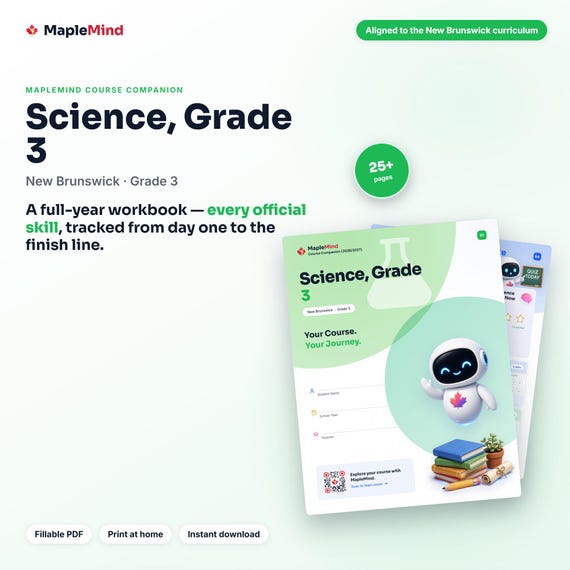
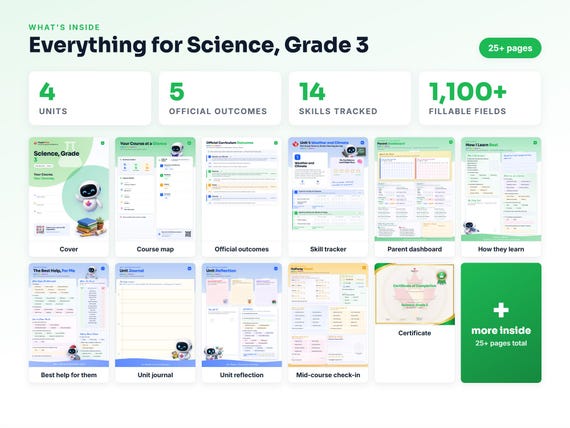
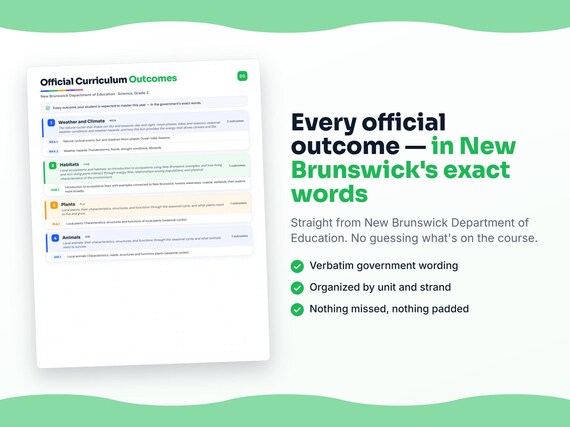
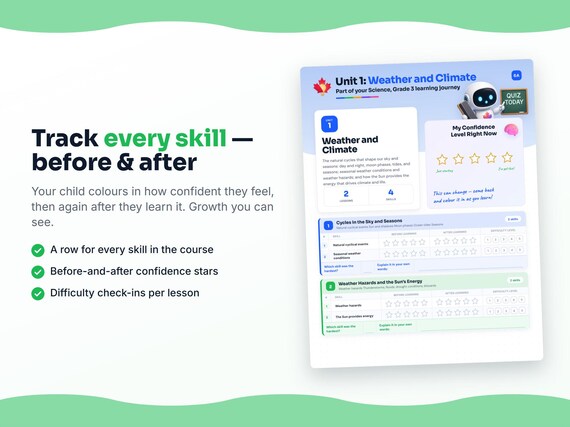
Printable workbook · A keepsake of the year
A Science, Grade 3 workbook worth keeping
Built from the same official curriculum as this page. Before and after each skill above, your student colours in how sure they feel — so the two of you can see, on one page, what's clicking and what needs another look. It's a quiet way to follow how the year is really going.
By June it's full of their own handwriting: units worked through, confidence grown, a mid-year check-in, notes from parent-teacher night, and a certificate at the end. Less a worksheet, more a record of the year worth keeping on the shelf.
Instant download · see every page, reviews and the full description · five or more workbooks are $2.99 each
What it looks like in the app
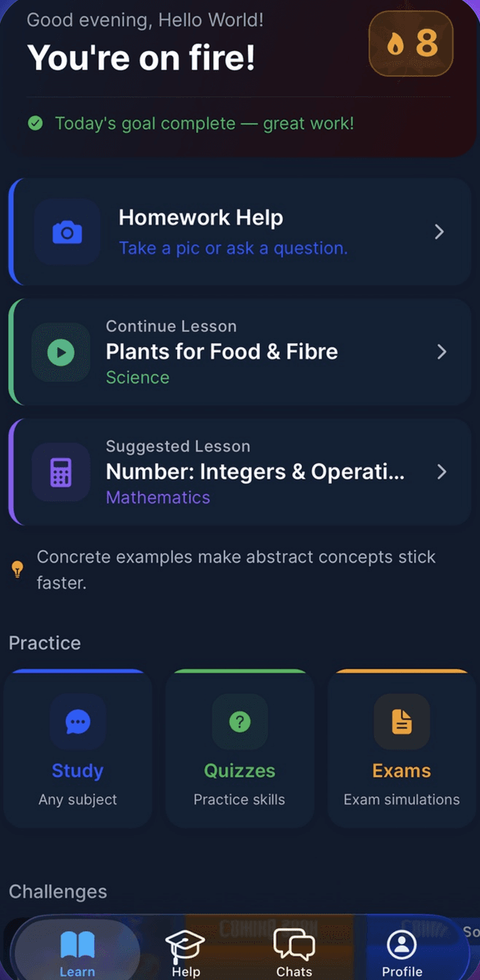
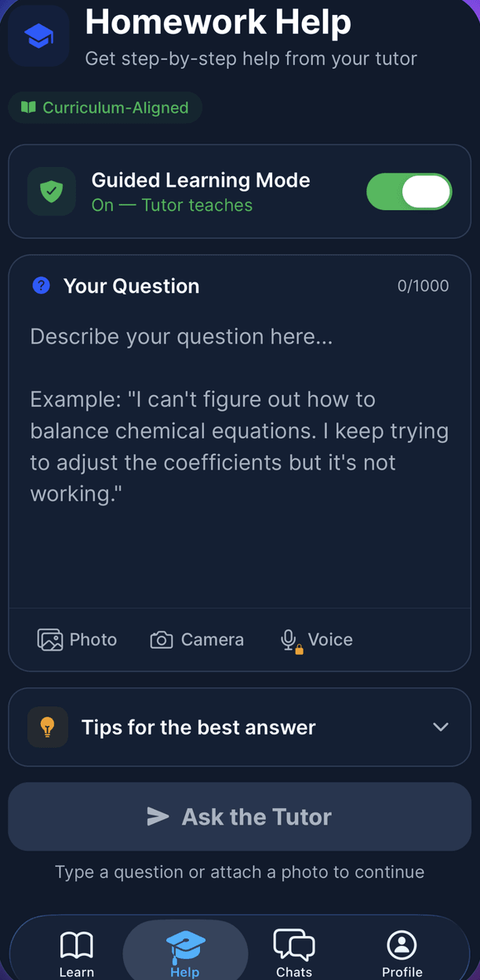
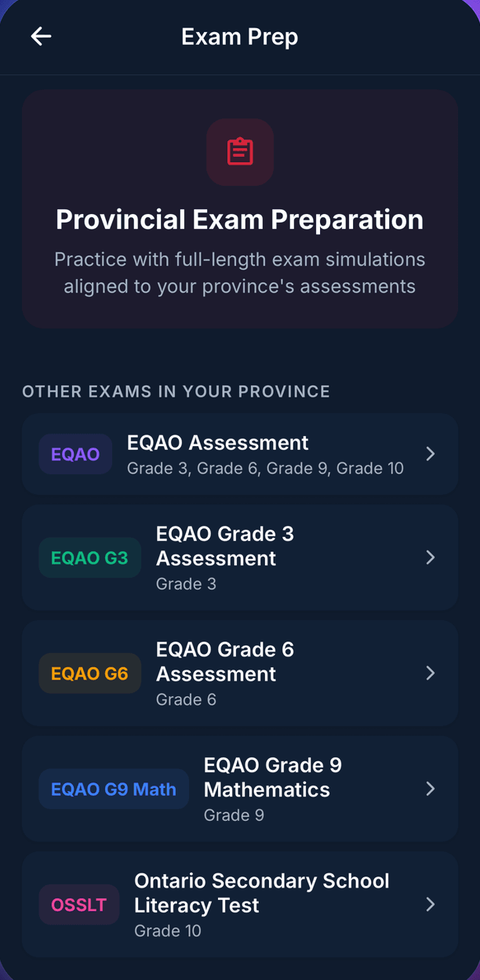
Common questions
Can MapleMind help my child with Science, Grade 3?
Yes. MapleMind's AI tutor covers all 14 skills in New Brunswick's Science, Grade 3 — your child picks the exact skill, and the tutor teaches it step by step: a short lesson, a worked example, solving together, then a skill check to show it stuck.
Is MapleMind aligned to New Brunswick's official curriculum?
Yes. Every skill in this course maps to an official outcome code from New Brunswick's Grade 3 Science curriculum, and the ministry's own wording is quoted under each unit on this page — with the official government source linked so you can check it yourself.
What does MapleMind cost?
It's free to start — 5 tutoring chats and a practice quiz every day, no credit card. A Pro subscription ($9.99/month or $49.99/year CAD, 7-day free trial) unlocks unlimited tutoring, practice, and exam simulations.
What if my child is stuck on just one topic?
That's the point of skill-level tutoring: open Science, Grade 3 in the app, tap the exact skill from the list on this page, and the tutor teaches just that — no wading through lessons your child doesn't need.
Does MapleMind work in French or other languages?
Yes — 14 languages, including French. Both the app and the tutor's explanations switch to the language your child chooses.
Where can I see the official New Brunswick curriculum for Science, Grade 3?
The official source is linked on this page — New Brunswick's official K-12 education resources. The outline here follows it: every MapleMind skill carries its official outcome code, and the ministry's own wording is quoted under each unit.
Keep exploring
Ready when you are
Pick a skill from this page and see it taught properly — free, in the browser, in under a minute.