Get help with Science, Grade 4
Most tutoring makes your child sit through material your child already knows. MapleMind flips that: pick the exact skill that's causing trouble — any of the 16 below — and the tutor teaches just that one, step by step, as many times as it takes. Ask questions in plain words, any time of day, in English, French, or 12 other languages.
The official New Brunswick Science, Grade 4 curriculum
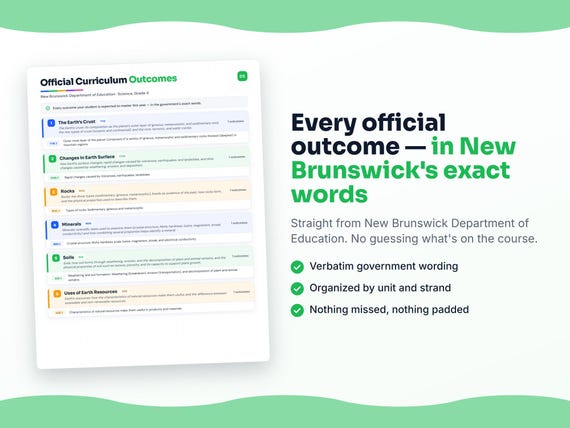
New Brunswick defines Science, Grade 4 by strands and outcomes. MapleMind teaches the same curriculum reorganized for one-skill-at-a-time tutoring — the table shows exactly where every official strand lands, and the ministry's own wording is quoted under each unit below.
Official source New Brunswick's official K-12 education resourcesRead it on the government site — www2.gnb.ca ↗| Official strand | Outcomes | Where MapleMind teaches it |
|---|---|---|
| Strand 1 | 3 | The Earth's Crust |
| Strand 2 | 3 | Changes in Earth Surface |
| Strand 3 | 4 | Rocks |
| Strand 4 | 2 | Minerals |
| Strand 5 | 2 | Soils |
| Strand 6 | 2 | Uses of Earth Resources |
Every skill below, taught one on one.
 Try the first session free
How MapleMind teaches Science, Grade 4 — every unit, lesson, and skill
Every skill below runs as a short session: a plain-words lesson, a worked example, solving it together, then a five-question skill check that earns up to three stars. Guided Mode keeps it teaching instead of answer-handing — turning it off needs a parent's password.
Unit 1The Earth's CrustOfficial strand · Strand 1
The Earth's crust: its composition as the planet's outer layer of igneous, metamorphic, and sedimentary rock; the two types of crust (oceanic and continental); and the rock, tectonic, and water cycles.
The Planet's Outer Layer
- Composition of the crustsci4.C1 — Describe the crust as Earth's outermost layer, made of igneous, metamorphic, and sedimentary rock.
- Oceanic and continental crustsci4.C2 — Compare the two types of crust: thin oceanic crust and thick continental crust.
- Rock, tectonic, and water cyclessci4.C3 — Introduce the rock cycle, tectonic cycle, and water cycle that reshape the crust.
The official wording — 3 outcomes in this unit
- sci4.C1
Outer most layer of the planet Composed of a variety of igneous, metamorphic and sedimentary rocks thickest (deepest) in mountain regions
- sci4.C2
Two types of crust Oceanic (5-10 km) and continental (30-50 km)
- sci4.C3
Cycles: Rock, tectonic, and water
Unit 2Changes in Earth SurfaceOfficial strand · Strand 2
How Earth's surface changes: rapid changes caused by volcanoes, earthquakes, and landslides, and slow changes caused by weathering, erosion, and deposition.
Fast and Slow Changes
- Rapid changes to the surfacesci4.C4 — Describe rapid changes to Earth's surface caused by volcanoes, earthquakes, and landslides.
- Slow changes: weathering, erosion, depositionsci4.C5 — Describe slow changes to Earth's surface - weathering, erosion, and deposition by water, wind, and ice.
- Forces that change Earth's surfacesci4.C16 — Explore the forces - such as moving water, wind, ice, gravity, and forces inside the Earth - that drive both rapid and slow changes to Earth's surface.
The official wording — 3 outcomes in this unit
- sci4.C4
Rapid changes caused by Volcanoes, earthquakes, landslides
- sci4.C5
Slow changes: weathering, erosion, and deposition from water, wind and ice
- sci4.C16
Forces changing Earth’s surface
Unit 3RocksOfficial strand · Strand 3
Rocks: the three types (sedimentary, igneous, metamorphic), fossils as evidence of the past, how rocks form, and the physical properties used to describe them.
Reading the Rocks
- Three types of rocksci4.C6 — Identify the three types of rock: sedimentary, igneous, and metamorphic.
- Fossils as evidencesci4.C7 — Explore how fossils provide evidence of past organisms and environments.
- How rocks formsci4.C8 — Explore the processes that form rocks: cooling of magma and lava, heat and pressure, and weathering, erosion, and deposition.
- Physical properties of rockssci4.C9 — Describe rocks using physical properties such as colour, weight, grain size, and texture.
The official wording — 4 outcomes in this unit
- sci4.C6
Types of rocks: Sedimentary, igneous and metamorphic
- sci4.C7
Fossils: Evidence of the past Ex. Organisms and environments
- sci4.C8
Formation processes: Solidification of magma, Cooling of lava, Heat and pressure, Weathering, erosion, and deposition.
- sci4.C9
Physical properties such as colour, weight, density, grain size, texture
Unit 4MineralsOfficial strand · Strand 4
Minerals: scientific tests used to examine them (crystal structure, Mohs hardness, lustre, magnetism, streak, conductivity) and how combining several properties helps identify a mineral.
Testing and Identifying Minerals
- Scientific testing of mineralssci4.C10 — Use scientific tests to examine minerals: crystal structure, Mohs hardness, lustre, magnetism, streak, and conductivity.
- Identifying mineralssci4.C11 — Use several properties together to identify a mineral.
The official wording — 2 outcomes in this unit
- sci4.C10
Crystal structure, Mohs hardness scale, lustre, magnetism, streak, and electrical conductivity
- sci4.C11
Multiple properties of a given mineral can help to identify minerals: Ex. Streak, crystal structure, transparency/opaque, hardness, electrical conductor, magnetic
Unit 5SoilsOfficial strand · Strand 5
Soils: how soil forms through weathering, erosion, and the decomposition of plant and animal remains, and the physical properties of soil such as texture, porosity, and its capacity to support plant growth.
How Soil Forms and What It's Like
- How soil formssci4.C12 — Explain how soil forms through weathering, erosion, and the decomposition of plant and animal remains.
- Physical properties of soilsci4.C13 — Describe the physical properties of soil: texture, colour, porosity, water-holding, and support for plant growth.
The official wording — 2 outcomes in this unit
- sci4.C12
Weathering and soil formation: Weathering (breakdown), erosion (transportation), and decomposition of plant and animal remains
- sci4.C13
Physical properties: Texture, colour, porosity, capacity to hold water, ability to support growth of plants
Unit 6Uses of Earth ResourcesOfficial strand · Strand 6
Earth's resources: how the characteristics of natural resources make them useful, and the difference between renewable and non-renewable resources.
Using Earth's Resources Wisely
- Why natural resources are usefulsci4.C14 — Explain how the characteristics of natural resources make them useful in products and materials.
- Renewable and non-renewable resourcessci4.C15 — Compare renewable resources with non-renewable resources.
The official wording — 2 outcomes in this unit
- sci4.C14
Characteristics of natural resources make them useful in products and materials
- sci4.C15
Renewable (Ex. Sunlight, air, plants, animals, and water) versus non-renewable (Ex. Coal, oil, and natural gas)
Printable workbook · A keepsake of the year
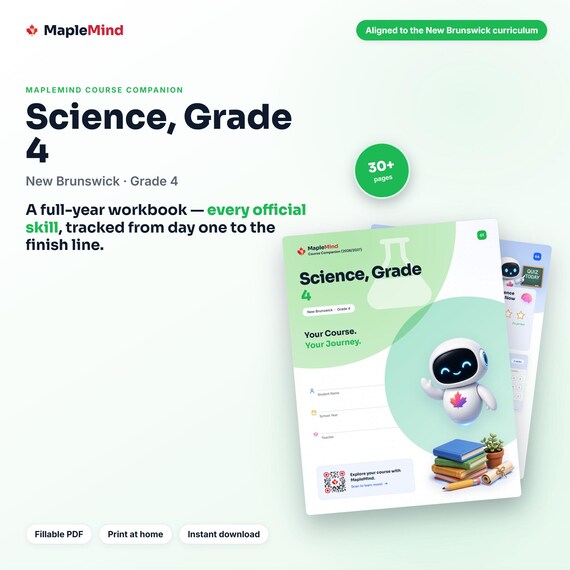
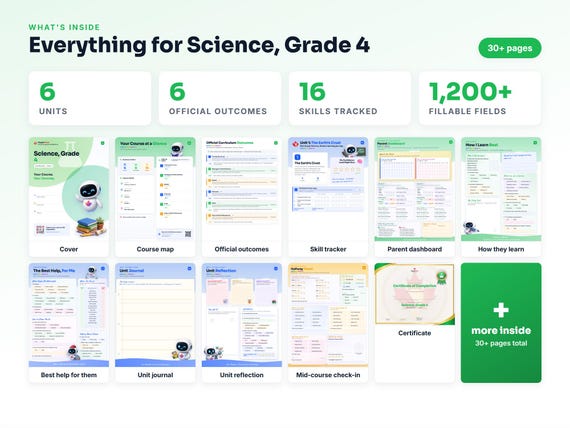
A Science, Grade 4 workbook worth keeping
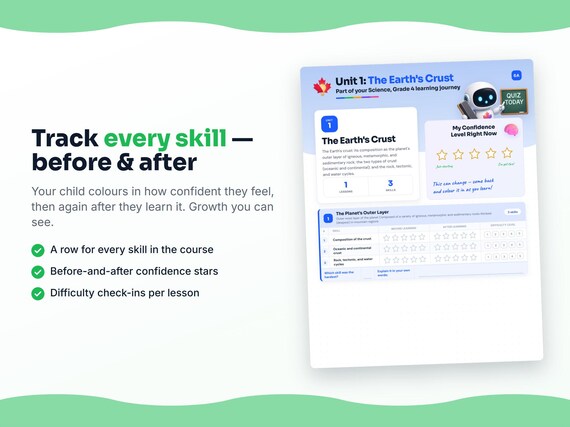
Built from the same official curriculum as this page. Before and after each skill above, your student colours in how sure they feel — so the two of you can see, on one page, what's clicking and what needs another look. It's a quiet way to follow how the year is really going.
By June it's full of their own handwriting: units worked through, confidence grown, a mid-year check-in, notes from parent-teacher night, and a certificate at the end. Less a worksheet, more a record of the year worth keeping on the shelf.
Instant download · see every page, reviews and the full description · five or more workbooks are $2.99 each
What it looks like in the app



Common questions
Can MapleMind help my child with Science, Grade 4?
Yes. MapleMind's AI tutor covers all 16 skills in New Brunswick's Science, Grade 4 — your child picks the exact skill, and the tutor teaches it step by step: a short lesson, a worked example, solving together, then a skill check to show it stuck.
Is MapleMind aligned to New Brunswick's official curriculum?
Yes. Every skill in this course maps to an official outcome code from New Brunswick's Grade 4 Science curriculum, and the ministry's own wording is quoted under each unit on this page — with the official government source linked so you can check it yourself.
What does MapleMind cost?
It's free to start — 5 tutoring chats and a practice quiz every day, no credit card. A Pro subscription ($9.99/month or $49.99/year CAD, 7-day free trial) unlocks unlimited tutoring, practice, and exam simulations.
What if my child is stuck on just one topic?
That's the point of skill-level tutoring: open Science, Grade 4 in the app, tap the exact skill from the list on this page, and the tutor teaches just that — no wading through lessons your child doesn't need.
Does MapleMind work in French or other languages?
Yes — 14 languages, including French. Both the app and the tutor's explanations switch to the language your child chooses.
Where can I see the official New Brunswick curriculum for Science, Grade 4?
The official source is linked on this page — New Brunswick's official K-12 education resources. The outline here follows it: every MapleMind skill carries its official outcome code, and the ministry's own wording is quoted under each unit.
Keep exploring
Ready when you are
Pick a skill from this page and see it taught properly — free, in the browser, in under a minute.