Get help with Social Studies, Grade 9: Canadian Identities
Most tutoring makes you sit through material you already know. MapleMind flips that: pick the exact skill that's causing trouble — any of the 17 below — and the tutor teaches just that one, step by step, as many times as it takes. Ask questions in plain words, any time of day, in English, French, or 12 other languages.
The official New Brunswick Social Studies, Grade 9: Canadian Identities curriculum
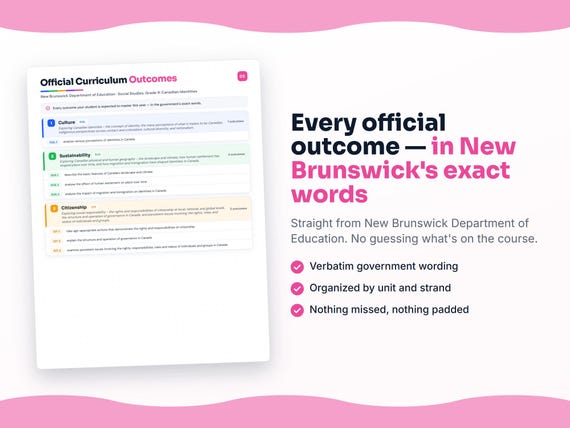
New Brunswick defines Social Studies, Grade 9: Canadian Identities by strands and outcomes. MapleMind teaches the same curriculum reorganized for one-skill-at-a-time tutoring — the table shows exactly where every official strand lands, and the ministry's own wording is quoted under each unit below.
Official source New Brunswick's official K-12 education resourcesRead it on the government site — www2.gnb.ca ↗| Official strand | Outcomes | Where MapleMind teaches it |
|---|---|---|
| Strand 1 | 1 | Culture |
| Strand 2 | 3 | Sustainability |
| Strand 3 | 3 | Citizenship |
Every skill below, taught one on one.
 Try the first session free
How MapleMind teaches Social Studies, Grade 9: Canadian Identities — every unit, lesson, and skill
Every skill below runs as a short session: a plain-words lesson, a worked example, solving it together, then a five-question skill check that earns up to three stars. Guided Mode keeps it teaching instead of answer-handing — turning it off needs a parent's password.
Unit 1CultureOfficial strand · Strand 1
Exploring Canadian identities - the concept of identity, the many perceptions of what it means to be Canadian, Indigenous perspectives across contact and colonialism, cultural diversity, and nationalism.
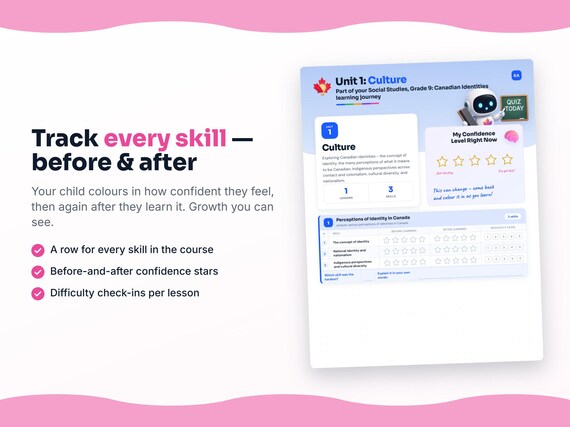
Perceptions of Identity in Canada
- The concept of identitySCO 1.1 — Analyse identity as a product of experience - for individuals, groups, and nations - and distinguish culture from counter-culture.
- National identity and nationalismSCO 1.1 — Investigate how a national identity evolves and how nationalism shapes what it means to identify as Canadian in a culturally diverse society.
- Indigenous perspectives and cultural diversitySCO 1.1 — Analyse Indigenous perspectives across pre-contact, first contact, and colonialism, and the many ethnic and newcomer perspectives that make up Canada's cultural diversity.
The official wording — 1 outcome in this unit
- SCO 1.1
analyse various perceptions of identities in Canada
Unit 2SustainabilityOfficial strand · Strand 2
Exploring Canadian physical and human geography - the landscape and climate, how human settlement has shaped place over time, and how migration and immigration have shaped identities in Canada.
Canada's Landscape and Climate
- Reading maps of Canada's landscapeSCO 2.1 — Interpret several types of maps (topographic, political, thematic, and more) to describe the variation in Canada's physical landscape and landforms.
- Climate, weather, and climate changeSCO 2.1 — Explain the difference between climate and weather, describe Canada's climate regions, and identify examples of climate change in Canada.
Human Settlement and Place Over Time
- Settlement, place, and the First PeoplesSCO 2.2 — Analyse how and where people settle in Canada - from the Six Cultural Regions of Canada's First Peoples on Turtle Island to modern urbanization - and why communities grow at particular locations.
- Resources, prosperity, and regionalismSCO 2.2 — Analyse how the use of natural and human resources drives regional prosperity, resource depletion, and regionalism across Canada.
Migration, Immigration, and Identities
- Why people migrate: push and pullSCO 2.3 — Explain why people migrate, using push and pull factors, and distinguish immigrants, migrants, and refugees or asylum seekers.
- Immigration history, policy, and impactSCO 2.3 — Examine immigration patterns across Canada's history, how immigration policies have shaped who comes, and the impact of immigration on Canadian identity and multiculturalism.
- Colonization, treaties, and the Residential SystemSCO 2.3 — Investigate how colonization and immigration affected Indigenous ways of life, including the Peace and Friendship and Land treaties and the harm of the Residential (residential school) System.
The official wording — 3 outcomes in this unit
- SCO 2.1
describe the basic features of Canada's landscape and climate
- SCO 2.2
analyse the effect of human settlement on place over time
- SCO 2.3
analyse the impact of migration and immigration on identities in Canada
Unit 3CitizenshipOfficial strand · Strand 3
Exploring social responsibility - the rights and responsibilities of citizenship at local, national, and global levels, the structure and operation of governance in Canada, and persistent issues involving the rights, roles, and status of individuals and groups.
Rights, Responsibilities, and Taking Action
- Citizenship, rights, and responsibilitiesSCO 3.1 — Define citizenship and the rights and responsibilities that come with it, from individual to collective to global citizenship, and how Canada's history shaped these ideas.
- Human rights, the Charter, and taking actionSCO 3.1 — Examine human rights as set out in the Canadian Charter of Rights and Freedoms and the UN Declaration of Human Rights, and plan and carry out an age-appropriate action demonstrating citizenship.
The Structure and Operation of Governance in Canada
- Levels of government and the federal systemSCO 3.2 — Explain how Canada's federal parliamentary democracy works across the municipal, provincial, and federal levels of government and their responsibilities.
- Branches of government and electionsSCO 3.2 — Describe the executive, legislative, and judicial branches of government and explain how the election process (first-past-the-post) and political parties work in Canada.
- First Nation band governance in New BrunswickSCO 3.2 — Describe how band governance operates and its responsibilities for at least one First Nation community in New Brunswick.
Persistent Issues in Canada
- Indigenous self-governance and Aboriginal rightsSCO 3.3 — Investigate traditional and current Indigenous self-governance - the Wabanaki Confederacy, the Indian Act of 1876, Section 35 of the Constitution, the Peace and Friendship Treaties, and the Marshall Decision.
- Gender equality and minority rightsSCO 3.3 — Investigate the historic and current work to end gender disparity and to gain minority rights in Canada, and the persistent issues of status and economic disparity among groups.
The official wording — 3 outcomes in this unit
- SCO 3.1
take age-appropriate actions that demonstrate the rights and responsibilities of citizenship
- SCO 3.2
explain the structure and operation of governance in Canada
- SCO 3.3
examine persistent issues involving the rights, responsibilities, roles and status of individuals and groups in Canada
Printable workbook · A keepsake of the year
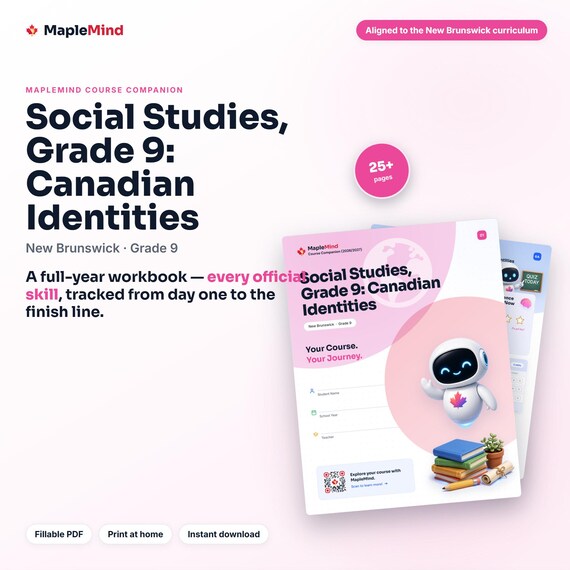
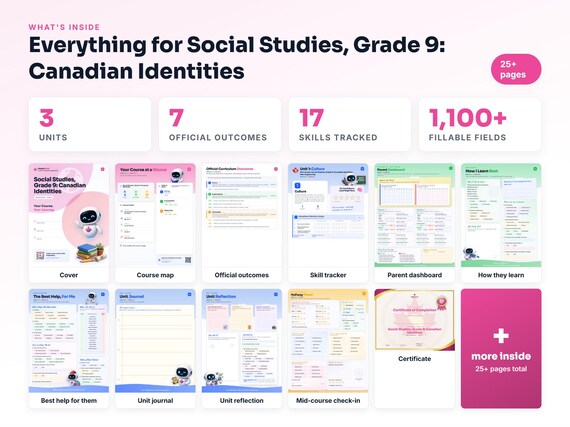
A Social Studies, Grade 9: Canadian Identities workbook worth keeping
Built from the same official curriculum as this page. Before and after each skill above, your student colours in how sure they feel — so the two of you can see, on one page, what's clicking and what needs another look. It's a quiet way to follow how the year is really going.
By June it's full of their own handwriting: units worked through, confidence grown, a mid-year check-in, notes from parent-teacher night, and a certificate at the end. Less a worksheet, more a record of the year worth keeping on the shelf.
Instant download · see every page, reviews and the full description · five or more workbooks are $2.99 each
What it looks like in the app



Common questions
Can MapleMind help me with Social Studies, Grade 9: Canadian Identities?
Yes. MapleMind's AI tutor covers all 17 skills in New Brunswick's Social Studies, Grade 9: Canadian Identities — you pick the exact skill, and the tutor teaches it step by step: a short lesson, a worked example, solving together, then a skill check to show it stuck.
Is MapleMind aligned to New Brunswick's official curriculum?
Yes. Every skill in this course maps to an official outcome code from New Brunswick's Grade 9 Social Studies curriculum, and the ministry's own wording is quoted under each unit on this page — with the official government source linked so you can check it yourself.
What does MapleMind cost?
It's free to start — 5 tutoring chats and a practice quiz every day, no credit card. A Pro subscription ($9.99/month or $49.99/year CAD, 7-day free trial) unlocks unlimited tutoring, practice, and exam simulations.
What if I'm stuck on just one topic?
That's the point of skill-level tutoring: open Social Studies, Grade 9: Canadian Identities in the app, tap the exact skill from the list on this page, and the tutor teaches just that — no wading through lessons you don't need.
Does MapleMind work in French or other languages?
Yes — 14 languages, including French. Both the app and the tutor's explanations switch to the language you choose.
Where can I see the official New Brunswick curriculum for Social Studies, Grade 9: Canadian Identities?
The official source is linked on this page — New Brunswick's official K-12 education resources. The outline here follows it: every MapleMind skill carries its official outcome code, and the ministry's own wording is quoted under each unit.
Keep exploring
Ready when you are
Pick a skill from this page and see it taught properly — free, in the browser, in under a minute.