Get help with Social Studies, Grade 8
Most tutoring makes you sit through material you already know. MapleMind flips that: pick the exact skill that's causing trouble — any of the 30 below — and the tutor teaches just that one, step by step, as many times as it takes. Ask questions in plain words, any time of day, in English, French, or 12 other languages.
The official New Brunswick Social Studies, Grade 8 curriculum
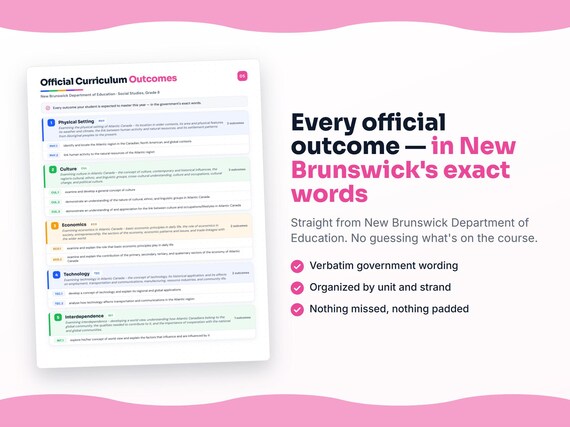
New Brunswick defines Social Studies, Grade 8 by strands and outcomes. MapleMind teaches the same curriculum reorganized for one-skill-at-a-time tutoring — the table shows exactly where every official strand lands, and the ministry's own wording is quoted under each unit below.
Official source New Brunswick's official K-12 education resourcesRead it on the government site — www2.gnb.ca ↗| Official strand | Outcomes | Where MapleMind teaches it |
|---|---|---|
| Strand 1 | 5 | Physical Setting |
| Strand 2 | 8 | Culture |
| Strand 3 | 6 | Economics |
| Strand 4 | 7 | Technology |
| Strand 5 | 4 | Interdependence |
Every skill below, taught one on one.
 Try the first session free
How MapleMind teaches Social Studies, Grade 8 — every unit, lesson, and skill
Every skill below runs as a short session: a plain-words lesson, a worked example, solving it together, then a five-question skill check that earns up to three stars. Guided Mode keeps it teaching instead of answer-handing — turning it off needs a parent's password.
Unit 1Physical SettingOfficial strand · Strand 1
Examining the physical setting of Atlantic Canada - its location in wider contexts, its area and physical features, its weather and climate, the link between human activity and natural resources, and its settlement patterns from Aboriginal peoples to the present.
Locating and Describing Atlantic Canada
- Locating the Atlantic region1.1 — Identify and locate the Atlantic region in the Canadian, North American, and global contexts.
- Area, size, and physical features1.2 — Describe the area, size, and physical features of Atlantic Canada.
- Weather and climate patterns1.3 — Identify the basic weather and climatic patterns of Atlantic Canada.
Resources and Settlement
- Human activity and natural resources1.4 — Link human activity to the natural resources of the Atlantic region.
- Settlement patterns over time1.5 — Identify and trace population and settlement patterns affecting Atlantic Canadians from the Wabanaki peoples through early new-world migration to the present day.
The official wording — 5 outcomes in this unit
- 1.1
identify and locate the Atlantic region in the Canadian, North American, and global contexts
- 1.2
describe the area, size, and physical features of Atlantic Canada
- 1.3
identify the basic weather and climatic patterns of Atlantic Canada
- 1.4
link human activity to the natural resources of the Atlantic region
- 1.5
identify and trace population and settlement patterns affecting Atlantic Canadians from Aboriginal to early new-world migration to the present day
Unit 2CultureOfficial strand · Strand 2
Examining culture in Atlantic Canada - the concept of culture, contemporary and historical influences, the region's cultural, ethnic, and linguistic groups, cross-cultural understanding, culture and occupations, cultural change, and political culture.
Culture in Atlantic Canada
- A general concept of culture2.1 — Examine and develop a general concept of culture.
- Contemporary culture and global connections2.2 — Examine and describe contemporary culture in the Atlantic Canadian context and its connections to other global cultures.
- Local and global factors shaping culture2.3 — Demonstrate an understanding of the local and global factors that have shaped the culture(s) of Atlantic Canada.
The Peoples of Atlantic Canada
- Cultural, ethnic, and linguistic groups2.4 — Demonstrate an understanding of the nature of the cultural, ethnic, and linguistic groups in Atlantic Canada, including the Wabanaki peoples, Acadians, and African-Canadians.
- Cross-cultural understanding2.5 — Demonstrate an understanding of the issues and events surrounding cross-cultural understanding at the local, regional, and global levels.
Culture, Work, Change, and Politics
- Culture and occupations2.6 — Demonstrate an understanding of and appreciation for the link between culture and occupations/lifestyles in Atlantic Canada.
- Forces that change cultures2.7 — Demonstrate an understanding of the local and global forces that cause cultures to constantly change.
- Shaping political culture2.8 — Explain how Atlantic Canadians shape political culture by exercising power and influencing political decisions.
The official wording — 8 outcomes in this unit
- 2.1
examine and develop a general concept of culture
- 2.2
examine and describe contemporary culture in the Atlantic Canadian context and its connections to other global cultures
- 2.3
demonstrate an understanding of the local and global factors that have shaped the culture(s) of Atlantic Canada
- 2.4
demonstrate an understanding of the nature of cultural, ethnic, and linguistic groups in Atlantic Canada
- 2.5
demonstrate an understanding of the issues and events surrounding cross-cultural understanding at the local, regional, and global levels
- 2.6
demonstrate an understanding of and appreciation for the link between culture and occupations/lifestyles in Atlantic Canada
- 2.7
demonstrate an understanding of the local and global forces that cause cultures to constantly change
- 2.8
explain how Atlantic Canadians shape political culture by exercising power and influencing political decisions
Unit 3EconomicsOfficial strand · Strand 3
Examining economics in Atlantic Canada - basic economic principles in daily life, the role of economics in society, entrepreneurship, the sectors of the economy, economic patterns and issues, and trade linkages with the wider world.
Economics in Daily Life and Society
- Economic principles in daily life3.1 — Examine and explain the role that basic economic principles play in daily life.
- The role of economics in society3.2 — Demonstrate an understanding of the role of economics in Atlantic Canadian society.
- Economics and entrepreneurship3.3 — Evaluate the importance of economics in entrepreneurship.
Sectors, Patterns, and Trade
- The four sectors of the economy3.4 — Examine and explain the contribution of the primary, secondary, tertiary, and quaternary sectors of the economy of Atlantic Canada.
- Economic patterns and issues3.5 — Analyse local, regional, and global economic patterns and related issues that are challenging Atlantic Canadians.
- Trade and economic linkages3.6 — Identify and demonstrate an understanding of trade and other economic linkages among Atlantic Canada and the national and global communities.
The official wording — 6 outcomes in this unit
- 3.1
examine and explain the role that basic economic principles play in daily life
- 3.2
demonstrate an understanding of the role of economics in Atlantic Canadian society
- 3.3
evaluate the importance of economics in entrepreneurship
- 3.4
examine and explain the contribution of the primary, secondary, tertiary, and quaternary sectors of the economy of Atlantic Canada
- 3.5
analyse local, regional, and global economic patterns and related issues that are challenging Atlantic Canadians
- 3.6
identify and demonstrate an understanding of trade and other economic linkages among Atlantic Canada and the national and global communities.
Unit 4TechnologyOfficial strand · Strand 4
Examining technology in Atlantic Canada - the concept of technology, its historical application, and its effects on employment, transportation and communications, manufacturing, resource industries, and community life.
The Concept and History of Technology
- A concept of technology4.1 — Develop a concept of technology and explain its regional and global applications.
- Historical technology in the region4.2 — Examine and describe the historical application of technology in the Atlantic region.
- Technology, employment, and living standards4.3 — Demonstrate an understanding of how technology has affected employment and the standard of living in Atlantic Canada.
The Effects of Technology
- Technology, transportation, and communications4.4 — Analyse how technology affects transportation and communications in the Atlantic region.
- Technology and manufacturing4.5 — Examine and describe the effects of technology on manufacturing in the Atlantic region.
- Technology and resource industries4.6 — Analyse the effect of technology on resource industries in Atlantic Canada.
- Technology and community life4.7 — Evaluate the effects of technology on recreation, home life, and community life.
The official wording — 7 outcomes in this unit
- 4.1
develop a concept of technology and explain its regional and global applications
- 4.2
examine and describe the historical application of technology in the Atlantic region
- 4.3
demonstrate an understanding of how technology has affected employment and the standard of living in Atlantic Canada
- 4.4
analyse how technology affects transportation and communications in the Atlantic region
- 4.5
examine and describe the effects of technology on manufacturing in the Atlantic region
- 4.6
analyse the effect of technology on resource industries in Atlantic Canada
- 4.7
evaluate the effects of technology on recreation, home life, and community life
Unit 5InterdependenceOfficial strand · Strand 5
Examining interdependence - developing a world view, understanding how Atlantic Canadians belong to the global community, the qualities needed to contribute to it, and the importance of cooperation with the national and global communities.
Atlantic Canada in the Global Community
- Developing a world view5.1 — Explore your concept of world view and explain the factors that influence and are influenced by it.
- Members of the global community5.2 — Examine and analyse how Atlantic Canadians are members of the global community through different interconnected systems.
- Qualities of a global citizen5.3 — Assess the individual qualities and attributes Atlantic Canadians need to become contributing members of the global community.
- Cooperation for future well-being5.4 — Demonstrate an understanding that the future well-being of Atlantic Canada involves cooperation with the national and global communities.
The official wording — 4 outcomes in this unit
- 5.1
explore his/her concept of world view and explain the factors that influence and are influenced by it
- 5.2
examine and analyse how Atlantic Canadians are members of the global community through different interconnected systems
- 5.3
assess the individual qualities and attributes Atlantic Canadians need to become contributing members of the global community
- 5.4
demonstrate an understanding that the future well-being of Atlantic Canada involves co- operation with the national and global communities
Printable workbook · A keepsake of the year
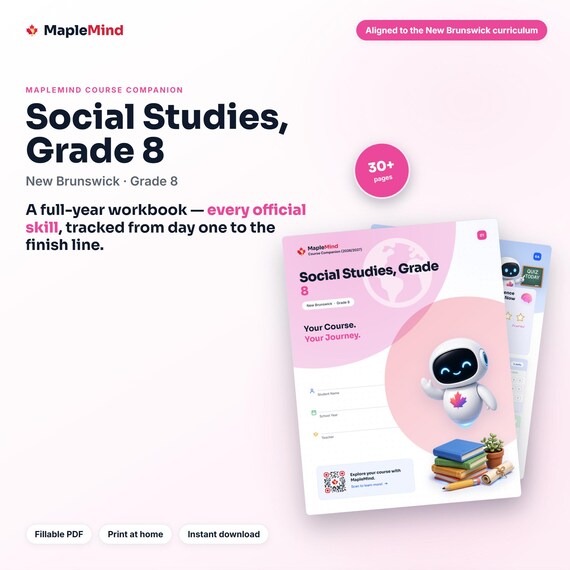
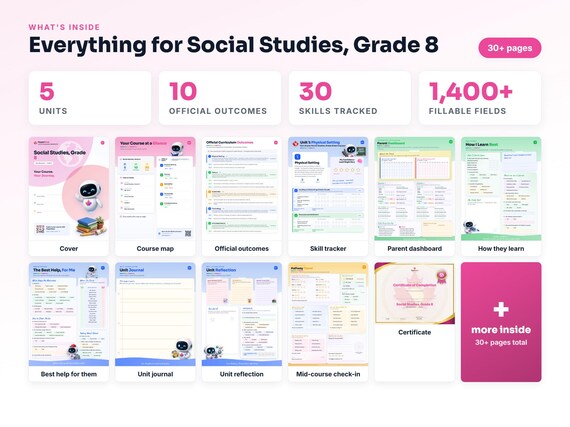
A Social Studies, Grade 8 workbook worth keeping
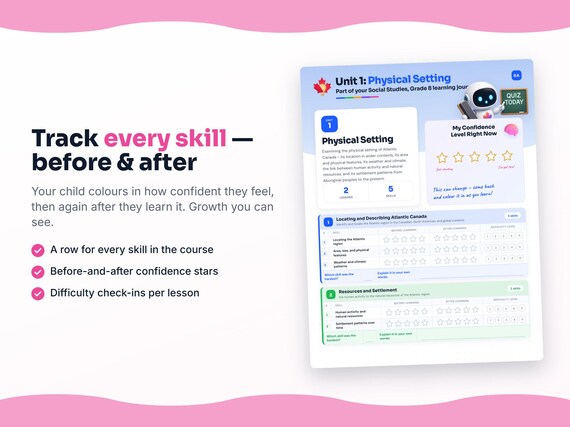
Built from the same official curriculum as this page. Before and after each skill above, your student colours in how sure they feel — so the two of you can see, on one page, what's clicking and what needs another look. It's a quiet way to follow how the year is really going.
By June it's full of their own handwriting: units worked through, confidence grown, a mid-year check-in, notes from parent-teacher night, and a certificate at the end. Less a worksheet, more a record of the year worth keeping on the shelf.
Instant download · see every page, reviews and the full description · five or more workbooks are $2.99 each
What it looks like in the app



Common questions
Can MapleMind help me with Social Studies, Grade 8?
Yes. MapleMind's AI tutor covers all 30 skills in New Brunswick's Social Studies, Grade 8 — you pick the exact skill, and the tutor teaches it step by step: a short lesson, a worked example, solving together, then a skill check to show it stuck.
Is MapleMind aligned to New Brunswick's official curriculum?
Yes. Every skill in this course maps to an official outcome code from New Brunswick's Grade 8 Social Studies curriculum, and the ministry's own wording is quoted under each unit on this page — with the official government source linked so you can check it yourself.
What does MapleMind cost?
It's free to start — 5 tutoring chats and a practice quiz every day, no credit card. A Pro subscription ($9.99/month or $49.99/year CAD, 7-day free trial) unlocks unlimited tutoring, practice, and exam simulations.
What if I'm stuck on just one topic?
That's the point of skill-level tutoring: open Social Studies, Grade 8 in the app, tap the exact skill from the list on this page, and the tutor teaches just that — no wading through lessons you don't need.
Does MapleMind work in French or other languages?
Yes — 14 languages, including French. Both the app and the tutor's explanations switch to the language you choose.
Where can I see the official New Brunswick curriculum for Social Studies, Grade 8?
The official source is linked on this page — New Brunswick's official K-12 education resources. The outline here follows it: every MapleMind skill carries its official outcome code, and the ministry's own wording is quoted under each unit.
Keep exploring
Ready when you are
Pick a skill from this page and see it taught properly — free, in the browser, in under a minute.