Get help with Social Studies 10
Most tutoring makes you sit through material you already know. MapleMind flips that: pick the exact skill that's causing trouble — any of the 22 below — and the tutor teaches just that one, step by step, as many times as it takes. Ask questions in plain words, any time of day, in English, French, or 12 other languages.
The official British Columbia Social Studies 10 curriculum
British Columbia defines Social Studies 10 by strands and outcomes. MapleMind teaches the same curriculum reorganized for one-skill-at-a-time tutoring — the table shows exactly where every official strand lands, and the ministry's own wording is quoted under each unit below.
Official source BC's official social studies curriculumRead it on the government site — curriculum.gov.bc.ca ↗| Official strand | Outcomes | Where MapleMind teaches it |
|---|---|---|
| Big Idea: The development of political institutions is influenced by economic, social, ideological, and geographic factors. | 7 | Political Institutions, Governance & Policy |
| Big Idea: Worldviews lead to different perspectives and ideas about developments in Canadian society. | 2 | Canadian Autonomy & Identity |
| Big Idea: Historical and contemporary injustices challenge the narrative and identity of Canada as an inclusive, multicultural society. | 8 | Injustices & Human Rights |
| Big Idea: Global and regional conflicts have been a powerful force in shaping our contemporary world and identities. | 5 | Conflict & Co-operation |
Every skill below, taught one on one.
 Try the first session free
How MapleMind teaches Social Studies 10 — every unit, lesson, and skill
Every skill below runs as a short session: a plain-words lesson, a worked example, solving it together, then a five-question skill check that earns up to three stars. Guided Mode keeps it teaching instead of answer-handing — turning it off needs a parent's password.
Unit 1Political Institutions, Governance & PolicyOfficial strand · Big Idea: The development of political institutions is influenced by economic, social, ideological, and geographic factors.
How Canada is governed — the models, ideologies, levels, and branches of government; First Peoples governance and the Indian Act; the Charter and electoral systems; environmental, political, and economic policy; and the inquiry skills (maps, graphs, data, citation) needed to study all of it.
Forms of Government and Decision-Making Models
- Forms of government and decision-making models10.GOV.1 — Compare forms of government and decision-making models — parliamentary democracy, constitutional monarchy, consensus government, autocracy, republic, and theocracy — and how each structures who holds power and how decisions get made.
Comparing Political and Economic Ideologies
- Comparing political and economic ideologies10.GOV.2 — Compare political and economic ideologies — socialism, communism, capitalism, fascism, liberalism, and conservatism — using classification models such as the left/right spectrum and the two-dimensional political compass.
Levels and Branches of Government
- Levels and branches of government10.GOV.3 — Explain the levels of government in Canada — local, regional, provincial, and federal — and the three branches within them: executive, legislative, and judicial.
First Peoples Governance, the Indian Act, and Land Claims
- First Peoples governance: the Indian Act, band councils, title, treaties, and land claims10.GOV.4 — Examine First Peoples governance — the Indian Act and the Crown-imposed governance structures it created (band councils), contemporary self-governance models, and Indigenous title, treaties, and land claims, including the Nisga'a, Sechelt, Tsawwassen, and Tsilhqot'in agreements and decisions.
The Charter of Rights and Freedoms and Electoral Systems
- The Charter of Rights and Freedoms and Canada's electoral systems10.GOV.5 — Examine the Canadian Charter of Rights and Freedoms and Canada's electoral systems, including election campaigns, minority and majority governments, and proposals for electoral reform.
Environmental, Political, and Economic Policy
- Environmental, political, and economic policies10.POL.1 — Investigate environmental, political, and economic policies — such as climate strategy and carbon pricing, social welfare programs, and trade agreements — and identify the stakeholders each policy affects.
Reading Maps, Graphs, and Data
- Reading maps, graphs, and data, and citing sources accurately10.INQ.1 — Interpret information and data from a variety of maps, graphs, and tables — election results, population and immigration statistics, conflict timelines — and accurately cite the sources used.
The official wording — 7 outcomes in this unit
- 10.GOV.1
government, First Peoples governance, political institutions, and ideologies
- 10.GOV.2
government, First Peoples governance, political institutions, and ideologies
- 10.GOV.3
government, First Peoples governance, political institutions, and ideologies
- 10.GOV.4
government, First Peoples governance, political institutions, and ideologies
- 10.GOV.5
government, First Peoples governance, political institutions, and ideologies
- 10.POL.1
environmental, political, and economic policies
- 10.INQ.1
Interpret information and data from a variety of maps, graphs, and tables
Unit 2Canadian Autonomy & IdentityOfficial strand · Big Idea: Worldviews lead to different perspectives and ideas about developments in Canadian society.
How Canada grew from a British colony into an autonomous nation on the world stage, and how Canadian identities — First Peoples, Francophone, immigrant, and shared national — have formed and been expressed.
The Growth of Canadian Autonomy
- Canada's growing autonomy10.AUTO.1 — Trace Canada's growing autonomy in relation to Britain, the United States, and the world — from the First World War, through the Statute of Westminster and the patriation of the Constitution in 1982, to Canada's independent role in NATO and the United Nations.
Canadian Identities
- Canadian identities10.IDEN.1 — Explore the many Canadian identities that shape the country — First Peoples, Francophone, immigrant and multicultural identities — and the shared national symbols Canadians recognize themselves in.
The official wording — 2 outcomes in this unit
- 10.AUTO.1
Canadian autonomy
- 10.IDEN.1
Canadian identities
Unit 3Injustices & Human RightsOfficial strand · Big Idea: Historical and contemporary injustices challenge the narrative and identity of Canada as an inclusive, multicultural society.
Residential schools and other injustices against First Peoples; the Chinese head tax, the Komagata Maru incident, the destruction of Hogan's Alley, and the internment of Japanese-Canadians; the Holocaust and the concept of genocide; and the advocacy — including the Truth and Reconciliation Commission — that has pushed for human rights and redress.
Residential Schools and Injustices Against First Peoples
- Residential schools and other discriminatory policies and injustices against First Peoples10.INJ.1 — Examine residential schools and other discriminatory policies and injustices against First Peoples in BC and Canada, and their lasting consequences for the people, families, and communities affected.
The Chinese Head Tax and Exclusion Act
- The Chinese head tax and the Chinese Exclusion Act10.INJ.2 — Examine the Chinese head tax and the Chinese Exclusion Act as government policies designed to restrict Chinese immigration to Canada, and their impact on Chinese-Canadian individuals and families.
The Komagata Maru Incident
- The Komagata Maru incident10.INJ.3 — Examine the Komagata Maru incident, in which Canada turned away a ship of South Asian passengers in 1914 under discriminatory immigration law, and its lasting significance for South Asian Canadians.
Racial Segregation and the Destruction of Hogan's Alley
- Racial segregation and the destruction of Hogan's Alley10.INJ.4 — Examine racial segregation in BC and the destruction of Hogan's Alley, Vancouver's historic Black community, and what its loss meant for the people who lived there.
The Internment of Japanese-Canadians
- The internment of Japanese-Canadians10.INJ.5 — Examine the internment of Japanese-Canadians during the Second World War — the forced removal, dispossession, and confinement of Japanese-Canadian families — and its lasting consequences.
The Holocaust and the Concept of Genocide
- The Holocaust and the concept of genocide10.HOLO.1 — Examine the Holocaust — the systematic persecution and murder of six million Jews and millions of others by Nazi Germany — and the concept of genocide it defined, handled with the factual, human-centred care the subject requires.
The Truth and Reconciliation Commission
- The Truth and Reconciliation Commission: its report and calls to action10.RIGHTS.1 — Examine the Truth and Reconciliation Commission's findings and recommendations on residential schools, including its report and its calls to action for individuals, institutions, and governments.
Human-Rights Advocacy and Redress Movements
- Human-rights advocacy and redress movements10.RIGHTS.2 — Investigate human-rights advocacy beyond the TRC — human rights tribunals, First Peoples protest and advocacy movements, and formal apologies and redress for historic wrongs such as the head tax and internments.
The official wording — 8 outcomes in this unit
- 10.INJ.1
residential schools and other discriminatory policies and injustices against First Peoples in BC and Canada
- 10.INJ.2
the head tax
- 10.INJ.3
the Komagata Maru incident
- 10.INJ.4
racial segregation and the destruction of Hogan’s Alley
- 10.INJ.5
the internment of Japanese- Canadians
- 10.HOLO.1
The Holocaust and the concept of genocide
- 10.RIGHTS.1
advocacy for human rights, including findings and recommendations of the Truth and Reconciliation Commission
- 10.RIGHTS.2
advocacy for human rights, including findings and recommendations of the Truth and Reconciliation Commission
Unit 4Conflict & Co-operationOfficial strand · Big Idea: Global and regional conflicts have been a powerful force in shaping our contemporary world and identities.
Domestic conflicts and co-operation within Canada — Quebec sovereignty, constitutional accords, and First Peoples actions — and Canada's role in international conflicts and co-operation, from the world wars to today's international organizations.
Quebec Sovereignty
- Quebec sovereignty10.DOM.1 — Trace the Quebec sovereignty movement — the Quiet Revolution, the October Crisis, Bill 101, and the 1980 and 1995 sovereignty referenda — and its effect on Canadian unity.
Constitutional Issues and Accords
- Constitutional issues and accords10.DOM.2 — Examine Canadian constitutional issues and accords — the Meech Lake Accord, the Charlottetown Accord, and the Calgary Declaration — and why each attempt at constitutional change succeeded or failed.
First Peoples Actions and Organizations
- First Peoples actions and organizations10.DOM.3 — Examine First Peoples actions and organizations — including the Oka Crisis, the Gustafsen Lake standoff, the Idle No More movement, and the Assembly of First Nations — and what each sought to achieve.
Global Armed Conflicts and Canada's Role
- Global armed conflicts and Canada's role10.INTL.1 — Examine global armed conflicts and Canada's role in them — the Second World War, the Korean War, the Suez Crisis, the Gulf War, Rwanda, and Afghanistan — as well as decisions where Canada chose not to participate.
Canada in International Organizations and Agreements
- Canada in international organizations and agreements10.INTL.2 — Examine Canada's role in international organizations and agreements — the League of Nations, the United Nations, NATO, NORAD, the Commonwealth, and La Francophonie.
The official wording — 5 outcomes in this unit
- 10.DOM.1
domestic conflicts and co-operation
- 10.DOM.2
domestic conflicts and co-operation
- 10.DOM.3
domestic conflicts and co-operation
- 10.INTL.1
international conflicts and co-operation
- 10.INTL.2
international conflicts and co-operation
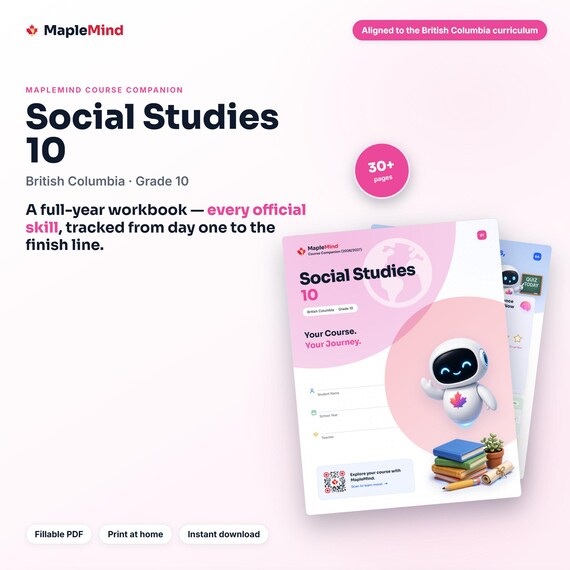
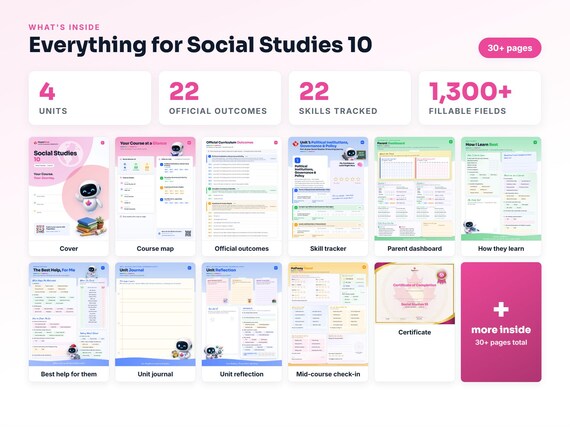
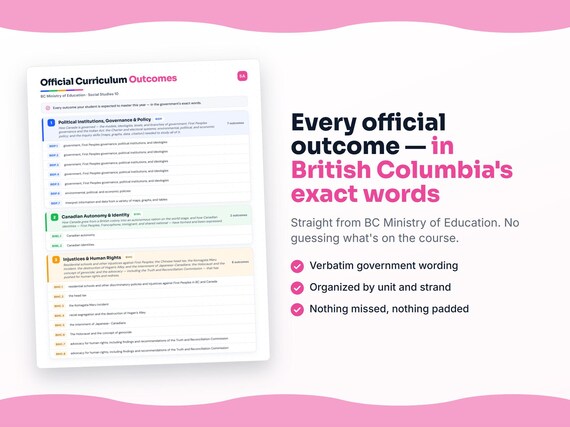
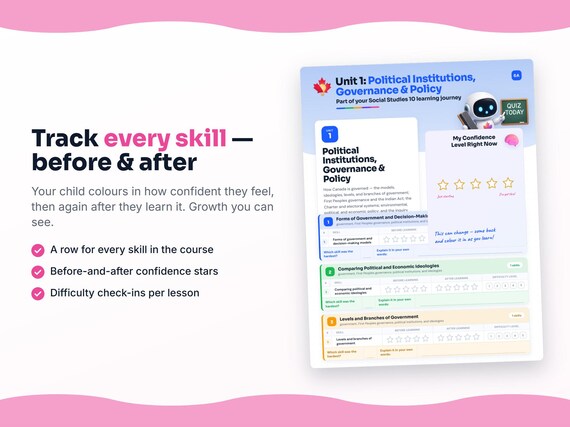
Printable workbook · A keepsake of the year
A Social Studies 10 workbook worth keeping
Built from the same official curriculum as this page. Before and after each skill above, your student colours in how sure they feel — so the two of you can see, on one page, what's clicking and what needs another look. It's a quiet way to follow how the year is really going.
By June it's full of their own handwriting: units worked through, confidence grown, a mid-year check-in, notes from parent-teacher night, and a certificate at the end. Less a worksheet, more a record of the year worth keeping on the shelf.
Instant download · see every page, reviews and the full description · five or more workbooks are $2.99 each
What it looks like in the app
Common questions
Can MapleMind help me with Social Studies 10?
Yes. MapleMind's AI tutor covers all 22 skills in British Columbia's Social Studies 10 — you pick the exact skill, and the tutor teaches it step by step: a short lesson, a worked example, solving together, then a skill check to show it stuck.
Is MapleMind aligned to British Columbia's official curriculum?
Yes. Every skill in this course maps to an official outcome code from British Columbia's Grade 10 Social Studies curriculum, and the ministry's own wording is quoted under each unit on this page — with the official government source linked so you can check it yourself.
What does MapleMind cost?
It's free to start — 5 tutoring chats and a practice quiz every day, no credit card. A Pro subscription ($9.99/month or $49.99/year CAD, 7-day free trial) unlocks unlimited tutoring, practice, and exam simulations.
What if I'm stuck on just one topic?
That's the point of skill-level tutoring: open Social Studies 10 in the app, tap the exact skill from the list on this page, and the tutor teaches just that — no wading through lessons you don't need.
Does MapleMind work in French or other languages?
Yes — 14 languages, including French. Both the app and the tutor's explanations switch to the language you choose.
Where can I see the official British Columbia curriculum for Social Studies 10?
The official source is linked on this page — BC's official social studies curriculum. The outline here follows it: every MapleMind skill carries its official outcome code, and the ministry's own wording is quoted under each unit.
Keep exploring
Ready when you are
Pick a skill from this page and see it taught properly — free, in the browser, in under a minute.