Get help with Explorations in Social Studies 11
Most tutoring makes you sit through material you already know. MapleMind flips that: pick the exact skill that's causing trouble — any of the 22 below — and the tutor teaches just that one, step by step, as many times as it takes. Ask questions in plain words, any time of day, in English, French, or 12 other languages.
The official British Columbia Explorations in Social Studies 11 curriculum
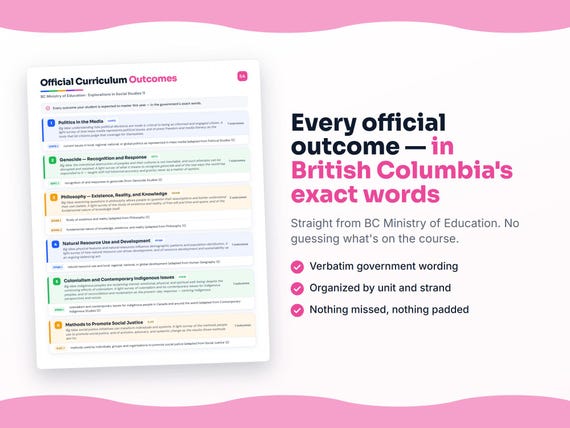
British Columbia defines Explorations in Social Studies 11 by strands and outcomes. MapleMind teaches the same curriculum reorganized for one-skill-at-a-time tutoring — the table shows exactly where every official strand lands, and the ministry's own wording is quoted under each unit below.
Official source BC's official social studies curriculumRead it on the government site — curriculum.gov.bc.ca ↗| Official strand | Outcomes | Where MapleMind teaches it |
|---|---|---|
| Understanding how political decisions are made (Political Studies 12) | 2 | Politics in the Media |
| Intentional destruction of peoples can be resisted (Genocide Studies 12) | 2 | Genocide — Recognition and Response |
| Questioning our assumptions and beliefs (Philosophy 12) | 3 | Philosophy — Existence, Reality, and Knowledge |
| Physical features & natural resources shape population (Human Geography 12) | 2 | Natural Resource Use and Development |
| Indigenous peoples reclaiming well-being (Contemporary Indigenous Studies 12) | 2 | Colonialism and Contemporary Indigenous Issues |
| Social justice initiatives can transform systems (Social Justice 12) | 2 | Methods to Promote Social Justice |
| Communication & transportation reshaped identity (20th Century World History 12) | 1 | 20th-Century Innovations and Developments |
| Rapid industrialization & growth in Asia (Asian Studies 12) | 1 | Economic Development in Asia |
| Cultural diversity enhances understanding (Comparative Cultures 12) | 1 | Power and Governance in Global Cultures |
| Cultural expressions of B.C. First Peoples (B.C. First Peoples 12) | 1 | Diversity of B.C. First Peoples |
| Laws affect people's daily lives (Law Studies 12) | 1 | Rights of Individuals in Canada |
| Representing natural & human-made phenomena (Physical Geography 12) | 1 | Mapping Natural and Human-Made Phenomena |
| Religion shapes social & political values (Comparative World Religions 12) | 1 | Sacred Texts and Narratives of Cultures |
| Economic theories affect social & political decisions (Economic Theory 12) | 1 | Theories of Money and Investment |
| Urban & regional planning balances many factors (Urban Studies 12) | 1 | Global Issues in Urbanization |
Every skill below, taught one on one.
 Try the first session free
How MapleMind teaches Explorations in Social Studies 11 — every unit, lesson, and skill
Every skill below runs as a short session: a plain-words lesson, a worked example, solving it together, then a five-question skill check that earns up to three stars. Guided Mode keeps it teaching instead of answer-handing — turning it off needs a parent's password.
Unit 1Politics in the MediaOfficial strand · Understanding how political decisions are made (Political Studies 12)
Big Idea: understanding how political decisions are made is critical to being an informed and engaged citizen. A light survey of how mass media represents political issues, and of press freedom and media literacy as the tools that let citizens judge that coverage for themselves.
Exploring: Politics in the Media
- Explore: politics in the media11.X.MEDIA.1 — Take a first, survey-level look at how a current issue in local, regional, national, or global politics gets represented in mass media — noticing that the same political story can look different depending on where it is covered.
- Explore: press freedom & media literacy11.X.MEDIA.2 — Explore freedom of the press and freedom of expression as the conditions that make diverse, competing media possible — and build a starting media-literacy sense for spotting fake news, checking source authenticity, and noticing who owns a media outlet.
The official wording — 2 outcomes in this unit
- 11.X.MEDIA.1
current issues in local, regional, national, or global politics as represented in mass media (adapted from Political Studies 12)
- 11.X.MEDIA.2
freedom of the press and freedom of expression
Unit 2Genocide — Recognition and ResponseOfficial strand · Intentional destruction of peoples can be resisted (Genocide Studies 12)
Big Idea: the intentional destruction of peoples and their cultures is not inevitable, and such attempts can be disrupted and resisted. A light survey of what it means to recognize genocide and of the real ways the world has responded to it — taught with full historical accuracy and gravity, never as a matter of opinion.
Exploring: Genocide
- Explore: recognizing & responding to genocide11.X.GENOCIDE.1 — Take a first, survey-level look at what it means to recognize genocide and at the range of ways individuals, states, and the international community have responded to it, grounded in real historical cases.
- Explore: apology, redress & memorialization11.X.GENOCIDE.2 — Explore the specific response repertoire that follows genocide recognition — apologies, reparations, redress, reconciliation, and memorialization — using real examples of memorials, museums, and international intervention.
The official wording — 2 outcomes in this unit
- 11.X.GENOCIDE.1
recognition of and responses to genocide (from Genocide Studies 12)
- 11.X.GENOCIDE.2
recognition and responses (e.g., apologies, reparations, redress, reconciliation, memorialization)
Unit 3Philosophy — Existence, Reality, and KnowledgeOfficial strand · Questioning our assumptions and beliefs (Philosophy 12)
Big Idea: examining questions in philosophy allows people to question their assumptions and better understand their own beliefs. A light survey of the study of existence and reality, of free will and time and space, and of the fundamental nature of knowledge itself.
Exploring: Existence and Reality
- Explore: existence & reality11.X.EXISTENCE.1 — Take a first, survey-level look at the philosophical study of existence and reality — what it means to ask "what is real?" and "why does anything exist at all?"
- Explore: free will, time & space11.X.EXISTENCE.2 — Explore two of philosophy's enduring puzzles — whether people truly have free will, and how thinkers have understood the nature of time and space.
Exploring: The Nature of Knowledge
- Explore: the nature of knowledge & reality11.X.KNOWLEDGE.1 — Take a first, survey-level look at the fundamental nature of knowledge itself — how philosophers have asked what counts as knowing something, versus merely believing or guessing it, alongside existence and reality.
The official wording — 3 outcomes in this unit
- 11.X.EXISTENCE.1
Study of existence and reality (adapted from Philosophy 12)
- 11.X.EXISTENCE.2
time and space
- 11.X.KNOWLEDGE.1
fundamental nature of knowledge, existence, and reality (adapted from Philosophy 12)
Unit 4Natural Resource Use and DevelopmentOfficial strand · Physical features & natural resources shape population (Human Geography 12)
Big Idea: physical features and natural resources influence demographic patterns and population distribution. A light survey of how natural resource use drives development, and of resource development and sustainability as an ongoing balancing act.
Exploring: Resource Use and Development
- Explore: natural resource use & development11.X.RESOURCE.1 — Take a first, survey-level look at how the use of natural resources drives local, regional, national, or global development.
- Explore: resource development & sustainability11.X.RESOURCE.2 — Explore resource development alongside sustainability — weighing economic benefit against environmental cost, including in First Peoples territories where resource-use conflicts often arise.
The official wording — 2 outcomes in this unit
- 11.X.RESOURCE.1
natural resource use and local, regional, national, or global development (adapted from Human Geography 12)
- 11.X.RESOURCE.2
natural resource use and local, regional, national, or global development (adapted from Human Geography 12)
Unit 5Colonialism and Contemporary Indigenous IssuesOfficial strand · Indigenous peoples reclaiming well-being (Contemporary Indigenous Studies 12)
Big Idea: Indigenous peoples are reclaiming mental, emotional, physical, and spiritual well-being despite the continuing effects of colonialism. A light survey of colonialism and its contemporary issues for Indigenous peoples, and of reconciliation and reclamation as the present-day response — centring Indigenous perspectives and voices.
Exploring: Colonialism and Contemporary Indigenous Issues
- Explore: colonialism & contemporary Indigenous issues11.X.COLONIALISM.1 — Take a first, survey-level look at colonialism and the contemporary issues it continues to raise for Indigenous people in Canada and around the world.
- Explore: reconciliation & reclamation11.X.COLONIALISM.2 — Explore reconciliation and reclamation as Indigenous-led responses to the continuing effects of colonialism, in Canada and around the world.
The official wording — 2 outcomes in this unit
- 11.X.COLONIALISM.1
colonialism and contemporary issues for indigenous people in Canada and around the world (adapted from Contemporary Indigenous Studies 12)
- 11.X.COLONIALISM.2
colonialism and contemporary issues for indigenous people in Canada and around the world (adapted from Contemporary Indigenous Studies 12)
Unit 6Methods to Promote Social JusticeOfficial strand · Social justice initiatives can transform systems (Social Justice 12)
Big Idea: social justice initiatives can transform individuals and systems. A light survey of the methods people use to promote social justice, and of activism, advocacy, and systemic change as the results those methods aim for.
Exploring: Methods to Promote Social Justice
- Explore: activism, advocacy & systemic change11.X.JUSTICE.2 — Explore activism, advocacy, and systemic change as the aims those social-justice methods are ultimately working toward.
The official wording — 2 outcomes in this unit
- 11.X.JUSTICE.1
methods used by individuals, groups, and organizations to promote social justice (adapted from Social Justice 12)
- 11.X.JUSTICE.2
methods used by individuals, groups, and organizations to promote social justice (adapted from Social Justice 12)
Unit 720th-Century Innovations and DevelopmentsOfficial strand · Communication & transportation reshaped identity (20th Century World History 12)
Big Idea: the rapid development and proliferation of communication and transportation technologies in the 20th century led to profound changes in personal and national identities. A light survey of the century's social, cultural, and technological innovations.
Exploring: 20th-Century Innovations
- Explore: 20th-century innovations & developments11.X.INNOVATION.1 — Take a first, survey-level look at social, cultural, or technological innovations and developments in the 20th century, and how they reshaped personal and national identity.
The official wording — 1 outcome in this unit
- 11.X.INNOVATION.1
social, cultural, or technological innovations and developments in the 20th century (adapted from 20th Century World History 12)
Unit 8Economic Development in AsiaOfficial strand · Rapid industrialization & growth in Asia (Asian Studies 12)
Big Idea: rapid industrialization, urbanization, and economic growth in Asia in the late 20th century have created complex social, political, and environmental challenges. A light survey of economic development in Asia from 1850 to the present.
Exploring: Economic Development in Asia
- Explore: economic development in Asia11.X.ASIA.1 — Take a first, survey-level look at economic development in Asia, from 1850 to the present, and the challenges rapid industrialization and growth have created.
The official wording — 1 outcome in this unit
- 11.X.ASIA.1
economic development in Asia (adapted from Asian Studies 12 – 1850-present)
Unit 9Power and Governance in Global CulturesOfficial strand · Cultural diversity enhances understanding (Comparative Cultures 12)
Big Idea: understanding the diversity and complexity of cultural expressions in one culture enhances our understanding of other cultures. A light survey of systems of power and governance across global cultures.
Exploring: Power and Governance in Global Cultures
- Explore: power & governance in global cultures11.X.POWER.1 — Take a first, survey-level look at systems of power and governance in global cultures, comparing how different societies structure authority and decision-making.
The official wording — 1 outcome in this unit
- 11.X.POWER.1
systems of power and governance in global cultures (adapted from Comparative Cultures 12)
Unit 10Diversity of B.C. First PeoplesOfficial strand · Cultural expressions of B.C. First Peoples (B.C. First Peoples 12)
Big Idea: cultural expressions convey the richness, diversity, and resiliency of B.C. First Peoples. A light survey of the diversity of B.C. First Peoples territories and communities.
Exploring: Diversity of B.C. First Peoples
- Explore: diversity of B.C. First Peoples11.X.FIRSTPEOPLES.1 — Take a first, survey-level look at the diversity of B.C. First Peoples territories and communities, and the richness of their cultural expressions.
The official wording — 1 outcome in this unit
- 11.X.FIRSTPEOPLES.1
diversity of B.C. First Peoples territories and communities (adapted from B.C. First Peoples 12)
Unit 11Rights of Individuals in CanadaOfficial strand · Laws affect people's daily lives (Law Studies 12)
Big Idea: a society's laws and legal framework affect many aspects of people's daily lives. A light survey of the rights of individuals in Canada.
Exploring: Rights of Individuals in Canada
- Explore: rights of individuals in Canada11.X.RIGHTS.1 — Take a first, survey-level look at the rights of individuals in Canada and the legal framework that protects them.
The official wording — 1 outcome in this unit
- 11.X.RIGHTS.1
rights of individuals in Canada (adapted from Law Studies 12)
Unit 12Mapping Natural and Human-Made PhenomenaOfficial strand · Representing natural & human-made phenomena (Physical Geography 12)
Big Idea: representing natural and human-made phenomena requires careful, purposeful choices. A light survey of how geographers represent physical and human-made phenomena, such as through maps.
Exploring: Mapping Natural and Human-Made Phenomena
- Explore: mapping natural & human-made phenomena11.X.PHENOMENA.1 — Take a first, survey-level look at how natural and human-made phenomena are represented — through maps, models, and other geographic tools.
The official wording — 1 outcome in this unit
- 11.X.PHENOMENA.1
representations of natural and human-made phenomena (adapted from Physical Geography 12)
Unit 13Sacred Texts and Narratives of CulturesOfficial strand · Religion shapes social & political values (Comparative World Religions 12)
Big Idea: religion can powerfully shape social, political, legal, and environmental values. A light survey of the sacred texts, traditions, and narratives of world cultures.
Exploring: Sacred Texts and Narratives of Cultures
- Explore: sacred texts & narratives of cultures11.X.RELIGION.1 — Take a first, survey-level look at the sacred texts, traditions, and narratives of world cultures, and how religion shapes social and political values.
The official wording — 1 outcome in this unit
- 11.X.RELIGION.1
sacred texts, traditions, and narratives of cultures (from Comparative World Religions 12)
Unit 14Theories of Money and InvestmentOfficial strand · Economic theories affect social & political decisions (Economic Theory 12)
Big Idea: the implementation of economic theories has profound effects on social and political decision making and movements. A light survey of contemporary theories of money and investment.
Exploring: Theories of Money and Investment
- Explore: theories of money & investment11.X.MONEY.1 — Take a first, survey-level look at contemporary theories of money and investment, and how they shape social and political decisions.
The official wording — 1 outcome in this unit
- 11.X.MONEY.1
contemporary theories of money and investment (adapted from Economic Theory 12)
Unit 15Global Issues in UrbanizationOfficial strand · Urban & regional planning balances many factors (Urban Studies 12)
Big Idea: decision making in urban and regional planning requires balancing political, economic, social, and environmental factors. A light survey of global issues in urbanization.
Exploring: Global Issues in Urbanization
- Explore: global issues in urbanization11.X.URBAN.1 — Take a first, survey-level look at global issues in urbanization, and the balancing act urban and regional planning requires.
The official wording — 1 outcome in this unit
- 11.X.URBAN.1
global issues in urbanization (adapted from Urban Studies 12)
Printable workbook · A keepsake of the year
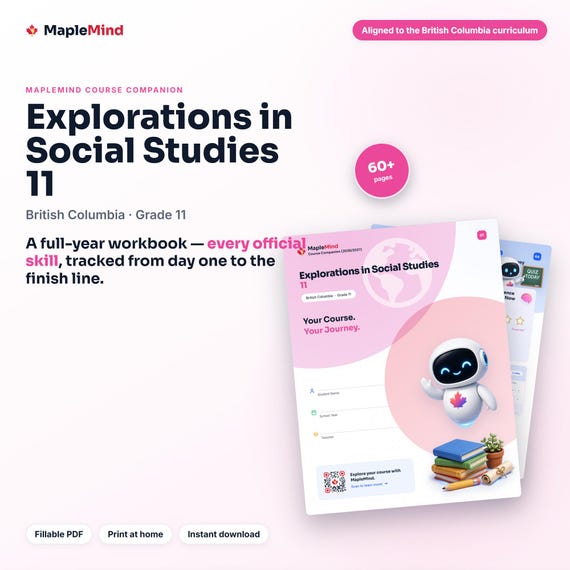
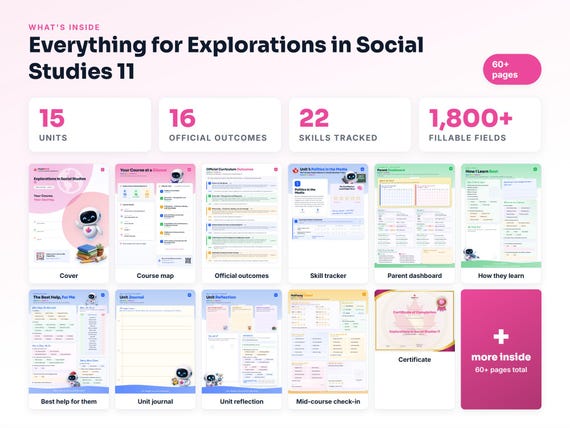
A Explorations in Social Studies 11 workbook worth keeping
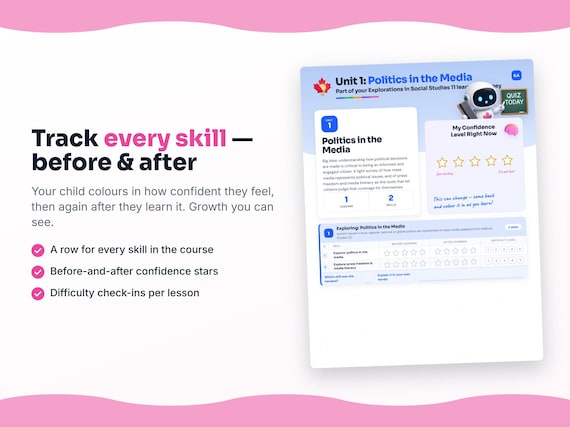
Built from the same official curriculum as this page. Before and after each skill above, your student colours in how sure they feel — so the two of you can see, on one page, what's clicking and what needs another look. It's a quiet way to follow how the year is really going.
By June it's full of their own handwriting: units worked through, confidence grown, a mid-year check-in, notes from parent-teacher night, and a certificate at the end. Less a worksheet, more a record of the year worth keeping on the shelf.
Instant download · see every page, reviews and the full description · five or more workbooks are $2.99 each
What it looks like in the app



Common questions
Can MapleMind help me with Explorations in Social Studies 11?
Yes. MapleMind's AI tutor covers all 22 skills in British Columbia's Explorations in Social Studies 11 — you pick the exact skill, and the tutor teaches it step by step: a short lesson, a worked example, solving together, then a skill check to show it stuck.
Is MapleMind aligned to British Columbia's official curriculum?
Yes. Every skill in this course maps to an official outcome code from British Columbia's Grade 11 Social Studies curriculum, and the ministry's own wording is quoted under each unit on this page — with the official government source linked so you can check it yourself.
What does MapleMind cost?
It's free to start — 5 tutoring chats and a practice quiz every day, no credit card. A Pro subscription ($9.99/month or $49.99/year CAD, 7-day free trial) unlocks unlimited tutoring, practice, and exam simulations.
What if I'm stuck on just one topic?
That's the point of skill-level tutoring: open Explorations in Social Studies 11 in the app, tap the exact skill from the list on this page, and the tutor teaches just that — no wading through lessons you don't need.
Does MapleMind work in French or other languages?
Yes — 14 languages, including French. Both the app and the tutor's explanations switch to the language you choose.
Where can I see the official British Columbia curriculum for Explorations in Social Studies 11?
The official source is linked on this page — BC's official social studies curriculum. The outline here follows it: every MapleMind skill carries its official outcome code, and the ministry's own wording is quoted under each unit.
Keep exploring
Ready when you are
Pick a skill from this page and see it taught properly — free, in the browser, in under a minute.