Get help with BC First Peoples 12
Most tutoring makes you sit through material you already know. MapleMind flips that: pick the exact skill that's causing trouble — any of the 20 below — and the tutor teaches just that one, step by step, as many times as it takes. Ask questions in plain words, any time of day, in English, French, or 12 other languages.
The official British Columbia BC First Peoples 12 curriculum
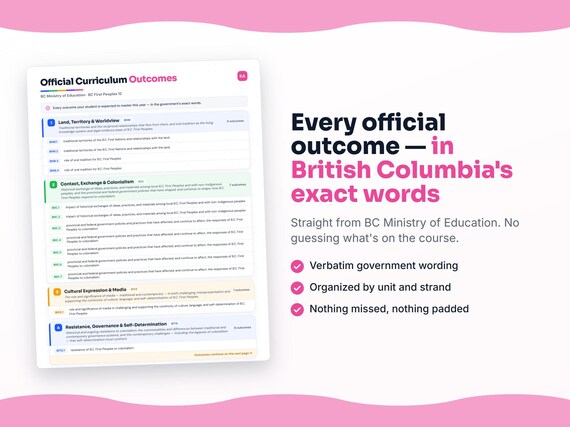
British Columbia defines BC First Peoples 12 by strands and outcomes. MapleMind teaches the same curriculum reorganized for one-skill-at-a-time tutoring — the table shows exactly where every official strand lands, and the ministry's own wording is quoted under each unit below.
Official source BC's official social studies curriculumRead it on the government site — curriculum.gov.bc.ca ↗| Official strand | Outcomes | Where MapleMind teaches it |
|---|---|---|
| Big Idea: The identities, worldviews, and languages of B.C. First Peoples are renewed, sustained, and transformed through their connection to the land. | 4 | Land, Territory & Worldview |
| Big Idea: The impact of contact and colonialism continues to affect the political, social, and economic lives of B.C. First Peoples. | 7 | Contact, Exchange & Colonialism |
| Big Idea: Cultural expressions convey the richness, diversity, and resiliency of B.C. First Peoples. | 1 | Cultural Expression & Media |
| Big Idea: Through self-governance, leadership, and self-determination, B.C. First Peoples challenge and resist Canada's ongoing colonialism. | 8 | Resistance, Governance & Self-Determination |
Every skill below, taught one on one.
 Try the first session free
How MapleMind teaches BC First Peoples 12 — every unit, lesson, and skill
Every skill below runs as a short session: a plain-words lesson, a worked example, solving it together, then a five-question skill check that earns up to three stars. Guided Mode keeps it teaching instead of answer-handing — turning it off needs a parent's password.
Unit 1Land, Territory & WorldviewOfficial strand · Big Idea: The identities, worldviews, and languages of B.C. First Peoples are renewed, sustained, and transformed through their connection to the land.
Traditional territories and the reciprocal relationships that flow from them, and oral tradition as the living knowledge system and legal evidence base of B.C. First Peoples.
Traditional Territories and Political Boundaries
- Traditional territories of B.C. First Nations: overlap and political vs. traditional boundaries12.LAND.1 — Map and explain the traditional territories of local B.C. First Nations, recognize that territories often overlap between neighbouring Nations, and distinguish traditional territories from the political boundaries later drawn by colonial and provincial governments.
How the Land Shapes Worldview
- How the land shapes worldview: stewardship, cultural practice, and linguistic diversity12.LAND.2 — Explain how the land shapes and influences B.C. First Peoples worldview — stewardship responsibilities, cultural practices tied to the land, and the relationship between land and language — and describe the cultural and linguistic diversity that exists among B.C. First Peoples.
Oral Tradition as Knowledge and Identity
- Oral tradition as knowledge and identity12.ORAL.1 — Explain the role of oral tradition for B.C. First Peoples as a knowledge and identity system — Elders as knowledge keepers, stories/songs/dance as forms of narrative, the guiding principles oral tradition provides for living, and the Indigenous concept of time (e.g. spiralling versus linear) — using appropriate protocols when engaging with it.
Oral Tradition as Legal Evidence
- Oral tradition as valid and legal evidence (Delgamuukw v. B.C., 1997)12.ORAL.2 — Explain how oral tradition functions as valid and legal evidence, using Delgamuukw v. British Columbia (1997) as the landmark case, and connect this to the ownership of property, territory, and political agreements.
The official wording — 4 outcomes in this unit
- 12.LAND.1
traditional territories of the B.C. First Nations and relationships with the land
- 12.LAND.2
traditional territories of the B.C. First Nations and relationships with the land
- 12.ORAL.1
role of oral tradition for B.C. First Peoples
- 12.ORAL.2
role of oral tradition for B.C. First Peoples
Unit 2Contact, Exchange & ColonialismOfficial strand · Big Idea: The impact of contact and colonialism continues to affect the political, social, and economic lives of B.C. First Peoples.
Historical exchange of ideas, practices, and materials among local B.C. First Peoples and with non-Indigenous peoples, and the provincial and federal government policies that have shaped, and continue to shape, how B.C. First Peoples respond to colonialism.
Trade Networks and the Fur Trade
- Trade networks and routes and the maritime and land fur trade12.EXCH.1 — Assess the impact of historical trade networks and routes among B.C. First Peoples, and the maritime and land fur trade with non-Indigenous peoples, on goods, technology, and economic power.
Settlement, Migration, and Resource Industries
- Settlement and migration patterns and resource industries (gold rush, whaling)12.EXCH.2 — Assess the impact of settlement and migration patterns and resource industries — such as the gold rush and whaling — on the exchange of goods, technology, and knowledge between B.C. First Peoples and non-Indigenous peoples.
The Indian Act and Enfranchisement
- The Indian Act, its amendments, and enfranchisement12.POLICY.1 — Analyze the Indian Act, its amendments over time, and the policy of enfranchisement, as government policies that have affected, and continue to affect, the responses of B.C. First Peoples to colonialism.
Residential Schools, the Apology, and the TRC
- Residential schools, the federal apology, and the Truth and Reconciliation Commission and Report12.POLICY.2 — Analyze the residential school system, the federal government apology, and the findings and Calls to Action of the Truth and Reconciliation Commission and Report, as government policies and practices that have affected, and continue to affect, the responses of B.C. First Peoples to colonialism.
The Sixties Scoop and the Foster Care System
- The Sixties Scoop and the foster care system12.POLICY.3 — Analyze the Sixties Scoop and the ongoing overrepresentation of First Peoples children in the foster care system as government policies and practices that have affected, and continue to affect, the responses of B.C. First Peoples to colonialism.
Treaties and the White, Red, and Brown Papers
- Treaties and the White, Red, and Brown Papers12.POLICY.4 — Analyze treaties (including fishing and hunting rights) and the 1969 White Paper, together with the Red Paper (Alberta) and Brown Paper (B.C.) responses, as government policies and practices that have affected, and continue to affect, the responses of B.C. First Peoples to colonialism.
Constitutional and International Recognition
- Constitutional and international recognition: Canada's constitution and UNDRIP12.POLICY.5 — Analyze constitutional and international recognition — Canada's constitution (the Canadian Charter of Rights and Freedoms and the Meech Lake and Charlottetown Accords) and the UN Declaration on the Rights of Indigenous Peoples — as government policies and practices that have affected, and continue to affect, the responses of B.C. First Peoples to colonialism.
The official wording — 7 outcomes in this unit
- 12.EXCH.1
impact of historical exchanges of ideas, practices, and materials among local B.C. First Peoples and with non-indigenous peoples
- 12.EXCH.2
impact of historical exchanges of ideas, practices, and materials among local B.C. First Peoples and with non-indigenous peoples
- 12.POLICY.1
provincial and federal government policies and practices that have affected, and continue to affect, the responses of B.C. First Peoples to colonialism
- 12.POLICY.2
provincial and federal government policies and practices that have affected, and continue to affect, the responses of B.C. First Peoples to colonialism
- 12.POLICY.3
provincial and federal government policies and practices that have affected, and continue to affect, the responses of B.C. First Peoples to colonialism
- 12.POLICY.4
provincial and federal government policies and practices that have affected, and continue to affect, the responses of B.C. First Peoples to colonialism
- 12.POLICY.5
provincial and federal government policies and practices that have affected, and continue to affect, the responses of B.C. First Peoples to colonialism
Unit 3Cultural Expression & MediaOfficial strand · Big Idea: Cultural expressions convey the richness, diversity, and resiliency of B.C. First Peoples.
The role and significance of media — traditional and contemporary — in both challenging misrepresentation and supporting the continuity of culture, language, and self-determination of B.C. First Peoples.
Media, Culture, and Self-Determination
- Role of media in challenging and supporting cultural continuity12.MEDIA.1 — Examine the role and significance of media — including portrayal and representation of First Peoples, repatriation and ownership of cultural objects, and the ethics of copyright and appropriation — in both challenging harmful stereotypes and supporting the continuity of culture, language, and self-determination of B.C. First Peoples.
The official wording — 1 outcome in this unit
- 12.MEDIA.1
role and significance of media in challenging and supporting the continuity of culture, language, and self-determination of B.C. First Peoples
Unit 4Resistance, Governance & Self-DeterminationOfficial strand · Big Idea: Through self-governance, leadership, and self-determination, B.C. First Peoples challenge and resist Canada's ongoing colonialism.
Historical and ongoing resistance to colonialism; the commonalities and differences between traditional and contemporary governance systems; and the contemporary challenges — including the legacies of colonialism — that self-determination must confront.
Political Action and Land Defence
- Political actions and land-defence: Union of B.C. Indian Chiefs, Métis Nation B.C., the Tsilhqot'in War, Gustafsen Lake, Idle No More12.RESIST.1 — Examine political actions and land-defence resistance of B.C. First Peoples to colonialism — including the Union of B.C. Indian Chiefs, Métis Nation B.C., the Tsilhqot'in War, Gustafsen Lake, and Idle No More.
Landmark Judicial Cases
- Landmark judicial cases (Calder, Guerin, Sparrow, Van der Peet) and the Cindy Blackstock/CHRT ruling12.RESIST.2 — Examine landmark judicial cases — Calder (1973), Guerin (1984), Sparrow (1990), and Van der Peet (1996) — and the Cindy Blackstock and Canadian Human Rights Tribunal ruling, as resistance of B.C. First Peoples to colonialism through the courts.
Ecological Justice and Protest
- Ecological justice and protest (pipelines, logging, hydraulic fracturing, LNG, hydroelectricity)12.RESIST.3 — Examine contemporary ecological justice and protest — resistance to pipelines, logging, hydraulic fracturing, liquefied natural gas, and hydroelectricity projects — as ongoing resistance of B.C. First Peoples to colonialism.
Traditional Governance Systems
- Traditional governance systems of B.C. First Peoples12.GOV.1 — Describe traditional governance systems of B.C. First Peoples — including hereditary, matriarchal, and clan-based structures and law enacted through ceremony — as a foundation for comparing traditional and contemporary governance.
Contemporary Governance: Band System, Land Claims, Self-Governance
- Contemporary governance: the band system, land claims, and self-governance12.GOV.2 — Compare the imposed band system, land claims processes, and self-governance agreements as contemporary governance of B.C. First Peoples, identifying commonalities and differences with traditional governance systems.
Missing and Murdered Women, Stereotypes, and Racism
- Missing and murdered women, stereotypes, and institutionalized racism12.CHAL.1 — Assess missing and murdered women, stereotypes, and institutionalized racism as contemporary challenges facing B.C. First Peoples that are legacies of colonialism.
Intergenerational Trauma and the Judicial, Correctional, and Child Welfare Systems
- Intergenerational trauma and the judicial, correctional, and child welfare systems12.CHAL.2 — Assess intergenerational trauma and its connection to the judicial, correctional, and child welfare systems as contemporary challenges facing B.C. First Peoples that are legacies of colonialism.
Conditions on Reserves
- Conditions on reserves (water, housing, education)12.CHAL.3 — Assess conditions on reserves — including water, housing, and education — as contemporary challenges facing B.C. First Peoples that are legacies of colonialism.
The official wording — 8 outcomes in this unit
- 12.RESIST.1
resistance of B.C. First Peoples to colonialism
- 12.RESIST.2
resistance of B.C. First Peoples to colonialism
- 12.RESIST.3
resistance of B.C. First Peoples to colonialism
- 12.GOV.1
commonalities and differences between governance systems of traditional and contemporary B.C. First Peoples
- 12.GOV.2
commonalities and differences between governance systems of traditional and contemporary B.C. First Peoples
- 12.CHAL.1
contemporary challenges facing B.C. First Peoples, including legacies of colonialism
- 12.CHAL.2
contemporary challenges facing B.C. First Peoples, including legacies of colonialism
- 12.CHAL.3
contemporary challenges facing B.C. First Peoples, including legacies of colonialism
Printable workbook · A keepsake of the year
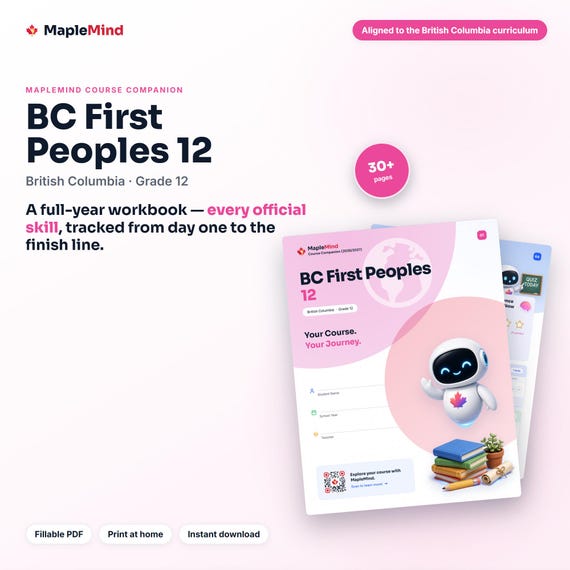
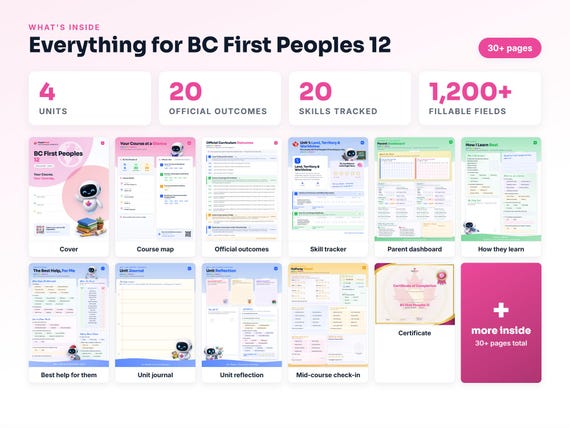
A BC First Peoples 12 workbook worth keeping
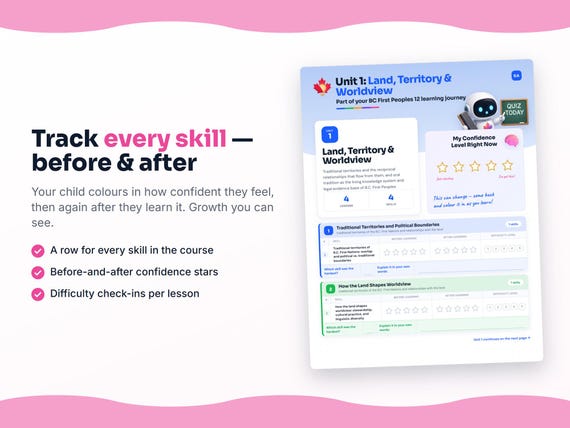
Built from the same official curriculum as this page. Before and after each skill above, your student colours in how sure they feel — so the two of you can see, on one page, what's clicking and what needs another look. It's a quiet way to follow how the year is really going.
By June it's full of their own handwriting: units worked through, confidence grown, a mid-year check-in, notes from parent-teacher night, and a certificate at the end. Less a worksheet, more a record of the year worth keeping on the shelf.
Instant download · see every page, reviews and the full description · five or more workbooks are $2.99 each
What it looks like in the app



Common questions
Can MapleMind help me with BC First Peoples 12?
Yes. MapleMind's AI tutor covers all 20 skills in British Columbia's BC First Peoples 12 — you pick the exact skill, and the tutor teaches it step by step: a short lesson, a worked example, solving together, then a skill check to show it stuck.
Is MapleMind aligned to British Columbia's official curriculum?
Yes. Every skill in this course maps to an official outcome code from British Columbia's Grade 12 Social Studies curriculum, and the ministry's own wording is quoted under each unit on this page — with the official government source linked so you can check it yourself.
What does MapleMind cost?
It's free to start — 5 tutoring chats and a practice quiz every day, no credit card. A Pro subscription ($9.99/month or $49.99/year CAD, 7-day free trial) unlocks unlimited tutoring, practice, and exam simulations.
What if I'm stuck on just one topic?
That's the point of skill-level tutoring: open BC First Peoples 12 in the app, tap the exact skill from the list on this page, and the tutor teaches just that — no wading through lessons you don't need.
Does MapleMind work in French or other languages?
Yes — 14 languages, including French. Both the app and the tutor's explanations switch to the language you choose.
Where can I see the official British Columbia curriculum for BC First Peoples 12?
The official source is linked on this page — BC's official social studies curriculum. The outline here follows it: every MapleMind skill carries its official outcome code, and the ministry's own wording is quoted under each unit.
Keep exploring
Ready when you are
Pick a skill from this page and see it taught properly — free, in the browser, in under a minute.