Get help with Law Studies 12
Most tutoring makes you sit through material you already know. MapleMind flips that: pick the exact skill that's causing trouble — any of the 17 below — and the tutor teaches just that one, step by step, as many times as it takes. Ask questions in plain words, any time of day, in English, French, or 12 other languages.
The official British Columbia Law Studies 12 curriculum
British Columbia defines Law Studies 12 by strands and outcomes. MapleMind teaches the same curriculum reorganized for one-skill-at-a-time tutoring — the table shows exactly where every official strand lands, and the ministry's own wording is quoted under each unit below.
Official source BC's official social studies curriculumRead it on the government site — curriculum.gov.bc.ca ↗| Official strand | Outcomes | Where MapleMind teaches it |
|---|---|---|
| Big Idea: Understanding legal rights and responsibilities allows citizens to participate more fully in society. | 5 | Constitutional Foundations & the Courts |
| Big Idea: A society's laws and legal framework affect many aspects of people's daily lives. | 4 | Areas of Law |
| Big Idea: Laws are interpreted, and these interpretations may evolve over time as a society's values and worldviews change. | 4 | First Peoples & Indigenous Legal Orders |
| Big Idea: Laws can maintain the status quo and can also be a force for change. | 4 | Corrections & Global Justice |
Every skill below, taught one on one.
 Try the first session free
How MapleMind teaches Law Studies 12 — every unit, lesson, and skill
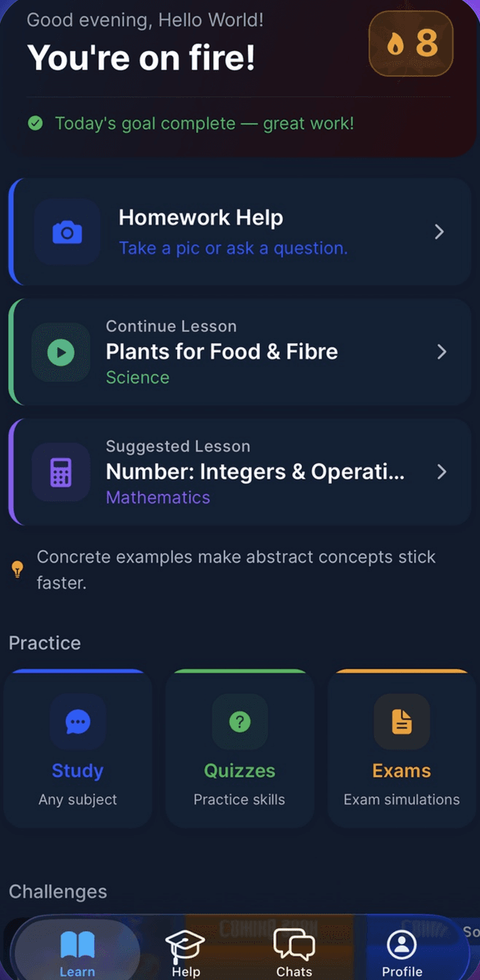
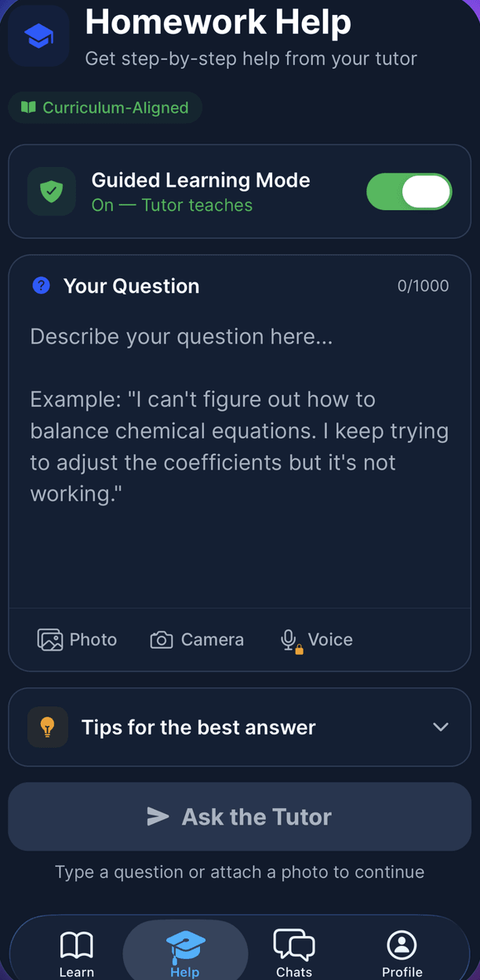
Every skill below runs as a short session: a plain-words lesson, a worked example, solving it together, then a five-question skill check that earns up to three stars. Guided Mode keeps it teaching instead of answer-handing — turning it off needs a parent's password.
Unit 1Constitutional Foundations & the CourtsOfficial strand · Big Idea: Understanding legal rights and responsibilities allows citizens to participate more fully in society.
The rulebook and the referees: the Constitution of Canada as supreme law and the Charter of Rights and Freedoms it entrenches, then the structure of the federal and provincial courts and administrative tribunals that apply and interpret them.
The Constitution of Canada
- The Constitution of Canada: supreme law, division of powers, amendment12.CONST.1 — Explain how the Constitution of Canada is the supreme law of the country — it divides law-making power between the federal and provincial governments and sets the rules every other law must follow — and how it can be amended.
The Canadian Charter of Rights and Freedoms
- The Canadian Charter of Rights and Freedoms: guaranteed rights, reasonable limits, notwithstanding clause12.CONST.2 — Explain how the Canadian Charter of Rights and Freedoms, entrenched within the Constitution since 1982, guarantees fundamental rights and freedoms against government action, subject to the Section 1 reasonable-limits test and the Section 33 notwithstanding clause.
Court Structure and Hierarchy
- Structure and hierarchy of federal and provincial courts and administrative tribunals, including small claims12.COURT.1 — Describe the structure and hierarchy of the Canadian court system — provincial/territorial courts (including small claims), provincial superior courts, courts of appeal, and the Supreme Court of Canada at the top, plus the parallel Federal Court system — and how administrative tribunals exercise powers delegated by legislation to resolve specific kinds of disputes outside the regular courts.
Case and Common Law; Judicial Independence
- Case and common law and the independence of the judiciary and lawyers12.COURT.2 — Explain how case law and common law develop through judicial decisions rather than only through legislation, and why the independence of the judiciary and of lawyers — freedom from political or outside interference — is essential to a fair legal system.
Rights of the Accused, Appeals, and Victims' Rights
- Rights of the accused, the appeals process, and victims' rights (Canadian Victims Bill of Rights)12.COURT.3 — Describe the rights of a person accused of a crime, how the appeals process allows a court decision to be reviewed by a higher court, and how the Canadian Victims Bill of Rights sets out rights for victims of crime within that same system.
The official wording — 5 outcomes in this unit
- 12.CONST.1
the Constitution of Canada and the Canadian Charter of Rights and Freedoms
- 12.CONST.2
the Constitution of Canada and the Canadian Charter of Rights and Freedoms
- 12.COURT.1
structures and powers of the federal and provincial courts and administrative tribunals
- 12.COURT.2
structures and powers of the federal and provincial courts and administrative tribunals
- 12.COURT.3
structures and powers of the federal and provincial courts and administrative tribunals
Unit 2Areas of LawOfficial strand · Big Idea: A society's laws and legal framework affect many aspects of people's daily lives.
Different kinds of legal problems are governed by different bodies of law, each with its own purpose, parties, standard of proof, and remedies: criminal law, civil law, and family, children's, and youth law.
Criminal Law
- Criminal law: the Criminal Code, burden of proof (reasonable doubt), checks and balances against wrongful convictions12.AREA.1 — Explain how criminal law prosecutes a person for an offence against society under the Criminal Code, why the standard of proof is beyond a reasonable doubt, and what checks and balances exist to guard against wrongful convictions.
Civil Law
- Civil law: torts, contracts, and the balance-of-probabilities standard12.AREA.2 — Distinguish civil law — one party suing another over a tort or a breach of contract to resolve a private dispute or seek compensation — from criminal law, and explain why its standard of proof is a balance of probabilities rather than beyond a reasonable doubt.
Family, Children's, and Youth Law
- Family, children's, and youth law, including the Youth Criminal Justice Act12.AREA.3 — Describe how family, children's, and youth law sets special rules and protections for young people and families, including how the Youth Criminal Justice Act treats young people accused of crimes differently from adults.
Legal Inquiry in Practice: Mock Trial and Resolving a Legal Issue
- Conduct a legal inquiry: resolve a civil legal issue, self-represent before a court or tribunal, evaluate legal evidence, and run or judge a mock trial12.INQ.1 — Carry out a legal inquiry from start to finish: identify and work through a real civil legal issue (such as a rental, employment, or separation dispute), find the community legal resources available to help, and explain how a person could represent themselves in court or in front of a tribunal; assess different types of evidence for bias, reliability, and relevance; and conduct or judge a mock trial or debate to decide a legal case or issue.
The official wording — 4 outcomes in this unit
- 12.AREA.1
key areas of law such as criminal law, civil law, and family, children’s, and youth law
- 12.AREA.2
key areas of law such as criminal law, civil law, and family, children’s, and youth law
- 12.AREA.3
key areas of law such as criminal law, civil law, and family, children’s, and youth law
- 12.INQ.1
Use Social Studies inquiry processes and skills to ask questions; gather, interpret, and analyze legal concepts, issues, and procedures; and communicate findings and decisions
Unit 3First Peoples & Indigenous Legal OrdersOfficial strand · Big Idea: Laws are interpreted, and these interpretations may evolve over time as a society's values and worldviews change.
Canadian legislation has shaped, and often harmed, the lives of First Peoples through specific named statutes — and alongside, and prior to, that legislation, Indigenous peoples in Canada and around the world hold their own legal orders and traditional laws that continue to govern communities today.
Historical Legislation Concerning First Peoples
- Historical legislation concerning First Peoples: the 1763 Royal Proclamation, the Indian Act, and treaty processes12.FPLAW.1 — Explain how historical Canadian legislation — the 1763 Royal Proclamation, the Indian Act, and the treaty processes that followed — defined and controlled the legal status, governance, land, and lives of First Peoples.
Constitutional Recognition and Reconciliation
- Constitutional recognition and reconciliation: the Constitution Act 1982, the Truth and Reconciliation Commission, and self-determination/self-government12.FPLAW.2 — Explain how later legal change — the recognition and affirmation of existing Aboriginal and treaty rights in the Constitution Act, 1982, the findings and calls to action of the Truth and Reconciliation Commission, and the ongoing recognition of the right to self-determination and self-government — has altered the relationship between Canadian law and First Peoples over time.
Indigenous Legal Orders and Traditional Laws
- Indigenous legal orders and traditional laws (Tlicho, Gitksan, Cree, and Tsimshian legal traditions; kinship networks)12.INDLAW.1 — Describe Indigenous legal orders and traditional laws as complete, functioning legal systems in their own right — drawing on examples such as Tlicho, Gitksan, Cree, and Tsimshian legal traditions and the matrilineal and patrilineal kinship networks that carry legal responsibilities and obligations — in Canada and other global jurisdictions.
Alternative Dispute Resolution and Restorative Justice
- Alternative dispute resolution processes, including restorative justice12.INDLAW.2 — Describe alternative dispute resolution processes, including restorative justice, and how Indigenous legal principles inform these approaches to resolving conflict outside the conventional courtroom.
The official wording — 4 outcomes in this unit
- 12.FPLAW.1
Canadian legislation concerning First Peoples
- 12.FPLAW.2
Canadian legislation concerning First Peoples
- 12.INDLAW.1
indigenous legal orders and traditional laws in Canada and other global jurisdictions
- 12.INDLAW.2
indigenous legal orders and traditional laws in Canada and other global jurisdictions
Unit 4Corrections & Global JusticeOfficial strand · Big Idea: Laws can maintain the status quo and can also be a force for change.
Once a person is found guilty, the correctional system must decide what justice actually requires — and when disputes cross borders, no single national court has automatic authority, so the international system relies on its own agencies and courts.
Correctional Institutions and Incarceration
- Correctional institutions and incarceration: provincial and federal institutions, levels and types of incarceration, youth corrections12.CORR.1 — Describe how Canada's correctional system is built — provincial and federal correctional institutions, the different levels and types of incarceration within and between them, and separate institutions and processes for youth corrections.
Rehabilitation, Punishment, and Restoration
- Principles of rehabilitation, punishment, and restoration, and the supportive reintegration of paroled offenders12.CORR.2 — Explain the three principles that shape sentencing and corrections in Canada — punishment (denouncing and deterring the offence), rehabilitation (addressing the causes of offending), and restoration (repairing harm to victims and community) — and how the supportive reintegration of paroled offenders back into society puts these principles into practice.
Global Dispute-Resolution Institutions
- Global dispute-resolution institutions: the International Court of Justice, the World Trade Organization, and the United Nations12.GLOBAL.1 — Describe the structures and roles of key global dispute-resolution institutions — the International Court of Justice, the World Trade Organization, and the United Nations — and how each depends on state consent and cooperation in ways a domestic court does not.
Global Disputes in Practice
- Global disputes in practice: trade disputes and agreements and global initiatives on climate change12.GLOBAL.2 — Describe real global disputes that global dispute-resolution institutions handle in practice, including trade disputes and agreements between states and global initiatives that address climate change.
The official wording — 4 outcomes in this unit
- 12.CORR.1
Canada’s correctional system and principles of rehabilitation, punishment, and restoration
- 12.CORR.2
Canada’s correctional system and principles of rehabilitation, punishment, and restoration
- 12.GLOBAL.1
structures and roles of global dispute resolution agencies and courts
- 12.GLOBAL.2
structures and roles of global dispute resolution agencies and courts
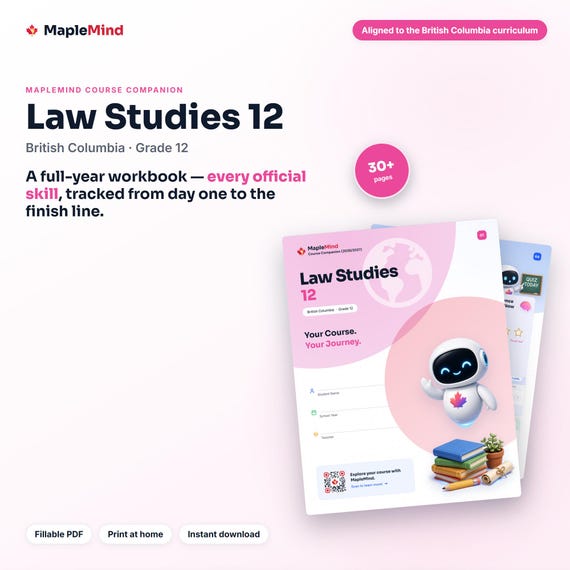
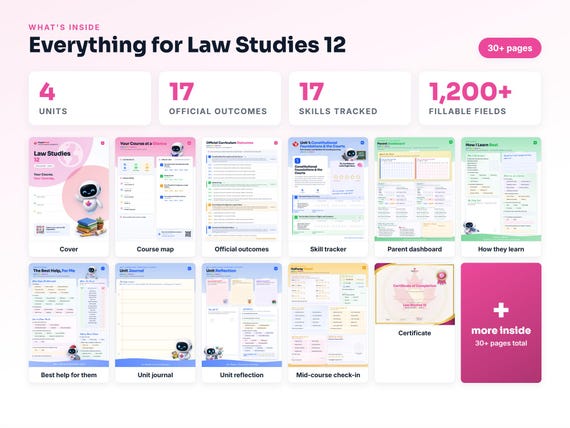
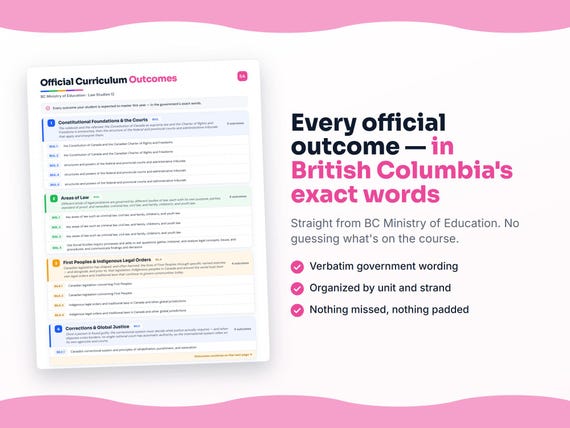
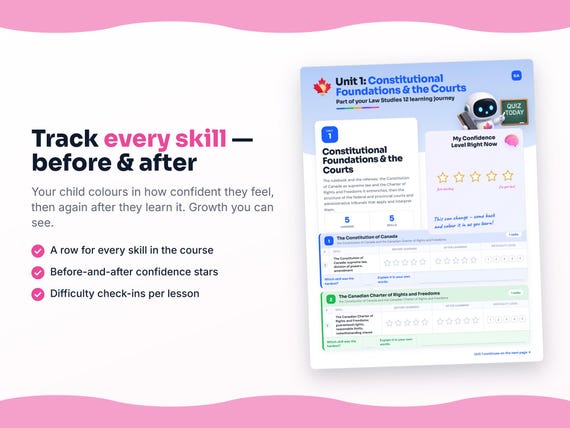
Printable workbook · A keepsake of the year
A Law Studies 12 workbook worth keeping
Built from the same official curriculum as this page. Before and after each skill above, your student colours in how sure they feel — so the two of you can see, on one page, what's clicking and what needs another look. It's a quiet way to follow how the year is really going.
By June it's full of their own handwriting: units worked through, confidence grown, a mid-year check-in, notes from parent-teacher night, and a certificate at the end. Less a worksheet, more a record of the year worth keeping on the shelf.
Instant download · see every page, reviews and the full description · five or more workbooks are $2.99 each
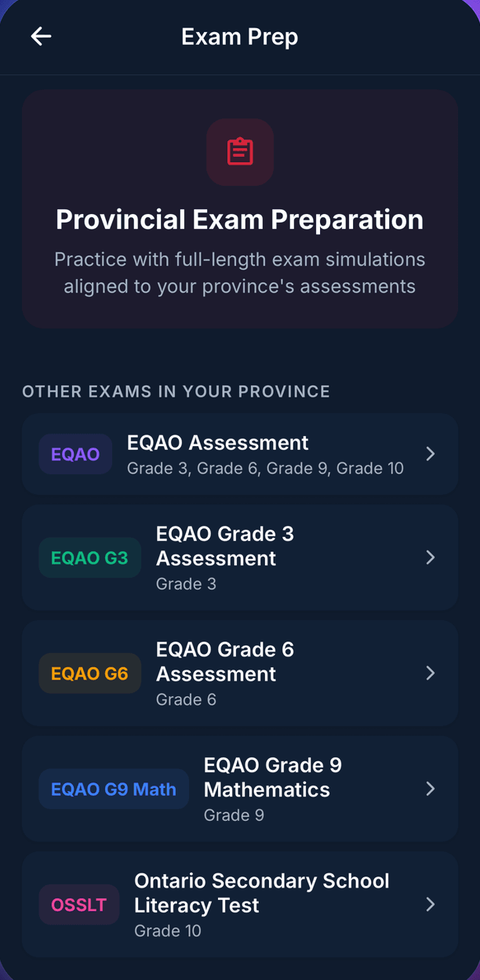
What it looks like in the app
Common questions
Can MapleMind help me with Law Studies 12?
Yes. MapleMind's AI tutor covers all 17 skills in British Columbia's Law Studies 12 — you pick the exact skill, and the tutor teaches it step by step: a short lesson, a worked example, solving together, then a skill check to show it stuck.
Is MapleMind aligned to British Columbia's official curriculum?
Yes. Every skill in this course maps to an official outcome code from British Columbia's Grade 12 Social Studies curriculum, and the ministry's own wording is quoted under each unit on this page — with the official government source linked so you can check it yourself.
What does MapleMind cost?
It's free to start — 5 tutoring chats and a practice quiz every day, no credit card. A Pro subscription ($9.99/month or $49.99/year CAD, 7-day free trial) unlocks unlimited tutoring, practice, and exam simulations.
What if I'm stuck on just one topic?
That's the point of skill-level tutoring: open Law Studies 12 in the app, tap the exact skill from the list on this page, and the tutor teaches just that — no wading through lessons you don't need.
Does MapleMind work in French or other languages?
Yes — 14 languages, including French. Both the app and the tutor's explanations switch to the language you choose.
Where can I see the official British Columbia curriculum for Law Studies 12?
The official source is linked on this page — BC's official social studies curriculum. The outline here follows it: every MapleMind skill carries its official outcome code, and the ministry's own wording is quoted under each unit.
Keep exploring
Ready when you are
Pick a skill from this page and see it taught properly — free, in the browser, in under a minute.