Get help with Social Studies 9
Most tutoring makes you sit through material you already know. MapleMind flips that: pick the exact skill that's causing trouble — any of the 12 below — and the tutor teaches just that one, step by step, as many times as it takes. Ask questions in plain words, any time of day, in English, French, or 12 other languages.
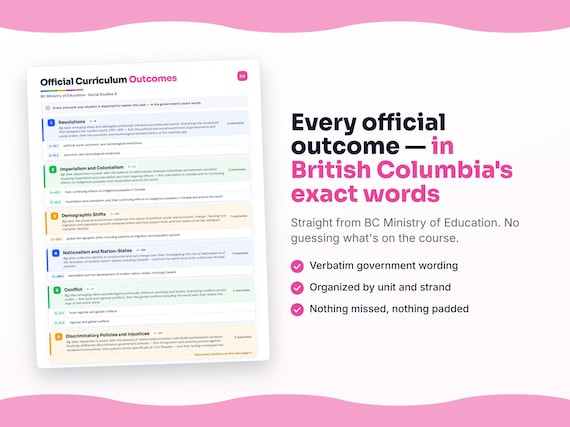
The official British Columbia Social Studies 9 curriculum
British Columbia defines Social Studies 9 by strands and outcomes. MapleMind teaches the same curriculum reorganized for one-skill-at-a-time tutoring — the table shows exactly where every official strand lands, and the ministry's own wording is quoted under each unit below.
Official source BC's official social studies curriculumRead it on the government site — curriculum.gov.bc.ca ↗| Official strand | Outcomes | Where MapleMind teaches it |
|---|---|---|
| Content — Revolutions | 2 | Revolutions |
| Content — Imperialism and Colonialism | 2 | Imperialism and Colonialism |
| Content — Demographic Shifts | 1 | Demographic Shifts |
| Content — Nationalism and Nation-States | 1 | Nationalism and Nation-States |
| Content — Conflict | 2 | Conflict |
| Content — Discriminatory Policies and Injustices | 2 | Discriminatory Policies and Injustices |
| Content — Physiographic Features and Natural Resources | 2 | Canada's Physical Geography |
Every skill below, taught one on one.
 Try the first session free
How MapleMind teaches Social Studies 9 — every unit, lesson, and skill
Every skill below runs as a short session: a plain-words lesson, a worked example, solving it together, then a five-question skill check that earns up to three stars. Guided Mode keeps it teaching instead of answer-handing — turning it off needs a parent's password.
Unit 1RevolutionsOfficial strand · Content — Revolutions
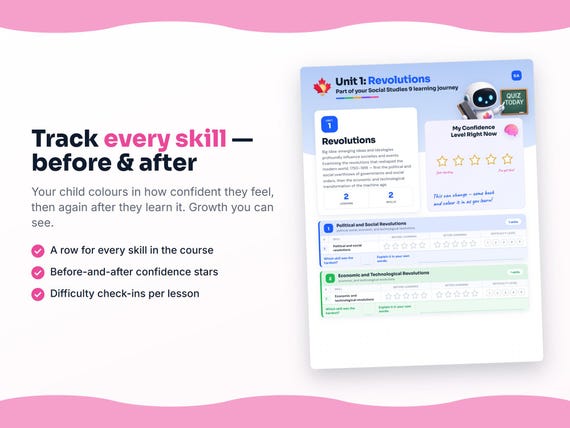
Big Idea: emerging ideas and ideologies profoundly influence societies and events. Examining the revolutions that reshaped the modern world, 1750–1919 — first the political and social overthrows of governments and social orders, then the economic and technological transformation of the machine age.
Political and Social Revolutions
Economic and Technological Revolutions
- Economic and technological revolutions9.PSE.2 — Investigate the economic and technological revolutions of this era — industrialization, advances in science and technology, and new methods of transportation including the railway, steamships, cars, and aircraft — and how they overturned how goods were made and how people moved, and for whom.
The official wording — 2 outcomes in this unit
- 9.PSE.1
political, social, economic, and technological revolutions
- 9.PSE.2
economic, and technological revolutions
Unit 2Imperialism and ColonialismOfficial strand · Content — Imperialism and Colonialism
Big Idea: disparities in power alter the balance of relationships between individuals and between societies. Studying imperialism and colonialism and their ongoing effects — first colonialism in Canada and its continuing effects on Indigenous peoples, then imperialism around the world.
Colonialism in Canada and Its Continuing Effects
- Colonialism in Canada and its continuing effects on indigenous peoples9.ICC.1 — Examine how colonialism operated in Canada — the numbered treaties, the Vancouver Island treaties, interactions between Europeans and First Peoples, and the Indian Act and residential school system — and trace the continuing effects of this history on indigenous peoples in Canada today, not just as something that happened in the past.
Imperialism Around the World
- Imperialism around the world9.ICC.2 — Examine how European powers and the United States expanded control over other peoples and lands worldwide — through the Scramble for Africa and Manifest Destiny — and identify the motivations shared across empires (resources, strategic rivalry, and a belief in racial or cultural superiority), so colonialism in Canada is seen as one instance of a global pattern.
The official wording — 2 outcomes in this unit
- 9.ICC.1
their continuing effects on indigenous peoples in Canada
- 9.ICC.2
imperialism and colonialism, and their continuing effects on indigenous peoples in Canada and around the world
Unit 3Demographic ShiftsOfficial strand · Content — Demographic Shifts
Big Idea: the physical environment influences the nature of political, social, and economic change. Tracking how migration and population growth reshaped where and how people lived, and how waves of arrival reshaped Canadian identity.
Migration and a Changing World Population
- Global demographic shifts, migration, and population growth9.GDS.1 — Explore global demographic shifts of this era — slavery as forced migration, and disease, poverty, famine, and the search for land as forces driving people to move — including why immigrants such as East and South Asian, Irish, and other groups came to BC and Canada, the challenges they faced, and how migration and population growth reshaped Canadian identity.
The official wording — 1 outcome in this unit
- 9.GDS.1
global demographic shifts, including patterns of migration and population growth
Unit 4Nationalism and Nation-StatesOfficial strand · Content — Nationalism and Nation-States
Big Idea: collective identity is constructed and can change over time. Investigating the rise of nationalism and the formation of modern nation-states, including Canada — and how the same force both united and divided peoples.
Nationalism and the Rise of Modern Nation-States
- Nationalism and the development of modern nation-states9.NDM.1 — Study how nationalism — a strong shared sense of identity and loyalty to one's nation — both united and divided peoples, through examples like Canadian Confederation and national projects such as the Canadian Pacific Railway and Macdonald's National Policy, responsible government, Japan's Meiji Restoration, and the unification of Italy and Germany.
The official wording — 1 outcome in this unit
- 9.NDM.1
nationalism and the development of modern nation-states, including Canada
Unit 5ConflictOfficial strand · Content — Conflict
Big Idea: emerging ideas and ideologies profoundly influence societies and events. Examining conflicts across scales — first local and regional conflicts, then the global conflicts including the world wars that redrew the map of the entire world.
Local and Regional Conflicts
- Local and regional conflicts9.LRG.1 — Investigate conflicts below the world stage — local conflicts like BC's own Chilcotin War and Fraser Canyon War (over land and jurisdiction between First Peoples and colonial settlers), and regional wars like the American Civil War, the wars of independence in Latin America, and the Franco-Prussian War — considering what each was fought over and who held power afterward.
Global Conflicts and the World Wars
- Global conflicts, including the world wars9.LRG.2 — Investigate the era's global conflicts — the Russo-Japanese War, the Russian Revolution, and above all World War I, the era's defining global catastrophe — and weigh their multiple long-building causes, their key turning points, and how they reshaped borders, governments, and the balance of power for the twentieth century.
The official wording — 2 outcomes in this unit
- 9.LRG.1
local, regional, and global conflicts
- 9.LRG.2
regional, and global conflicts
Unit 6Discriminatory Policies and InjusticesOfficial strand · Content — Discriminatory Policies and Injustices
Big Idea: disparities in power alter the balance of relationships between individuals and between societies. Studying deliberate discriminatory government policies — first immigration and wartime policies against racialized communities, then policies aimed specifically at First Peoples — and their lasting consequences.
Discriminatory Immigration and Wartime Policies
- Discriminatory immigration and wartime policies against racialized communities9.DPI.1 — Examine deliberate government policies that targeted racialized newcomers and minorities — the Head Tax and other anti-Asian immigration restrictions, the Asiatic Exclusion League, the Komagata Maru incident, and World War I internments and discrimination against German Canadians — along with the broader struggle over suffrage and labour rights, and their lasting impact on the communities affected.
Discriminatory Policies Against First Peoples
- Discriminatory policies against First Peoples9.DPI.2 — Examine discriminatory policies aimed specifically at First Peoples — the Indian Act, the potlatch ban that outlawed a central ceremonial practice, and residential schools — distinct in their target and mechanism from immigration policy, and their lasting impact on the individuals, families, and communities affected.
The official wording — 2 outcomes in this unit
- 9.DPI.1
discriminatory policies and injustices in Canada and the world, such as the Head Tax, the Komagata Maru incident
- 9.DPI.2
residential schools, and World War I internment
Unit 7Canada's Physical GeographyOfficial strand · Content — Physiographic Features and Natural Resources
Big Idea: the physical environment influences the nature of political, social, and economic change. Mapping the physiographic features and natural resources of Canada, and connecting geography to regional identity, settlement, and development.
Canada's Physiographic Features
- Physiographic features in Canada9.PFN.1 — Locate and describe Canada's major physiographic regions — its landform areas, such as the Canadian Shield, the interior plains, and the Cordillera — and connect these features to how Canada's physical geography has shaped settlement, transportation, and regional and national identity.
Canada's Natural Resources
- Natural resources in Canada9.PFN.2 — Identify Canada's major natural resources and connect them to the economic activities they support, weighing the different perspectives — environmental groups, resource-industry workers, First Peoples, and urban and rural communities — on how those resources should be used.
The official wording — 2 outcomes in this unit
- 9.PFN.1
physiographic features
- 9.PFN.2
natural resources in Canada
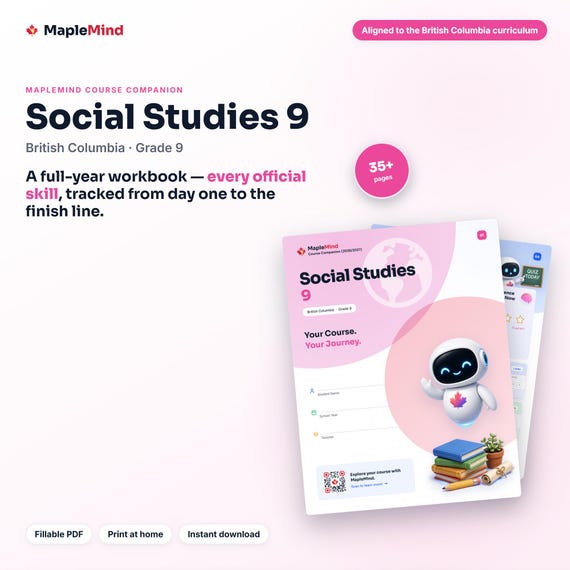
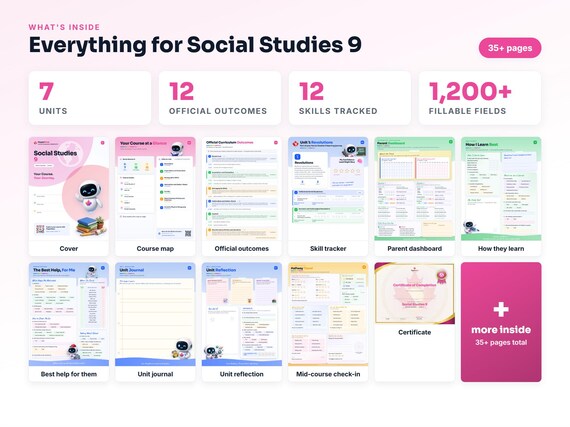
Printable workbook · A keepsake of the year
A Social Studies 9 workbook worth keeping
Built from the same official curriculum as this page. Before and after each skill above, your student colours in how sure they feel — so the two of you can see, on one page, what's clicking and what needs another look. It's a quiet way to follow how the year is really going.
By June it's full of their own handwriting: units worked through, confidence grown, a mid-year check-in, notes from parent-teacher night, and a certificate at the end. Less a worksheet, more a record of the year worth keeping on the shelf.
Instant download · see every page, reviews and the full description · five or more workbooks are $2.99 each
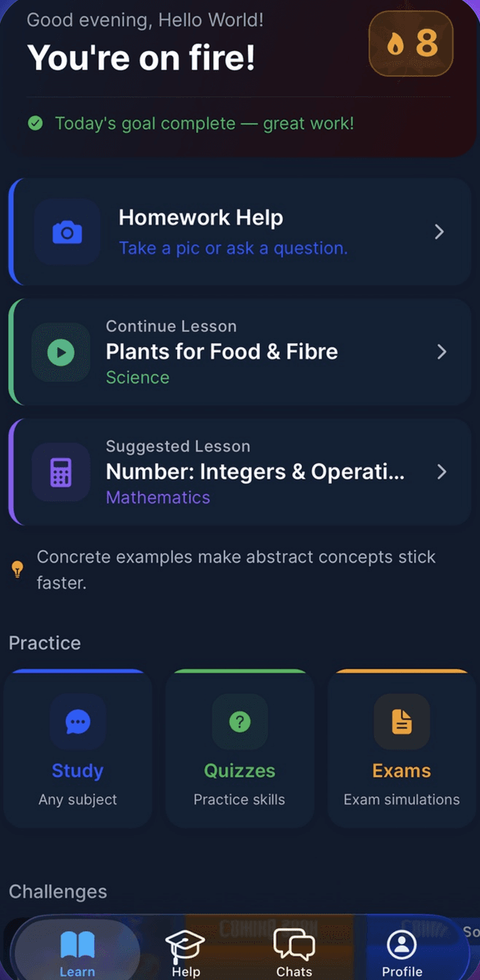
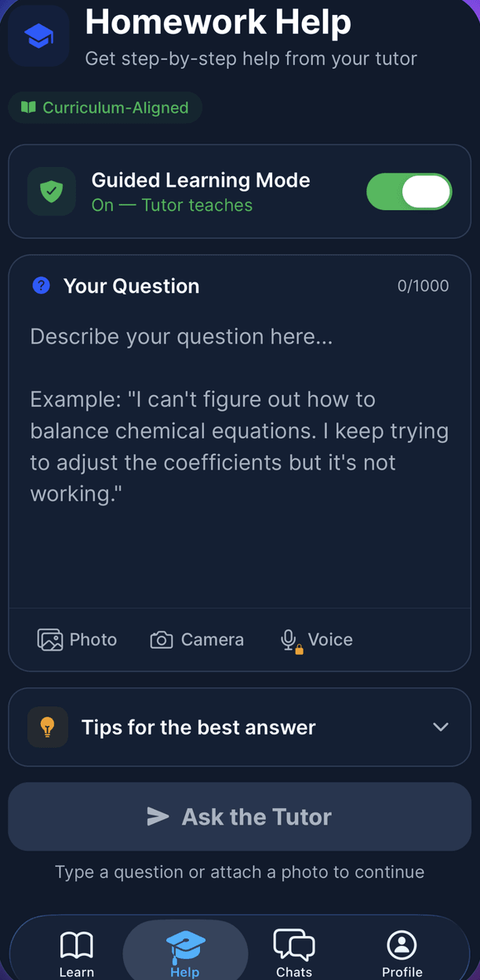
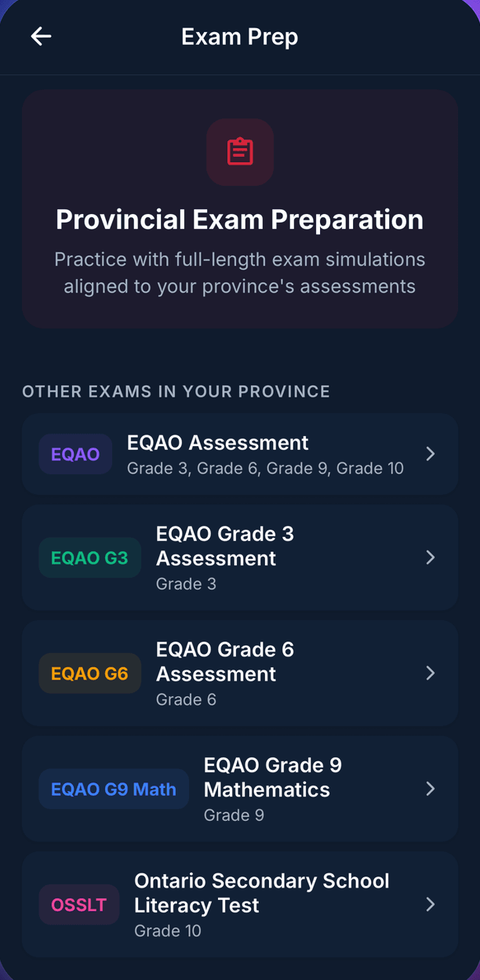
What it looks like in the app
Common questions
Can MapleMind help me with Social Studies 9?
Yes. MapleMind's AI tutor covers all 12 skills in British Columbia's Social Studies 9 — you pick the exact skill, and the tutor teaches it step by step: a short lesson, a worked example, solving together, then a skill check to show it stuck.
Is MapleMind aligned to British Columbia's official curriculum?
Yes. Every skill in this course maps to an official outcome code from British Columbia's Grade 9 Social Studies curriculum, and the ministry's own wording is quoted under each unit on this page — with the official government source linked so you can check it yourself.
What does MapleMind cost?
It's free to start — 5 tutoring chats and a practice quiz every day, no credit card. A Pro subscription ($9.99/month or $49.99/year CAD, 7-day free trial) unlocks unlimited tutoring, practice, and exam simulations.
What if I'm stuck on just one topic?
That's the point of skill-level tutoring: open Social Studies 9 in the app, tap the exact skill from the list on this page, and the tutor teaches just that — no wading through lessons you don't need.
Does MapleMind work in French or other languages?
Yes — 14 languages, including French. Both the app and the tutor's explanations switch to the language you choose.
Where can I see the official British Columbia curriculum for Social Studies 9?
The official source is linked on this page — BC's official social studies curriculum. The outline here follows it: every MapleMind skill carries its official outcome code, and the ministry's own wording is quoted under each unit.
Keep exploring
Ready when you are
Pick a skill from this page and see it taught properly — free, in the browser, in under a minute.