Get help with Social Studies 8
Most tutoring makes you sit through material you already know. MapleMind flips that: pick the exact skill that's causing trouble — any of the 10 below — and the tutor teaches just that one, step by step, as many times as it takes. Ask questions in plain words, any time of day, in English, French, or 12 other languages.
The official British Columbia Social Studies 8 curriculum
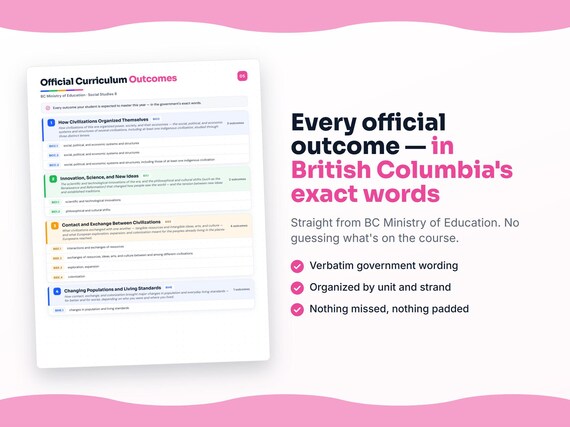
British Columbia defines Social Studies 8 by strands and outcomes. MapleMind teaches the same curriculum reorganized for one-skill-at-a-time tutoring — the table shows exactly where every official strand lands, and the ministry's own wording is quoted under each unit below.
Official source BC's official social studies curriculumRead it on the government site — curriculum.gov.bc.ca ↗| Official strand | Outcomes | Where MapleMind teaches it |
|---|---|---|
| Big Idea: Contact and conflict between peoples stimulated significant cultural, social, and political change. | 3 | How Civilizations Organized Themselves |
| Big Idea: Changing ideas about the world created tension between people wanting to adopt new ideas and those wanting to preserve established traditions. | 2 | Innovation, Science, and New Ideas |
| Big Idea: Exploration, expansion, and colonization had varying consequences for different groups. | 4 | Contact and Exchange Between Civilizations |
| Big Idea: Human and environmental factors shape changes in population and living standards. | 1 | Changing Populations and Living Standards |
Every skill below, taught one on one.
 Try the first session free
How MapleMind teaches Social Studies 8 — every unit, lesson, and skill
Every skill below runs as a short session: a plain-words lesson, a worked example, solving it together, then a five-question skill check that earns up to three stars. Guided Mode keeps it teaching instead of answer-handing — turning it off needs a parent's password.
Unit 1How Civilizations Organized ThemselvesOfficial strand · Big Idea: Contact and conflict between peoples stimulated significant cultural, social, and political change.
How civilizations of this era organized power, society, and their economies — the social, political, and economic systems and structures of several civilizations, including at least one indigenous civilization, studied through three distinct lenses.
Social Systems: How Societies Were Organized
Political Systems: Who Held Power
- Political systems and structures8.SYS.2 — Compare the political systems and structures of several civilizations of this era — who held power, how decisions were made, and how religious and political authority interacted — including at least one indigenous civilization's own system of governance.
Economic Systems: How Wealth Was Made and Shared
- Economic systems and structures8.SYS.3 — Compare the economic systems and structures of several civilizations of this era — how each produced, traded, and managed labour and resources, and how wealth was distributed — including at least one indigenous civilization.
The official wording — 3 outcomes in this unit
- 8.SYS.1
social, political, and economic systems and structures
- 8.SYS.2
social, political, and economic systems and structures
- 8.SYS.3
social, political, and economic systems and structures, including those of at least one indigenous civilization
Unit 2Innovation, Science, and New IdeasOfficial strand · Big Idea: Changing ideas about the world created tension between people wanting to adopt new ideas and those wanting to preserve established traditions.
The scientific and technological innovations of the era, and the philosophical and cultural shifts (such as the Renaissance and Reformation) that changed how people saw the world — and the tension between new ideas and established traditions.
Scientific and Technological Breakthroughs
- Scientific and technological innovations8.STI.1 — Identify major scientific and technological innovations of the era (such as the printing press, navigation instruments, and advances from the Islamic Golden Age and Zheng He's China) and explain how each one changed what people could do or learn.
New Ways of Thinking
- Philosophical and cultural shifts8.PCS.1 — Explain major philosophical and cultural shifts of the era — such as the Renaissance's focus on human potential, the Reformation's challenge to religious authority, and the Enlightenment — and how they changed what people believed and valued.
The official wording — 2 outcomes in this unit
- 8.STI.1
scientific and technological innovations
- 8.PCS.1
philosophical and cultural shifts
Unit 3Contact and Exchange Between CivilizationsOfficial strand · Big Idea: Exploration, expansion, and colonization had varying consequences for different groups.
What civilizations exchanged with one another — tangible resources and intangible ideas, arts, and culture — and what European exploration, expansion, and colonization meant for the peoples already living in the places Europeans reached.
Trading Goods: The Exchange of Resources
- Interactions and exchanges of resources8.EXC.1 — Describe the exchange of tangible resources — goods, crops, animals, and diseases — between civilizations along the Silk Road, Indian Ocean trade, and the Columbian Exchange, and explain the environmental and human effects on each side.
Sharing Ideas: The Exchange of Culture
- Exchange of ideas, arts, and culture8.EXC.2 — Describe the exchange of ideas, arts, and culture between and among civilizations — cultural diffusion of religion, art, architecture, mathematics, and language along trade routes and through the Crusades and the Renaissance — and explain how each side was changed.
Exploration and Expansion
- Exploration and expansion8.EEC.1 — Explain the motivations and methods behind European exploration and expansion during the era — the search for trade routes, resources, and religious or political goals — and how reaching the Americas led to state formation and the collapse of existing states.
Colonization and Its Impact
- Colonization and its impact on indigenous peoples8.EEC.2 — Explain what colonization involved — settling claimed land and imposing control — and the effects it had on the indigenous peoples and civilizations already living in the places reached, understanding contact turned to conflict rather than a "discovery" of empty land.
The official wording — 4 outcomes in this unit
- 8.EXC.1
interactions and exchanges of resources
- 8.EXC.2
exchanges of resources, ideas, arts, and culture between and among different civilizations
- 8.EEC.1
exploration, expansion
- 8.EEC.2
colonization
Unit 4Changing Populations and Living StandardsOfficial strand · Big Idea: Human and environmental factors shape changes in population and living standards.
How contact, exchange, and colonization brought major changes in population and everyday living standards — for better and for worse, depending on who you were and where you lived.
How Populations and Daily Life Changed
- Changes in population and living standards8.CPL.1 — Explain how population size and living standards changed for different groups during the era — including devastating population loss for some indigenous peoples through disease, forced and unforced migration, urbanization, and environmental impact — and why the effects were not the same for everyone.
The official wording — 1 outcome in this unit
- 8.CPL.1
changes in population and living standards
Printable workbook · A keepsake of the year
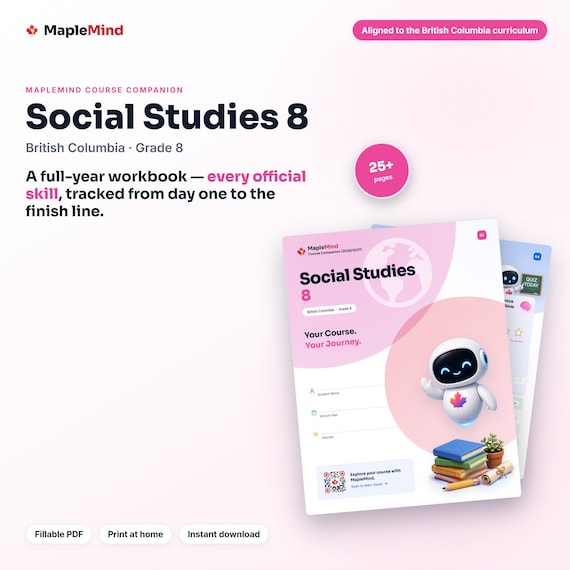
A Social Studies 8 workbook worth keeping
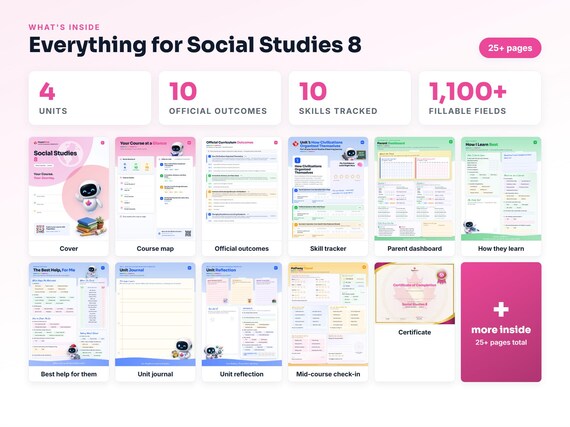
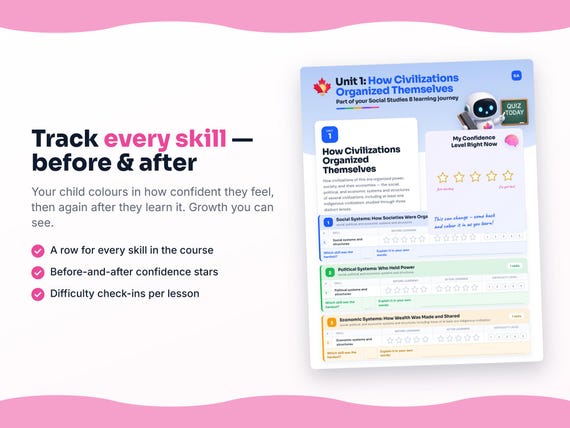
Built from the same official curriculum as this page. Before and after each skill above, your student colours in how sure they feel — so the two of you can see, on one page, what's clicking and what needs another look. It's a quiet way to follow how the year is really going.
By June it's full of their own handwriting: units worked through, confidence grown, a mid-year check-in, notes from parent-teacher night, and a certificate at the end. Less a worksheet, more a record of the year worth keeping on the shelf.
Instant download · see every page, reviews and the full description · five or more workbooks are $2.99 each
What it looks like in the app



Common questions
Can MapleMind help me with Social Studies 8?
Yes. MapleMind's AI tutor covers all 10 skills in British Columbia's Social Studies 8 — you pick the exact skill, and the tutor teaches it step by step: a short lesson, a worked example, solving together, then a skill check to show it stuck.
Is MapleMind aligned to British Columbia's official curriculum?
Yes. Every skill in this course maps to an official outcome code from British Columbia's Grade 8 Social Studies curriculum, and the ministry's own wording is quoted under each unit on this page — with the official government source linked so you can check it yourself.
What does MapleMind cost?
It's free to start — 5 tutoring chats and a practice quiz every day, no credit card. A Pro subscription ($9.99/month or $49.99/year CAD, 7-day free trial) unlocks unlimited tutoring, practice, and exam simulations.
What if I'm stuck on just one topic?
That's the point of skill-level tutoring: open Social Studies 8 in the app, tap the exact skill from the list on this page, and the tutor teaches just that — no wading through lessons you don't need.
Does MapleMind work in French or other languages?
Yes — 14 languages, including French. Both the app and the tutor's explanations switch to the language you choose.
Where can I see the official British Columbia curriculum for Social Studies 8?
The official source is linked on this page — BC's official social studies curriculum. The outline here follows it: every MapleMind skill carries its official outcome code, and the ministry's own wording is quoted under each unit.
Keep exploring
Ready when you are
Pick a skill from this page and see it taught properly — free, in the browser, in under a minute.