Manitoba · For parents

What your child learns in Grade 5 in Manitoba

Every subject, unit by unit, from Manitoba’s curriculum: 221 skills in plain words.

Subjects
5
Skills
221
Provincial exams
None
Official curriculum
edu.gov.mb.ca

Math in Grade 5

Mathematics, Grade 5

4 units · 37 skills

  1. Unit 1

    Number

    We write large numbers with spaces, not commas: 934 567.

    • Reading and writing numbers to a million
    • Expanded notation to a million
    • Front-end rounding and compensation
    17 more skills
    • Compatible numbers for estimating
    • Multiplication facts to 81
    • The 9s pattern and division facts
    • Mental strategies for bigger multiplication
    • Using the distributive property
    • Multiplying with personal strategies and area models
    • The standard multiplication algorithm
    • Dividing and interpreting remainders
    • The standard division algorithm
    • Equivalent fractions
    • Comparing fractions with unlike denominators
    • Decimals to thousandths
    • Connecting decimals and fractions to thousandths
    • Ordering decimals with benchmarks
    • Ordering decimals with equivalent decimals
    • Adding and subtracting decimals
    • Estimating and solving decimal problems
  2. Unit 2

    Patterns and Relations

    A pattern rule describes how each element relates to the one before.

    • Pattern rules and predictions
    • Writing single-variable equations
    • Solving single-variable equations
  3. Unit 3

    Shape and Space

    Many rectangles can share the same perimeter or the same area.

    • Rectangles with given perimeter or area
    • Measuring in millimetres
    • Referents and estimating volume
    7 more skills
    • Measuring and building volume
    • Millilitres and litres
    • Estimating and measuring capacity
    • Parallel, perpendicular, and more
    • Sorting quadrilaterals
    • Performing transformations
    • Identifying transformations
  4. Unit 4

    Statistics and Probability

    First-hand data is collected by us; second-hand data comes from another source.

    • First-hand and second-hand data
    • Double bar graphs
    • Impossible, possible, and certain
    1 more skill
    • Comparing likelihoods

Science in Grade 5

Science, Grade 5

5 units · 65 skills

  1. Unit 1

    Scientific Skills and Inquiry

    We select and use tools and instruments to observe, measure, and construct.

    • Selecting instruments to measure
    • Measuring in SI units
    • Building and evaluating graphs
    1 more skill
    • Building a prototype
  2. Unit 2

    Maintaining a Healthy Body

    Nutrients include carbohydrates, proteins, fats, vitamins, and minerals.

    • Words for human health
    • Reading food labels
    • Nutrients and what they do
    12 more skills
    • Evaluating a daily menu
    • Evaluating prepared foods
    • The digestive system
    • Skeleton, muscles, and nerves
    • Skin and the integumentary system
    • The body's defences against infection
    • Breathing and blood systems
    • How the body removes waste
    • Systems working together
    • Keeping a healthy body
    • Judging health messages in the media
    • How choices and environment affect health
  3. Unit 3

    Properties of and Changes in Substances

    Matter is anything made of substances, and each substance has properties.

    • Words for substances and changes
    • Telling substances apart by properties
    • How substances change when they interact
    11 more skills
    • What matter is
    • Properties of the three states of matter
    • Mass in liquid and solid states
    • Mass of the whole equals the parts
    • Changes of state are reversible
    • Reversible and non-reversible changes
    • Physical versus chemical change
    • Classifying changes
    • Using chemicals safely
    • Evaluating household chemicals
    • Turning raw materials into products
  4. Unit 4

    Forces and Simple Machines

    An applied force is a push or pull we give; forces can be balanced or unbalanced.

    • Words for forces and simple machines
    • Diagramming forces on an object
    • The three classes of levers
    11 more skills
    • Wheels and axles around us
    • Gears turn other gears
    • Devices with pulleys and gears
    • How a two-gear system works
    • Pulley systems and force
    • Improving pulley and gear systems
    • The six simple machines
    • Why simple machines help
    • Comparing machines for a task
    • Devices that vary a simple machine
    • Designing a machine system
  5. Unit 5

    Weather

    Weather words include pressure, air masses, fronts, and weather instruments.

    • Words for weather
    • How weather affects living things
    • Properties of air
    15 more skills
    • Air masses and fronts
    • Building a weather instrument
    • Measuring local weather over time
    • Reading a weather report
    • Features of weather phenomena
    • Severe weather safety
    • Ways of predicting weather
    • Short- and long-term forecasts
    • Technology that improves forecasting
    • The Sun drives the weather
    • Clouds and the water cycle
    • Common cloud types
    • Weather versus climate
    • What influences Manitoba's weather and climate
    • Climates are always changing

English in Grade 5

English Language Arts, Grade 5

4 units · 48 skills

  1. Unit 1

    Explore and Discover Language and Literacy

    • Listening critically to the ideas of others
    • Using non-verbal cues and conventions when listening
    • Interacting to exchange and consider ideas
    7 more skills
    • Asking questions to explore and critique ideas
    • Using the rules and structures of oral language
    • Adapting spoken language to audience and purpose
    • Decoding and encoding complex multisyllabic words
    • Applying morphology to understand and spell words
    • Building and using precise vocabulary
    • Applying fluency to comprehend text
  2. Unit 2

    Comprehend and Respond to Multimodal Texts

    • Activating prior knowledge to understand new text
    • Generating questions to drive inquiry
    • Engaging with a variety of multimodal texts
    12 more skills
    • Reviewing information and filling gaps
    • Understanding how text form and structure carry meaning
    • Using text features and cues to comprehend
    • Making and confirming predictions
    • Making connections to deepen meaning
    • Using strategies to monitor understanding
    • Summarizing key ideas and drawing conclusions
    • Consolidating and communicating new knowledge
    • Analyzing how texts present diversity and equity
    • Identifying stereotyping, bias and reliable sources
    • Identifying point of view and judging viewpoints
    • Responding personally to bias and prejudice
  3. Unit 3

    Compose and Create Multimodal Texts

    • Generating ideas and focusing a topic
    • Gathering and assessing information from sources
    • Planning text creation with strategies and tools
    12 more skills
    • Choosing text forms for purpose and audience
    • Creating multimodal texts
    • Organizing ideas with structure and paragraphs
    • Crafting varied, correct sentences
    • Choosing precise, impactful words
    • Developing personal voice and tone
    • Revising for clarity, logic and coherence
    • Producing legible, well-formatted text
    • Applying spelling strategies and word structure
    • Applying capitalization conventions
    • Applying punctuation for clarity
    • Publishing a final multimodal text
  4. Unit 4

    Communicate Ideas and Build New Understandings

    • Adjusting tone, volume and expression for delivery
    • Using visuals and media to enhance communication
    • Organizing and presenting ideas for an audience
    5 more skills
    • Reflecting on effective learning strategies
    • Using criteria and tools to self-assess
    • Using feedback to refine strategies
    • Setting learning goals and planning steps
    • Monitoring progress toward goals

French in Grade 5

Core French, Grade 5

4 units · 18 skills

  1. Unit 1

    Oral Communication

    When the speaker speaks SLOWLY and CLEARLY, listen for specific information: name the KEY WORDS or the MAIN IDEA in short, familiar, simple messages.

    • Listening to understand messages
    • Introducing yourself and describing preferences
    • Describing things, surroundings, and needs
    3 more skills
    • Asking for information and giving directions
    • Fluency
    • Accuracy
  2. Unit 2

    Reading

    Anticipate the general idea of a text: read the title, subtitles, and table of contents; look at the pictures; and find cognates (mots amis) and familiar words.

    • Understanding the global meaning of a text
    • Responding to what you read
    • Reading aloud with ease and precision
  3. Unit 3

    Writing

    Show your communicative purpose - identify the TARGET AUDIENCE for your writing.

    • Purpose, structure, and introducing yourself
    • Describing in a paragraph
    • Fluency: varying sentences
    1 more skill
    • Accuracy: grammar and conventions
  4. Unit 4

    Culture

    Identify elements of your OWN cultural background (traditions, songs, celebrities).

    • Francophone and Metis communities in Canada
    • Connecting to my own culture
    • Forms of address and French-English differences
    2 more skills
    • Advantages of learning French
    • French in my daily life

Social studies in Grade 5

Social Studies, Grade 5

4 units · 53 skills

  1. Unit 1

    First Peoples

    First Peoples have their own stories that tell how they came to be on this land.

    • Origins and migration
    • The ice age and the land
    • Canada's physical regions
    8 more skills
    • Traditional territories
    • Beliefs and connection to the land
    • Diverse cultures before contact
    • Comparing daily life
    • Stories of pre-contact and early contact
    • Leadership in First Peoples communities
    • How communities interacted
    • Views of natural resources
  2. Unit 2

    Early European Colonization (1600 to 1763)

    Several European countries, like France, Britain, Spain, and Portugal, built colonial empires.

    • European colonial empires
    • Why Europeans came to North America
    • Explorers and the Northwest Passage
    10 more skills
    • Places of the colonization era
    • Life in Nouvelle-France
    • The royal government
    • Builders of Nouvelle-France
    • Impact of contact
    • Life in Atlantic settlements
    • European wars in early Canada
    • The Acadian deportation
    • The conquest of Nouvelle-France
    • Where Europeans settled and why
  3. Unit 3

    Fur Trade

    The fur trade was driven by demand in Europe, especially for beaver-felt hats.

    • Global forces behind the fur trade
    • How the fur trade shaped Canada
    • Fur trade moves west and north
    12 more skills
    • Mapping the fur trade and Métis Nation
    • How the land shaped the trade
    • The stories in place names
    • Fur trade versus farming
    • Daily life in the fur trade
    • Stories of the fur trade
    • The trade depended on First Nations and Métis
    • Rival trading companies
    • The rise of the Métis Nation
    • Traditional Métis lands
    • Diversity of pre-Confederation Canada
    • Changing European views of First Peoples
  4. Unit 4

    From British Colony to Confederation (1763 to 1867)

    People immigrated to Canada because of events in other parts of the world — wars, hardship, and the search for land and opportunity.

    • Why people immigrated
    • The United Empire Loyalists
    • How migration affects identity
    11 more skills
    • First Peoples, traders, and settlers
    • The Selkirk Settlement
    • The War of 1812
    • The Rebellions of 1837–1838
    • Canada East and Canada West
    • Arguments for and against Confederation
    • Building Confederation
    • The first four provinces
    • Citizens' rights in 1867
    • Who was left out in 1867
    • Citizenship then and now

MapleMind

See Grade 5 in MapleMind

Real screens from the app your child would use.

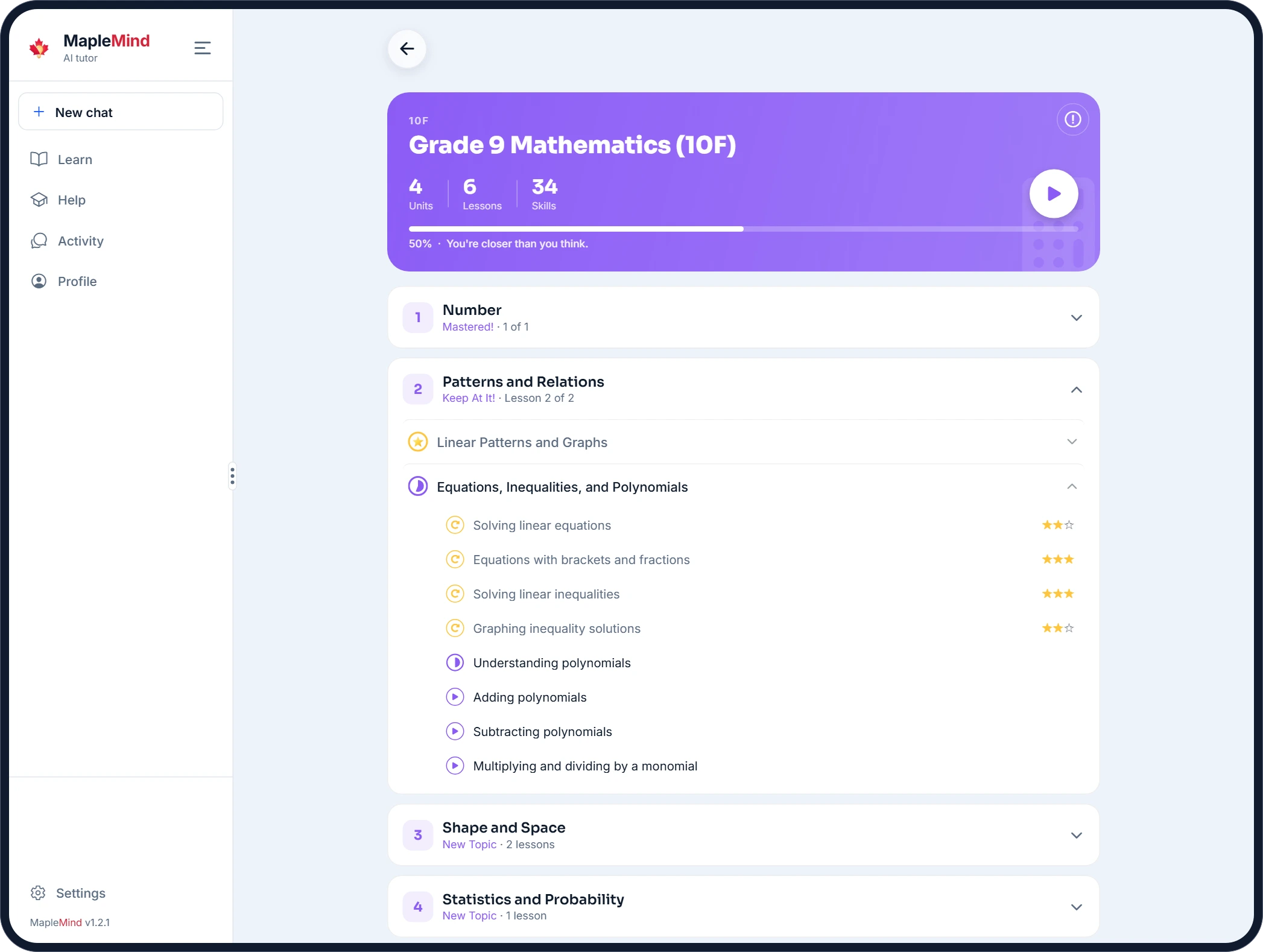
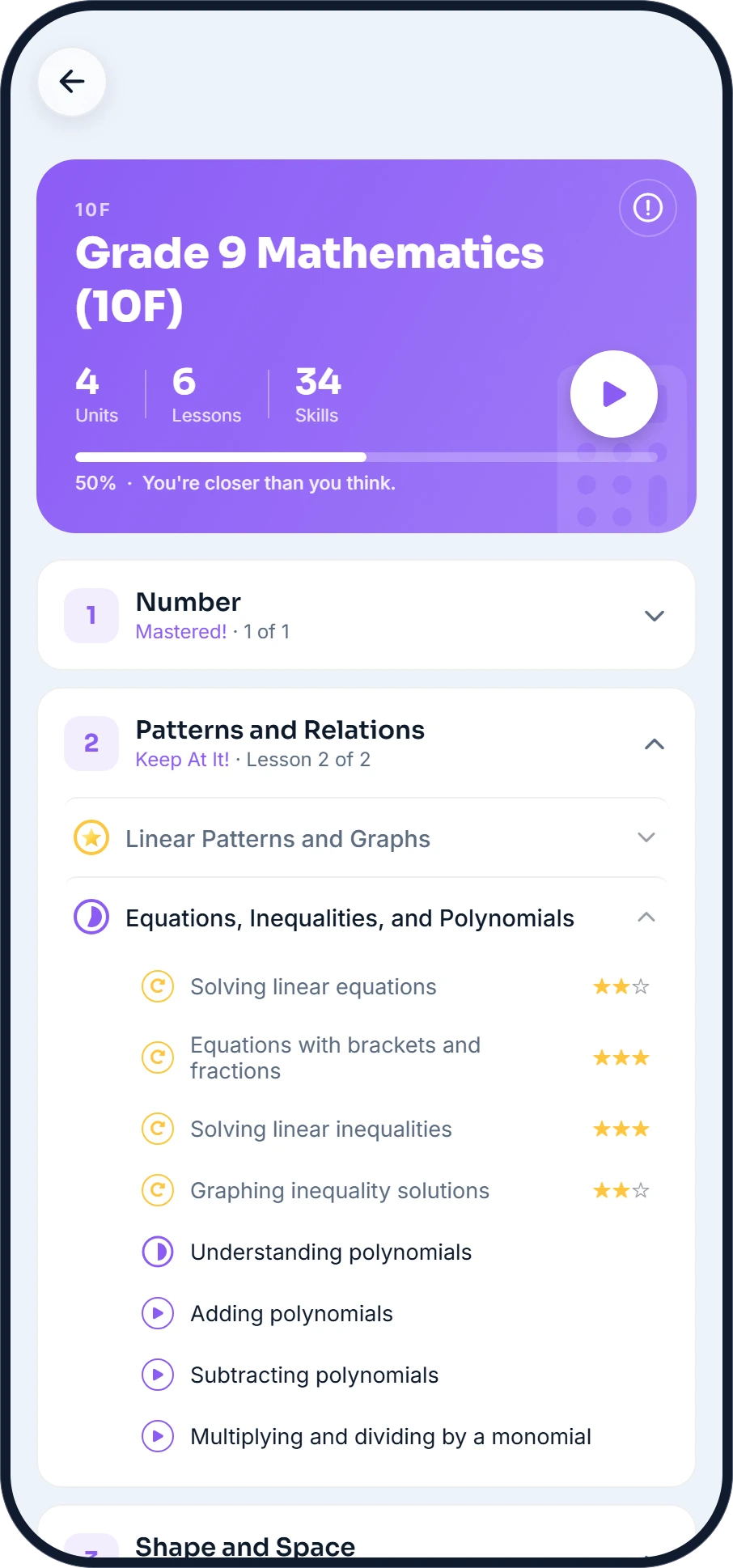
Grade 9 Mathematics (10F) in MapleMind on a tablet: its units and lessons in order, a student partway through.Grade 9 Mathematics (10F) in MapleMind on a phone: its units and lessons in order, a student partway through.
Their course, unit by unit, the way Manitoba teaches it.Shown: Grade 9 Mathematics (10F)
Homework Help on a tablet: a photo of a worksheet, the tutor’s worked example of a two-step equation, and a question back to the student.Homework Help on a phone: a photo of a worksheet, the tutor’s worked example of a two-step equation, and a question back to the student.
Homework Help: they take a photo of the question, and the tutor works through it with them.
The Parent Dashboard on a tablet: a student’s days studied, streak, lessons, quiz average and recent activity.The Parent Dashboard on a phone: a student’s days studied, streak, lessons, quiz average and recent activity.
The Parent Dashboard: how each child’s week went, in lessons, quizzes and days studied.
A Grade 9 provincial mathematics exam on a tablet: a readiness score, the exam’s time and its next sitting.A Grade 9 provincial mathematics exam on a phone: a readiness score, the exam’s time and its next sitting.
A provincial exam: a practice sitting under the real time, and how ready they are.
The Learn tab on a tablet: a four-day streak, the week’s days, Homework Help, the next lesson and a review.The Learn tab on a phone: a four-day streak, the week’s days, Homework Help, the next lesson and a review.
The Learn tab: their week so far, and the next thing to do.

Help at home

Questions parents ask

What will my child learn in Grade 5 in Manitoba?

Math: Mathematics, Grade 5. Science: Science, Grade 5. English: English Language Arts, Grade 5. French: Core French, Grade 5. Social studies: Social Studies, Grade 5. That’s 221 skills in all, from Manitoba’s curriculum.

Does my child write a provincial exam in Grade 5?

No. Manitoba has no provincial exam in Grade 5.

Where does this list come from?

From Manitoba’s official curriculum, the documents its education ministry publishes for each course. Each skill here is one of their expectations, written in plain words.

Can MapleMind help my child in Grade 5?

Yes. Every course on this page is in MapleMind, with lessons, practice and a tutor that works through each step with them. A free account gets 30 messages and 4 activities a day.

Help with Grade 5, one skill at a time.

Every course on this page is in MapleMind, free with daily limits.