Manitoba · For parents

What your child learns in Grade 10 in Manitoba

Every subject, unit by unit, from Manitoba’s curriculum: 227 skills in plain words.

Subjects
5
Skills
227
Provincial exams
None
Official curriculum
edu.gov.mb.ca

Math in Grade 10

2 courses. Choose the one your child takes.

Essential Mathematics, Grade 10 (20S)

7 units · 27 skills

  1. Unit 1

    Analysis of Games and Numbers

    A strategy is a plan you can repeat and explain, like guess-and-check, look-for-a-pattern, or work-backward.

    • Winning strategies for spatial puzzles
    • Inventing and adapting a spatial puzzle
  2. Unit 2

    Personal Finance

    Income can come as an hourly wage, a salary, a contract, a commission, or piecework.

    • Ways of earning income
    • Calculating gross pay
    • Deductions and net pay
    1 more skill
    • Rearranging income formulas
  3. Unit 3

    Measurement

    SI is built on base ten: each prefix is a power of ten (kilo = 1000, centi = 1/100).

    • The SI system and its units
    • Converting within SI
    • The imperial system
    7 more skills
    • Converting between imperial and SI
    • Measuring with SI and imperial tools
    • Solving linear measurement problems
    • Applying and rearranging conversion formulas
    • Area of regular and composite shapes
    • Changing dimensions and unit conversion
    • Rearranging perimeter and area formulas
  4. Unit 4

    Trigonometry

    In a right triangle, a squared + b squared = c squared, where c is the hypotenuse.

    • The Pythagorean theorem
    • Sine, cosine, and tangent ratios
    • Solving with trig ratios
    1 more skill
    • Rearranging Pythagorean and trig formulas
  5. Unit 5

    Consumer Decisions

    Unit price = total price divided by the quantity, letting you compare sizes fairly.

    • Unit pricing and best buys
    • Currency exchange
  6. Unit 6

    Transformations

    A translation slides, a rotation turns, and a reflection flips a shape.

    • Translations, rotations, and reflections
    • Dilations and similarity
  7. Unit 7

    Angle Construction

    Angles are named by size: acute, right, obtuse, straight, and reflex.

    • Drawing and measuring angles
    • Replicating and bisecting angles
    • Parallel lines and transversals

Introduction to Applied and Pre-Calculus Mathematics, Grade 10 (20S)

3 units · 29 skills

  1. Unit 1

    Measurement

    A referent is a familiar length used to estimate, like a doorway height for a metre.

    • Referents and estimating linear measure
    • Measuring with instruments
    • Converting within and between SI and imperial
    3 more skills
    • Surface area and volume of solids
    • Composite solids and unknown dimensions
    • Primary trig ratios in right triangles
  2. Unit 2

    Algebra and Number

    Every whole number greater than 1 factors uniquely into primes.

    • Prime factors, GCF, and LCM
    • Square roots and cube roots
    • Understanding irrational numbers
    5 more skills
    • Ordering irrational numbers
    • Powers with rational exponents
    • Multiplying polynomials
    • Common factors and trinomial factoring
    • Difference of squares
  3. Unit 3

    Relations and Functions

    A graph's shape matches the story of its context.

    • Data, graphs, and contexts
    • Relations and functions
    • Slope as rise, run, and rate of change
    12 more skills
    • Parallel and perpendicular slopes
    • Linear relations in words and ordered pairs
    • Linear relations in tables and graphs
    • Linear relations as equations
    • Characteristics of linear graphs
    • Forms of a linear equation
    • Equation of a line from a graph or point-slope
    • Equation of a line from two points or a scatterplot
    • Function notation
    • Solving systems graphically
    • Solving systems algebraically
    • Distance and midpoint

Science in Grade 10

Science, Grade 10 (Senior 2)

20F · 5 units · 46 skills

  1. Unit 1

    Scientific Skills and Inquiry

    Sampling studies a part to learn about the whole: we cannot count every plant in a field, so we count them in sample areas and scale up.

    • Select and use appropriate methods and tools for sampling and collecting data
    • Estimate and measure accurately using Système International (SI) and other standard units
    • Record, organize, and display data using an appropriate format.
  2. Unit 2

    Dynamics of Ecosystems

    Carbon cycle: photosynthesis takes carbon dioxide from the air into plants; feeding passes the carbon along food chains; respiration, decomposition and burning return it to the air; carbon is stored for long times in oceans, forests, peat, limestone and fossil fuels.

    • Illustrate and explain how carbon, nitrogen, and oxygen are cycled through an ecosystem
    • Discuss factors that may disturb biogeochemical cycles
    • Describe bioaccumulation and explain its potential impact on consumers
    7 more skills
    • Describe the carrying capacity of an ecosystem
    • Investigate and discuss various limiting factors that influence population dynamics
    • Construct and interpret graphs of population dynamics
    • Describe potential consequences of introducing new species and species extinction on an ecosystem
    • Observe and document a range of organisms that illustrate the biodiversity within a local or regional ecosystem
    • Explain how the biodiversity of an ecosystem contributes to its sustainability
    • Investigate how human activities affect an ecosystem and use the decision-making process to propose a course of action to enhance its sustainability
  3. Unit 3

    Chemistry in Action

    Combining capacity (valence) is the number of electrons an atom tends to lose, gain or share when it forms a compound.

    • Relate an element's position in the periodic table to its combining capacity (valence)
    • Explain, using the periodic table, how and why elements combine in specific ratios to form compounds
    • Write formulas and names of binary ionic compounds
    9 more skills
    • Write formulas and names for covalent compounds using prefixes.
    • Investigate the Law of Conservation of Mass, and recognize that mass is conserved in chemical reactions
    • Balance chemical equations
    • Investigate and classify reactions as synthesis, decomposition, single displacement, double displacement, or combustion
    • Experiment to classify acids and bases using their characteristic properties
    • Discuss the occurrence of acids and bases in biological systems, industrial processes, and domestic applications
    • Explain how acids and bases interact to form a salt and water in the process of neutralization
    • Describe the formation and the environmental impact of various types of air pollution
    • Investigate technologies that are used to reduce emissions of potential air pollutants
  4. Unit 4

    In Motion

    Displacement is the change in position in a stated direction; distance is the total length of the path travelled.

    • Analyze the relationship among displacement, time, and velocity for an object in uniform motion
    • Collect displacement data to calculate and graph velocity versus time for an object that is accelerating at a constant rate
    • Analyze the relationships among velocity, time, and acceleration for an object that is accelerating at a constant rate
    10 more skills
    • Outline the historical development of the concepts of force and “natural” motion
    • Experiment to illustrate the effects of inertia in car collisions
    • Describe qualitatively how force is related to motion
    • Investigate and describe qualitatively Newton's Third Law
    • Define momentum and impulse and qualitatively relate impulse to change in momentum for everyday situations
    • Investigate the conservation of energy in a motor vehicle collision
    • Investigate conditions that illustrate the effects of friction on motion
    • Investigate the factors that influence braking distance
    • Using the relationship between displacement, velocity, and friction (d = kv²), calculate the braking distance of a motor vehicle
    • Use the decision-making process to address an STSE issue related to safe driving conditions
  5. Unit 5

    Weather Dynamics

    The hydrosphere is all of Earth's water: about 97% is salt water in the oceans and about 3% is fresh water, most of it frozen in polar ice caps and glaciers, with the rest in groundwater, lakes, rivers and the air.

    • Illustrate the composition and organization of the hydrosphere and the atmosphere
    • Outline factors influencing the Earth's radiation budget
    • Explain effects of heat transfer within the atmosphere and hydrosphere on the development and movement of wind and ocean currents
    5 more skills
    • Explain the formation and dynamics of selected severe weather phenomena
    • Collect, interpret, and analyze meteorological data related to a severe weather event
    • Investigate the social, economic, and environmental impacts of a recent severe weather event
    • Investigate and evaluate evidence that climate change occurs naturally and could be influenced by human activities
    • Discuss potential consequences of climate change

English in Grade 10

English Language Arts, Grade 10

20F · 4 units · 47 skills

  1. Unit 1

    Explore and Discover Language and Literacy

    • Listening critically to oral texts
    • Using non-verbal cues and inclusive conventions when listening
    • Adjusting language to foster inclusive interaction
    6 more skills
    • Asking questions to explore and challenge ideas
    • Using the rules and structures of oral language
    • Adapting spoken language to situation and audience
    • Applying morphology to understand and spell words
    • Building and refining precise vocabulary
    • Applying fluency to comprehend complex text
  2. Unit 2

    Comprehend and Respond to Multimodal Texts

    • Activating prior knowledge to build understanding
    • Creating focused questions to drive inquiry
    • Engaging with a variety of multimodal texts
    12 more skills
    • Analyzing and synthesizing information across sources
    • Analyzing and critiquing text cues
    • Using textual cues and organizational patterns to construct meaning
    • Making and testing predictions with text evidence
    • Making connections to deepen understanding
    • Selecting and integrating comprehension strategies
    • Summarizing and synthesizing complex texts
    • Consolidating and communicating new knowledge
    • Analyzing how texts portray diversity and equity
    • Differentiating facts, opinions and bias
    • Examining point of view and viewpoint credibility
    • Responding critically to bias and prejudice
  3. Unit 3

    Compose and Create Multimodal Texts

    • Selecting and focusing a topic
    • Researching and evaluating sources
    • Planning with strategies and tools
    12 more skills
    • Choosing and blending forms purposefully
    • Drafting complex multimodal texts
    • Organizing ideas with structure and transitions
    • Crafting sentences for meaning and style
    • Choosing precise, discipline-specific words
    • Controlling voice for purpose and audience
    • Revising for clarity, coherence and logic
    • Producing legible, well-formatted text
    • Applying spelling strategies and word structure
    • Applying capitalization conventions
    • Applying punctuation for clarity and effect
    • Publishing a polished multimodal project
  4. Unit 4

    Communicate Ideas and Build New Understandings

    • Using tone, volume and expression for delivery
    • Combining visuals and media for polished messages
    • Structuring a presentation to engage an audience
    5 more skills
    • Reflecting on and reviewing personal growth
    • Using criteria and tools to assess your learning
    • Using feedback to refine strategies
    • Setting learning goals and planning steps
    • Monitoring progress toward goals

French in Grade 10

Core French, Grade 10

20F · 4 units · 27 skills

  1. Unit 1

    Oral Communication

    Building on Grade 9, respond to a WIDER range of message types and identify the message intent behind them.

    • Understanding and retelling oral messages
    • Listening strategies
    • Describing people and things
    6 more skills
    • Talking about the past
    • Expressing feelings and giving advice
    • Predicting and justifying a viewpoint
    • Talking about the future
    • Fluency
    • Accuracy
  2. Unit 2

    Reading

    Building on Grade 9, match your reading strategy to your PURPOSE across text types (narrative, expository, poetic).

    • Reading for purpose and main idea
    • Identifying details and describing characters
    • Responding to and connecting with text
    2 more skills
    • Questioning and evaluating text
    • Reading aloud with fluency and accuracy
  3. Unit 3

    Writing

    Building on Grade 9, aim your writing at a TARGETED ACTION OR REACTION from a specific audience.

    • Purpose, conventions, and describing
    • Writing about the past
    • Writing feelings, opinions, and advice
    5 more skills
    • Writing predictions and justifying viewpoints
    • Writing about the future and sharing information
    • Organizing varied, coherent texts
    • Writing devices and synchronizing tenses
    • Accuracy: grammar and syntax
  4. Unit 4

    Culture

    Building on Grade 9, form INFORMED opinions about francophone cultural events and explain why they matter.

    • Francophone cultures and cultural events
    • Connecting to francophone teens
    • Language register and comparisons
    2 more skills
    • Reasons for learning French
    • Bilingualism and French beyond the classroom

Social studies in Grade 10

Social Studies, Grade 10 (Geographic Issues of the 21st Century)

20F · 5 units · 51 skills

  1. Unit 1

    Geographic Literacy

    Geography is the study of the Earth's surface, its features, and how humans interact with it.

    • Defining geography
    • Elements of physical and human geography
    • How physical and human geography connect
    7 more skills
    • Geography and change over time
    • Physical features of North America
    • Political divisions of North America
    • Provinces, territories, and capitals of Canada
    • Geography and decision making
    • Place and identity
    • Maps, globes, and perceptions
  2. Unit 2

    Natural Resources

    A global environmental type is a region defined by its climate, vegetation, and soils together.

    • Global environmental types
    • Global environmental types on a world map
    • Global environmental types in Manitoba
    9 more skills
    • Population and environmental types
    • Stewardship of the Earth's environment
    • Natural resources on world, North America, and Canada maps
    • Sustainability of resource extraction
    • Aboriginal perspectives and rights on natural resources
    • Competing interests over land and resources
    • Changing use of natural resources over time
    • Aboriginal peoples in business and industry
    • Resource extraction between developed and less-developed countries
  3. Unit 3

    Food from the Land

    Food is produced in regions with good soil, climate, and water, like the Canadian Prairies.

    • Major food production areas
    • Physical conditions for major food crops
    • How natural and human phenomena affect food production
    9 more skills
    • Human factors in food production and use
    • How food production has changed over time
    • The changing nature of prairie farming
    • Agricultural practices and the environment
    • Stages of food production and distribution
    • Genetic modification of plants and animals
    • Freshwater and saltwater food resources
    • Climate change and food production
    • Scarcity and distribution of food
  4. Unit 4

    Industry and Trade

    Industry is economic activity that produces goods or services.

    • Types of industry
    • Factors that determine the location of industry
    • Advantages and disadvantages of a manufacturing location
    4 more skills
    • Major manufacturing regions
    • Canada's major trading partners
    • Current issues in industry and trade
    • Globalization and its social issues
  5. Unit 5

    Urban Places

    Urban places are cities; rural places are countryside; remote places are far from cities.

    • Rural, urban, and remote places
    • Locating major urban centres
    • Factors influencing the location of cities
    7 more skills
    • Cities as centres of power and wealth
    • Functions of urban places
    • Urbanization and Canadian ways of life
    • Urban environmental and economic issues
    • Urban social issues
    • The role of urban planning
    • Issues of urban growth and decline

MapleMind

See Grade 10 in MapleMind

Real screens from the app your child would use.

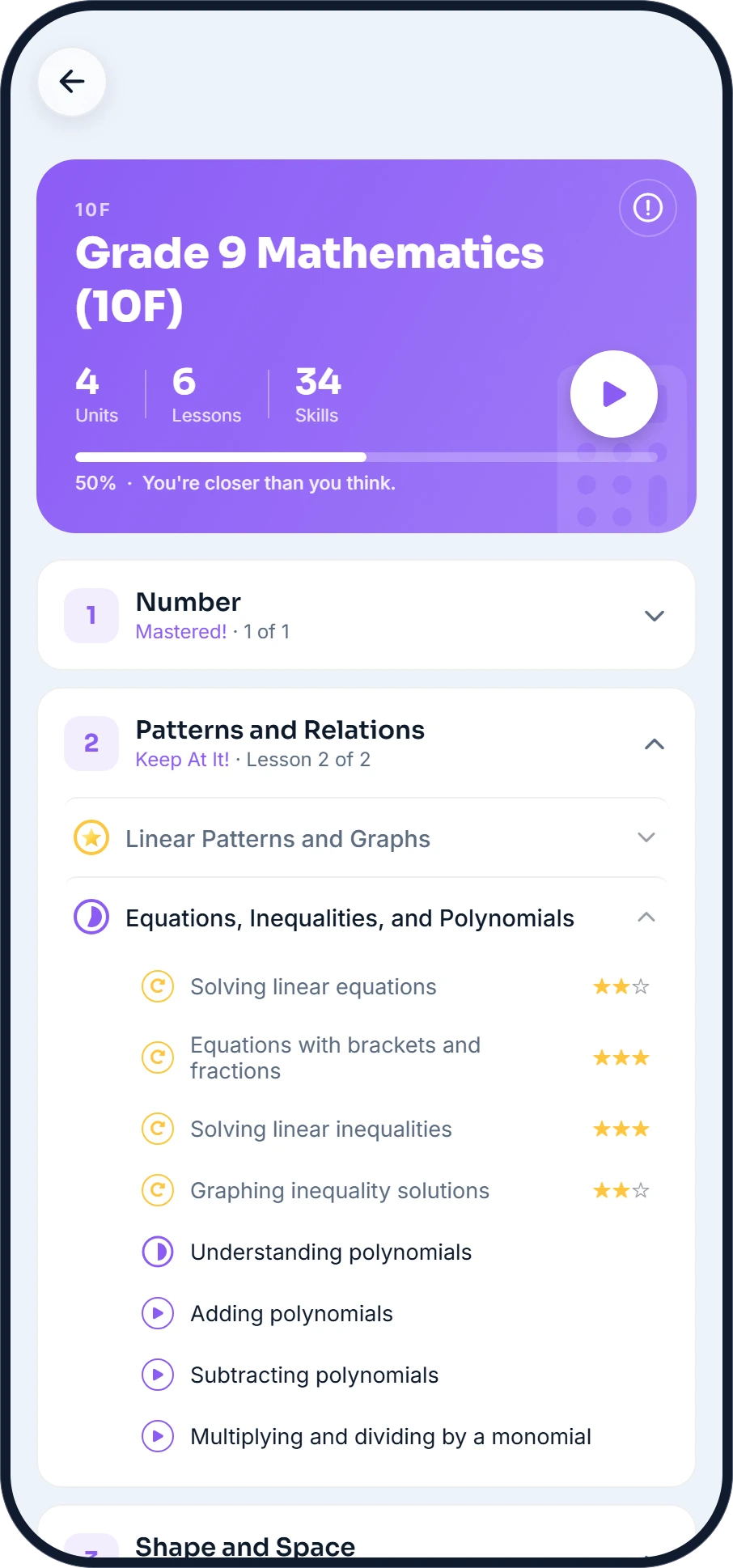
Grade 9 Mathematics (10F) in MapleMind on a tablet: its units and lessons in order, a student partway through.Grade 9 Mathematics (10F) in MapleMind on a phone: its units and lessons in order, a student partway through.
Their course, unit by unit, the way Manitoba teaches it.Shown: Grade 9 Mathematics (10F)
Homework Help on a tablet: a photo of a worksheet, the tutor’s worked example of a two-step equation, and a question back to the student.Homework Help on a phone: a photo of a worksheet, the tutor’s worked example of a two-step equation, and a question back to the student.
Homework Help: they take a photo of the question, and the tutor works through it with them.
The Parent Dashboard on a tablet: a student’s days studied, streak, lessons, quiz average and recent activity.The Parent Dashboard on a phone: a student’s days studied, streak, lessons, quiz average and recent activity.
The Parent Dashboard: how each child’s week went, in lessons, quizzes and days studied.
A Grade 9 provincial mathematics exam on a tablet: a readiness score, the exam’s time and its next sitting.A Grade 9 provincial mathematics exam on a phone: a readiness score, the exam’s time and its next sitting.
A provincial exam: a practice sitting under the real time, and how ready they are.
The Learn tab on a tablet: a four-day streak, the week’s days, Homework Help, the next lesson and a review.The Learn tab on a phone: a four-day streak, the week’s days, Homework Help, the next lesson and a review.
The Learn tab: their week so far, and the next thing to do.

Help at home

Questions parents ask

What will my child learn in Grade 10 in Manitoba?

Math: Essential Mathematics, Grade 10 (20S) and Introduction to Applied and Pre-Calculus Mathematics, Grade 10 (20S). Science: Science, Grade 10 (Senior 2). English: English Language Arts, Grade 10. French: Core French, Grade 10. Social studies: Social Studies, Grade 10 (Geographic Issues of the 21st Century). That’s 227 skills in all, from Manitoba’s curriculum.

Does my child write a provincial exam in Grade 10?

No. Manitoba has no provincial exam in Grade 10.

Where does this list come from?

From Manitoba’s official curriculum, the documents its education ministry publishes for each course. Each skill here is one of their expectations, written in plain words.

Can MapleMind help my child in Grade 10?

Yes. Every course on this page is in MapleMind, with lessons, practice and a tutor that works through each step with them. A free account gets 30 messages and 4 activities a day.

Help with Grade 10, one skill at a time.

Every course on this page is in MapleMind, free with daily limits.