Manitoba · For parents

What your child learns in Grade 1 in Manitoba

Every subject, unit by unit, from Manitoba’s curriculum: 177 skills in plain words.

Subjects
4
Skills
177
Provincial exams
None
Official curriculum
edu.gov.mb.ca

Math in Grade 1

Mathematics, Grade 1

3 units · 27 skills

  1. Unit 1

    Number

    Counting forward means the numbers get bigger by one each time; counting backward means they get smaller by one.

    • Counting forward and backward by 1s
    • Skip-counting by 2s, 5s, and 10s
    • Seeing how many at a glance
    14 more skills
    • Counting on from a number you know
    • Counting with groups of 2s, 5s, and 10s
    • Showing numbers to 20
    • Breaking numbers into two parts
    • Making equal groups
    • Comparing sets with referents
    • Matching sets one to one
    • Estimating amounts to 20
    • One more, two more, one less, two less
    • Talking about adding and taking away
    • Making and solving math stories
    • Showing and writing addition and subtraction
    • Strategies for adding facts to 18
    • Using addition to subtract
  2. Unit 2

    Patterns and Relations

    A repeating pattern has a core that repeats, like red-blue-red-blue.

    • Describing and extending repeating patterns
    • Copying and creating patterns
    • Showing a pattern a different way
    2 more skills
    • Balance and imbalance
    • Writing equalities with the equal sign
  3. Unit 3

    Shape and Space

    We can compare objects by length, mass, how much they hold, or area.

    • Comparing and ordering by an attribute
    • Comparing by filling, covering, and matching
    • Sorting shapes and objects
    2 more skills
    • Building shapes from smaller shapes
    • Finding flat shapes on solid objects

Science in Grade 1

Science, Grade 1

5 units · 63 skills

  1. Unit 1

    Scientific Skills and Inquiry

    We can measure how big something is using everyday things like paper clips, blocks, or hand spans laid end to end with no gaps.

    • Measuring and building with tools
    • Timing how long things take
    • Measuring how long things are
    2 more skills
    • Making picture graphs
    • Building something to solve a problem
  2. Unit 2

    Characteristics and Needs of Living Things

    Living things include humans, animals, and plants - they all grow and need things to stay alive.

    • Words for living things
    • Parts of the human body
    • How humans and animals are alike
    12 more skills
    • What makes each person special
    • Plants come in many forms
    • How living things are the same inside
    • Living things have needs
    • Caring for a pet or plant
    • How people and animals meet their needs
    • We depend on the world around us
    • Designing a home for a Manitoba animal
    • Jobs that need to know living things
    • Plans for a healthy environment
    • Being gentle with living things
    • Real science or make-believe?
  3. Unit 3

    The Senses

    The five senses are sight, smell, hearing, taste, and touch, and each uses a body part: eye, nose, ear, tongue, and skin.

    • Words for the senses
    • The five senses and their body parts
    • Sorting things with our senses
    12 more skills
    • Parts that protect the eye
    • Sensitive fingertips
    • The outside of the ear
    • Smelling safely
    • Parts of the nose
    • How we taste
    • Keeping our senses safe
    • Changing how things seem
    • When senses help and when they trick us
    • Helpers for our senses
    • We sense things differently
    • Senses in jobs and hobbies
  4. Unit 4

    Characteristics of Objects and Materials

    Materials have names - wood, metal, plastic, and cloth - and characteristics we can describe.

    • Words for objects and materials
    • Describing materials by feel and look
    • The object and its material
    8 more skills
    • What familiar objects are made of
    • Finding what materials can do
    • The same material, similar jobs
    • Testing which material is best
    • The best object for a task
    • Ways to join materials
    • Building a useful object
    • Reduce, reuse, recycle
  5. Unit 5

    Daily and Seasonal Changes

    We use words for time - day, night, morning, afternoon, yesterday, today, tomorrow, and the days of the week.

    • Words for changes over time
    • The Sun gives light and heat
    • Day time and night time
    14 more skills
    • How shadows are made
    • Putting events in order
    • How the Sun seems to move
    • Temperature through the day
    • Living things through the day
    • Comparing the seasons
    • Getting ready for the seasons
    • People who help with the seasons
    • How buildings keep us comfortable
    • Dressing for each season
    • Staying safe in the weather
    • Activities in any season
    • How Manitoba plants and animals change
    • Building to help a Manitoba animal

English in Grade 1

English Language Arts, Grade 1

4 units · 50 skills

  1. Unit 1

    Explore and Discover Language and Literacy

    • Listen to the ideas and opinions of others and respond by sharing relevant experiences to demonstrate
    • Use non-verbal cues to demonstrate listening
    • Experiment with language to initiate and maintain
    9 more skills
    • Ask questions to clarify understanding and respond
    • Use complete sentences with attention to word
    • Contribute to discussions, recognizing they have a voice
    • Identify sounds in beginning, middle and end
    • Identify individual alphabet letters by name
    • Use knowledge of letters and sounds to recognize and decode/encode
    • Understand with support how to use small
    • Understand and use a range of vocabulary
    • Identify and apply letter sounds accurately and automatically to decode; read known words
  2. Unit 2

    Comprehend and Respond to Multimodal Texts

    • Activate prior knowledge including knowledge gained from field trips, experts, Elders, texts and diverse experiences to
    • Ask questions based on personal curiosities to explore a topic in a group inquiry
    • Identify and choose multimodal texts based on interests
    12 more skills
    • Recognize, and use gathered information as a basis for sharing.
    • Recognize with guidance different forms/genres and structures
    • Use images, photographs and other text features
    • Use prior knowledge to make predictions about a new text
    • Make connections to texts by drawing on personal experiences and knowledge of topics to construct meaning.
    • Use strategies to check understanding
    • Recall information and talk about what is
    • Acquire, understand and use new vocabulary words
    • Recognize when they see themselves and others
    • Recognize what information and/or ideas might be true and false in texts, with guidance
    • Recognize others can have different viewpoints based
    • Express a personal response by sharing an opinion about text and give reasons.
  3. Unit 3

    Compose and Create Multimodal Texts

    • Contribute ideas to a topic based on personal experience and background knowledge.
    • Discuss new information gathered from a relevant
    • Use strategies with others to plan for
    12 more skills
    • Begin to develop an awareness of different
    • Create simple multimodal text; use writing/drawing tools
    • Recognize and experiment with organizational patterns; group
    • Produce simple, complete sentences; reread written text
    • Use new words to enhance meaning for the audience in drawings
    • Demonstrate personal voice in texts, using words
    • Understand that text creators can change their ideas in response to feedback to improve clarity
    • Form letters/words with accurate formation, size, placement
    • Use knowledge of letter sounds, word parts
    • Use a capital letter when writing names
    • Know and use some punctuation conventions to
    • Produce final text and develop awareness of the effect of different modes of communication
  4. Unit 4

    Communicate Ideas and Build New Understandings

    • Begin to adjust communication style (formal or informal) for an audience
    • Use artifacts to enhance message; use dramatizations
    • Present information in a sequence including a main idea with some supporting details to an audience.
    5 more skills
    • Engage in basic self-reflection as a listener
    • Begin to use stickers, charts or checklists
    • Listen to specific and immediate feedback; reflect
    • Develop learning goals with guidance
    • Recognize and monitor progress with guidance to achieve learning goal; use visual aids as a form

Social studies in Grade 1

Social Studies, Grade 1

3 units · 37 skills

  1. Unit 1

    I Belong

    Everyone belongs to more than one group at the same time — a family, a class, a team, a group of friends.

    • Groups I belong to
    • My First Nation, Inuit, or Métis community
    • My francophone community
    5 more skills
    • How my family shows its culture
    • Traditions that connect us to the past
    • Francophone stories across generations
    • My family across generations
    • Remembrance Day
  2. Unit 2

    My Environment

    A globe is a small round model of the Earth; a map is a flat picture of it.

    • Globes and maps show the Earth
    • Land and water on maps
    • My province and my country
    15 more skills
    • Canada's two official languages
    • The language of my First Nation, Inuit, or Métis community
    • Canada's anthem
    • Canada's anthem in my community's language
    • Where my home is
    • What makes a community
    • Landmarks near me
    • Local Aboriginal landmarks
    • Local francophone landmarks
    • We depend on the environment
    • The seasons change how we live
    • Needs and wants
    • How ads change what we want
    • Sharing the work
    • Caring for our things
  3. Unit 3

    Connecting with Others

    People live in different kinds of homes, eat different foods, and celebrate in different ways.

    • Different ways people live
    • How communities are alike
    • My rights and responsibilities
    8 more skills
    • How we help each other
    • Making decisions
    • How we affect each other
    • Why we have rules
    • Solving disagreements
    • Dealing with bullying
    • People everywhere are alike
    • My connections to the world

MapleMind

See Grade 1 in MapleMind

Real screens from the app your child would use.

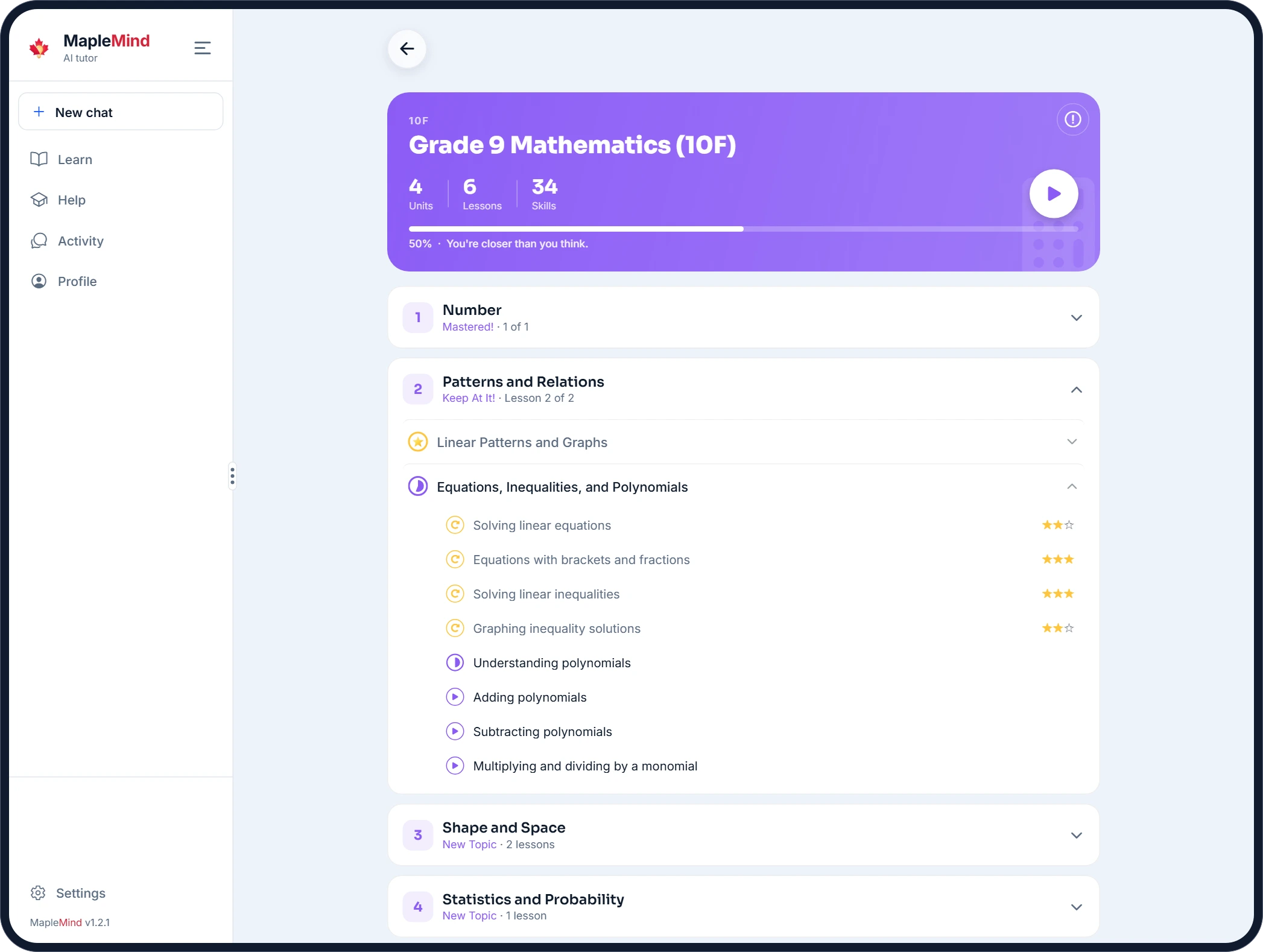
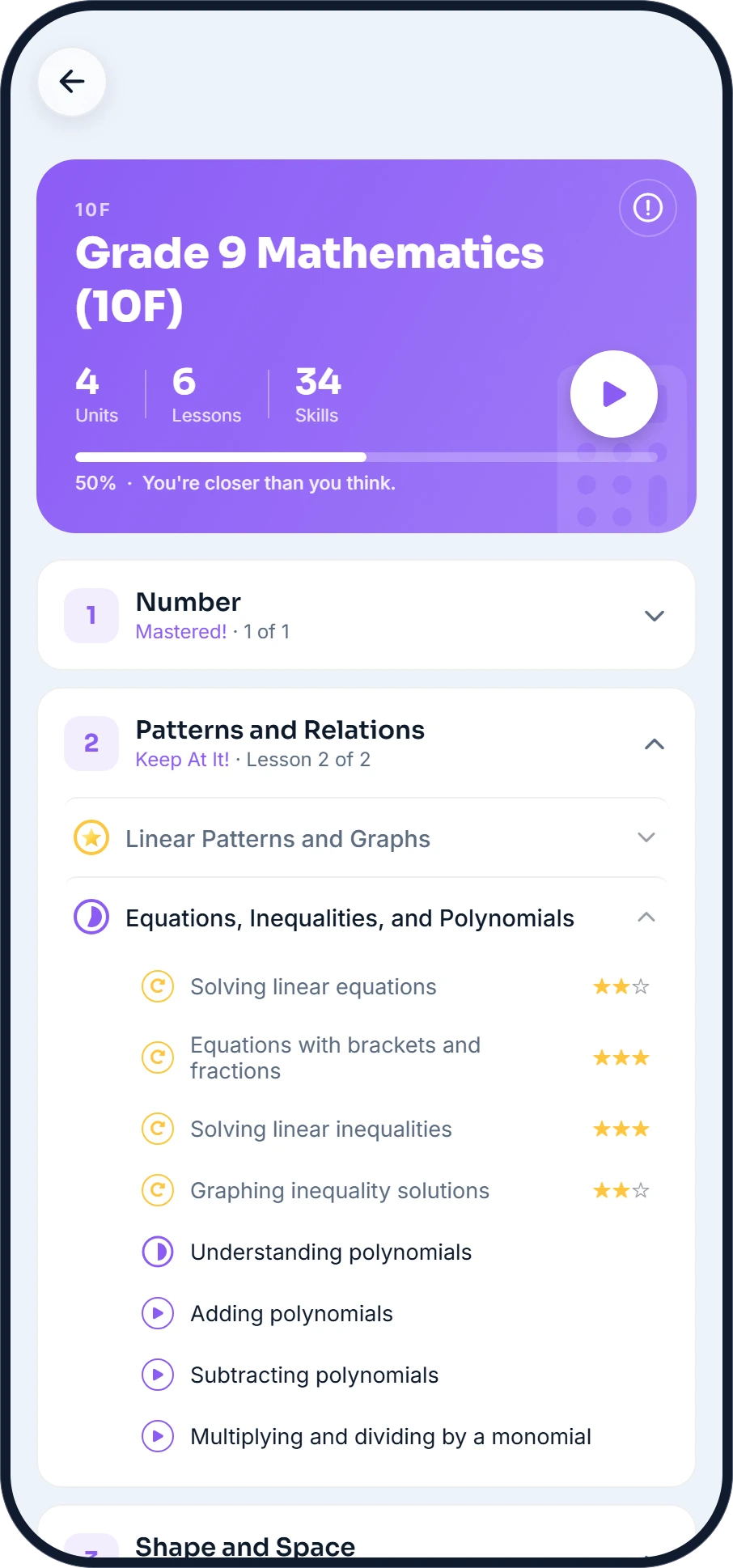
Grade 9 Mathematics (10F) in MapleMind on a tablet: its units and lessons in order, a student partway through.Grade 9 Mathematics (10F) in MapleMind on a phone: its units and lessons in order, a student partway through.
Their course, unit by unit, the way Manitoba teaches it.Shown: Grade 9 Mathematics (10F)
Homework Help on a tablet: a photo of a worksheet, the tutor’s worked example of a two-step equation, and a question back to the student.Homework Help on a phone: a photo of a worksheet, the tutor’s worked example of a two-step equation, and a question back to the student.
Homework Help: they take a photo of the question, and the tutor works through it with them.
The Parent Dashboard on a tablet: a student’s days studied, streak, lessons, quiz average and recent activity.The Parent Dashboard on a phone: a student’s days studied, streak, lessons, quiz average and recent activity.
The Parent Dashboard: how each child’s week went, in lessons, quizzes and days studied.
A Grade 9 provincial mathematics exam on a tablet: a readiness score, the exam’s time and its next sitting.A Grade 9 provincial mathematics exam on a phone: a readiness score, the exam’s time and its next sitting.
A provincial exam: a practice sitting under the real time, and how ready they are.
The Learn tab on a tablet: a four-day streak, the week’s days, Homework Help, the next lesson and a review.The Learn tab on a phone: a four-day streak, the week’s days, Homework Help, the next lesson and a review.
The Learn tab: their week so far, and the next thing to do.

Help at home

Questions parents ask

What will my child learn in Grade 1 in Manitoba?

Math: Mathematics, Grade 1. Science: Science, Grade 1. English: English Language Arts, Grade 1. Social studies: Social Studies, Grade 1. That’s 177 skills in all, from Manitoba’s curriculum.

Does my child write a provincial exam in Grade 1?

No. Manitoba has no provincial exam in Grade 1.

Where does this list come from?

From Manitoba’s official curriculum, the documents its education ministry publishes for each course. Each skill here is one of their expectations, written in plain words.

Can MapleMind help my child in Grade 1?

Yes. Every course on this page is in MapleMind, with lessons, practice and a tutor that works through each step with them. A free account gets 30 messages and 4 activities a day.

Help with Grade 1, one skill at a time.

Every course on this page is in MapleMind, free with daily limits.