Get help with Social Studies, Grade 1
Most tutoring makes your child sit through material your child already knows. MapleMind flips that: pick the exact skill that's causing trouble — any of the 37 below — and the tutor teaches just that one, step by step, as many times as it takes. Ask questions in plain words, any time of day, in English, French, or 12 other languages.
The official Manitoba Social Studies, Grade 1 curriculum
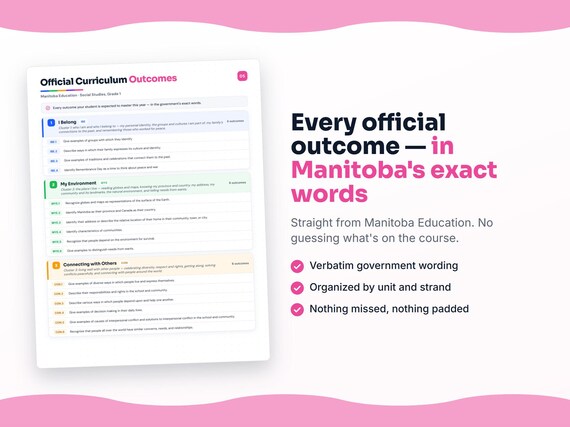
Manitoba defines Social Studies, Grade 1 by strands and outcomes. MapleMind teaches the same curriculum reorganized for one-skill-at-a-time tutoring — the table shows exactly where every official strand lands, and the ministry's own wording is quoted under each unit below.
Official source Manitoba's official curriculumRead it on the government site — edu.gov.mb.ca ↗| Official strand | Outcomes | Where MapleMind teaches it |
|---|---|---|
| Strand C1 | 8 | I Belong |
| Strand C2 | 18 | My Environment |
| Strand C3 | 11 | Connecting with Others |
Every skill below, taught one on one.
 Try the first session free
How MapleMind teaches Social Studies, Grade 1 — every unit, lesson, and skill
Every skill below runs as a short session: a plain-words lesson, a worked example, solving it together, then a five-question skill check that earns up to three stars. Guided Mode keeps it teaching instead of answer-handing — turning it off needs a parent's password.
Unit 1I BelongOfficial strand · Strand C1
Cluster 1: who I am and who I belong to — my personal identity, the groups and cultures I am part of, my family's connections to the past, and remembering those who worked for peace.
Personal Identity
- Groups I belong toKI-007 — Give examples of the groups the child identifies with, such as their family, class, team, or club.
- My First Nation, Inuit, or Métis communityKI-007A — Recognize, for children who are First Nation, Inuit, or Métis, that they are members of that community.
- My francophone communityKI-007F — Recognize, for children who are francophone, that they are members of a francophone community.
Cultural Expressions
- How my family shows its cultureKI-009 — Describe ways in which the child's family expresses its culture and identity.
Connections to the Past
- Traditions that connect us to the pastKH-017 — Give examples of traditions and celebrations that connect the child to the past.
- Francophone stories across generationsKH-017F — Recognize, for francophone children, that the stories, traditions, and celebrations of the francophone community connect them to previous generations.
- My family across generationsKH-018 — Identify the child's family connections to previous generations.
Remembrance Day
- Remembrance DayKC-004 — Identify Remembrance Day as a time to think about peace and war.
The official wording — 8 outcomes in this unit
- KI-007
Give examples of groups with which they identify
- KI-007A
Recognize that they are members of a First Nation, Inuit, or Métis community.
- KI-007F
Recognize that they are members of a francophone community.
- KI-009
Describe ways in which their family expresses its culture and identity.
- KH-017
Give examples of traditions and celebrations that connect them to the past.
- KH-017F
Recognize that stories, traditions, and celebrations of the francophone community connect them to previous generations.
- KH-018
Identify family connections to previous generations.
- KC-004
Identify Remembrance Day as a time to think about peace and war.
Unit 2My EnvironmentOfficial strand · Strand C2
Cluster 2: the place I live — reading globes and maps, knowing my province and country, my address, my community and its landmarks, the natural environment, and telling needs from wants.
Globes and Maps
- Globes and maps show the EarthKL-014 — Recognize globes and maps as representations of the surface of the Earth.
- Land and water on mapsKL-015 — Distinguish land and water masses on globes and maps.
My Province and Country
- My province and my countryKC-001 — Identify Manitoba as the child's province and Canada as their country.
- Canada's two official languagesKC-002 — Recognize English and French as the two official languages of Canada.
- The language of my First Nation, Inuit, or Métis communityKC-002A — Identify the language spoken in the child's First Nation, Inuit, or Métis community.
- Canada's anthemKC-003 — Recite the words to Canada's national anthem in English or French.
- Canada's anthem in my community's languageKC-003A — Recite the words to Canada's national anthem in the child's First Nation, Inuit, or Métis language.
My Address
- Where my home isKL-013 — Identify the child's address or describe the relative location of their home in their community, town, or city.
My Community
- What makes a communityKI-008 — Identify characteristics of communities.
- Landmarks near meKL-016 — Identify and locate landmarks and significant places using relative terms.
- Local Aboriginal landmarksKL-016A — Identify local Aboriginal landmarks and significant places.
- Local francophone landmarksKL-016F — Identify local francophone landmarks and significant places.
The Natural Environment
- We depend on the environmentKL-012 — Recognize that people depend on the environment for survival.
- The seasons change how we liveKH-019 — Describe how the repeating patterns of the seasons influence the child's life.
Needs and Wants
- Needs and wantsKE-027 — Give examples to distinguish needs from wants.
- How ads change what we wantKE-028 — Give examples of how media may influence the child's needs, wants, and choices.
- Sharing the workKE-029 — Describe ways in which work may be shared in families, schools, and communities.
- Caring for our thingsKE-030 — Recognize the need to care for personal property.
The official wording — 18 outcomes in this unit
- KL-014
Recognize globes and maps as representations of the surface of the Earth.
- KL-015
Distinguish land and water masses on globes and maps.
- KC-001
Identify Manitoba as their province and Canada as their country.
- KC-002
Recognize English and French as the two official languages of Canada.
- KC-002A
Identify the language spoken in their First Nation, Inuit, or Métis community.
- KC-003
Recite the words to Canada’s national anthem in English or French.
- KC-003A
Recite the words to Canada’s national anthem in their First Nation, Inuit, or Métis language.
- KL-013
Identify their address or describe the relative location of their home in their community, town, or city.
- KI-008
Identify characteristics of communities.
- KL-016
Identify and locate landmarks and significant places using relative terms.
- KL-016A
Identify local Aboriginal landmarks and significant places.
- KL-016F
Identify local francophone landmarks and significant places.
- KL-012
Recognize that people depend on the environment for survival.
- KH-019
Describe how the repeating patterns of the seasons influence their lives.
- KE-027
Give examples to distinguish needs from wants.
- KE-028
Give examples of how media may influence their needs, wants, and choices.
- KE-029
Describe ways in which work may be shared in families, schools, and communities.
- KE-030
Recognize the need to care for personal property.
Unit 3Connecting with OthersOfficial strand · Strand C3
Cluster 3: living well with other people — celebrating diversity, respect and rights, getting along, solving conflicts peacefully, and connecting with people around the world.
Diversity
- Different ways people liveKI-010 — Give examples of diverse ways in which people live and express themselves.
- How communities are alikeKI-011 — Identify similarities between diverse communities.
Respect, Responsibility, Rights
- My rights and responsibilitiesKC-005 — Describe the child's responsibilities and rights in the school and community.
Living with Others
- How we help each otherKC-006 — Describe various ways in which people depend upon and help one another.
Getting Along
- Making decisionsKP-022 — Give examples of decision making in the child's daily life.
- How we affect each otherKP-023 — Describe how other people may influence the child's life and how they may influence the lives of others.
- Why we have rulesKP-024 — Explain the purposes of rules and laws in the school and community.
Conflict Resolution
- Solving disagreementsKP-025 — Give examples of causes of interpersonal conflict and solutions to it in the school and community.
- Dealing with bullyingKP-026 — Identify ways to deal with bullying.
Global Connections
- People everywhere are alikeKG-020 — Recognize that people all over the world have similar concerns, needs, and relationships.
- My connections to the worldKG-021 — Identify relationships or connections the child has with people in other places in the world.
The official wording — 11 outcomes in this unit
- KI-010
Give examples of diverse ways in which people live and express themselves.
- KI-011
Identify similarities between diverse communities.
- KC-005
Describe their responsibilities and rights in the school and community.
- KC-006
Describe various ways in which people depend upon and help one another.
- KP-022
Give examples of decision making in their daily lives.
- KP-023
Describe how other people may influence their lives and how they may influence the lives of others.
- KP-024
Explain purposes of rules and laws in the school and community.
- KP-025
Give examples of causes of interpersonal conflict and solutions to interpersonal conflict in the school and community.
- KP-026
Identify ways to deal with bullying.
- KG-020
Recognize that people all over the world have similar concerns, needs, and relationships.
- KG-021
Identify relationships or connections they have with people in other places in the world.
Printable workbook · A keepsake of the year
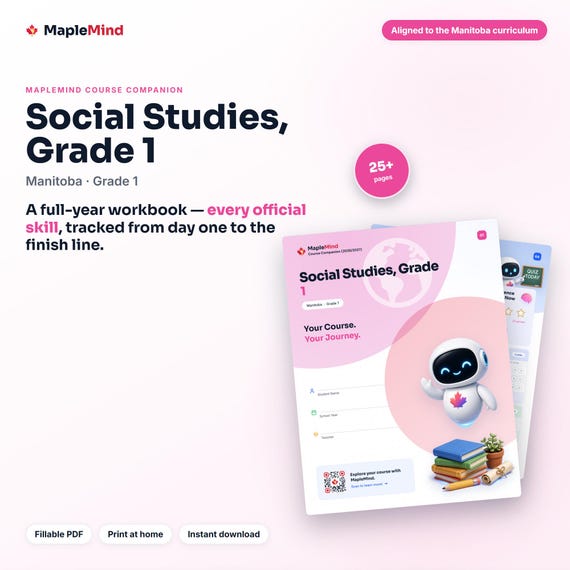
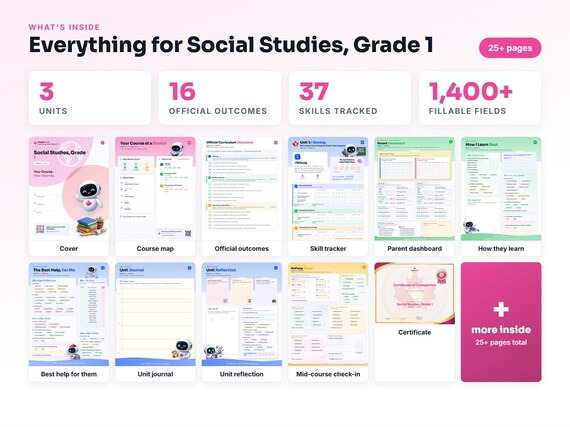
A Social Studies, Grade 1 workbook worth keeping
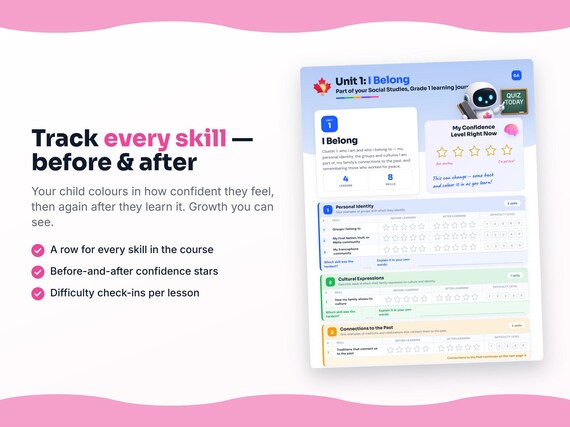
Built from the same official curriculum as this page. Before and after each skill above, your student colours in how sure they feel — so the two of you can see, on one page, what's clicking and what needs another look. It's a quiet way to follow how the year is really going.
By June it's full of their own handwriting: units worked through, confidence grown, a mid-year check-in, notes from parent-teacher night, and a certificate at the end. Less a worksheet, more a record of the year worth keeping on the shelf.
Instant download · see every page, reviews and the full description · five or more workbooks are $2.99 each
What it looks like in the app



Common questions
Can MapleMind help my child with Social Studies, Grade 1?
Yes. MapleMind's AI tutor covers all 37 skills in Manitoba's Social Studies, Grade 1 — your child picks the exact skill, and the tutor teaches it step by step: a short lesson, a worked example, solving together, then a skill check to show it stuck.
Is MapleMind aligned to Manitoba's official curriculum?
Yes. Every skill in this course maps to an official outcome code from Manitoba's Grade 1 Social Studies curriculum, and the ministry's own wording is quoted under each unit on this page — with the official government source linked so you can check it yourself.
What does MapleMind cost?
It's free to start — 5 tutoring chats and a practice quiz every day, no credit card. A Pro subscription ($9.99/month or $49.99/year CAD, 7-day free trial) unlocks unlimited tutoring, practice, and exam simulations.
What if my child is stuck on just one topic?
That's the point of skill-level tutoring: open Social Studies, Grade 1 in the app, tap the exact skill from the list on this page, and the tutor teaches just that — no wading through lessons your child doesn't need.
Does MapleMind work in French or other languages?
Yes — 14 languages, including French. Both the app and the tutor's explanations switch to the language your child chooses.
Where can I see the official Manitoba curriculum for Social Studies, Grade 1?
The official source is linked on this page — Manitoba's official curriculum. The outline here follows it: every MapleMind skill carries its official outcome code, and the ministry's own wording is quoted under each unit.
Keep exploring
Ready when you are
Pick a skill from this page and see it taught properly — free, in the browser, in under a minute.