Get help with Science, Grade 1
Most tutoring makes your child sit through material your child already knows. MapleMind flips that: pick the exact skill that's causing trouble — any of the 63 below — and the tutor teaches just that one, step by step, as many times as it takes. Ask questions in plain words, any time of day, in English, French, or 12 other languages.
The official Manitoba Science, Grade 1 curriculum
Manitoba defines Science, Grade 1 by strands and outcomes. MapleMind teaches the same curriculum reorganized for one-skill-at-a-time tutoring — the table shows exactly where every official strand lands, and the ministry's own wording is quoted under each unit below.
Official source Manitoba's official curriculumRead it on the government site — edu.gov.mb.ca ↗| Official strand | Outcomes | Where MapleMind teaches it |
|---|---|---|
| Strand 0 | 5 | Scientific Skills and Inquiry |
| Strand 1 | 15 | Characteristics and Needs of Living Things |
| Strand 2 | 15 | The Senses |
| Strand 3 | 11 | Characteristics of Objects and Materials |
| Strand 4 | 17 | Daily and Seasonal Changes |
Every skill below, taught one on one.
 Try the first session free
How MapleMind teaches Science, Grade 1 — every unit, lesson, and skill
Every skill below runs as a short session: a plain-words lesson, a worked example, solving it together, then a five-question skill check that earns up to three stars. Guided Mode keeps it teaching instead of answer-handing — turning it off needs a parent's password.
Unit 1Scientific Skills and InquiryOfficial strand · Strand 0
The hands-on doing of science in Grade 1 - measuring with everyday things, making simple picture graphs, and building an object to solve a problem.
Measuring With Everyday Things
- Measuring and building with tools1-0-5b — Use everyday materials and simple tools to measure things and to build with them.
- Timing how long things take1-0-5c — Estimate and measure how long an activity takes using non-standard units, and compare how long different activities take.
- Measuring how long things are1-0-5d — Choose a good non-standard unit and use it to estimate and measure length.
Picture Graphs and Building
- Making picture graphs1-0-6a — Build concrete-object graphs and pictographs where one object or picture stands for one thing.
- Building something to solve a problem1-0-4b — Construct an object or device to solve a problem or meet a need.
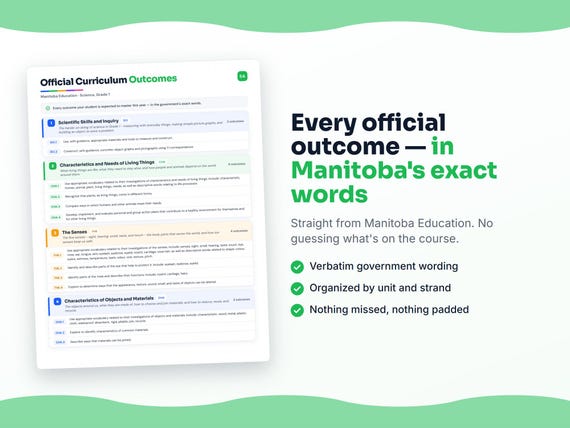
The official wording — 5 outcomes in this unit
- 1-0-5b
Use, with guidance, appropriate materials and tools to measure and construct.
- 1-0-5c
Estimate and measure the passage of time using non-standard units, and compare the duration of activities.
- 1-0-5d
Select an appropriate non-standard unit, and estimate and measure length.
- 1-0-6a
Construct, with guidance, concrete-object graphs and pictographs using 1:1 correspondence.
- 1-0-4b
Construct an object or device to solve a problem or meet a need.
Unit 2Characteristics and Needs of Living ThingsOfficial strand · Strand 1
What living things are like, what they need to stay alive, and how people and animals depend on the world around them.
Living Things and What They Need
- Words for living things1-1-01 — Use words like characteristic, human, animal, plant, living thing, and needs to talk about living things.
- Parts of the human body1-1-02 — Identify major parts of the human body and describe what each one does.
- How humans and animals are alike1-1-03 — Identify and describe common characteristics of humans and other animals they have observed.
- What makes each person special1-1-04 — Identify and appreciate the variations that make each human unique.
Plants, Life, and Needs
- Plants come in many forms1-1-05 — Recognize that plants, as living things, come in different forms.
- How living things are the same inside1-1-06 — Observe and identify similarities in life processes between themselves and other living things.
- Living things have needs1-1-07 — Recognize that plants, animals, and humans, as living things, have particular needs.
- Caring for a pet or plant1-1-08 — Describe what is needed to care for a pet, a farm animal, or an indoor plant.
Meeting Needs in the Environment
- How people and animals meet their needs1-1-09 — Compare ways in which humans and other animals meet their needs.
- We depend on the world around us1-1-10 — Describe how humans and other living things depend on their environment to meet their needs.
- Designing a home for a Manitoba animal1-1-11 — Design a representation of an environment that meets the needs of a Manitoba animal.
- Jobs that need to know living things1-1-12 — Identify hobbies and jobs that require knowledge of the needs of living things.
A Healthy World for Living Things
- Plans for a healthy environment1-1-13 — Develop, carry out, and evaluate personal and group action plans that keep the environment healthy for living things.
- Being gentle with living things1-1-14 — Show respect for living things in their immediate environment.
- Real science or make-believe?1-1-15 — Recognize that some information about living things is not scientific in nature.
The official wording — 15 outcomes in this unit
- 1-1-01
Use appropriate vocabulary related to their investigations of characteristics and needs of living things. Include: characteristic, human, animal, plant, living things, needs, as well as descriptive words relating to life processes.
- 1-1-02
Identify major parts of the human body and describe their functions.
- 1-1-03
Identify and describe common characteristics of humans and other animals they have observed.
- 1-1-04
Identify and appreciate variations that make each human unique.
- 1-1-05
Recognize that plants, as living things, come in different forms.
- 1-1-06
Observe and identify similarities in life processes between themselves and other living things.
- 1-1-07
Recognize that plants, animals, and humans, as living things, have particular needs.
- 1-1-08
Describe what is needed to care for a pet, a farm animal, or an indoor plant.
- 1-1-09
Compare ways in which humans and other animals meet their needs.
- 1-1-10
Describe how humans and other living things depend on their environment to meet their needs.
- 1-1-11
Design a representation of an environment that meets the needs of a Manitoba animal.
- 1-1-12
Identify hobbies and jobs that require knowledge of the needs of living things.
- 1-1-13
Develop, implement, and evaluate personal and group action plans that contribute to a healthy environment for themselves and for other living things.
- 1-1-14
Show respect for living things in their immediate environment.
- 1-1-15
Recognize that some information they receive about living things is not scientific in nature.
Unit 3The SensesOfficial strand · Strand 2
The five senses - sight, hearing, smell, taste, and touch - the body parts that sense the world, and how our senses keep us safe.
Our Five Senses
- Words for the senses1-2-01 — Use words for the senses and for the body parts and sensations that go with them.
- The five senses and their body parts1-2-02 — Identify the five senses and describe the main body parts associated with each.
- Sorting things with our senses1-2-03 — Use the senses to sort and classify objects.
How Our Sense Parts Work
- Parts that protect the eye1-2-04 — Identify and describe the parts of the eye that help protect it.
- Sensitive fingertips1-2-05 — Recognize that fingertips are especially sensitive to touch.
- The outside of the ear1-2-06 — Identify the external part of the ear and explore what it does.
- Smelling safely1-2-07 — Use smell to identify familiar substances, following safe procedures.
Nose, Tongue, and Staying Safe
- Parts of the nose1-2-08 — Identify parts of the nose and describe their functions.
- How we taste1-2-09 — Identify the body parts involved directly and indirectly in tasting.
- Keeping our senses safe1-2-10 — Identify objects and procedures that protect the body and preserve each of the senses.
Senses in the World
- Changing how things seem1-2-11 — Explore ways that the appearance, texture, sound, smell, and taste of objects can be altered.
- When senses help and when they trick us1-2-12 — Describe ways in which the senses can both protect and mislead.
- Helpers for our senses1-2-13 — Recognize that humans have different sensing capabilities and can use aids to assist them.
- We sense things differently1-2-14 — Recognize that humans may have different interpretations of similar sensory observations.
- Senses in jobs and hobbies1-2-15 — Give examples of how the senses are important in activities, hobbies, and jobs.
The official wording — 15 outcomes in this unit
- 1-2-01
Use appropriate vocabulary related to their investigations of the senses. Include: senses, sight, smell, hearing, taste, touch, eye, nose, ear, tongue, skin, eyelash, eyebrow, eyelid, nostril, cartilage, nose hair, as well as descriptive words related to shape, colour, lustre, wetness, temperature, taste, odour, size, texture, pitch.
- 1-2-02
Identify the five senses and describe the main body parts with which they are associated. Include: sight and eyes; smell and nose; hearing and ears; taste and tongue; touch and skin.
- 1-2-03
Use their senses to sort and classify objects.
- 1-2-04
Identify and describe parts of the eye that help to protect it. Include: eyelash, eyebrow, eyelid.
- 1-2-05
Recognize that their fingertips are especially sensitive to touch.
- 1-2-06
Identify the external part of the ear, and explore to determine its function.
- 1-2-07
Use smell to identify familiar substances, following safe procedures.
- 1-2-08
Identify parts of the nose and describe their functions. Include: nostril, cartilage, hairs.
- 1-2-09
Identify parts of the body that are involved directly and indirectly in tasting. Include: the tongue is involved directly, the nose is involved indirectly.
- 1-2-10
Identify objects and procedures that protect the body and preserve each of the senses in explorations and in daily life.
- 1-2-11
Explore to determine ways that the appearance, texture, sound, smell, and taste of objects can be altered.
- 1-2-12
Describe ways in which the senses can both protect and mislead.
- 1-2-13
Recognize and appreciate that humans have different capabilities for sensing the environment and can use aids to assist them.
- 1-2-14
Recognize and appreciate that humans may have different interpretations of similar sensory observations.
- 1-2-15
Give examples of how the senses are important in various activities, hobbies, and jobs.
Unit 4Characteristics of Objects and MaterialsOfficial strand · Strand 3
The objects around us, what they are made of, how to choose and join materials, and how to reduce, reuse, and recycle.
Objects and What They Are Made Of
- Words for objects and materials1-3-01 — Use words like wood, metal, plastic, cloth, waterproof, absorbent, rigid, pliable, join, and recycle.
- Describing materials by feel and look1-3-02 — Explore and describe characteristics of materials using sensory observations.
- The object and its material1-3-03 — Distinguish between an object and the materials used to construct it.
- What familiar objects are made of1-3-04 — Identify materials that make up familiar objects.
Choosing the Right Material
- Finding what materials can do1-3-05 — Explore to identify characteristics of common materials.
- The same material, similar jobs1-3-06 — Give examples of how the same material can serve a similar function in different objects.
- Testing which material is best1-3-07 — Test and evaluate the suitability of materials for a particular function.
- The best object for a task1-3-08 — Evaluate and describe the usefulness of common objects for a specific task.
Joining Materials and Recycling
- Ways to join materials1-3-09 — Describe ways that materials can be joined.
- Building a useful object1-3-10 — Use the design process to construct a useful object by selecting, combining, joining, and shaping materials.
- Reduce, reuse, recycle1-3-11 — Demonstrate ways to reduce, reuse, and recycle materials during classroom experiences.
The official wording — 11 outcomes in this unit
- 1-3-01
Use appropriate vocabulary related to their investigations of objects and materials. Include: characteristic, wood, metal, plastic, cloth, waterproof, absorbent, rigid, pliable, join, recycle.
- 1-3-02
Explore and describe characteristics of materials using their sensory observations.
- 1-3-03
Distinguish between an object and the materials used to construct it.
- 1-3-04
Identify materials that make up familiar objects.
- 1-3-05
Explore to identify characteristics of common materials.
- 1-3-06
Give examples that show how the same material can serve a similar function in different objects.
- 1-3-07
Test and evaluate the suitability of materials for a particular function.
- 1-3-08
Evaluate and describe the usefulness of common objects for a specific task.
- 1-3-09
Describe ways that materials can be joined.
- 1-3-10
Use the design process to construct a useful object by selecting, combining, joining, and shaping materials.
- 1-3-11
Demonstrate ways to reduce, reuse, and recycle materials during classroom learning experiences.
Unit 5Daily and Seasonal ChangesOfficial strand · Strand 4
How the Sun, day and night, shadows, and the four seasons change over time, and how people, plants, and animals get ready for those changes.
The Sun, Day, and Night
- Words for changes over time1-4-01 — Use words like Sun, light, heat, day, night, morning, seasons, shadow, and cycle.
- The Sun gives light and heat1-4-02 — Recognize that the Sun is a source of light and heat.
- Day time and night time1-4-03 — Recognize that a day has day time and night time based on the presence or absence of sunlight.
- How shadows are made1-4-05 — Recognize that shadows are caused by blocking light.
Watching the Day Change
- Putting events in order1-4-04 — Sequence and record events and activities that occur over a day, a week, or a year.
- How the Sun seems to move1-4-06 — Observe and describe how the Sun appears to change position over the course of a day.
- Temperature through the day1-4-07 — Record, describe, and compare changes in temperature at different times of the day.
- Living things through the day1-4-08 — Investigate and describe changes in characteristics and behaviours of living things throughout a day.
The Four Seasons
- Comparing the seasons1-4-09 — Compare characteristics of the four seasons.
- Getting ready for the seasons1-4-10 — Describe how humans prepare for seasonal changes.
- People who help with the seasons1-4-11 — Identify people who help us prepare for and deal with seasonal changes.
- How buildings keep us comfortable1-4-12 — Identify features of buildings that help keep humans sheltered and comfortable through daily and seasonal cycles.
Living With the Seasons
- Dressing for each season1-4-13 — Sort clothing to suit each season, and justify their decisions.
- Staying safe in the weather1-4-14 — Describe safety precautions related to daily weather, the changing seasons, and weather extremes.
- Activities in any season1-4-15 — Describe how humans are able to participate in non-seasonal activities.
- How Manitoba plants and animals change1-4-16 — Identify physical and behavioural changes that occur seasonally among Manitoba plants and animals, and discuss reasons.
- Building to help a Manitoba animal1-4-17 — Use the design process to construct a device or structure that helps a Manitoba animal adjust to seasonal changes.
The official wording — 17 outcomes in this unit
- 1-4-01
Use appropriate vocabulary related to changes over time. Include: Sun, light, heat, day, day time, night time, morning, afternoon, days of the week, yesterday, today, tomorrow, seasons, shadow, characteristic, behaviour, living things, cycle.
- 1-4-02
Recognize that the Sun is a source of light and heat.
- 1-4-03
Recognize that a day is divided into day time and night time based on the presence or absence of sunlight.
- 1-4-05
Recognize that shadows are caused by blocking light.
- 1-4-04
Sequence and record events and activities that occur over the course of a day, a week, or a year.
- 1-4-06
Observe and describe how the Sun appears to change position over the course of a day.
- 1-4-07
Record, describe, and compare changes in temperature at different times of the day.
- 1-4-08
Investigate and describe changes that occur in characteristics and behaviours of living things throughout a day.
- 1-4-09
Compare characteristics of the four seasons.
- 1-4-10
Describe how humans prepare for seasonal changes.
- 1-4-11
Identify people who help us prepare for and deal with seasonal changes.
- 1-4-12
Identify features of buildings that help keep humans sheltered and comfortable throughout daily and seasonal cycles.
- 1-4-13
Sort clothing to suit each season, and justify their decisions.
- 1-4-14
Describe safety precautions related to daily weather, the changing of the seasons, and weather extremes.
- 1-4-15
Describe how humans are able to participate in non-seasonal activities.
- 1-4-16
Identify physical and behavioural changes that occur seasonally among Manitoba plants and animals, and discuss possible reasons for these changes.
- 1-4-17
Use the design process to construct a device or structure that helps a Manitoba animal adjust to seasonal changes.
Printable workbook · A keepsake of the year
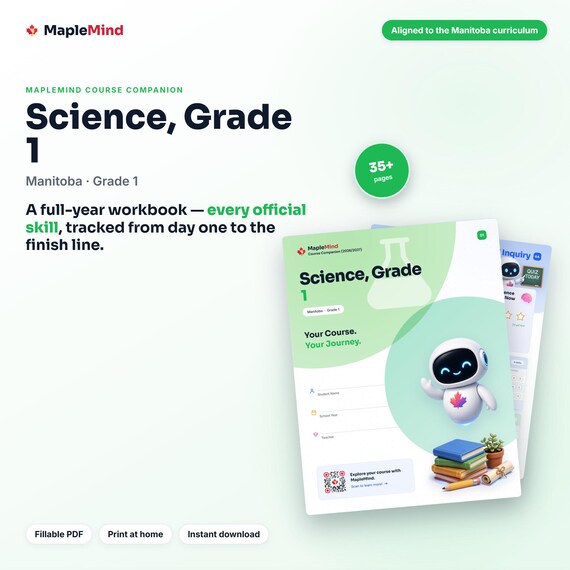
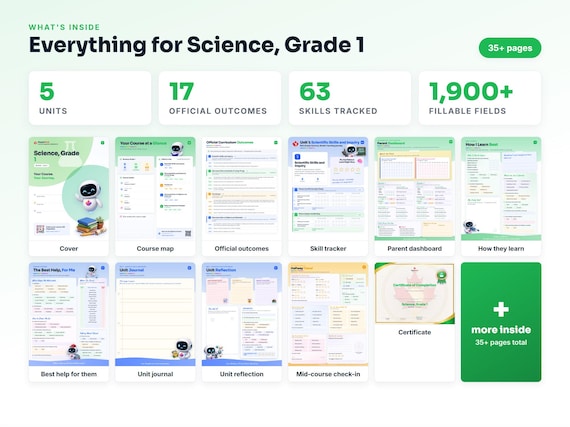
A Science, Grade 1 workbook worth keeping
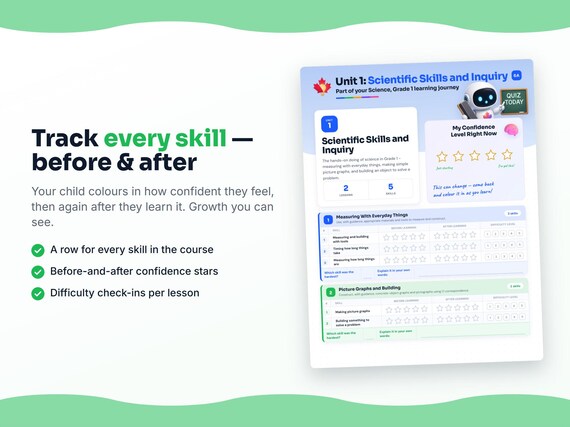
Built from the same official curriculum as this page. Before and after each skill above, your student colours in how sure they feel — so the two of you can see, on one page, what's clicking and what needs another look. It's a quiet way to follow how the year is really going.
By June it's full of their own handwriting: units worked through, confidence grown, a mid-year check-in, notes from parent-teacher night, and a certificate at the end. Less a worksheet, more a record of the year worth keeping on the shelf.
Instant download · see every page, reviews and the full description · five or more workbooks are $2.99 each
What it looks like in the app



Common questions
Can MapleMind help my child with Science, Grade 1?
Yes. MapleMind's AI tutor covers all 63 skills in Manitoba's Science, Grade 1 — your child picks the exact skill, and the tutor teaches it step by step: a short lesson, a worked example, solving together, then a skill check to show it stuck.
Is MapleMind aligned to Manitoba's official curriculum?
Yes. Every skill in this course maps to an official outcome code from Manitoba's Grade 1 Science curriculum, and the ministry's own wording is quoted under each unit on this page — with the official government source linked so you can check it yourself.
What does MapleMind cost?
It's free to start — 5 tutoring chats and a practice quiz every day, no credit card. A Pro subscription ($9.99/month or $49.99/year CAD, 7-day free trial) unlocks unlimited tutoring, practice, and exam simulations.
What if my child is stuck on just one topic?
That's the point of skill-level tutoring: open Science, Grade 1 in the app, tap the exact skill from the list on this page, and the tutor teaches just that — no wading through lessons your child doesn't need.
Does MapleMind work in French or other languages?
Yes — 14 languages, including French. Both the app and the tutor's explanations switch to the language your child chooses.
Where can I see the official Manitoba curriculum for Science, Grade 1?
The official source is linked on this page — Manitoba's official curriculum. The outline here follows it: every MapleMind skill carries its official outcome code, and the ministry's own wording is quoted under each unit.
Keep exploring
Ready when you are
Pick a skill from this page and see it taught properly — free, in the browser, in under a minute.