Get help with Science, Grade 2
Most tutoring makes your child sit through material your child already knows. MapleMind flips that: pick the exact skill that's causing trouble — any of the 68 below — and the tutor teaches just that one, step by step, as many times as it takes. Ask questions in plain words, any time of day, in English, French, or 12 other languages.
The official Manitoba Science, Grade 2 curriculum
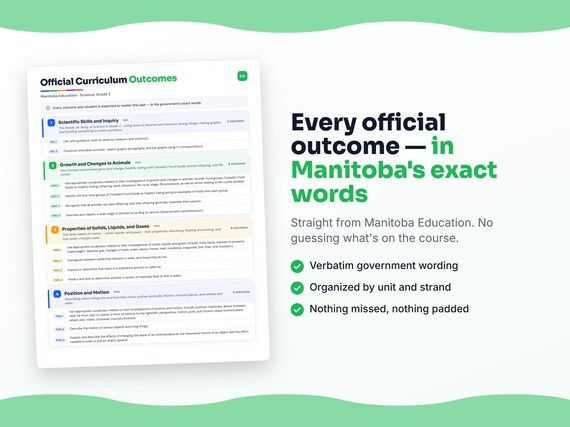
Manitoba defines Science, Grade 2 by strands and outcomes. MapleMind teaches the same curriculum reorganized for one-skill-at-a-time tutoring — the table shows exactly where every official strand lands, and the ministry's own wording is quoted under each unit below.
Official source Manitoba's official curriculumRead it on the government site — edu.gov.mb.ca ↗| Official strand | Outcomes | Where MapleMind teaches it |
|---|---|---|
| Strand 0 | 4 | Scientific Skills and Inquiry |
| Strand 1 | 17 | Growth and Changes in Animals |
| Strand 2 | 19 | Properties of Solids, Liquids, and Gases |
| Strand 3 | 14 | Position and Motion |
| Strand 4 | 14 | Air and Water in the Environment |
Every skill below, taught one on one.
 Try the first session free
How MapleMind teaches Science, Grade 2 — every unit, lesson, and skill
Every skill below runs as a short session: a plain-words lesson, a worked example, solving it together, then a five-question skill check that earns up to three stars. Guided Mode keeps it teaching instead of answer-handing — turning it off needs a parent's password.
Unit 1Scientific Skills and InquiryOfficial strand · Strand 0
The hands-on doing of science in Grade 2 - using tools to observe and measure, timing things, making graphs, and building something to solve a problem.
Tools and Timing
- Using tools to observe and measure2-0-5b — Use tools such as a ruler, balance, magnifying glass, and thermometer to observe, measure, and construct.
- Measuring time in minutes and hours2-0-5c — Estimate and measure the passage of time related to minutes and hours.
Graphs and Building
- Making graphs of our data2-0-6a — Construct and label concrete-object graphs, pictographs, and bar graphs using one-to-one correspondence.
- Building to solve a problem2-0-4b — Construct an object or device to solve a problem or meet a need.
The official wording — 4 outcomes in this unit
- 2-0-5b
Use, with guidance, tools to observe, measure, and construct.
- 2-0-5c
Estimate and measure the passage of time related to minutes and hours.
- 2-0-6a
Construct and label concrete- object graphs, pictographs, and bar graphs using 1:1 correspondence.
- 2-0-4b
Construct an object or device to solve a problem or meet a need.
Unit 2Growth and Changes in AnimalsOfficial strand · Strand 1
How humans and animals grow and change, healthy eating with Canada's Food Guide, animal offspring, and life cycles.
Growing Up and Eating Well
- Words for growth and changes2-1-01 — Use words like offspring, adult, behaviour, life cycle, stage, and life processes.
- What stays the same and what changes2-1-02 — Identify and describe constant and changing characteristics of humans as they grow and develop.
- We all grow at different rates2-1-03 — Recognize that all humans do not grow and develop at the same rate.
- Food gives us energy2-1-04 — Recognize that food is a form of energy and that healthy eating is essential for growth and development.
Food Groups and Where Food Comes From
- The four food groups2-1-05 — Identify the four food groups of Canada's Food Guide and give examples from each.
- Planning a healthy day of food2-1-06 — Plan a menu for one day based on the four food groups.
- Food from plants and animals2-1-07 — Recognize that foods humans eat come from plants and animals, and classify foods accordingly.
Baby Animals and Their Parents
- Offspring look like their parents2-1-08 — Recognize that all animals can have offspring, and that offspring generally resemble their parents.
- Young and grown animals2-1-09 — Compare the appearance of young and mature animals of the same type.
- How long to grow up2-1-10 — Compare the length of time from birth to adulthood for humans and other animals.
- How an animal changes as it grows2-1-11 — Identify and describe constant and changing characteristics of an animal as it grows and develops.
Sorting Animals and Life Cycles
- Sorting animals by their features2-1-12 — Describe and classify a wide range of animals according to various characteristics and behaviours.
- How animals care for their babies2-1-13 — Describe and compare ways different animals care for their offspring.
- A complete life cycle2-1-14 — Describe changes in appearance and activity as animals go through a complete life cycle.
- Comparing life cycles2-1-15 — Compare the life cycles of animals with similar and different life cycles.
- An animal's life processes2-1-16 — Observe and describe an animal's life processes.
- How people help animals2-1-17 — Identify and describe ways in which humans help other animals.
The official wording — 17 outcomes in this unit
- 2-1-01
Use appropriate vocabulary related to their investigations of growth and changes in animals. Include: food groups, Canada's Food Guide to Healthy Eating, offspring, adult, behaviour, life cycle, stage, life processes, as well as terms relating to life cycles studied.
- 2-1-02
Identify and describe constant and changing characteristics of humans as they grow and develop.
- 2-1-03
Recognize that all humans do not grow and develop at the same rate.
- 2-1-04
Recognize that food is a form of energy and that healthy eating is essential for growth and development.
- 2-1-05
Identify the four food groups of Canada's Food Guide to Healthy Eating and give examples of foods from each group.
- 2-1-06
Plan a menu for one day based on the four food groups outlined in Canada's Food Guide to Healthy Eating.
- 2-1-07
Recognize that foods humans eat come from plants and animals, and classify foods accordingly.
- 2-1-08
Recognize that all animals can have offspring, and that offspring generally resemble their parents.
- 2-1-09
Compare the appearance of young and mature animals of the same type.
- 2-1-10
Compare the length of time from birth to adulthood for humans and other animals.
- 2-1-11
Identify and describe constant and changing characteristics of an animal as it grows and develops.
- 2-1-12
Describe and classify a wide range of animals according to various characteristics and behaviours.
- 2-1-13
Describe and compare ways in which different animals care for their offspring.
- 2-1-14
Describe changes in the appearance and activity of various animals as they go through a complete life cycle. Include: an insect, a bird, an amphibian.
- 2-1-15
Compare the life cycles of animals that have similar life cycles and those that have different life cycles.
- 2-1-16
Observe and describe an animal's life processes. Include: eating habits, movement, rest patterns, breathing.
- 2-1-17
Identify and describe ways in which humans help other animals.
Unit 3Properties of Solids, Liquids, and GasesOfficial strand · Strand 2
The three states of matter - solids, liquids, and gases - their properties, dissolving, floating and sinking, and how water changes state.
Solids and Liquids
- Words for solids, liquids, and gases2-2-01 — Use words like solid, liquid, gas, dissolve, changes of state, freeze, melt, evaporate, float, sink, and buoyancy.
- Is it a solid or a liquid?2-2-02 — Identify substances, materials, and objects as solids or liquids.
- Properties of solids2-2-03 — Investigate and compare properties of familiar solids.
- Properties of liquids2-2-04 — Investigate and compare properties of familiar liquids.
- Comparing solids and liquids2-2-05 — Identify similarities and differences among properties of familiar solids and liquids.
Dissolving and Mixing
- Does it dissolve?2-2-06 — Distinguish between solids that dissolve in water and those that do not.
- How liquids behave2-2-07 — Explore interactions of familiar liquids with surfaces, powdered solids, and other liquids, and describe how these determine uses.
- Liquids we use at home2-2-08 — Identify liquids used in the home, and describe how they are used.
- Which material soaks up more?2-2-09 — Compare materials by their capacity to absorb liquids, and describe how this determines uses.
- Making things by mixing2-2-10 — Describe useful materials that are made by combining solids and liquids.
Air, Gases, and Changing Water
- Air is all around us2-2-11 — Explore to determine that there is a substance around us called air.
- Air is made of gases2-2-12 — Recognize that air is composed of several gases.
- Properties of gases2-2-13 — Identify properties of gases.
- Water changing state2-2-14 — Explore how water can change from one state to another and back again.
- When states stay and when they change2-2-15 — Recognize that states of solids and liquids stay constant in some circumstances and change in others.
- Getting rid of waste safely2-2-16 — Describe ways humans dispose of solids and liquids to maintain a clean, healthy environment.
Floating and Sinking
- Float or sink?2-2-17 — Predict and test whether materials float or sink in water.
- Making things float and sink2-2-18 — Demonstrate ways to make sinking materials float and floating materials sink.
- Building a boat that carries a load2-2-19 — Use the design process to construct an object that is buoyant and can support a given mass.
The official wording — 19 outcomes in this unit
- 2-2-01
Use appropriate vocabulary related to their investigations of solids, liquids, and gases. Include: solid, liquid, substance, property, mass/weight, dissolve, gas, changes of state, water vapour, freeze, melt, condense, evaporate, boil, float, sink, buoyancy.
- 2-2-02
Identify substances, materials, and objects as solids or liquids.
- 2-2-03
Investigate and compare properties of familiar solids. Include: have mass/weight, take up space, maintain their shape.
- 2-2-04
Investigate and compare properties of familiar liquids. Include: have mass/weight, take up space, have no definite shape.
- 2-2-05
Identify similarities and differences among properties of familiar solids and liquids.
- 2-2-06
Distinguish between solids that dissolve in water and those that do not.
- 2-2-07
Explore interactions of familiar liquids with different surfaces, powdered solids, and other liquids, and describe how these interactions determine their uses.
- 2-2-08
Identify liquids used in the home, and describe how they are used.
- 2-2-09
Compare different materials with respect to their capacity to absorb liquids, and describe how this capacity determines their uses.
- 2-2-10
Describe useful materials that are made by combining solids and liquids.
- 2-2-11
Explore to determine that there is a substance around us called air.
- 2-2-12
Recognize that air is composed of several gases
- 2-2-13
Identify properties of gases. Include: occupy the space not taken up by solids and liquids, have no definite shape.
- 2-2-14
Explore to determine how water can be made to change from one state to another and back again.
- 2-2-15
Recognize that the states of solids and liquids remain constant in some circumstances, but may change in other circumstances.
- 2-2-16
Describe ways humans dispose of solids and liquids to maintain a clean and healthy environment.
- 2-2-17
Predict and test to determine whether a variety of materials float or sink in water.
- 2-2-18
Demonstrate ways to make sinking materials float and floating materials sink.
- 2-2-19
Use the design process to construct an object that is buoyant and able to support a given mass/weight.
Unit 4Position and MotionOfficial strand · Strand 3
Describing where things are and how they move, pushes and pulls, friction, inclined planes, and wheels and axles.
Where Things Are
- Words for position and motion2-3-01 — Use words like position, push, pull, friction, slope, inclined plane, wheel, axle, and rotate.
- Describing where a still object is2-3-02 — Explore and describe the position of a stationary object with reference to themselves, other objects, or an area.
- When an object moves2-3-03 — Explore and describe changes in the position of an object relative to its start, themselves, or another object.
- Looking from another spot2-3-04 — Explore and describe the position of an object viewed from a different perspective.
- Changing your own view2-3-05 — Explore and describe how changing your own body position affects perspective on a stationary object.
Motion, Pushes, Pulls, and Friction
- Ways things move2-3-06 — Describe the motion of various objects and living things.
- Pushes and pulls2-3-07 — Recognize that position and motion can be changed by a push or pull, and the size of the change relates to the strength.
- Friction on different surfaces2-3-08 — Compare and describe the effects of friction on motion across different surfaces.
Ramps, Wheels, and Axles
- How a ramp's slope changes things2-3-09 — Explore the effects of changing the slope of an inclined plane on an object's motion and the effort to move it.
- Ramps that help people2-3-10 — Identify how humans use inclined planes to make motion easier.
- How wheels and axles move2-3-11 — Explore toys to determine how wheels and axles interact and move.
- Which way wheels turn2-3-12 — Recognize that a vehicle's wheels rotate clockwise or counterclockwise depending on its direction of motion.
- Wheels and axles that help people2-3-13 — Identify how humans use the wheel and axle to make movement easier.
- Building a vehicle with wheels2-3-14 — Use the design process to construct a vehicle with wheels and axles that meets given criteria.
The official wording — 14 outcomes in this unit
- 2-3-01
Use appropriate vocabulary related to their investigations of position and motion. Include: position, stationary, above, between, near, far from, next to, below, in front of, behind, to the right/left, perspective, motion, push, pull, friction, slope, inclined plane, wheel, axle, rotate, clockwise, counterclockwise.
- 2-3-02
Explore and describe the position of a stationary object with reference to themselves, to other objects, or to a specific area.
- 2-3-03
Explore and describe changes in the position of an object in relation to its original position, themselves, or another object.
- 2-3-04
Explore and describe the position of an object viewed from a perspective different from one's own.
- 2-3-05
Explore and describe how changing the position of one's own body affects perspective with reference to a stationary object.
- 2-3-06
Describe the motion of various objects and living things.
- 2-3-07
Recognize that the position and motion of an object can be changed by a push or a pull and the size of the change is related to the strength of the push or pull.
- 2-3-08
Compare and describe the effects of friction on the motion of objects and humans when travelling across different surfaces.
- 2-3-09
Explore and describe the effects of changing the slope of an inclined plane on the downward motion of an object and the effort needed to push or pull an object upward.
- 2-3-10
Identify how humans use inclined planes to make motion easier.
- 2-3-11
Explore toys to determine how wheels and axles interact and move.
- 2-3-12
Recognize that the wheels of a vehicle rotate clockwise or counterclockwise depending on the direction of motion of the vehicle.
- 2-3-13
Identify how humans use the wheel and axle to make movement easier.
- 2-3-14
Use the design process to construct a vehicle with wheels and axles that meets given criteria.
Unit 5Air and Water in the EnvironmentOfficial strand · Strand 4
Moving air and wind, water in the environment, the water cycle, drinking water, and keeping our air and water clean.
Moving Air and Wind
- Words for air and water2-4-01 — Use words like wind, air current, water cycle, evaporate, condense, and pollution.
- Air can move2-4-02 — Recognize that air can move.
- Signs of moving air2-4-03 — Observe and identify evidence of moving air indoors and outdoors.
- Good and bad effects of air changes2-4-04 — Identify positive and negative effects of changes in air temperature and movement.
- Building a wind device2-4-05 — Use the design process to construct and test a device that shows evidence of air movement.
Water and the Water Cycle
- Water all around us2-4-06 — Observe and identify examples of water in the environment.
- Water changing state and the water cycle2-4-07 — Describe evidence of water changing state and recognize these are part of the water cycle.
- What makes things dry faster2-4-08 — Investigate factors that cause things to dry quickly or slowly.
Clean Water and Clean Air
- Where drinking water comes from2-4-09 — Identify sources of drinking water and explain how it is distributed in communities.
- How people use water2-4-10 — Describe different uses of water by humans.
- Why clean air and water matter2-4-11 — Explain and appreciate the importance of clean air and water for living things.
- Pollution and how to reduce it2-4-12 — Identify substances that pollute air and water, and describe ways of reducing pollution.
- Clean water is precious2-4-13 — Recognize that clean water is an increasingly scarce resource and describe consequences of a shortage.
- Saving water at home2-4-14 — Record personal water use and identify ways to reduce it.
The official wording — 14 outcomes in this unit
- 2-4-01
Use appropriate vocabulary related to their investigations of air and water. Include: wind, air current, temperature, changes of state, water cycle, freeze, melt, condense, evaporate, sources of drinking water, pollution.
- 2-4-02
Recognize that air can move.
- 2-4-03
Observe and identify evidence of moving air in indoor and outdoor environments.
- 2-4-04
Identify positive and negative effects of changes in air temperature and air movement in indoor and outdoor environments.
- 2-4-05
Use the design process to construct and test a device that shows evidence of air movement.
- 2-4-06
Observe and identify examples of water in the environment.
- 2-4-07
Describe evidence of water changing state, and recognize that these changes are part of the water cycle.
- 2-4-08
Investigate to determine factors that cause things to dry quickly or slowly.
- 2-4-09
Identify sources of drinking water, and explain how this water is distributed in one's own and in other communities.
- 2-4-10
Describe different uses of water by humans.
- 2-4-11
Explain and appreciate the importance of clean air and water for humans, plants, and animals.
- 2-4-12
Identify substances that pollute air and water, and describe ways of reducing such pollution.
- 2-4-13
Recognize that clean water is an increasingly scarce resource in many parts of the world, and describe consequences of a shortage of clean water.
- 2-4-14
Record personal use of water, and identify ways in which they can reduce water usage.
Printable workbook · A keepsake of the year
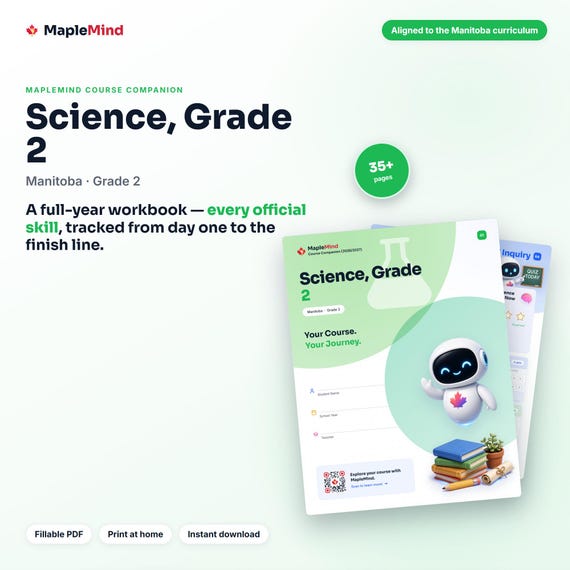
A Science, Grade 2 workbook worth keeping
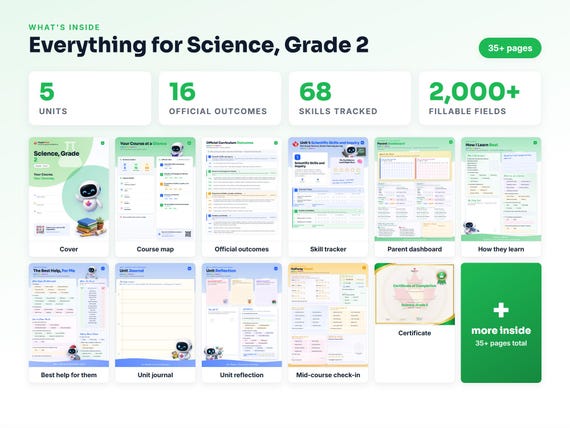
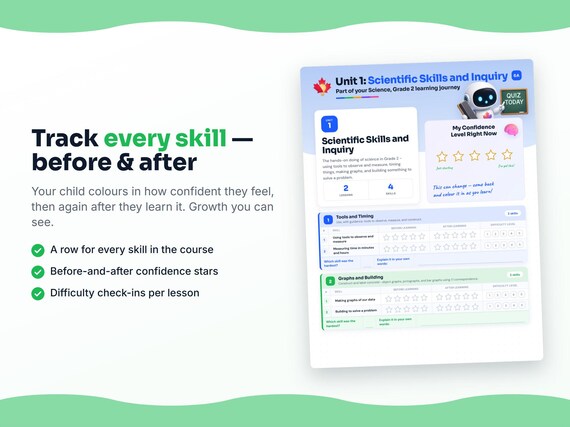
Built from the same official curriculum as this page. Before and after each skill above, your student colours in how sure they feel — so the two of you can see, on one page, what's clicking and what needs another look. It's a quiet way to follow how the year is really going.
By June it's full of their own handwriting: units worked through, confidence grown, a mid-year check-in, notes from parent-teacher night, and a certificate at the end. Less a worksheet, more a record of the year worth keeping on the shelf.
Instant download · see every page, reviews and the full description · five or more workbooks are $2.99 each
What it looks like in the app
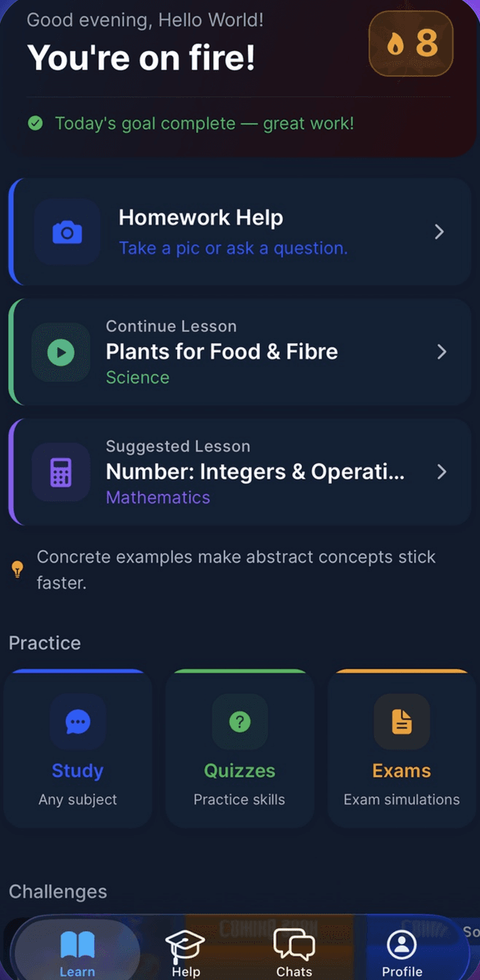
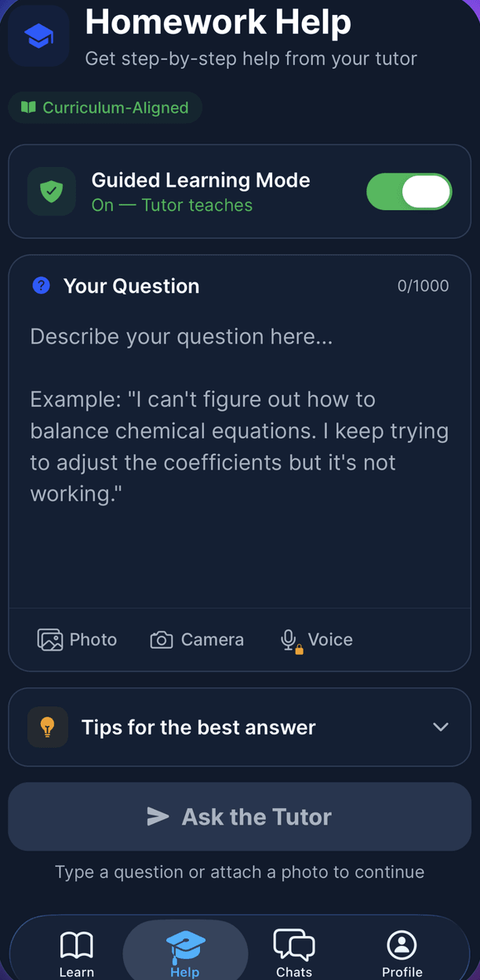
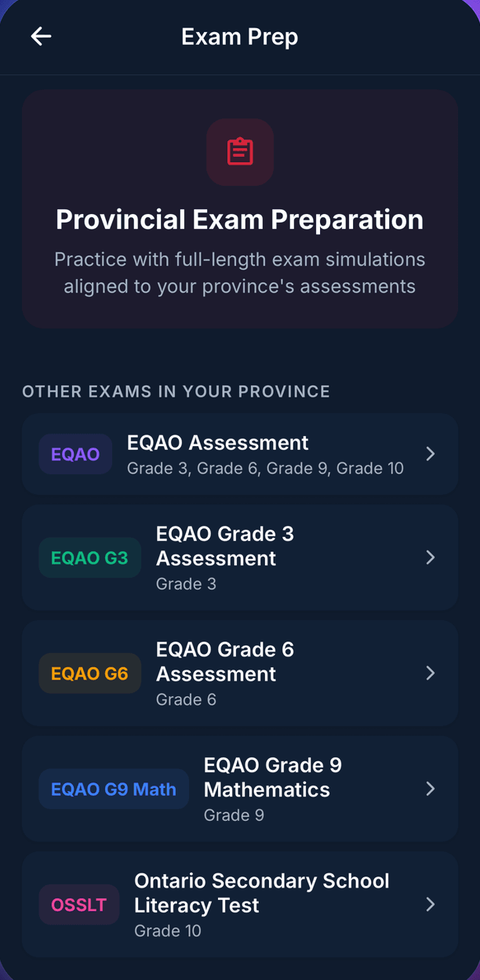
Common questions
Can MapleMind help my child with Science, Grade 2?
Yes. MapleMind's AI tutor covers all 68 skills in Manitoba's Science, Grade 2 — your child picks the exact skill, and the tutor teaches it step by step: a short lesson, a worked example, solving together, then a skill check to show it stuck.
Is MapleMind aligned to Manitoba's official curriculum?
Yes. Every skill in this course maps to an official outcome code from Manitoba's Grade 2 Science curriculum, and the ministry's own wording is quoted under each unit on this page — with the official government source linked so you can check it yourself.
What does MapleMind cost?
It's free to start — 5 tutoring chats and a practice quiz every day, no credit card. A Pro subscription ($9.99/month or $49.99/year CAD, 7-day free trial) unlocks unlimited tutoring, practice, and exam simulations.
What if my child is stuck on just one topic?
That's the point of skill-level tutoring: open Science, Grade 2 in the app, tap the exact skill from the list on this page, and the tutor teaches just that — no wading through lessons your child doesn't need.
Does MapleMind work in French or other languages?
Yes — 14 languages, including French. Both the app and the tutor's explanations switch to the language your child chooses.
Where can I see the official Manitoba curriculum for Science, Grade 2?
The official source is linked on this page — Manitoba's official curriculum. The outline here follows it: every MapleMind skill carries its official outcome code, and the ministry's own wording is quoted under each unit.
Keep exploring
Ready when you are
Pick a skill from this page and see it taught properly — free, in the browser, in under a minute.