Get help with Science, Grade 3
Most tutoring makes your child sit through material your child already knows. MapleMind flips that: pick the exact skill that's causing trouble — any of the 67 below — and the tutor teaches just that one, step by step, as many times as it takes. Ask questions in plain words, any time of day, in English, French, or 12 other languages.
The official Manitoba Science, Grade 3 curriculum
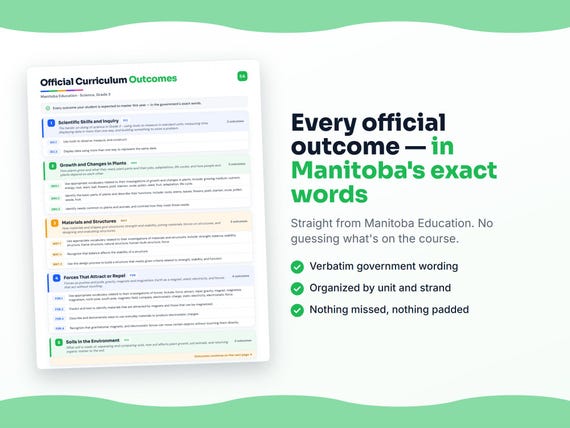
Manitoba defines Science, Grade 3 by strands and outcomes. MapleMind teaches the same curriculum reorganized for one-skill-at-a-time tutoring — the table shows exactly where every official strand lands, and the ministry's own wording is quoted under each unit below.
Official source Manitoba's official curriculumRead it on the government site — edu.gov.mb.ca ↗| Official strand | Outcomes | Where MapleMind teaches it |
|---|---|---|
| Strand 0 | 5 | Scientific Skills and Inquiry |
| Strand 1 | 18 | Growth and Changes in Plants |
| Strand 2 | 13 | Materials and Structures |
| Strand 3 | 19 | Forces That Attract or Repel |
| Strand 4 | 12 | Soils in the Environment |
Every skill below, taught one on one.
 Try the first session free
How MapleMind teaches Science, Grade 3 — every unit, lesson, and skill
Every skill below runs as a short session: a plain-words lesson, a worked example, solving it together, then a five-question skill check that earns up to three stars. Guided Mode keeps it teaching instead of answer-handing — turning it off needs a parent's password.
Unit 1Scientific Skills and InquiryOfficial strand · Strand 0
The hands-on doing of science in Grade 3 - using tools to measure in standard units, measuring time, displaying data in more than one way, and building something to solve a problem.
Measuring in Standard Units
- Using science tools3-0-5b — Use tools such as a ruler, balance, magnifying glass, thermometer, and magnet to observe, measure, and construct.
- Measuring mass, length, volume, and temperature3-0-5c — Estimate and measure mass, length, volume, and temperature using standard units.
- Measuring time in standard units3-0-5d — Estimate and measure the passage of time using standard units: seconds, minutes, and hours.
Showing Data and Building
- Showing data more than one way3-0-6a — Display data using more than one way to represent the same data.
- Building to solve a problem3-0-4b — Construct an object or device to solve a problem or meet a need.
The official wording — 5 outcomes in this unit
- 3-0-5b
Use tools to observe, measure, and construct.
- 3-0-5c
Estimate and measure mass/weight, length, volume, and temperature using standard units.
- 3-0-5d
Estimate and measure the passage of time using standard units. Include: seconds, minutes, hours.
- 3-0-6a
Display data using more than one way to represent the same data.
- 3-0-4b
Construct an object or device to solve a problem or meet a need.
Unit 2Growth and Changes in PlantsOfficial strand · Strand 1
How plants grow and what they need, plant parts and their jobs, adaptations, life cycles, and how people and plants depend on each other.
What Plants Need to Grow
- Words for plant growth3-1-01 — Use words like root, stem, leaf, flower, pollen, seed, fruit, adaptation, and life cycle.
- Comparing different plants3-1-02 — Observe, compare, and contrast the structure and appearance of several types of plants.
- Respecting plants as living things3-1-03 — Show respect for plants as living things.
- Conditions for healthy growth3-1-04 — Conduct experiments to determine conditions needed for healthy plant growth.
- Plants make their own food3-1-05 — Recognize that a plant uses the Sun's energy to make its own food.
- Building a place for plants to grow3-1-06 — Use the design process to construct an environment that enhances plant growth.
Plant Parts, Adaptations, and Life Cycles
- Plant parts and their jobs3-1-07 — Identify the basic parts of plants and describe their functions.
- Adaptations that help plants survive3-1-08 — Explain how different adaptations help plants survive in particular environments.
- Plant adaptations that can harm us3-1-09 — Identify plant adaptations that can be harmful to humans, and describe their effects.
- Caring for a plant through its life cycle3-1-10 — Care for a flowering plant throughout its life cycle, tracking its growth and changes.
- What stays the same and changes in a plant's life3-1-11 — Identify characteristics that remain constant and those that change through a flowering plant's life cycle.
Plants, Animals, and People
- Needs of plants and animals3-1-12 — Identify needs common to plants and animals, and contrast how they meet those needs.
- How plants and animals help each other3-1-13 — Describe ways that plants and animals depend on each other.
- Why plants matter to the environment3-1-14 — Describe ways plants are important to the environment.
- Hobbies and jobs with plants3-1-15 — Identify and describe hobbies and jobs involving plants.
- Plants for food and medicine3-1-16 — Identify how humans from various cultures use plant parts for food and medicine.
- Useful products from plants3-1-17 — Investigate how humans from various cultures make useful products from plant materials.
- Replanting what we use3-1-18 — Explain how humans replenish the plants they use and the consequences if they do not.
The official wording — 18 outcomes in this unit
- 3-1-01
Use appropriate vocabulary related to their investigations of growth and changes in plants. Include: growing medium, nutrient, energy, root, stem, leaf, flowers, pistil, stamen, ovule, pollen, seed, fruit, adaptation, life cycle.
- 3-1-02
Observe, compare, and contrast the structure and appearance of several types of plants.
- 3-1-03
Show respect for plants as living things.
- 3-1-04
Conduct experiments to determine conditions needed for healthy plant growth. Include: light, water, air, space, warmth, growing medium, nutrients.
- 3-1-05
Recognize that a plant uses the Sun's energy to make its own food.
- 3-1-06
Use the design process to construct an environment that enhances plant growth.
- 3-1-07
Identify the basic parts of plants and describe their functions. Include: roots, stems, leaves, flowers, pistil, stamen, ovule, pollen, seeds, fruit.
- 3-1-08
Explain how different adaptations of plants help them survive in particular environments.
- 3-1-09
Identify plant adaptations that can be harmful to humans, and describe their effects.
- 3-1-10
Care for a flowering plant throughout its life cycle, tracking its growth and its changes over time.
- 3-1-11
Identify characteristics that remain constant and those that change throughout the life cycle of a flowering plant.
- 3-1-12
Identify needs common to plants and animals, and contrast how they meet those needs.
- 3-1-13
Describe ways that plants and animals depend on each other.
- 3-1-14
Describe ways plants are important to the environment.
- 3-1-15
Identify and describe hobbies and jobs involving plants.
- 3-1-16
Identify how humans from various cultures use plant parts for food and medicine.
- 3-1-17
Investigate to determine how humans from various cultures make useful products from plant materials.
- 3-1-18
Explain how humans replenish the plants they use and the consequences if plants are not replenished.
Unit 3Materials and StructuresOfficial strand · Strand 2
How materials and shapes give structures strength and stability, joining materials, forces on structures, and designing and evaluating structures.
Strong Materials and Shapes
- Words for materials and structures3-2-01 — Use words like strength, balance, stability, structure, frame structure, and force.
- Testing material strength3-2-02 — Conduct experiments to compare the strength of common materials.
- Making a material stronger3-2-03 — Explore ways to strengthen a material used for building.
- Joining materials for a job3-2-04 — Explore to determine an appropriate method for joining two materials for a specific use.
Balance, Stability, and Strong Shapes
- Balance keeps structures steady3-2-05 — Recognize that balance affects the stability of a structure.
- Making frames strong and stable3-2-06 — Explore to determine ways to improve the strength and stability of a frame structure.
- Strong shapes in structures3-2-07 — Identify shapes in natural and human-built structures and describe how they give strength and stability.
- Choosing materials to build3-2-08 — Identify characteristics of materials to consider when choosing materials for structures.
Designing and Testing Structures
- Building a structure to meet criteria3-2-09 — Use the design process to build a structure that meets criteria for strength, stability, and function.
- Forces on structures3-2-10 — Describe the effects of various forces on different structures.
- Are structures safe?3-2-11 — Evaluate simple structures to determine if they are safe and appropriate for the user.
- Jobs in building and engineering3-2-12 — Investigate to identify hobbies and jobs related to construction, engineering, and architecture.
- Building materials around the world3-2-13 — Identify materials used in construction of buildings in their community and around the world.
The official wording — 13 outcomes in this unit
- 3-2-01
Use appropriate vocabulary related to their investigations of materials and structures. Include: strength, balance, stability, structure, frame structure, natural structure, human-built structure, force.
- 3-2-02
Conduct experiments to compare the strength of common materials.
- 3-2-03
Explore to determine ways to strengthen a material used for building. Include: changing shape, bulk, and number of layers.
- 3-2-04
Explore to determine an appropriate method for joining two materials for a specific use.
- 3-2-05
Recognize that balance affects the stability of a structure.
- 3-2-06
Explore to determine ways to improve the strength and stability of a frame structure.
- 3-2-07
Identify shapes that are part of natural and human-built structures from various cultures and describe how these shapes help to provide strength and stability.
- 3-2-08
Identify characteristics of materials that need to be considered when choosing materials for building structures.
- 3-2-09
Use the design process to build a structure that meets given criteria related to strength, stability, and function.
- 3-2-10
Describe the effects of various forces on different structures.
- 3-2-11
Evaluate simple structures to determine if they are safe and appropriate to the user.
- 3-2-12
Investigate to identify hobbies and jobs related to construction, engineering, and architecture.
- 3-2-13
Identify various materials used in the construction of buildings in their community and in communities around the world.
Unit 4Forces That Attract or RepelOfficial strand · Strand 3
Forces as pushes and pulls, gravity, magnets and magnetism, Earth as a magnet, static electricity, and forces that act without touching.
Forces and Gravity
- Words for forces and magnetism3-3-01 — Use words like force, attract, repel, gravity, magnet, magnetic field, compass, and static electricity.
- Forces are pushes and pulls3-3-02 — Recognize that force is a push or pull and that attraction and repulsion are types of pushes and pulls.
- Gravity pulls toward Earth3-3-03 — Describe evidence that objects and living things near Earth are pulled toward it by gravity.
Magnets and Magnetism
- What magnets attract3-3-04 — Predict and test to identify materials attracted by magnets and those that can be magnetized.
- Making something magnetic3-3-05 — Investigate to determine how to magnetize a given object.
- Poles and magnetic fields3-3-06 — Investigate to determine the location of poles on a magnet and the shape of its magnetic field.
- How magnet poles interact3-3-07 — Demonstrate that opposite poles attract and like poles repel.
- Earth is like a giant magnet3-3-08 — Explain why Earth can be compared to a giant magnet.
- How a compass works3-3-09 — Demonstrate and explain how a compass operates by magnetism.
- When magnets cause harm3-3-10 — Describe potentially harmful effects of magnets on magnetized materials.
Static Electricity and Forces at a Distance
- Making static electricity3-3-11 — Describe and demonstrate ways to use everyday materials to produce electrostatic charges.
- How charged materials interact3-3-12 — Investigate how electrostatically charged materials interact with each other and with uncharged materials.
- Avoiding static electricity problems3-3-13 — Identify ways problems associated with static electricity can be avoided or eliminated.
- Forces at different distances3-3-14 — Investigate the change in magnetic and electrostatic forces at different distances.
- Materials between forces3-3-15 — Predict and test the effect of placing materials between a magnet and an attracted object and between charged objects.
Forces Without Touching
- Forces that move things without touching3-3-16 — Recognize that gravitational, magnetic, and electrostatic forces can move objects without touching them.
- Contact and non-contact motion3-3-17 — Distinguish between motion caused without contact and motion caused by contact.
- Devices that use these forces3-3-18 — Identify devices that use gravitational, magnetic, or electrostatic forces.
- Building a device that uses a force3-3-19 — Use the design process to construct a game, toy, or useful device that uses gravitational, magnetic, or electrostatic forces.
The official wording — 19 outcomes in this unit
- 3-3-01
Use appropriate vocabulary related to their investigations of forces. Include: force, attract, repel, gravity, magnet, magnetize, magnetism, north pole, south pole, magnetic field, compass, electrostatic charge, static electricity, electrostatic force.
- 3-3-02
Recognize that force is a push or pull and that attraction and repulsion are types of pushes and pulls.
- 3-3-03
Describe evidence showing that objects and living things on or near Earth are pulled toward it by a force called gravity.
- 3-3-04
Predict and test to identify materials that are attracted by magnets and those that can be magnetized.
- 3-3-05
Investigate to determine how to magnetize a given object. Include: contact with another magnet, proximity to a magnet.
- 3-3-06
Investigate to determine the location of poles on a magnet, and the shape of the magnetic field around a magnet.
- 3-3-07
Demonstrate that opposite poles attract and like poles repel.
- 3-3-08
Explain why Earth can be compared to a giant magnet. Include: Earth has a magnetic field with poles adjacent to the geographic poles.
- 3-3-09
Demonstrate and explain how a compass operates by magnetism.
- 3-3-10
Describe potentially harmful effects of magnets on magnetized materials.
- 3-3-11
Describe and demonstrate ways to use everyday materials to produce electrostatic charges.
- 3-3-12
Investigate to determine how electrostatically charged materials interact with each other and with uncharged materials.
- 3-3-13
Identify ways in which problems associated with static electricity can be avoided or eliminated.
- 3-3-14
Investigate to determine the change in magnetic and electrostatic forces at different distances.
- 3-3-15
Predict and test to determine the effect of placing materials between a magnet and an attracted object and between charged objects.
- 3-3-16
Recognize that gravitational, magnetic, and electrostatic forces can move certain objects without touching them directly.
- 3-3-17
Distinguish between motion that is caused without contact and that which is caused by contact.
- 3-3-18
Identify devices that use gravitational, magnetic, or electrostatic forces.
- 3-3-19
Use the design process to construct a game, toy, or useful device that uses gravitational, magnetic, or electrostatic forces.
Unit 5Soils in the EnvironmentOfficial strand · Strand 4
What soil is made of, separating and comparing soils, how soil affects plant growth, soil animals, and returning organic matter to the soil.
What Soil Is Made Of
- Words for soils3-4-01 — Use words like soil, loam, clay, sand, humus, sedimentation, sieving, and water-holding capacity.
- Components in a soil sample3-4-02 — Identify and describe various components within a sample of soil.
- Separating soil components3-4-03 — Explore to determine ways to separate soil components.
- Comparing soils from different places3-4-04 — Describe and compare components of soil samples collected at different locations and depths.
Soil, Water, and Plant Growth
- How much water soils hold3-4-05 — Compare the water-holding capacity of different soils.
- How water changes soil3-4-06 — Describe the effect of water on different soils.
- How soil affects plant growth3-4-07 — Conduct experiments to determine how different soils affect the growth of plants.
- Why knowing soil matters3-4-08 — Explain the importance of understanding the characteristics of different soils.
Living Soil and Composting
- Animals that help the soil3-4-09 — Identify animals found in soil and explain their importance to soil quality.
- Returning organic matter to soil3-4-10 — Describe ways to return organic matter to the soil.
- Building a composter3-4-11 — Use the design process to construct a simple composter that returns organic matter to the soil.
- Making objects from earth materials3-4-12 — Investigate how humans from various cultures use earth materials to make objects.
The official wording — 12 outcomes in this unit
- 3-4-01
Use appropriate vocabulary related to their investigations of soils in the environment. Include: soil, soil component, loam, clay, sand, pebbles, organic matter, humus, rocks, sedimentation, sieving, water-holding capacity.
- 3-4-02
Identify and describe various components within a sample of soil from the local environment.
- 3-4-03
Explore to determine ways to separate soil components. Include: sedimentation and sieving techniques.
- 3-4-04
Describe and compare components of soil samples collected at different locations and depths.
- 3-4-05
Compare the water-holding capacity of different soils.
- 3-4-06
Describe the effect of water on different soils.
- 3-4-07
Conduct experiments to determine how different soils affect the growth of plants.
- 3-4-08
Explain the importance of understanding the characteristics of different soils.
- 3-4-09
Identify animals found in soil and explain their importance to soil quality.
- 3-4-10
Describe ways to return organic matter to the soil.
- 3-4-11
Use the design process to construct a simple composter that returns organic matter to the soil.
- 3-4-12
Investigate how humans from various cultures use earth materials to make objects.
Printable workbook · A keepsake of the year
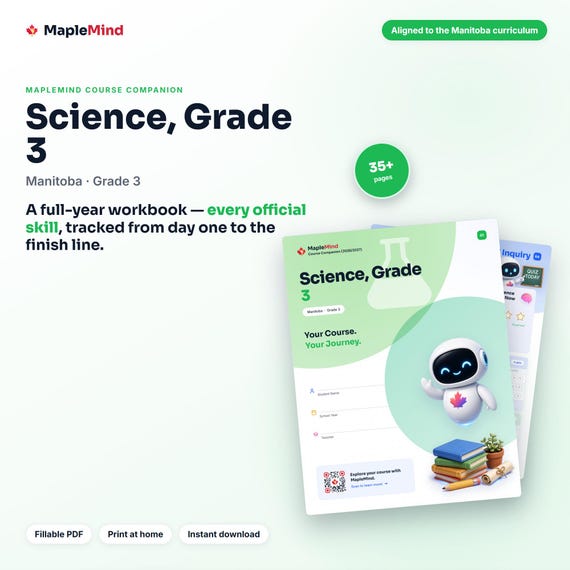
A Science, Grade 3 workbook worth keeping
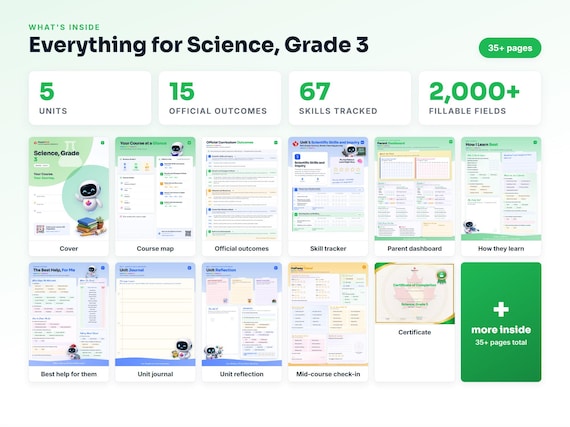
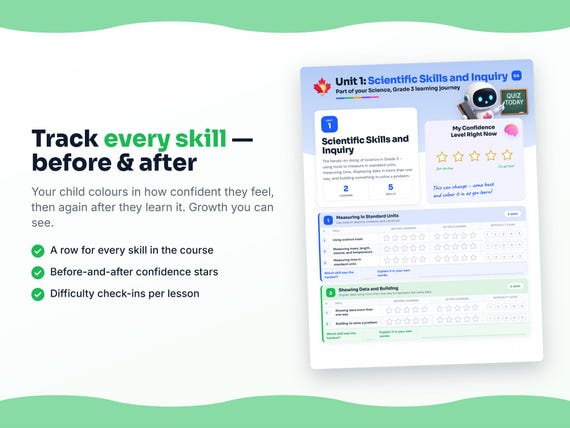
Built from the same official curriculum as this page. Before and after each skill above, your student colours in how sure they feel — so the two of you can see, on one page, what's clicking and what needs another look. It's a quiet way to follow how the year is really going.
By June it's full of their own handwriting: units worked through, confidence grown, a mid-year check-in, notes from parent-teacher night, and a certificate at the end. Less a worksheet, more a record of the year worth keeping on the shelf.
Instant download · see every page, reviews and the full description · five or more workbooks are $2.99 each
What it looks like in the app



Common questions
Can MapleMind help my child with Science, Grade 3?
Yes. MapleMind's AI tutor covers all 67 skills in Manitoba's Science, Grade 3 — your child picks the exact skill, and the tutor teaches it step by step: a short lesson, a worked example, solving together, then a skill check to show it stuck.
Is MapleMind aligned to Manitoba's official curriculum?
Yes. Every skill in this course maps to an official outcome code from Manitoba's Grade 3 Science curriculum, and the ministry's own wording is quoted under each unit on this page — with the official government source linked so you can check it yourself.
What does MapleMind cost?
It's free to start — 5 tutoring chats and a practice quiz every day, no credit card. A Pro subscription ($9.99/month or $49.99/year CAD, 7-day free trial) unlocks unlimited tutoring, practice, and exam simulations.
What if my child is stuck on just one topic?
That's the point of skill-level tutoring: open Science, Grade 3 in the app, tap the exact skill from the list on this page, and the tutor teaches just that — no wading through lessons your child doesn't need.
Does MapleMind work in French or other languages?
Yes — 14 languages, including French. Both the app and the tutor's explanations switch to the language your child chooses.
Where can I see the official Manitoba curriculum for Science, Grade 3?
The official source is linked on this page — Manitoba's official curriculum. The outline here follows it: every MapleMind skill carries its official outcome code, and the ministry's own wording is quoted under each unit.
Keep exploring
Ready when you are
Pick a skill from this page and see it taught properly — free, in the browser, in under a minute.