Get help with Science, Grade 4
Most tutoring makes your child sit through material your child already knows. MapleMind flips that: pick the exact skill that's causing trouble — any of the 70 below — and the tutor teaches just that one, step by step, as many times as it takes. Ask questions in plain words, any time of day, in English, French, or 12 other languages.
The official Manitoba Science, Grade 4 curriculum
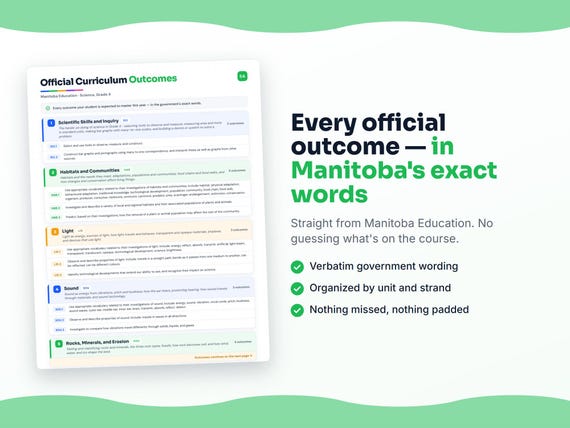
Manitoba defines Science, Grade 4 by strands and outcomes. MapleMind teaches the same curriculum reorganized for one-skill-at-a-time tutoring — the table shows exactly where every official strand lands, and the ministry's own wording is quoted under each unit below.
Official source Manitoba's official curriculumRead it on the government site — edu.gov.mb.ca ↗| Official strand | Outcomes | Where MapleMind teaches it |
|---|---|---|
| Strand 0 | 4 | Scientific Skills and Inquiry |
| Strand 1 | 17 | Habitats and Communities |
| Strand 2 | 16 | Light |
| Strand 3 | 18 | Sound |
| Strand 4 | 15 | Rocks, Minerals, and Erosion |
Every skill below, taught one on one.
 Try the first session free
How MapleMind teaches Science, Grade 4 — every unit, lesson, and skill
Every skill below runs as a short session: a plain-words lesson, a worked example, solving it together, then a five-question skill check that earns up to three stars. Guided Mode keeps it teaching instead of answer-handing — turning it off needs a parent's password.
Unit 1Scientific Skills and InquiryOfficial strand · Strand 0
The hands-on doing of science in Grade 4 - selecting tools to observe and measure, measuring area and more in standard units, making bar graphs with many-to-one scales, and building a device or system to solve a problem.
Choosing Tools and Measuring
- Selecting the right tool4-0-5a — Select and use tools to observe, measure, and construct.
- Measuring mass, length, volume, area, and temperature4-0-5b — Estimate and measure mass, length, volume, area, and temperature using standard units.
Bar Graphs and Building Systems
- Graphs with a scale4-0-6a — Construct bar graphs and pictographs using many-to-one correspondence, and interpret these and graphs from other sources.
- Building a device or system4-0-4b — Construct an object, device, or system to solve a problem or meet a need.
The official wording — 4 outcomes in this unit
- 4-0-5a
Select and use tools to observe, measure, and construct.
- 4-0-5b
Estimate and measure mass/weight, length, volume, area, and temperature using standard units.
- 4-0-6a
Construct bar graphs and pictographs using many to one correspondence, and interpret these as well as graphs from other sources.
- 4-0-4b
Construct an object, device, or system to solve a problem or meet a need.
Unit 2Habitats and CommunitiesOfficial strand · Strand 1
Habitats and the needs they meet, adaptations, populations and communities, food chains and food webs, and how changes and conservation affect living things.
Habitats and Adaptations
- Words for habitats and communities4-1-01 — Use words like habitat, adaptation, population, community, food chain, food web, producer, consumer, predator, and prey.
- Living things depend on their habitat4-1-02 — Recognize that each plant and animal depends on a specific habitat to meet its needs.
- Parts of an animal habitat4-1-03 — Identify the components of an animal habitat.
- Adaptations for survival4-1-04 — Identify physical and behavioural adaptations of animals and plants and infer how they help survival in a specific habitat.
- Traditional knowledge of adaptations4-1-05 — Investigate alternate explanations of plant or animal adaptations based on traditional knowledge from various cultures.
- Inventions that copy nature4-1-06 — Investigate how technological developments often mirror physical adaptations.
Populations, Communities, and Food Webs
- Local and regional habitats4-1-07 — Investigate and describe a variety of local and regional habitats and their populations of plants and animals.
- Measuring a plant population4-1-08 — Predict and test to determine an appropriate method for measuring a plant population within a habitat.
- Populations interact in a community4-1-09 — Recognize that plant and animal populations interact within a community.
- Energy in a food chain4-1-10 — Recognize that the food chain is a system in which energy from the Sun is transferred to animals.
- Building food chains and webs4-1-11 — Construct food chains and food webs, and classify organisms according to their roles.
- Building a model habitat4-1-12 — Use the design process to construct a model of a local or regional habitat and its populations.
Change and Conservation
- Removing a population4-1-13 — Predict how the removal of a plant or animal population may affect the rest of the community.
- Changes to habitats4-1-14 — Investigate natural and human-caused changes to habitats and identify effects on populations.
- How our actions conserve habitats4-1-15 — Describe how their actions can help conserve plant and animal populations and their habitats.
- Technology helps us study nature4-1-16 — Describe how specific technological developments help humans increase knowledge about populations.
- Traditional knowledge of populations4-1-17 — Recognize how traditional knowledge contributes to understanding populations and interactions.
The official wording — 17 outcomes in this unit
- 4-1-01
Use appropriate vocabulary related to their investigations of habitats and communities. Include: habitat, physical adaptation, behavioural adaptation, traditional knowledge, technological development, population, community, food chain, food web, organism, producer, consumer, herbivore, omnivore, carnivore, predator, prey, scavenger, endangerment, extinction, conservation.
- 4-1-02
Recognize that each plant and animal depends on a specific habitat to meet its needs.
- 4-1-03
Identify the components of an animal habitat. Include: food, water, living space, cover/shelter.
- 4-1-04
Identify physical and behavioural adaptations of animals and plants, and infer how these adaptations help them to survive in a specific habitat.
- 4-1-05
Investigate alternate explanations of plant or animal adaptations based on traditional knowledge from a variety of cultures.
- 4-1-06
Investigate how technological developments often mirror physical adaptations.
- 4-1-07
Investigate and describe a variety of local and regional habitats and their associated populations of plants and animals.
- 4-1-08
Predict and test to determine an appropriate method for measuring a plant population within a given habitat.
- 4-1-09
Recognize that plant and animal populations interact within a community.
- 4-1-10
Recognize that the food chain is a system in which some of the energy from the Sun is transferred eventually to animals.
- 4-1-11
Construct food chains and food webs, and classify organisms according to their roles. Include: producer, consumer, herbivore, omnivore, carnivore, predator, prey, scavenger.
- 4-1-12
Use the design process to construct a model of a local or regional habitat and its associated populations of plants and animals
- 4-1-13
Predict, based on their investigations, how the removal of a plant or animal population may affect the rest of the community.
- 4-1-14
Investigate natural and human-caused changes to habitats, and identify resulting effects on plant and animal populations. Include: endangerment, extinction.
- 4-1-15
Describe how their actions can help conserve plant and animal populations and their habitats.
- 4-1-16
Describe how specific technological developments have enabled humans to increase their knowledge about plant and animal populations.
- 4-1-17
Recognize and appreciate how traditional knowledge contributes to our understanding of plant and animal populations and interactions.
Unit 3LightOfficial strand · Strand 2
Light as energy, sources of light, how light travels and behaves, transparent and opaque materials, shadows, and devices that use light.
Energy and Sources of Light
- Words for light4-2-01 — Use words like energy, reflect, absorb, transmit, transparent, translucent, and opaque.
- Forms of energy4-2-02 — Give examples of various forms of energy.
- Energy in daily life4-2-03 — Recognize that energy is an integral part of daily life.
- White light is made of colours4-2-04 — Demonstrate that white light can be separated into colours.
- Making light or reflecting it4-2-05 — Distinguish between objects that produce their own light and those that reflect light.
- Natural and artificial light sources4-2-06 — Identify a variety of natural and artificial light sources.
How Light Behaves
- Properties of light4-2-07 — Observe and describe properties of light.
- Materials that bend and focus light4-2-08 — Explore the effects different materials and objects have on a light beam.
- Light and heat4-2-09 — Recognize that most objects that produce light give off heat, and identify ones that give off little or none.
- Transparent, translucent, and opaque4-2-10 — Classify materials as transparent, translucent, or opaque.
- Choosing materials for light4-2-11 — Evaluate the usefulness of a material for a task based on how it transmits, reflects, or absorbs light.
- Predicting shadows4-2-12 — Predict the location, shape, and size of a shadow based on the light source and object.
Light Devices and Safety
- Technology that extends our sight4-2-13 — Identify technological developments that extend our ability to see, and recognize their impact on science.
- Building a light device4-2-14 — Use the design process to construct a device that transmits and reflects light.
- Protecting eyes and sight4-2-15 — Describe practices that help protect eyes and sight.
- Uses of light around us4-2-16 — Identify uses of light and explain how brightness and colour suit each use.
The official wording — 16 outcomes in this unit
- 4-2-01
Use appropriate vocabulary related to their investigations of light. Include: energy, reflect, absorb, transmit, artificial, light beam, transparent, translucent, opaque, technological development, science, brightness.
- 4-2-02
Give examples of various forms of energy. Include: light, heat, food, sound.
- 4-2-03
Recognize that energy is an integral part of daily life.
- 4-2-04
Demonstrate that white light can be separated into colours.
- 4-2-05
Distinguish between objects that produce their own light and those that reflect light from another source.
- 4-2-06
Identify a variety of natural and artificial light sources.
- 4-2-07
Observe and describe properties of light. Include: travels in a straight path, bends as it passes from one medium to another, can be reflected, can be different colours.
- 4-2-08
Explore to determine effects different materials and objects have on a light beam.
- 4-2-09
Recognize that most objects that produce light also give off heat, and identify objects that produce light but give off little or no heat.
- 4-2-10
Classify materials as transparent, translucent, or opaque.
- 4-2-11
Evaluate the usefulness of a material for a particular task based on its ability to transmit, reflect, or absorb light.
- 4-2-12
Predict the location, shape, and size of a shadow based on the position of a light source relative to an object.
- 4-2-13
Identify technological developments that extend our ability to see, and recognize their impact on science.
- 4-2-14
Use the design process to construct a device that transmits and reflects light.
- 4-2-15
Describe practices that help ensure protection of eyes and sight.
- 4-2-16
Identify different uses of light at home, at school, and in the community, and explain how the brightness and colour of the light are appropriate for each use.
Unit 4SoundOfficial strand · Strand 3
Sound as energy from vibrations, pitch and loudness, how the ear hears, protecting hearing, how sound travels through materials, and sound technology.
Sound and Vibrations
- Words for sound4-3-01 — Use words like sound, vibration, vocal cords, pitch, loudness, sound waves, and the parts of the ear.
- Sound is energy4-3-02 — Recognize that sound is a form of energy.
- Energy makes things happen4-3-03 — Recognize that energy makes things happen and can be found all around us.
- Sorting sounds4-3-04 — Identify and classify various sounds using student-generated criteria.
- Sounds come from vibrations4-3-05 — Recognize that sounds are caused by vibrations.
- Making a musical instrument4-3-06 — Use the design process to create a musical instrument.
- Changing pitch and loudness4-3-07 — Demonstrate how the pitch and loudness of sounds can be modified.
Hearing and How Sound Travels
- Properties of sound4-3-08 — Observe and describe properties of sound.
- How the ear detects sound4-3-09 — Describe how the human ear is designed to detect sound vibrations.
- Sounds we can and cannot hear4-3-10 — Recognize that there is a range of sounds that humans can and cannot hear.
- Protecting your hearing4-3-11 — Describe practices that help protect the ears and hearing.
- Harmful and hazardous sounds4-3-12 — Describe harmful effects of high or sustained sound levels and identify potential sound hazards.
Sound Through Materials and Technology
- Sound through solids, liquids, and gases4-3-13 — Investigate to compare how vibrations travel differently through solids, liquids, and gases.
- Materials that carry or muffle sound4-3-14 — Explore to determine the ability of materials to transmit or absorb sound.
- Using materials to control sound4-3-15 — Describe how materials that absorb or reflect sound are used in different situations.
- Devices that work with sound4-3-16 — Describe devices that extend our ability to produce, transmit, and detect sound.
- Sound inventions and society4-3-17 — Investigate inventions related to sound and describe their impacts on society.
- Sound in jobs and hobbies4-3-18 — Describe the role of sound in different jobs and hobbies.
The official wording — 18 outcomes in this unit
- 4-3-01
Use appropriate vocabulary related to their investigations of sound. Include: energy, sound, vibration, vocal cords, pitch, loudness, sound waves, outer ear, middle ear, inner ear, brain, transmit, absorb, reflect, detect.
- 4-3-02
Recognize that sound is a form of energy.
- 4-3-03
Recognize that energy makes things happen and can be found all around us.
- 4-3-04
Identify and classify various sounds using student-generated criteria.
- 4-3-05
Recognize that sounds are caused by vibrations. Include: the human voice relies on the vibrations of vocal cords.
- 4-3-06
Use the design process to create a musical instrument.
- 4-3-07
Demonstrate how the pitch and loudness of sounds can be modified.
- 4-3-08
Observe and describe properties of sound. Include: travels in waves in all directions.
- 4-3-09
Describe how the human ear is designed to detect sound vibrations. Include: sound is transmitted from the outer ear to the middle ear and the inner ear, which relays messages to the brain.
- 4-3-10
Recognize that there is a range of sounds that humans can and cannot hear.
- 4-3-11
Describe practices that help ensure protection of the ears and hearing.
- 4-3-12
Describe harmful effects of high or sustained sound levels and identify potential sound hazards at home or in the community.
- 4-3-13
Investigate to compare how vibrations travel differently through solids, liquids, and gases.
- 4-3-14
Explore to determine the ability of materials to transmit or absorb sound.
- 4-3-15
Describe how materials that absorb or reflect sound are used in different situations.
- 4-3-16
Describe devices that extend our ability to produce, transmit, and detect sound.
- 4-3-17
Investigate to identify inventions related to sound, and describe their impacts on society.
- 4-3-18
Describe the role of sound in different jobs and hobbies.
Unit 5Rocks, Minerals, and ErosionOfficial strand · Strand 4
Testing and classifying rocks and minerals, the three rock types, fossils, how rock becomes soil, and how wind, water, and ice shape the land.
Rocks and Minerals
- Words for rocks and minerals4-4-01 — Use words like rock, mineral, scratch test, streak test, igneous, sedimentary, metamorphic, fossil, and erosion.
- Sorting rocks and minerals4-4-02 — Classify rocks and minerals according to student-generated criteria.
- Testing rocks and minerals4-4-03 — Test to determine characteristics of rocks and properties of minerals, and classify accordingly.
- Minerals and rocks are different4-4-04 — Differentiate between minerals and rocks.
- Comparing rocks from different places4-4-05 — Compare local rocks and minerals with each other and with those from other geological areas.
Using Rocks and Rock Types
- Products from rocks and minerals4-4-06 — Give examples of products derived from rocks and minerals.
- Why properties decide uses4-4-07 — Describe how characteristics of rocks and properties of minerals determine their uses.
- The three types of rock4-4-08 — Recognize the three types of rock and describe how each is formed.
Fossils and Soil Formation
- How fossils form4-4-09 — Explain how fossils are formed.
- Fossils and Earth's history4-4-10 — Describe how fossils help humans understand Earth's history, including extinct organisms.
- How rock becomes soil4-4-11 — Investigate and describe ways in which rock contributes to soil formation.
Erosion and Changing Landscapes
- Controlling soil erosion4-4-12 — Investigate and describe ways soil erosion is controlled or minimized in communities.
- Designing an erosion-control system4-4-13 — Use the design process to determine an appropriate system for controlling soil erosion.
- Wind, water, and ice on the land4-4-14 — Describe effects of wind, water, and ice on the landscape.
- Big changes to the landscape4-4-15 — Identify natural phenomena and human activities that cause significant changes in the landscape.
The official wording — 15 outcomes in this unit
- 4-4-01
Use appropriate vocabulary related to their investigations of rocks, minerals, and erosion. Include: rock, mineral, characteristic, property, scratch test, streak test, igneous, sedimentary, metamorphic, fossil, organism, extinct, soil formation, erosion, natural phenomena.
- 4-4-02
Classify rocks and minerals according to student-generated criteria.
- 4-4-03
Test to determine characteristics of rocks and properties of minerals, and classify accordingly. Include: scratch test for hardness, streak test for colour.
- 4-4-04
Differentiate between minerals and rocks. Include: minerals are composed of the same substance throughout, rocks are composed of two or more minerals..
- 4-4-05
Compare rocks and minerals from the local environment with each other and with those from other geological areas.
- 4-4-06
Give examples of products derived from rocks and minerals.
- 4-4-07
Describe how characteristics of rocks and properties of minerals determine their uses.
- 4-4-08
Recognize that there are three types of rock, and describe how each is formed. Include: igneous, sedimentary, metamorphic.
- 4-4-09
Explain how fossils are formed.
- 4-4-10
Describe how fossils help humans gain a better understanding of Earth's history, including identifying organisms that are now extinct.
- 4-4-11
Investigate and describe ways in which rock contributes to soil formation.
- 4-4-12
Investigate and describe ways in which soil erosion is controlled or minimized in their community and in communities around the world.
- 4-4-13
Use the design process to determine an appropriate system for controlling soil erosion in a given situation.
- 4-4-14
Describe effects of wind, water, and ice on the landscape.
- 4-4-15
Identify natural phenomena and human activities that cause significant changes in the landscape.
Printable workbook · A keepsake of the year
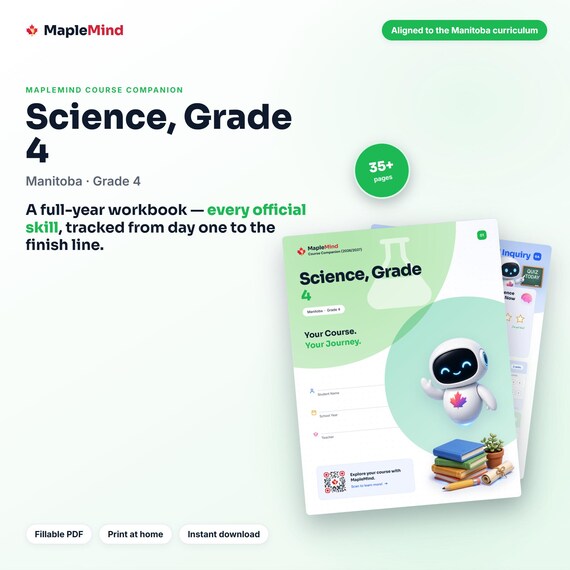
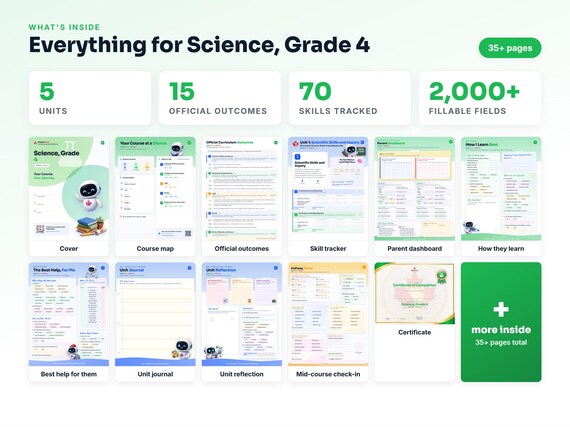
A Science, Grade 4 workbook worth keeping
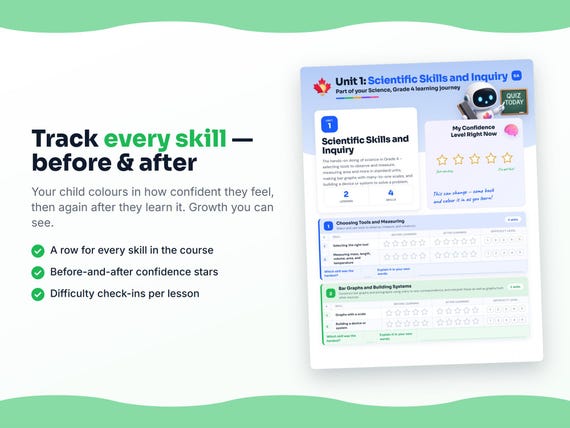
Built from the same official curriculum as this page. Before and after each skill above, your student colours in how sure they feel — so the two of you can see, on one page, what's clicking and what needs another look. It's a quiet way to follow how the year is really going.
By June it's full of their own handwriting: units worked through, confidence grown, a mid-year check-in, notes from parent-teacher night, and a certificate at the end. Less a worksheet, more a record of the year worth keeping on the shelf.
Instant download · see every page, reviews and the full description · five or more workbooks are $2.99 each
What it looks like in the app



Common questions
Can MapleMind help my child with Science, Grade 4?
Yes. MapleMind's AI tutor covers all 70 skills in Manitoba's Science, Grade 4 — your child picks the exact skill, and the tutor teaches it step by step: a short lesson, a worked example, solving together, then a skill check to show it stuck.
Is MapleMind aligned to Manitoba's official curriculum?
Yes. Every skill in this course maps to an official outcome code from Manitoba's Grade 4 Science curriculum, and the ministry's own wording is quoted under each unit on this page — with the official government source linked so you can check it yourself.
What does MapleMind cost?
It's free to start — 5 tutoring chats and a practice quiz every day, no credit card. A Pro subscription ($9.99/month or $49.99/year CAD, 7-day free trial) unlocks unlimited tutoring, practice, and exam simulations.
What if my child is stuck on just one topic?
That's the point of skill-level tutoring: open Science, Grade 4 in the app, tap the exact skill from the list on this page, and the tutor teaches just that — no wading through lessons your child doesn't need.
Does MapleMind work in French or other languages?
Yes — 14 languages, including French. Both the app and the tutor's explanations switch to the language your child chooses.
Where can I see the official Manitoba curriculum for Science, Grade 4?
The official source is linked on this page — Manitoba's official curriculum. The outline here follows it: every MapleMind skill carries its official outcome code, and the ministry's own wording is quoted under each unit.
Keep exploring
Ready when you are
Pick a skill from this page and see it taught properly — free, in the browser, in under a minute.