Get help with Science, Grade 5
Most tutoring makes your child sit through material your child already knows. MapleMind flips that: pick the exact skill that's causing trouble — any of the 65 below — and the tutor teaches just that one, step by step, as many times as it takes. Ask questions in plain words, any time of day, in English, French, or 12 other languages.
The official Manitoba Science, Grade 5 curriculum
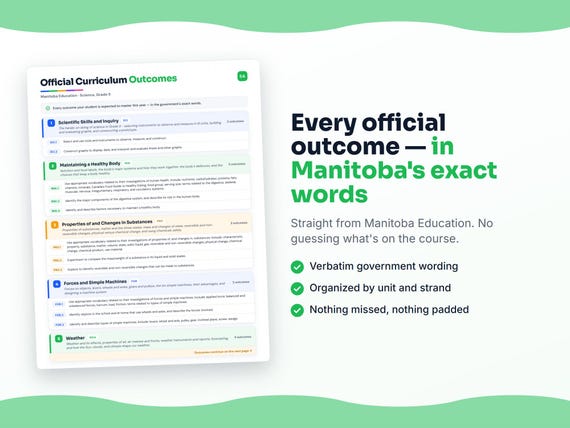
Manitoba defines Science, Grade 5 by strands and outcomes. MapleMind teaches the same curriculum reorganized for one-skill-at-a-time tutoring — the table shows exactly where every official strand lands, and the ministry's own wording is quoted under each unit below.
Official source Manitoba's official curriculumRead it on the government site — edu.gov.mb.ca ↗| Official strand | Outcomes | Where MapleMind teaches it |
|---|---|---|
| Strand 0 | 4 | Scientific Skills and Inquiry |
| Strand 1 | 15 | Maintaining a Healthy Body |
| Strand 2 | 14 | Properties of and Changes in Substances |
| Strand 3 | 14 | Forces and Simple Machines |
| Strand 4 | 18 | Weather |
Every skill below, taught one on one.
 Try the first session free
How MapleMind teaches Science, Grade 5 — every unit, lesson, and skill
Every skill below runs as a short session: a plain-words lesson, a worked example, solving it together, then a five-question skill check that earns up to three stars. Guided Mode keeps it teaching instead of answer-handing — turning it off needs a parent's password.
Unit 1Scientific Skills and InquiryOfficial strand · Strand 0
The hands-on doing of science in Grade 5 - selecting instruments to observe and measure in SI units, building and evaluating graphs, and constructing a prototype.
Instruments and SI Units
- Selecting instruments to measure5-0-5c — Select and use tools and instruments to observe, measure, and construct.
- Measuring in SI units5-0-5e — Estimate and measure mass, length, volume, and temperature using SI and other standard units.
Graphs and Prototypes
- Building and evaluating graphs5-0-6a — Construct graphs to display data, and interpret and evaluate these and other graphs.
- Building a prototype5-0-4b — Construct a prototype.
The official wording — 4 outcomes in this unit
- 5-0-5c
Select and use tools and instruments to observe, measure, and construct.
- 5-0-5e
Estimate and measure mass/weight, length, volume, and temperature using SI and other standard units.
- 5-0-6a
Construct graphs to display data, and interpret and evaluate these and other graphs.
- 5-0-4b
Construct a prototype.
Unit 2Maintaining a Healthy BodyOfficial strand · Strand 1
Nutrition and food labels, the body's major systems and how they work together, the body's defences, and the choices that keep a body healthy.
Nutrition and Healthy Eating
- Words for human health5-1-01 — Use words like nutrients, carbohydrates, proteins, fats, vitamins, minerals, serving size, and the body systems.
- Reading food labels5-1-02 — Interpret nutritional information found on food labels.
- Nutrients and what they do5-1-03 — Describe the types of nutrients in foods and their function in maintaining a healthy body.
- Evaluating prepared foods5-1-05 — Evaluate prepared food products using the design process.
The Body's Systems
- The digestive system5-1-06 — Identify the major components of the digestive system and describe its role.
- Skeleton, muscles, and nerves5-1-07 — Identify the major components of the skeletal, muscular, and nervous systems and describe each role.
- Skin and the integumentary system5-1-08 — Identify skin as the major component of the integumentary system and describe its protecting and supporting role.
- The body's defences against infection5-1-09 — Identify components of the body's defences against infections and describe their role.
- Breathing and blood systems5-1-10 — Identify the major components of the respiratory and circulatory systems and describe each role.
- How the body removes waste5-1-11 — Describe how the human body gets rid of waste.
- Systems working together5-1-12 — Give examples of how systems of the human body work together.
Staying Healthy
- Keeping a healthy body5-1-13 — Identify and describe factors necessary to maintain a healthy body.
- Judging health messages in the media5-1-14 — Evaluate information about body image and health from media for science content and bias.
- How choices and environment affect health5-1-15 — Explain how health may be affected by lifestyle choices and environmental factors.
The official wording — 15 outcomes in this unit
- 5-1-01
Use appropriate vocabulary related to their investigations of human health. Include: nutrients; carbohydrates; proteins; fats; vitamins; minerals; Canada's Food Guide to Healthy Eating; food group; serving size; terms related to the digestive, skeletal, muscular, nervous, integumentary, respiratory, and circulatory systems.
- 5-1-02
Interpret nutritional information found on food labels.
- 5-1-03
Describe the types of nutrients in foods and their function in maintaining a healthy body.
- 5-1-04
Evaluate a daily menu plan and suggest changes to make it align more closely with Canada's Food Guide to Healthy Eating.
- 5-1-05
Evaluate prepared food products using the design process.
- 5-1-06
Identify the major components of the digestive system, and describe its role in the human body.
- 5-1-07
Identify the major components of the skeletal, muscular, and nervous systems, and describe the role of each system in the human body.
- 5-1-08
Identify skin as the major component of the integumentary system, and describe its role in protecting and supporting the human body.
- 5-1-09
Identify components of the human body's defenses against infections, and describe their role in defending the body against infection.
- 5-1-10
Identify the major components of the respiratory and circulatory systems, and describe the role of each system in the human body.
- 5-1-11
Describe how the human body gets rid of waste.
- 5-1-12
Give examples of how systems of the human body work together.
- 5-1-13
Identify and describe factors necessary to maintain a healthy body.
- 5-1-14
Evaluate information related to body image and health from media sources for science content and bias.
- 5-1-15
Explain how human health may be affected by lifestyle choices and natural- and human-caused environmental factors.
Unit 3Properties of and Changes in SubstancesOfficial strand · Strand 2
Properties of substances, matter and the three states, mass and changes of state, reversible and non-reversible changes, physical versus chemical change, and using chemicals safely.
Substances and Matter
- Words for substances and changes5-2-01 — Use words like property, substance, matter, state, reversible and non-reversible changes, physical change, and chemical change.
- Telling substances apart by properties5-2-02 — Identify characteristics and properties that allow substances to be distinguished from one another.
- How substances change when they interact5-2-03 — Investigate how properties of substances may change when they interact with one another.
- What matter is5-2-04 — Recognize that matter is anything that has mass and takes up space.
- Properties of the three states of matter5-2-05 — Identify properties of the three states of matter.
Mass and Changes of State
- Mass in liquid and solid states5-2-06 — Experiment to compare the mass of a substance in its liquid and solid states.
- Mass of the whole equals the parts5-2-07 — Demonstrate that the mass of a whole object equals the sum of the mass of its parts.
- Changes of state are reversible5-2-08 — Demonstrate that changes of state are reversible through adding or removing heat.
Physical and Chemical Changes
- Reversible and non-reversible changes5-2-09 — Explore to identify reversible and non-reversible changes that can be made to substances.
- Physical versus chemical change5-2-10 — Recognize that a physical change makes no new substance, while a chemical change makes a new substance.
- Classifying changes5-2-11 — Observe changes in substances, classify them as physical or chemical, and justify the choice.
- Using chemicals safely5-2-12 — Identify potentially harmful chemical products at home and describe safe practices.
- Evaluating household chemicals5-2-13 — Evaluate household chemical products using the design process.
- Turning raw materials into products5-2-14 — Research and describe how raw materials are transformed into useful products.
The official wording — 14 outcomes in this unit
- 5-2-01
Use appropriate vocabulary related to their investigations of properties of, and changes in, substances. Include: characteristic, property, substance, matter, volume, state, solid, liquid, gas, reversible and non-reversible changes, physical change, chemical change, chemical product, raw material.
- 5-2-02
Identify characteristics and properties that allow substances to be distinguished from one another.
- 5-2-03
Investigate to determine how characteristics and properties of substances may change when they interact with one other.
- 5-2-04
Recognize that matter is anything that has mass/weight and takes up space.
- 5-2-05
Identify properties of the three states of matter.
- 5-2-06
Experiment to compare the mass/weight of a substance in its liquid and solid states.
- 5-2-07
Demonstrate that the mass/weight of a whole object is equal to the sum of the mass/weight of its parts.
- 5-2-08
Demonstrate that changes of state are reversible through the addition or removal of heat.
- 5-2-09
Explore to identify reversible and non-reversible changes that can be made to substances.
- 5-2-10
Recognize that a physical change alters the characteristics of a substance without producing a new substance, and that a chemical change produces a new substance with distinct characteristics and properties.
- 5-2-11
Observe examples of changes in substances, classify them as physical or chemical changes, and justify the designation.
- 5-2-12
Identify potentially harmful chemical products used at home, and describe practices to ensure personal safety.
- 5-2-13
Evaluate household chemical products using the design process.
- 5-2-14
Research and describe how raw materials are transformed into useful products.
Unit 4Forces and Simple MachinesOfficial strand · Strand 3
Forces on objects, levers, wheels and axles, gears and pulleys, the six simple machines, their advantages, and designing a machine system.
Forces and Levers
- Words for forces and simple machines5-3-01 — Use words like applied force, balanced and unbalanced forces, fulcrum, load, friction, and simple machines.
- Diagramming forces on an object5-3-02 — Describe, using diagrams, the forces acting on an object and the effects of changing them.
- The three classes of levers5-3-03 — Investigate a variety of levers and compare them by fulcrum position, applied force, and load.
Wheels, Gears, and Pulleys
- Wheels and axles around us5-3-04 — Identify objects at school and home that use wheels and axles, and describe the forces involved.
- Gears turn other gears5-3-05 — Recognize that a gear is a wheel and axle used to turn another wheel and axle.
- Devices with pulleys and gears5-3-06 — Identify common devices and systems that incorporate pulleys and/or gears.
- How a two-gear system works5-3-07 — Explore how direction, applied force, and speed vary within a two-gear system.
- Pulley systems and force5-3-08 — Compare the force needed to lift a load with a pulley system versus a single fixed pulley.
- Improving pulley and gear systems5-3-09 — Identify and make modifications to their own pulley and/or gear systems to improve how they move loads.
Simple Machines and Designing a System
- The six simple machines5-3-10 — Identify and describe types of simple machines.
- Why simple machines help5-3-11 — Describe the advantage of using simple machines to move or lift a load.
- Comparing machines for a task5-3-12 — Investigate advantages and disadvantages of using different simple machines for the same task.
- Devices that vary a simple machine5-3-13 — Compare devices that use variations of simple machines to accomplish similar tasks.
- Designing a machine system5-3-14 — Use the design process to construct a prototype with two or more simple machines that work together.
The official wording — 14 outcomes in this unit
- 5-3-01
Use appropriate vocabulary related to their investigations of forces and simple machines. Include: applied force, balanced and unbalanced forces, fulcrum, load, friction, terms related to types of simple machines.
- 5-3-02
Describe, using diagrams, the forces acting on an object and the effects of increasing or decreasing them.
- 5-3-03
Investigate a variety of levers used to accomplish particular tasks in order to compare them qualitatively with respect to fulcrum position, applied force, and load.
- 5-3-04
Identify objects in the school and at home that use wheels and axles, and describe the forces involved.
- 5-3-05
Recognize that a gear is a wheel and axle used to turn another wheel and axle.
- 5-3-06
Identify common devices and systems that incorporate pulleys and/or gears.
- 5-3-07
Explore to determine how the direction and amount of the applied force and the speed of rotation vary within a two-gear system.
- 5-3-08
Compare, quantitatively, the force required to lift a load using a pulley system versus a single fixed pulley, and recognize the relationship between the force required and the distance over which the force is applied.
- 5-3-09
Identify and make modifications to their own pulley and/or gear systems to improve how they move loads.
- 5-3-10
Identify and describe types of simple machines. Include: levers, wheel and axle, pulley, gear, inclined plane, screw, wedge.
- 5-3-11
Describe the advantage of using simple machines to move or lift a given load.
- 5-3-12
Investigate to identify advantages and disadvantages of using different simple machines to accomplish the same task.
- 5-3-13
Compare devices that use variations of simple machines to accomplish similar tasks.
- 5-3-14
Use the design process to construct a prototype containing a system of two or more different simple machines that move in a controlled way to perform a specific function.
Unit 5WeatherOfficial strand · Strand 4
Weather and its effects, properties of air, air masses and fronts, weather instruments and reports, forecasting, and how the Sun, clouds, and climate shape our weather.
Weather and the Air
- Words for weather5-4-01 — Use words like weather, pressure, air masses, fronts, weather instrument, forecast, water cycle, and climate.
- How weather affects living things5-4-02 — Describe how weather conditions may affect the activities of humans and other animals.
- Properties of air5-4-03 — Describe properties of air.
- Air masses and fronts5-4-04 — Recognize that warm and cold air masses are important to weather, and describe what happens at a front.
Measuring and Reporting Weather
- Building a weather instrument5-4-05 — Use the design process to construct a weather instrument.
- Measuring local weather over time5-4-06 — Observe and measure local weather over time and record and analyze the data.
- Reading a weather report5-4-07 — Identify and describe components of public weather reports.
- Features of weather phenomena5-4-08 — Describe the key features of a variety of weather phenomena.
- Severe weather safety5-4-09 — Provide examples of severe weather forecasts and describe preparations for personal safety.
Forecasting Weather
- Ways of predicting weather5-4-10 — Investigate various ways of predicting weather, and evaluate their usefulness.
- Short- and long-term forecasts5-4-11 — Contrast the accuracy of short- and long-term weather forecasts and discuss reasons.
- Technology that improves forecasting5-4-12 — Describe technological advances that deepen understanding of weather and improve predictions.
The Sun, Clouds, and Climate
- The Sun drives the weather5-4-13 — Explain how the transfer of energy from the Sun affects weather conditions.
- Clouds and the water cycle5-4-14 — Explain how clouds form, and relate cloud formation and precipitation to the water cycle.
- Common cloud types5-4-15 — Identify and describe common cloud formations.
- Weather versus climate5-4-16 — Differentiate between weather and climate.
- What influences Manitoba's weather and climate5-4-17 — Identify factors that influence weather and climate in Manitoba and across Canada.
- Climates are always changing5-4-18 — Recognize that climates around the world are ever changing, and identify possible explanations.
The official wording — 18 outcomes in this unit
- 5-4-01
Use appropriate vocabulary related to their investigations of weather. Include: weather; properties; volume; pressure; air masses; fronts; weather instrument; severe weather; forecast; accuracy; water cycle; climate; terms related to public weather reports, and cloud formations.
- 5-4-02
Describe how weather conditions may affect the activities of humans and other animals.
- 5-4-03
Describe properties of air. Include: has mass/weight and volume; expands to fill a space; expands and rises when heated; contracts and sinks when cooled; exerts pressure; moves from areas of high pressure to areas of low pressure.
- 5-4-04
Recognize that warm and cold air masses are important components of weather, and describe what happens when these air masses meet along a front.
- 5-4-05
Use the design process to construct a weather instrument.
- 5-4-06
Observe and measure local weather conditions over a period of time, using student-constructed or standard instruments, and record and analyze these data.
- 5-4-07
Identify and describe components of public weather reports from a variety of sources.
- 5-4-08
Describe the key features of a variety of weather phenomena.
- 5-4-09
Provide examples of severe weather forecasts, and describe preparations for ensuring personal safety during severe weather and related natural disasters.
- 5-4-10
Investigate various ways of predicting weather, and evaluate their usefulness.
- 5-4-11
Contrast the accuracy of short- and long-term weather forecasts, and discuss possible reasons for the discrepancies.
- 5-4-12
Describe examples of technological advances that have enabled humans to deepen their scientific understanding of weather and improve the accuracy of weather predictions.
- 5-4-13
Explain how the transfer of energy from the Sun affects weather conditions.
- 5-4-14
Explain how clouds form, and relate cloud formation and precipitation to the water cycle.
- 5-4-15
Identify and describe common cloud formations. Include: cumulus, cirrus, stratus.
- 5-4-16
Differentiate between weather and climate.
- 5-4-17
Identify factors that influence weather and climate in Manitoba and across Canada, and describe their impacts.
- 5-4-18
Recognize that climates around the world are ever changing, and identify possible explanations.
Printable workbook · A keepsake of the year
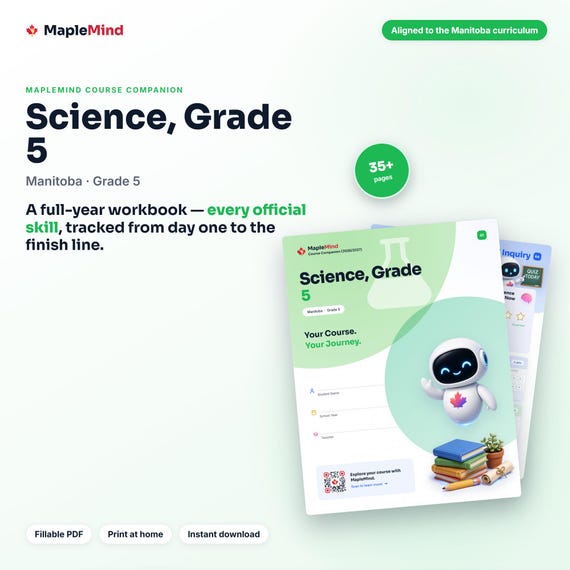
A Science, Grade 5 workbook worth keeping
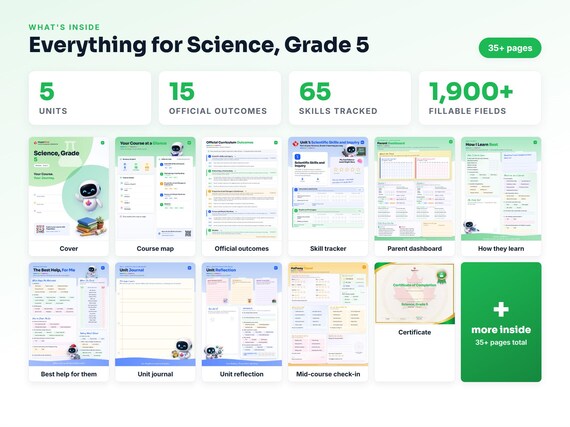
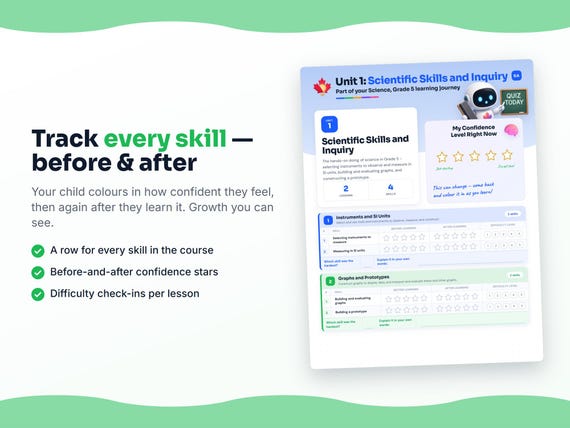
Built from the same official curriculum as this page. Before and after each skill above, your student colours in how sure they feel — so the two of you can see, on one page, what's clicking and what needs another look. It's a quiet way to follow how the year is really going.
By June it's full of their own handwriting: units worked through, confidence grown, a mid-year check-in, notes from parent-teacher night, and a certificate at the end. Less a worksheet, more a record of the year worth keeping on the shelf.
Instant download · see every page, reviews and the full description · five or more workbooks are $2.99 each
What it looks like in the app



Common questions
Can MapleMind help my child with Science, Grade 5?
Yes. MapleMind's AI tutor covers all 65 skills in Manitoba's Science, Grade 5 — your child picks the exact skill, and the tutor teaches it step by step: a short lesson, a worked example, solving together, then a skill check to show it stuck.
Is MapleMind aligned to Manitoba's official curriculum?
Yes. Every skill in this course maps to an official outcome code from Manitoba's Grade 5 Science curriculum, and the ministry's own wording is quoted under each unit on this page — with the official government source linked so you can check it yourself.
What does MapleMind cost?
It's free to start — 5 tutoring chats and a practice quiz every day, no credit card. A Pro subscription ($9.99/month or $49.99/year CAD, 7-day free trial) unlocks unlimited tutoring, practice, and exam simulations.
What if my child is stuck on just one topic?
That's the point of skill-level tutoring: open Science, Grade 5 in the app, tap the exact skill from the list on this page, and the tutor teaches just that — no wading through lessons your child doesn't need.
Does MapleMind work in French or other languages?
Yes — 14 languages, including French. Both the app and the tutor's explanations switch to the language your child chooses.
Where can I see the official Manitoba curriculum for Science, Grade 5?
The official source is linked on this page — Manitoba's official curriculum. The outline here follows it: every MapleMind skill carries its official outcome code, and the ministry's own wording is quoted under each unit.
Keep exploring
Ready when you are
Pick a skill from this page and see it taught properly — free, in the browser, in under a minute.