Get help with Science, Grade 6
Most tutoring makes your child sit through material your child already knows. MapleMind flips that: pick the exact skill that's causing trouble — any of the 70 below — and the tutor teaches just that one, step by step, as many times as it takes. Ask questions in plain words, any time of day, in English, French, or 12 other languages.
The official Manitoba Science, Grade 6 curriculum
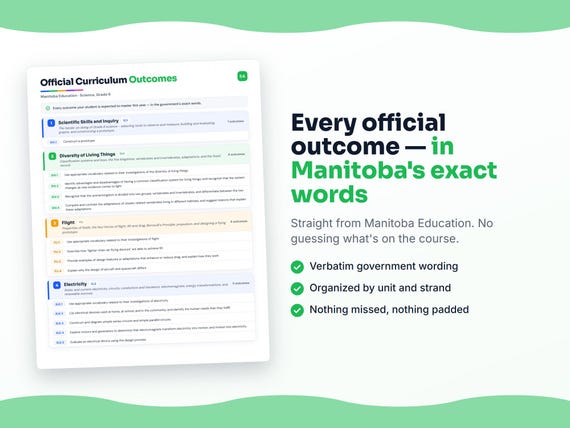
Manitoba defines Science, Grade 6 by strands and outcomes. MapleMind teaches the same curriculum reorganized for one-skill-at-a-time tutoring — the table shows exactly where every official strand lands, and the ministry's own wording is quoted under each unit below.
Official source Manitoba's official curriculumRead it on the government site — edu.gov.mb.ca ↗| Official strand | Outcomes | Where MapleMind teaches it |
|---|---|---|
| Strand 0 | 4 | Scientific Skills and Inquiry |
| Strand 1 | 15 | Diversity of Living Things |
| Strand 2 | 15 | Flight |
| Strand 3 | 19 | Electricity |
| Strand 4 | 17 | Exploring the Solar System |
Every skill below, taught one on one.
 Try the first session free
How MapleMind teaches Science, Grade 6 — every unit, lesson, and skill
Every skill below runs as a short session: a plain-words lesson, a worked example, solving it together, then a five-question skill check that earns up to three stars. Guided Mode keeps it teaching instead of answer-handing — turning it off needs a parent's password.
Unit 1Scientific Skills and InquiryOfficial strand · Strand 0
The hands-on doing of Grade 6 science - selecting tools to observe and measure, building and evaluating graphs, and constructing a prototype.
Doing Science: Measuring, Graphing, and Designing
- Construct a prototype6-0-4b — Construct a prototype.
- Select and use tools and instruments to observe, measure,6-0-5c — Select and use tools and instruments to observe, measure, and construct.
- Estimate and measure accurately using SI and other standard6-0-5e — Estimate and measure accurately using SI and other standard units.
- Construct graphs to display data, and interpret and evaluate6-0-6a — Construct graphs to display data, and interpret and evaluate these and other graphs.
The official wording — 4 outcomes in this unit
- 6-0-4b
Construct a prototype
- 6-0-5c
Select and use tools and instruments to observe, measure, and construct
- 6-0-5e
Estimate and measure accurately using SI and other standard units
- 6-0-6a
Construct graphs to display data, and interpret and evaluate these and other graphs
Unit 2Diversity of Living ThingsOfficial strand · Strand 1
Classification systems and keys, the five kingdoms, vertebrates and invertebrates, adaptations, and the fossil record.
Diversity of Living Things: Part 1
- Describe various kinds of classification systems used in everyday6-1-02 — Describe various kinds of classification systems used in everyday life, and identify related advantages and disadvantages.
- Develop a system to classify common objects or living6-1-03 — Develop a system to classify common objects or living things into groups and subgroups, and explain the reasoning used in the system’s development.
- Identify living things using an existing classification key, and explain the rationale used6-1-04 — Identify living things using an existing classification key, and explain the rationale used.
Diversity of Living Things: Part 2
- Identify advantages and disadvantages of having a common classification6-1-05 — Identify advantages and disadvantages of having a common classification system for living things, and recognize that the system changes as new evidence comes to light.
- Identify the five kingdoms commonly used for the classification6-1-06 — Identify the five kingdoms commonly used for the classification of living things, and provide examples of organisms from each to illustrate the diversity of living things. Include: monerans, protists, fungi, plants, animals.
- Recognize that many living things are difficult to see6-1-07 — Recognize that many living things are difficult to see with the unaided eye, and observe and describe some examples.
- Observe and describe the diversity of living things within6-1-08 — Observe and describe the diversity of living things within the local environment. Include: fungi, plants, animals.
Diversity of Living Things: Part 3
- Recognize that the animal kingdom is divided into two6-1-09 — Recognize that the animal kingdom is divided into two groups, vertebrates and invertebrates, and differentiate between the two. Include: vertebrates have backbones, invertebrates do not.
- Provide examples of a variety of invertebrates to illustrate6-1-10 — Provide examples of a variety of invertebrates to illustrate their diversity. Include: sponges, worms, molluscs, arthropods.
- Compare and contrast adaptations of common arthropods, and describe6-1-11 — Compare and contrast adaptations of common arthropods, and describe how these adaptations enable them to live in particular habitats.
- Classify vertebrates as fishes, amphibians, reptiles, birds, and mammals,6-1-12 — Classify vertebrates as fishes, amphibians, reptiles, birds, and mammals, and provide examples to illustrate the diversity within each group.
Diversity of Living Things: Part 4
- Compare animals living today with those of the past using fossil evidence6-1-14 — Identify, based on evidence gathered by paleontologists, similarities and differences in animals living today and those that lived in the past.
- Identify and describe contributions of scientists and naturalists who6-1-15 — Identify and describe contributions of scientists and naturalists who have increased our understanding of the diversity of living things.
The official wording — 15 outcomes in this unit
- 6-1-01
Use appropriate vocabulary related to their investigations of the diversity of living things
- 6-1-02
Describe various kinds of classification systems used in everyday life, and identify related advantages and disadvantages
- 6-1-03
Develop a system to classify common objects or living things into groups and subgroups, and explain the reasoning used in the system’s development
- 6-1-04
Identify living things using an existing classification key, and explain the rationale used
- 6-1-05
Identify advantages and disadvantages of having a common classification system for living things, and recognize that the system changes as new evidence comes to light
- 6-1-06
Identify the five kingdoms commonly used for the classification of living things, and provide examples of organisms from each to illustrate the diversity of living things
- 6-1-07
Recognize that many living things are difficult to see with the unaided eye, and observe and describe some examples
- 6-1-08
Observe and describe the diversity of living things within the local environment
- 6-1-09
Recognize that the animal kingdom is divided into two groups, vertebrates and invertebrates, and differentiate between the two
- 6-1-10
Provide examples of a variety of invertebrates to illustrate their diversity
- 6-1-11
Compare and contrast adaptations of common arthropods, and describe how these adaptations enable them to live in particular habitats
- 6-1-12
Classify vertebrates as fishes, amphibians, reptiles, birds, and mammals, and provide examples to illustrate the diversity within each group
- 6-1-13
Compare and contrast the adaptations of closely related vertebrates living in different habitats, and suggest reasons that explain these adaptations
- 6-1-14
Identify, based on evidence gathered by paleontologists, similarities and differences in animals living today and those that lived in the past
- 6-1-15
Identify and describe contributions of scientists and naturalists who have increased our understanding of the diversity of living things
Unit 3FlightOfficial strand · Strand 2
Properties of fluids, the four forces of flight, lift and drag, Bernoulli's Principle, propulsion, and designing a flying prototype.
Flight: Part 1
- Describe properties of fluids using air and water as6-2-02 — Describe properties of fluids using air and water as examples, and identify manifestations of these properties in daily life. Include: air and water flow and exert pressure; objects can flow through air and water; warm air and water rise.
- Identify adaptations that enable living things to propel themselves6-2-03 — Identify adaptations that enable living things to propel themselves through air, water, or to be transported by the wind.
- Recognize that in order for devices or living things6-2-04 — Recognize that in order for devices or living things to fly they must have sufficient lift to overcome the downward force of gravity, and that the force of gravity increases as mass increases.
Flight: Part 2
- Describe how “lighter-than-air flying devices” are able to achieve6-2-05 — Describe how “lighter-than-air flying devices” are able to achieve lift. Include: hot-air balloons, helium balloons.
- Test models of aircraft to observe Bernoulli’s Principle. Include:6-2-06 — Test models of aircraft to observe Bernoulli’s Principle. Include: the shape of a wing affects the speed of airflow, creating lift in a “heavier-than-air flying device.”.
- Explain how Bernoulli’s Principle is applied in a device6-2-07 — Explain how Bernoulli’s Principle is applied in a device other than an aircraft.
- Provide examples of design features or adaptations that enhance6-2-08 — Provide examples of design features or adaptations that enhance or reduce lift, and explain how they work.
Flight: Part 3
- Provide examples of design features or adaptations that enhance6-2-09 — Provide examples of design features or adaptations that enhance or reduce drag, and explain how they work.
- Identify and diagram the four forces that act on living things or devices that fly through the air6-2-10 — Identify and diagram the four forces that act on living things or devices that fly through the air. Include: lift, gravity, thrust, drag.
- Compare a variety of propulsion methods that are used6-2-11 — Compare a variety of propulsion methods that are used to produce thrust in animals and flying devices.
- Describe how unbalanced forces are used to steer aircraft6-2-12 — Describe how unbalanced forces are used to steer aircraft and spacecraft.
Flight: Part 4
- Explain why the design of aircraft and spacecraft differs6-2-13 — Explain why the design of aircraft and spacecraft differs.
- Identify milestones in the history of air travel and describe their impacts on daily life6-2-14 — Identify milestones in the history of air travel and describe their impacts on daily life.
- Use the design process to construct a prototype that can fly and meet specific performance criteria6-2-15 — Use the design process to construct a prototype that can fly and meet specific performance criteria.
The official wording — 15 outcomes in this unit
- 6-2-01
Use appropriate vocabulary related to their investigations of flight
- 6-2-02
Describe properties of fluids using air and water as examples, and identify manifestations of these properties in daily life
- 6-2-03
Identify adaptations that enable living things to propel themselves through air, water, or to be transported by the wind
- 6-2-04
Recognize that in order for devices or living things to fly they must have sufficient lift to overcome the downward force of gravity, and that the force of gravity increases as mass increases
- 6-2-05
Describe how “lighter-than-air flying devices” are able to achieve lift
- 6-2-06
Test models of aircraft to observe Bernoulli’s Principle
- 6-2-07
Explain how Bernoulli’s Principle is applied in a device other than an aircraft
- 6-2-08
Provide examples of design features or adaptations that enhance or reduce lift, and explain how they work
- 6-2-09
Provide examples of design features or adaptations that enhance or reduce drag, and explain how they work
- 6-2-10
Identify and diagram the four forces that act on living things or devices that fly through the air
- 6-2-11
Compare a variety of propulsion methods that are used to produce thrust in animals and flying devices
- 6-2-12
Describe how unbalanced forces are used to steer aircraft and spacecraft
- 6-2-13
Explain why the design of aircraft and spacecraft differs
- 6-2-14
Identify milestones in the history of air travel and describe their impacts on daily life
- 6-2-15
Use the design process to construct a prototype that can fly and meet specific performance criteria
Unit 4ElectricityOfficial strand · Strand 3
Static and current electricity, circuits, conductors and insulators, electromagnets, energy transformations, and renewable sources.
Electricity: Part 1
- Explain the attraction and repulsion of electrostatically charged materials.6-3-02 — Explain the attraction and repulsion of electrostatically charged materials. Include: negatively and positively charged materials attract one another; materials of like charge repel one another.
- Explain current electricity, and compare the characteristics of current6-3-03 — Explain current electricity, and compare the characteristics of current and static electricity by using a model.
- Identify dangers associated with static and current electricity6-3-04 — Identify dangers associated with static and current electricity, and demonstrate and describe appropriate safety precautions.
Electricity: Part 2
- List electrical devices used at home, at school, and in the community6-3-05 — List electrical devices used at home, at school, and in the community, and identify the human needs that they fulfill.
- Develop a definition of an electrical circuit, based on classroom explorations6-3-06 — Develop a definition of an electrical circuit, based on classroom explorations. Include: an electrical circuit is a continuous path for charges and must contain a power source and a conductor.
- Experiment to classify a variety of materials as insulators6-3-07 — Experiment to classify a variety of materials as insulators or conductors.
- Demonstrate and describe the function of switches in electrical6-3-08 — Demonstrate and describe the function of switches in electrical circuits.
Electricity: Part 3
- Construct and diagram simple series circuits and simple parallel6-3-09 — Construct and diagram simple series circuits and simple parallel circuits.
- Explore to determine factors that affect bulb brightness in simple series and parallel circuits6-3-10 — Explore to determine factors that affect bulb brightness in simple series and parallel circuits. Include: number of bulbs, number of batteries, placement of bulbs and batteries.
- Use the design process to construct an electrical circuit6-3-11 — Use the design process to construct an electrical circuit that performs a useful function.
- Demonstrate that an electric current can create a magnetic field6-3-12 — Demonstrate, using a simple electromagnet constructed in class, that an electric current can create a magnetic field.
Electricity: Part 4
- Explore motors and generators to determine that electromagnets transform6-3-13 — Explore motors and generators to determine that electromagnets transform electricity into motion, and motion into electricity.
- Identify forms of energy that may result from the transformation of electrical energy6-3-14 — Identify forms of energy that may result from the transformation of electrical energy, and recognize that energy can only be changed from one form into another, not created or destroyed. Include: light, heat, sound, motion.
- Identify the two major sources of electrical energy, and provide examples of each6-3-15 — Identify the two major sources of electrical energy, and provide examples of each. Include: chemical sources such as batteries; electromagnetic sources such as turbine motion caused by wind, falling water, and steam.
- Identify renewable and non-renewable sources of electrical energy6-3-16 — Identify renewable and non-renewable sources of electrical energy, and discuss advantages and disadvantages of each.
Electricity: Part 5
- Evaluate an electrical device using the design process6-3-17 — Evaluate an electrical device using the design process.
- Describe factors that affect the consumption of electrical energy,6-3-18 — Describe factors that affect the consumption of electrical energy, and outline an action plan to reduce electrical energy consumption at home, at school, or in the community.
- Describe the ways in which electricity has had an impact on daily life6-3-19 — Describe the ways in which electricity has had an impact on daily life.
The official wording — 19 outcomes in this unit
- 6-3-01
Use appropriate vocabulary related to their investigations of electricity
- 6-3-02
Explain the attraction and repulsion of electrostatically charged materials
- 6-3-03
Explain current electricity, and compare the characteristics of current and static electricity by using a model
- 6-3-04
Identify dangers associated with static and current electricity, and demonstrate and describe appropriate safety precautions
- 6-3-05
List electrical devices used at home, at school, and in the community, and identify the human needs that they fulfill
- 6-3-06
Develop a definition of an electrical circuit, based on classroom explorations
- 6-3-07
Experiment to classify a variety of materials as insulators or conductors
- 6-3-08
Demonstrate and describe the function of switches in electrical circuits
- 6-3-09
Construct and diagram simple series circuits and simple parallel circuits
- 6-3-10
Explore to determine factors that affect bulb brightness in simple series and parallel circuits
- 6-3-11
Use the design process to construct an electrical circuit that performs a useful function
- 6-3-12
Demonstrate, using a simple electromagnet constructed in class, that an electric current can create a magnetic field
- 6-3-13
Explore motors and generators to determine that electromagnets transform electricity into motion, and motion into electricity
- 6-3-14
Identify forms of energy that may result from the transformation of electrical energy, and recognize that energy can only be changed from one form into another, not created or destroyed
- 6-3-15
Identify the two major sources of electrical energy, and provide examples of each
- 6-3-16
Identify renewable and non-renewable sources of electrical energy, and discuss advantages and disadvantages of each
- 6-3-17
Evaluate an electrical device using the design process
- 6-3-18
Describe factors that affect the consumption of electrical energy, and outline an action plan to reduce electrical energy consumption at home, at school, or in the community
- 6-3-19
Describe the ways in which electricity has had an impact on daily life
Unit 5Exploring the Solar SystemOfficial strand · Strand 4
Space exploration, the Sun-centred solar system, the planets, day and night and seasons, moon phases and eclipses, and astronomy versus astrology.
Exploring the Solar System: Part 1
- Identify technological developments that enable astronauts to meet their basic needs in space6-4-02 — Identify technological developments that enable astronauts to meet their basic needs in space.
- Identify Canadians who have contributed to space science or space technology6-4-03 — Identify Canadians who have contributed to space science or space technology, and describe their achievements.
- Investigate past and present space research programs involving astronauts,6-4-04 — Investigate past and present space research programs involving astronauts, and explain the contributions to scientific knowledge.
Exploring the Solar System: Part 2
- Describe positive and negative impacts arising from space research6-4-05 — Describe positive and negative impacts arising from space research programs.
- Identify technological devices placed in space that help humans6-4-06 — Identify technological devices placed in space that help humans learn more about the Earth and communicate more efficiently. Include: communication and remote sensing satellites.
- Describe how the conception of the Earth and its position in space have been continuously6-4-07 — Describe how the conception of the Earth and its position in space have been continuously questioned and how our understanding has evolved over time. Include: from a flat Earth, to an Earth-centred system, to a Sun-centred system.
- Recognize that the Sun is the centre of the6-4-08 — Recognize that the Sun is the centre of the solar system and it is the source of energy for all life on Earth.
Exploring the Solar System: Part 3
- Identify the planets in the solar system and describe6-4-09 — Identify the planets in the solar system and describe their size relative to the Earth and their position relative to the Sun.
- Classify planets as inner or outer planets, based on their position relative to the asteroid belt6-4-10 — Classify planets as inner or outer planets, based on their position relative to the asteroid belt, and describe characteristics of each type. Include: inner planets are small and rocky; outer planets (except Pluto) are giant balls of gas.
- Recognize that mass is the amount of matter in an object6-4-11 — Recognize that mass is the amount of matter in an object, that weight is the force of gravity on the mass of an object, and that the force of gravity varies from planet to planet.
- Explain, using models and simulations, how the Earth’s rotation6-4-12 — Explain, using models and simulations, how the Earth’s rotation causes the cycle of day and night, and how the Earth’s tilt of axis and revolution cause the yearly cycle of seasons.
Exploring the Solar System: Part 4
- Use the design process to construct a prototype that tells the time of day or measures a time span6-4-13 — Use the design process to construct a prototype that tells the time of day or measures a time span.
- Explain how the relative positions of the Earth, moon,6-4-14 — Explain how the relative positions of the Earth, moon, and Sun are responsible for moon phases and eclipses.
- Identify points of reference in the night sky and recognize that the apparent movement of celestial6-4-15 — Identify points of reference in the night sky and recognize that the apparent movement of celestial objects is regular, predictable, and related to the Earth’s rotation and revolution.
- Identify and describe how people from various cultures, past6-4-16 — Identify and describe how people from various cultures, past and present, apply astronomy in daily life.
Exploring the Solar System: Part 5
- Differentiate between astrology and astronomy, and explain why astrology6-4-17 — Differentiate between astrology and astronomy, and explain why astrology is considered unscientific.
The official wording — 17 outcomes in this unit
- 6-4-01
Use appropriate vocabulary related to their investigations of Earth and space
- 6-4-02
Identify technological developments that enable astronauts to meet their basic needs in space
- 6-4-03
Identify Canadians who have contributed to space science or space technology, and describe their achievements
- 6-4-04
Investigate past and present space research programs involving astronauts, and explain the contributions to scientific knowledge
- 6-4-05
Describe positive and negative impacts arising from space research programs
- 6-4-06
Identify technological devices placed in space that help humans learn more about the Earth and communicate more efficiently
- 6-4-07
Describe how the conception of the Earth and its position in space have been continuously questioned and how our understanding has evolved over time
- 6-4-08
Recognize that the Sun is the centre of the solar system and it is the source of energy for all life on Earth
- 6-4-09
Identify the planets in the solar system and describe their size relative to the Earth and their position relative to the Sun
- 6-4-10
Classify planets as inner or outer planets, based on their position relative to the asteroid belt, and describe characteristics of each type
- 6-4-11
Recognize that mass is the amount of matter in an object, that weight is the force of gravity on the mass of an object, and that the force of gravity varies from planet to planet
- 6-4-12
Explain, using models and simulations, how the Earth’s rotation causes the cycle of day and night, and how the Earth’s tilt of axis and revolution cause the yearly cycle of seasons
- 6-4-13
Use the design process to construct a prototype that tells the time of day or measures a time span
- 6-4-14
Explain how the relative positions of the Earth, moon, and Sun are responsible for moon phases and eclipses
- 6-4-15
Identify points of reference in the night sky and recognize that the apparent movement of celestial objects is regular, predictable, and related to the Earth’s rotation and revolution
- 6-4-16
Identify and describe how people from various cultures, past and present, apply astronomy in daily life
- 6-4-17
Differentiate between astrology and astronomy, and explain why astrology is considered unscientific
Printable workbook · A keepsake of the year
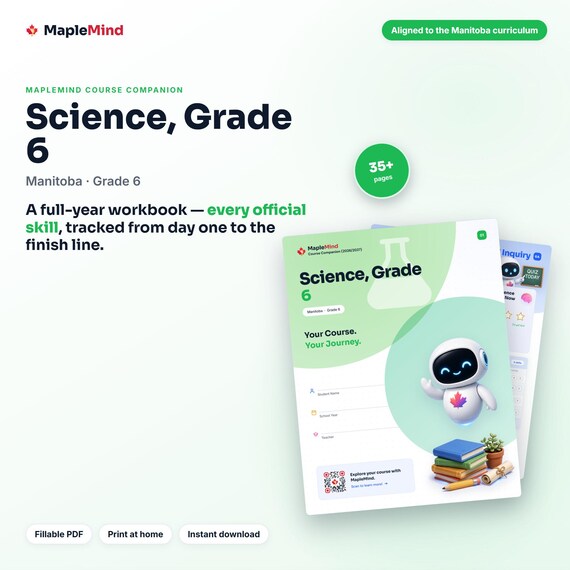
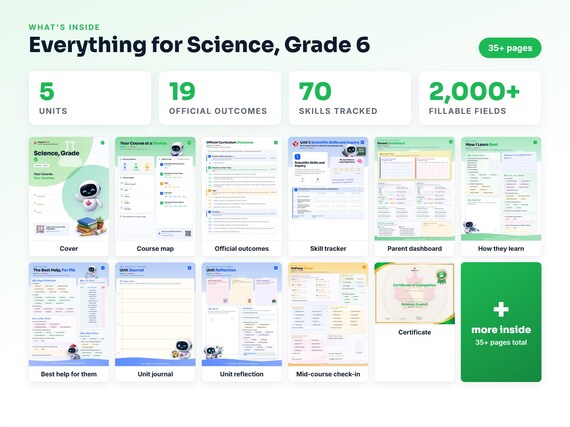
A Science, Grade 6 workbook worth keeping
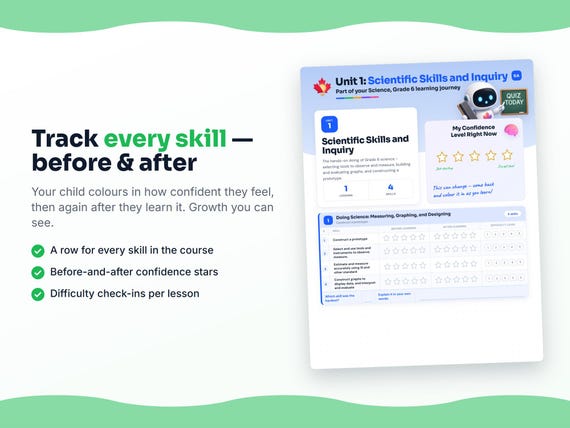
Built from the same official curriculum as this page. Before and after each skill above, your student colours in how sure they feel — so the two of you can see, on one page, what's clicking and what needs another look. It's a quiet way to follow how the year is really going.
By June it's full of their own handwriting: units worked through, confidence grown, a mid-year check-in, notes from parent-teacher night, and a certificate at the end. Less a worksheet, more a record of the year worth keeping on the shelf.
Instant download · see every page, reviews and the full description · five or more workbooks are $2.99 each
What it looks like in the app



Common questions
Can MapleMind help my child with Science, Grade 6?
Yes. MapleMind's AI tutor covers all 70 skills in Manitoba's Science, Grade 6 — your child picks the exact skill, and the tutor teaches it step by step: a short lesson, a worked example, solving together, then a skill check to show it stuck.
Is MapleMind aligned to Manitoba's official curriculum?
Yes. Every skill in this course maps to an official outcome code from Manitoba's Grade 6 Science curriculum, and the ministry's own wording is quoted under each unit on this page — with the official government source linked so you can check it yourself.
What does MapleMind cost?
It's free to start — 5 tutoring chats and a practice quiz every day, no credit card. A Pro subscription ($9.99/month or $49.99/year CAD, 7-day free trial) unlocks unlimited tutoring, practice, and exam simulations.
What if my child is stuck on just one topic?
That's the point of skill-level tutoring: open Science, Grade 6 in the app, tap the exact skill from the list on this page, and the tutor teaches just that — no wading through lessons your child doesn't need.
Does MapleMind work in French or other languages?
Yes — 14 languages, including French. Both the app and the tutor's explanations switch to the language your child chooses.
Where can I see the official Manitoba curriculum for Science, Grade 6?
The official source is linked on this page — Manitoba's official curriculum. The outline here follows it: every MapleMind skill carries its official outcome code, and the ministry's own wording is quoted under each unit.
Keep exploring
Ready when you are
Pick a skill from this page and see it taught properly — free, in the browser, in under a minute.