Get help with Science, Grade 7
Most tutoring makes you sit through material you already know. MapleMind flips that: pick the exact skill that's causing trouble — any of the 69 below — and the tutor teaches just that one, step by step, as many times as it takes. Ask questions in plain words, any time of day, in English, French, or 12 other languages.
The official Manitoba Science, Grade 7 curriculum
Manitoba defines Science, Grade 7 by strands and outcomes. MapleMind teaches the same curriculum reorganized for one-skill-at-a-time tutoring — the table shows exactly where every official strand lands, and the ministry's own wording is quoted under each unit below.
Official source Manitoba's official curriculumRead it on the government site — edu.gov.mb.ca ↗| Official strand | Outcomes | Where MapleMind teaches it |
|---|---|---|
| Strand 0 | 4 | Scientific Skills and Inquiry |
| Strand 1 | 15 | Interactions Within Ecosystems |
| Strand 2 | 23 | Particle Theory of Matter |
| Strand 3 | 12 | Forces and Structures |
| Strand 4 | 15 | Earth’s Crust |
Every skill below, taught one on one.
 Try the first session free
How MapleMind teaches Science, Grade 7 — every unit, lesson, and skill
Every skill below runs as a short session: a plain-words lesson, a worked example, solving it together, then a five-question skill check that earns up to three stars. Guided Mode keeps it teaching instead of answer-handing — turning it off needs a parent's password.
Unit 1Scientific Skills and InquiryOfficial strand · Strand 0
The hands-on doing of Grade 7 science - selecting tools to observe and measure, constructing and evaluating graphs, and building a prototype.
Doing Science: Measuring, Graphing, and Designing
- Construct a prototype7-0-4b — Construct a prototype.
- Construct graphs to display data, and interpret and evaluate7-0-6a — Construct graphs to display data, and interpret and evaluate these and other graphs.
- Select and use tools to observe, measure, and construct.7-0-5c — Select and use tools to observe, measure, and construct. Include: microscopes, a variety of thermometers, graduated cylinders, glassware, balance.
- Estimate and measure accurately using SI and other standard7-0-5e — Estimate and measure accurately using SI and other standard units. Include: determining volume by displacement of water.
The official wording — 4 outcomes in this unit
- 7-0-4b
Construct a prototype
- 7-0-6a
Construct graphs to display data, and interpret and evaluate these and other graphs
- 7-0-5c
Select and use tools to observe, measure, and construct
- 7-0-5e
Estimate and measure accurately using SI and other standard units
Unit 2Interactions Within EcosystemsOfficial strand · Strand 1
Ecosystems and the biosphere, abiotic and biotic factors, ecological succession, photosynthesis and respiration, food webs and ecological pyramids, and micro-organisms.
Interactions Within Ecosystems: Part 1
- Define ecosystem, and describe various examples that range from7-1-02 — Define ecosystem, and describe various examples that range from the microscopic to the entire biosphere. Include: a place on Earth where living things interact with other living things as well as non- living things.
- Identify abiotic and biotic components of ecosystems that allow7-1-03 — Identify abiotic and biotic components of ecosystems that allow particular organisms to survive.
- Describe ecological succession and identify signs of succession in a variety of ecosystems7-1-04 — Describe ecological succession and identify signs of succession in a variety of ecosystems. Include: the natural process whereby some species are replaced by other species in a predictable pattern.
Interactions Within Ecosystems: Part 2
- Identify and describe positive and negative examples of human7-1-05 — Identify and describe positive and negative examples of human interventions that have an impact on ecological succession or the makeup of ecosystems.
- Propose a course of action to protect the habitat7-1-07 — Propose a course of action to protect the habitat of a particular organism within an ecosystem.
- Compare photosynthesis to cellular respiration, and explain how both7-1-08 — Compare photosynthesis to cellular respiration, and explain how both are part of the cycling of matter and the transfer of energy in ecosystems. Include: photosynthesis: water + carbon dioxide + light energy = sugar + oxygen in the presence of chlorophyll; cellular respiration: sugar + oxygen = water + carbon dioxide + energy.
Interactions Within Ecosystems: Part 3
- Analyze food webs, using ecological pyramids, to show energy7-1-09 — Analyze food webs, using ecological pyramids, to show energy gained or lost at various consumer levels. Include: producers; primary, secondary, and tertiary consumers.
- Analyze, using ecological pyramids, the implications of the loss7-1-10 — Analyze, using ecological pyramids, the implications of the loss of producers and consumers to the transfer of energy within an ecosystem.
- Explain, using ecological pyramids, the potential for bioaccumulation within7-1-11 — Explain, using ecological pyramids, the potential for bioaccumulation within an ecosystem.
- Provide examples of scavengers and decomposers7-1-12 — Provide examples of scavengers and decomposers, and describe their role in cycling matter in an ecosystem. Include: micro-organisms.
Interactions Within Ecosystems: Part 4
- Demonstrate proper use and care of the microscope to observe micro-organisms7-1-13 — Demonstrate proper use and care of the microscope to observe micro-organisms. Include: preparing wet mounts beginning with the least powerful lens; focussing; drawing specimens; indicating magnification.
- Identify beneficial and harmful roles played by micro-organisms7-1-14 — Identify beneficial and harmful roles played by micro-organisms.
- Research and describe human food production or preservation techniques7-1-15 — Research and describe human food production or preservation techniques that apply a knowledge of micro-organisms.
The official wording — 15 outcomes in this unit
- 7-1-01
Use appropriate vocabulary related to their investigations of interactions within ecosystems
- 7-1-02
Define ecosystem, and describe various examples that range from the microscopic to the entire biosphere
- 7-1-03
Identify abiotic and biotic components of ecosystems that allow particular organisms to survive
- 7-1-04
Describe ecological succession and identify signs of succession in a variety of ecosystems
- 7-1-05
Identify and describe positive and negative examples of human interventions that have an impact on ecological succession or the makeup of ecosystems
- 7-1-06
Identify environmental, social, and economic factors that should be considered in the management and preservation of ecosystems
- 7-1-07
Propose a course of action to protect the habitat of a particular organism within an ecosystem
- 7-1-08
Compare photosynthesis to cellular respiration, and explain how both are part of the cycling of matter and the transfer of energy in ecosystems
- 7-1-09
Analyze food webs, using ecological pyramids, to show energy gained or lost at various consumer levels
- 7-1-10
Analyze, using ecological pyramids, the implications of the loss of producers and consumers to the transfer of energy within an ecosystem
- 7-1-11
Explain, using ecological pyramids, the potential for bioaccumulation within an ecosystem
- 7-1-12
Provide examples of scavengers and decomposers, and describe their role in cycling matter in an ecosystem
- 7-1-13
Demonstrate proper use and care of the microscope to observe micro-organisms
- 7-1-14
Identify beneficial and harmful roles played by micro-organisms
- 7-1-15
Research and describe human food production or preservation techniques that apply a knowledge of micro-organisms
Unit 3Particle Theory of MatterOfficial strand · Strand 2
The particle theory, heat and temperature, heat transfer, pure substances and mixtures, solutions and solubility, and separating mixtures.
Particle Theory of Matter: Part 1
- Evaluate different types of thermometers using the design process7-2-02 — Evaluate different types of thermometers using the design process.
- Demonstrate the effects of heating and cooling on the volume of solids, liquids, and gases7-2-03 — Demonstrate the effects of heating and cooling on the volume of solids, liquids, and gases, and give examples from daily life.
- Compare the boiling and melting points of a variety7-2-04 — Compare the boiling and melting points of a variety of substances and recognize that boiling and melting points are properties of pure substances. Include: water.
Particle Theory of Matter: Part 2
- Explain what scientific theories are, and provide some examples.7-2-05 — Explain what scientific theories are, and provide some examples. Include: a scientific theory helps to explain an observation; when this explanation has been repeatedly tested and shown to be consistent it is generally accepted in the scientific world.
- Describe the particle theory of matter and use it7-2-06 — Describe the particle theory of matter and use it to explain changes of state.
- Differentiate between the concept of temperature and the concept7-2-07 — Differentiate between the concept of temperature and the concept of heat.
- Demonstrate how heat can be transmitted through solids, liquids,7-2-08 — Demonstrate how heat can be transmitted through solids, liquids, and gases. Include: conduction, convection, radiation.
Particle Theory of Matter: Part 3
- Plan an experiment to identify materials that are good7-2-09 — Plan an experiment to identify materials that are good heat insulators and good heat conductors, and describe some uses of these materials.
- Use the design process to construct a prototype that controls the transfer of heat energy7-2-10 — Use the design process to construct a prototype that controls the transfer of heat energy.
- Recognize that heat energy is the most common by-product7-2-11 — Recognize that heat energy is the most common by-product of energy transformations, and describe some examples.
- Identify different forms of energy that can be transformed7-2-12 — Identify different forms of energy that can be transformed into heat energy. Include: mechanical, chemical, nuclear, electrical.
Particle Theory of Matter: Part 4
- Differentiate between pure substances and mixtures by using the particle theory of matter7-2-13 — Differentiate between pure substances and mixtures by using the particle theory of matter. Include: a pure substance is made up of one type of particle; a mixture is made up of two or more types of particles.
- Differentiate between the two types of mixtures, solutions and mechanical mixtures7-2-14 — Differentiate between the two types of mixtures, solutions and mechanical mixtures. Include: solutions — homogeneous; mechanical mixtures — heterogeneous mixtures.
- Classify a variety of substances used in daily life7-2-15 — Classify a variety of substances used in daily life as pure substances, solutions, or mechanical mixtures.
- Demonstrate the difference between saturated and unsaturated solutions7-2-22 — Demonstrate the difference between saturated and unsaturated solutions.
Particle Theory of Matter: Part 5
- Discuss the potential harmful effects of some substances on the environment7-2-23 — Discuss the potential harmful effects of some substances on the environment, and identify methods to ensure their safe use and disposal.
- Identify solutes and solvents in common solid, liquid, and gaseous solutions7-2-16 — Identify solutes and solvents in common solid, liquid, and gaseous solutions.
- Describe solutions by using the particle theory of matter.7-2-17 — Describe solutions by using the particle theory of matter. Include: particles have an attraction for each other; the attraction between the particles of solute and solvent keeps them in solution.
- Demonstrate different methods of separating the components of both7-2-18 — Demonstrate different methods of separating the components of both solutions and mechanical mixtures.
Particle Theory of Matter: Part 6
- Identify a separation technique used in industry, and explain7-2-19 — Identify a separation technique used in industry, and explain why it is appropriate.
- Experiment to determine factors that affect solubility. Include: agitation,7-2-20 — Experiment to determine factors that affect solubility. Include: agitation, surface area, temperature.
- Describe the concentration of a solution in qualitative and quantitative terms7-2-21 — Describe the concentration of a solution in qualitative and quantitative terms, and give examples from daily life when the concentration of a solution influences its usefulness. Include: dilute, concentrated, grams of solute per 100 mL.
The official wording — 23 outcomes in this unit
- 7-2-01
Use appropriate vocabulary related to their investigations of the particle theory of matter
- 7-2-02
Evaluate different types of thermometers using the design process
- 7-2-03
Demonstrate the effects of heating and cooling on the volume of solids, liquids, and gases, and give examples from daily life
- 7-2-04
Compare the boiling and melting points of a variety of substances and recognize that boiling and melting points are properties of pure substances
- 7-2-05
Explain what scientific theories are, and provide some examples
- 7-2-06
Describe the particle theory of matter and use it to explain changes of state
- 7-2-07
Differentiate between the concept of temperature and the concept of heat
- 7-2-08
Demonstrate how heat can be transmitted through solids, liquids, and gases
- 7-2-09
Plan an experiment to identify materials that are good heat insulators and good heat conductors, and describe some uses of these materials
- 7-2-10
Use the design process to construct a prototype that controls the transfer of heat energy
- 7-2-11
Recognize that heat energy is the most common by-product of energy transformations, and describe some examples
- 7-2-12
Identify different forms of energy that can be transformed into heat energy
- 7-2-13
Differentiate between pure substances and mixtures by using the particle theory of matter
- 7-2-14
Differentiate between the two types of mixtures, solutions and mechanical mixtures
- 7-2-15
Classify a variety of substances used in daily life as pure substances, solutions, or mechanical mixtures
- 7-2-22
Demonstrate the difference between saturated and unsaturated solutions
- 7-2-23
Discuss the potential harmful effects of some substances on the environment, and identify methods to ensure their safe use and disposal
- 7-2-16
Identify solutes and solvents in common solid, liquid, and gaseous solutions
- 7-2-17
Describe solutions by using the particle theory of matter
- 7-2-18
Demonstrate different methods of separating the components of both solutions and mechanical mixtures
- 7-2-19
Identify a separation technique used in industry, and explain why it is appropriate
- 7-2-20
Experiment to determine factors that affect solubility
- 7-2-21
Describe the concentration of a solution in qualitative and quantitative terms, and give examples from daily life when the concentration of a solution influences its usefulness
Unit 4Forces and StructuresOfficial strand · Strand 3
Frame, shell, and solid structures, centre of gravity and stability, internal and external forces, structural strength, and designing structures.
Forces and Structures: Part 1
- Classify natural and human-built structures found locally and around7-3-02 — Classify natural and human-built structures found locally and around the world. Include: frame, shell, solid.
- Identify the centre of gravity in a model structure,7-3-03 — Identify the centre of gravity in a model structure, and demonstrate that changes in the location of a structure’s centre of gravity affect its stability.
- Identify internal forces acting on a structure, and describe7-3-04 — Identify internal forces acting on a structure, and describe them using diagrams. Include: compression, tension, shear, torsion.
Forces and Structures: Part 2
- Identify external forces acting on a structure, and describe7-3-05 — Identify external forces acting on a structure, and describe them using diagrams.
- Recognize that internal and external forces apply stress to structures7-3-06 — Recognize that internal and external forces apply stress to structures, and describe examples in which this stress has led to structural fatigue or structural failure.
- Investigate to determine that the effect of a force7-3-07 — Investigate to determine that the effect of a force on a structure depends on its magnitude, direction, and point and plane of application.
- Describe, using diagrams, how common structural shapes and components7-3-08 — Describe, using diagrams, how common structural shapes and components can increase the strength and stability of a structure.
Forces and Structures: Part 3
- Describe and demonstrate methods to increase the strength of materials7-3-09 — Describe and demonstrate methods to increase the strength of materials.
- Determine the efficiency of a structure by comparing its mass with the mass of the load it supports7-3-10 — Determine the efficiency of a structure by comparing its mass with the mass of the load it supports.
- Evaluate a structure to determine the appropriateness of its design, using the design process7-3-11 — Evaluate a structure to determine the appropriateness of its design, using the design process.
- Use the design process to construct a structure that will withstand the application of an external7-3-12 — Use the design process to construct a structure that will withstand the application of an external force.
The official wording — 12 outcomes in this unit
- 7-3-01
Use appropriate vocabulary related to their investigations of forces and structures
- 7-3-02
Classify natural and human-built structures found locally and around the world
- 7-3-03
Identify the centre of gravity in a model structure, and demonstrate that changes in the location of a structure’s centre of gravity affect its stability
- 7-3-04
Identify internal forces acting on a structure, and describe them using diagrams
- 7-3-05
Identify external forces acting on a structure, and describe them using diagrams
- 7-3-06
Recognize that internal and external forces apply stress to structures, and describe examples in which this stress has led to structural fatigue or structural failure
- 7-3-07
Investigate to determine that the effect of a force on a structure depends on its magnitude, direction, and point and plane of application
- 7-3-08
Describe, using diagrams, how common structural shapes and components can increase the strength and stability of a structure
- 7-3-09
Describe and demonstrate methods to increase the strength of materials
- 7-3-10
Determine the efficiency of a structure by comparing its mass with the mass of the load it supports
- 7-3-11
Evaluate a structure to determine the appropriateness of its design, using the design process
- 7-3-12
Use the design process to construct a structure that will withstand the application of an external force
Unit 5Earth’s CrustOfficial strand · Strand 4
Earth's layers, rock and mineral formation, weathering and erosion, the rock cycle, geological resources, and plate tectonics.
Earth’s Crust: Part 1
- Describe the Earth’s structure. Include: crust, mantle, outer core,7-4-02 — Describe the Earth’s structure. Include: crust, mantle, outer core, inner core.
- Describe the geological processes involved in rock and mineral7-4-03 — Describe the geological processes involved in rock and mineral formation, and classify rocks and minerals by their method of formation.
- Investigate and describe the processes of weathering and erosion,7-4-04 — Investigate and describe the processes of weathering and erosion, and recognize that they cause changes in the landscape over time. Include: physical, biological, and chemical weathering.
Earth’s Crust: Part 2
- Explain how rocks on the Earth constantly undergo a7-4-05 — Explain how rocks on the Earth constantly undergo a slow process of change through the rock cycle.
- Identify geological resources that are used by humans as7-4-06 — Identify geological resources that are used by humans as sources of energy, and describe their method of formation. Include: fossil fuels, geothermal energy.
- Identify geological resources that are present in Manitoba and Canada7-4-07 — Identify geological resources that are present in Manitoba and Canada, and describe the processes involved in their location, extraction, processing, and recycling. Include: fossil fuels, minerals.
- Identify environmental impacts of geological resource extraction, and describe7-4-08 — Identify environmental impacts of geological resource extraction, and describe techniques used to address these.
Earth’s Crust: Part 3
- Recognize that soil is a natural resource, and explain7-4-09 — Recognize that soil is a natural resource, and explain how the characteristics of soil determine its use.
- Describe methods used to control soil erosion, and recognize7-4-10 — Describe methods used to control soil erosion, and recognize the importance of soil conservation.
- Describe evidence used to support the continental drift theory,7-4-12 — Describe evidence used to support the continental drift theory, and explain why this theory was not generally accepted by scientists.
Earth’s Crust: Part 4
- Describe evidence used to support the theory of plate7-4-13 — Describe evidence used to support the theory of plate tectonics, the role technology has played in the development of this theory, and reasons why it is generally accepted by scientists.
- Explain geological processes and events using the theory of plate tectonics7-4-14 — Explain geological processes and events using the theory of plate tectonics. Include: mountain formation, earthquakes, volcanoes.
- Identify specialized careers involving the study of the Earth’s7-4-15 — Identify specialized careers involving the study of the Earth’s crust or the utilization of geological resources, and give examples of technologies used in each.
The official wording — 15 outcomes in this unit
- 7-4-01
Use appropriate vocabulary related to their investigations of the Earth’s crust
- 7-4-02
Describe the Earth’s structure
- 7-4-03
Describe the geological processes involved in rock and mineral formation, and classify rocks and minerals by their method of formation
- 7-4-04
Investigate and describe the processes of weathering and erosion, and recognize that they cause changes in the landscape over time
- 7-4-05
Explain how rocks on the Earth constantly undergo a slow process of change through the rock cycle
- 7-4-06
Identify geological resources that are used by humans as sources of energy, and describe their method of formation
- 7-4-07
Identify geological resources that are present in Manitoba and Canada, and describe the processes involved in their location, extraction, processing, and recycling
- 7-4-08
Identify environmental impacts of geological resource extraction, and describe techniques used to address these
- 7-4-09
Recognize that soil is a natural resource, and explain how the characteristics of soil determine its use
- 7-4-10
Describe methods used to control soil erosion, and recognize the importance of soil conservation
- 7-4-11
Identify environmental, social, and economic factors that should be considered in making informed decisions about land use
- 7-4-12
Describe evidence used to support the continental drift theory, and explain why this theory was not generally accepted by scientists
- 7-4-13
Describe evidence used to support the theory of plate tectonics, the role technology has played in the development of this theory, and reasons why it is generally accepted by scientists
- 7-4-14
Explain geological processes and events using the theory of plate tectonics
- 7-4-15
Identify specialized careers involving the study of the Earth’s crust or the utilization of geological resources, and give examples of technologies used in each

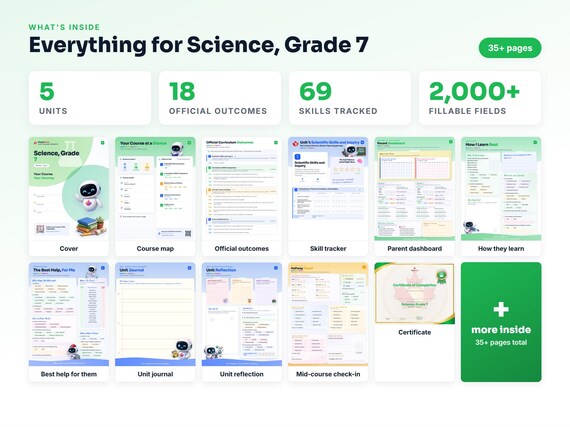


Printable workbook · A keepsake of the year
A Science, Grade 7 workbook worth keeping
Built from the same official curriculum as this page. Before and after each skill above, your student colours in how sure they feel — so the two of you can see, on one page, what's clicking and what needs another look. It's a quiet way to follow how the year is really going.
By June it's full of their own handwriting: units worked through, confidence grown, a mid-year check-in, notes from parent-teacher night, and a certificate at the end. Less a worksheet, more a record of the year worth keeping on the shelf.
Instant download · see every page, reviews and the full description · five or more workbooks are $2.99 each
What it looks like in the app



Common questions
Can MapleMind help me with Science, Grade 7?
Yes. MapleMind's AI tutor covers all 69 skills in Manitoba's Science, Grade 7 — you pick the exact skill, and the tutor teaches it step by step: a short lesson, a worked example, solving together, then a skill check to show it stuck.
Is MapleMind aligned to Manitoba's official curriculum?
Yes. Every skill in this course maps to an official outcome code from Manitoba's Grade 7 Science curriculum, and the ministry's own wording is quoted under each unit on this page — with the official government source linked so you can check it yourself.
What does MapleMind cost?
It's free to start — 5 tutoring chats and a practice quiz every day, no credit card. A Pro subscription ($9.99/month or $49.99/year CAD, 7-day free trial) unlocks unlimited tutoring, practice, and exam simulations.
What if I'm stuck on just one topic?
That's the point of skill-level tutoring: open Science, Grade 7 in the app, tap the exact skill from the list on this page, and the tutor teaches just that — no wading through lessons you don't need.
Does MapleMind work in French or other languages?
Yes — 14 languages, including French. Both the app and the tutor's explanations switch to the language you choose.
Where can I see the official Manitoba curriculum for Science, Grade 7?
The official source is linked on this page — Manitoba's official curriculum. The outline here follows it: every MapleMind skill carries its official outcome code, and the ministry's own wording is quoted under each unit.
Keep exploring
Ready when you are
Pick a skill from this page and see it taught properly — free, in the browser, in under a minute.