Get help with Science, Grade 8
Most tutoring makes you sit through material you already know. MapleMind flips that: pick the exact skill that's causing trouble — any of the 70 below — and the tutor teaches just that one, step by step, as many times as it takes. Ask questions in plain words, any time of day, in English, French, or 12 other languages.
The official Manitoba Science, Grade 8 curriculum
Manitoba defines Science, Grade 8 by strands and outcomes. MapleMind teaches the same curriculum reorganized for one-skill-at-a-time tutoring — the table shows exactly where every official strand lands, and the ministry's own wording is quoted under each unit below.
Official source Manitoba's official curriculumRead it on the government site — edu.gov.mb.ca ↗| Official strand | Outcomes | Where MapleMind teaches it |
|---|---|---|
| Strand 0 | 4 | Scientific Skills and Inquiry |
| Strand 1 | 19 | Cells and Systems |
| Strand 2 | 14 | Optics |
| Strand 3 | 14 | Fluids |
| Strand 4 | 19 | Water Systems |
Every skill below, taught one on one.
 Try the first session free
How MapleMind teaches Science, Grade 8 — every unit, lesson, and skill
Every skill below runs as a short session: a plain-words lesson, a worked example, solving it together, then a five-question skill check that earns up to three stars. Guided Mode keeps it teaching instead of answer-handing — turning it off needs a parent's password.
Unit 1Scientific Skills and InquiryOfficial strand · Strand 0
The hands-on doing of Grade 8 science - selecting tools including the microscope, constructing and evaluating graphs, and building a prototype.
Doing Science: Measuring, Graphing, and Designing
- Construct a prototype8-0-4b — Construct a prototype.
- Construct graphs to display data, and interpret and evaluate8-0-6a — Construct graphs to display data, and interpret and evaluate these and other graphs.
- Select and use tools to observe, measure, and construct.8-0-5c — Select and use tools to observe, measure, and construct. Include: microscope, concave and convex mirrors and lenses, chemical indicators.
- Estimate and measure accurately using SI and other standard8-0-5e — Estimate and measure accurately using SI and other standard units. Include: determining volume by displacement of water.
The official wording — 4 outcomes in this unit
- 8-0-4b
Construct a prototype
- 8-0-6a
Construct graphs to display data, and interpret and evaluate these and other graphs
- 8-0-5c
Select and use tools to observe, measure, and construct
- 8-0-5e
Estimate and measure accurately using SI and other standard units
Unit 2Cells and SystemsOfficial strand · Strand 1
Characteristics of living things, cell theory, plant and animal cells, movement across membranes, the heart and blood, and body-system interdependence.
Cells and Systems: Part 1
- Identify characteristics of living things, and describe how different8-1-02 — Identify characteristics of living things, and describe how different living things exhibit these characteristics. Include: composed of cells; reproduce; grow; repair themselves; require energy; respond to the environment; have a lifespan; produce wastes.
- Describe cell theory. Include: all living things are composed8-1-03 — Describe cell theory. Include: all living things are composed of one or more cells; cells are the basic unit of structure and function of any organism; all cells come from pre-existing cells; the activity of an organism as a whole depends on the total activity of all its cells.
- Identify major events and technological innovations that have enabled8-1-04 — Identify major events and technological innovations that have enabled scientists to increase our understanding of cell biology.
Cells and Systems: Part 2
- Identify and compare major structures in plants and animal8-1-05 — Identify and compare major structures in plants and animal cells, and explain their function. Include: cell membrane, cytoplasm, mitochondria, nucleus, vacuoles, cell wall, chloroplasts.
- Demonstrate proper use and care of the microscope to observe the general structure of plant8-1-06 — Demonstrate proper use and care of the microscope to observe the general structure of plant and animal cells. Include: preparing wet mounts beginning with the least powerful lens; focussing; drawing specimens; indicating magnification.
- Describe the movement of nutrients and wastes across cell8-1-07 — Describe the movement of nutrients and wastes across cell membranes and explain its importance. Include: osmosis, diffusion, selective permeability.
- Differentiate between unicellular and multicellular organisms8-1-08 — Differentiate between unicellular and multicellular organisms.
Cells and Systems: Part 3
- Describe why cells and tissues are specialized in multicellular8-1-09 — Describe why cells and tissues are specialized in multicellular organisms, and observe examples. Include: specialization is needed because all cells in a complex organism do not have access to the external environment.
- Describe structural and functional relationships among cells, tissues, organs,8-1-10 — Describe structural and functional relationships among cells, tissues, organs, and systems.
- Describe the structure and function of the heart and the path of blood to and from the heart8-1-11 — Describe the structure and function of the heart and the path of blood to and from the heart through its four chambers. Include: atria, ventricles, septum, valves, aorta, pulmonary artery, pulmonary veins, superior vena cava, inferior vena cava.
- Compare and contrast the structure and function of arteries,8-1-12 — Compare and contrast the structure and function of arteries, veins, and capillaries.
Cells and Systems: Part 4
- Identify components of blood and describe the function of each8-1-13 — Identify components of blood and describe the function of each. Include: red blood cells carry oxygen; white blood cells fight infection; platelets clot blood; plasma is the liquid part of blood that transports blood cells, dissolved material, nutrients, and waste products.
- Describe, using examples, how individual systems in the human8-1-14 — Describe, using examples, how individual systems in the human body function interdependently.
- Compare heart rate and respiratory rate before, during8-1-15 — Compare heart rate and respiratory rate before, during, and after various physical activities; explain the observed variations; and discuss implications for overall health.
- Identify components of the primary and secondary defence systems8-1-16 — Identify components of the primary and secondary defence systems of the human body, and describe their roles. Include: primary defense system — skin, tears, ear wax, saliva, gastric juices, cilia hairs; secondary defense system — white blood cells, antibodies.
Cells and Systems: Part 5
- Identify medical advances that enhance the human body’s defence8-1-17 — Identify medical advances that enhance the human body’s defence mechanisms and describe their effects on society.
- Research and describe disorders/diseases that affect body systems8-1-18 — Research and describe disorders/diseases that affect body systems, and identify possible preventative measures.
- Describe functional similarities and differences of comparable structures and systems in different8-1-19 — Describe functional similarities and differences of comparable structures and systems in different groups of living things.
The official wording — 19 outcomes in this unit
- 8-1-01
Use appropriate vocabulary related to their investigations of cells and systems
- 8-1-02
Identify characteristics of living things, and describe how different living things exhibit these characteristics
- 8-1-03
Describe cell theory
- 8-1-04
Identify major events and technological innovations that have enabled scientists to increase our understanding of cell biology
- 8-1-05
Identify and compare major structures in plants and animal cells, and explain their function
- 8-1-06
Demonstrate proper use and care of the microscope to observe the general structure of plant and animal cells
- 8-1-07
Describe the movement of nutrients and wastes across cell membranes and explain its importance
- 8-1-08
Differentiate between unicellular and multicellular organisms
- 8-1-09
Describe why cells and tissues are specialized in multicellular organisms, and observe examples
- 8-1-10
Describe structural and functional relationships among cells, tissues, organs, and systems
- 8-1-11
Describe the structure and function of the heart and the path of blood to and from the heart through its four chambers
- 8-1-12
Compare and contrast the structure and function of arteries, veins, and capillaries
- 8-1-13
Identify components of blood and describe the function of each
- 8-1-14
Describe, using examples, how individual systems in the human body function interdependently
- 8-1-15
Compare heart rate and respiratory rate before, during, and after various physical activities; explain the observed variations; and discuss implications for overall health
- 8-1-16
Identify components of the primary and secondary defence systems of the human body, and describe their roles
- 8-1-17
Identify medical advances that enhance the human body’s defence mechanisms and describe their effects on society
- 8-1-18
Research and describe disorders/diseases that affect body systems, and identify possible preventative measures
- 8-1-19
Describe functional similarities and differences of comparable structures and systems in different groups of living things
Unit 3OpticsOfficial strand · Strand 2
Light sources, the visible spectrum, additive and subtractive colour, electromagnetic radiation, reflection and refraction, mirrors and lenses, and the eye.
Optics: Part 1
- Differentiate between incandescent and luminescent sources of light. Include:8-2-02 — Differentiate between incandescent and luminescent sources of light. Include: fluorescent, phosphorescent, chemiluscent, bioluminescent.
- Demonstrate that light is a form of energy, that light travels in a straight line8-2-03 — Demonstrate that light is a form of energy, that light travels in a straight line, and can be separated into the visible light spectrum.
- Explain, using the additive theory, how colours are produced,8-2-04 — Explain, using the additive theory, how colours are produced, and identify applications of this theory in daily life.
Optics: Part 2
- Explain how the human eye detects colour, and how8-2-05 — Explain how the human eye detects colour, and how the ability to perceive colour may vary from person to person.
- Demonstrate, using the subtractive theory, how colours are produced,8-2-06 — Demonstrate, using the subtractive theory, how colours are produced, and identify applications of this theory in daily life.
- Compare and contrast various types of electromagnetic radiation, with respect to relative energy8-2-07 — Compare and contrast various types of electromagnetic radiation, with respect to relative energy, frequency, wavelength, and human perception. Include: radio waves, microwaves, infrared radiation, visible light, ultra-violet radiation, x-rays, gamma rays.
- Provide examples of technologies that use electromagnetic radiation8-2-08 — Provide examples of technologies that use electromagnetic radiation, and describe potential positive and negative impacts of their uses.
Optics: Part 3
- Conduct experiments to determine the law of reflection8-2-09 — Conduct experiments to determine the law of reflection, and provide examples of the use of reflection in daily life. Include: the angle of reflection is the same as the angle of incidence; the incident beam, the normal and the reflected beam are all on the same plane.
- Conduct experiments to compare the refraction of light through8-2-10 — Conduct experiments to compare the refraction of light through substances of different densities.
- Explain how reflection and refraction produce natural phenomena8-2-11 — Explain how reflection and refraction produce natural phenomena.
- Investigate to determine how light interacts with concave and convex mirrors and lenses8-2-12 — Investigate to determine how light interacts with concave and convex mirrors and lenses, and provide examples of their use in various optical instruments and systems.
Optics: Part 4
- Demonstrate the formation of images using a double convex8-2-13 — Demonstrate the formation of images using a double convex lens, and predict the effects of changes in lens position on the size and location of the image.
- Compare the functional operation of the human eye to that of a camera in focussing an image8-2-14 — Compare the functional operation of the human eye to that of a camera in focussing an image.
The official wording — 14 outcomes in this unit
- 8-2-01
Use appropriate vocabulary related to their investigations of optics
- 8-2-02
Differentiate between incandescent and luminescent sources of light
- 8-2-03
Demonstrate that light is a form of energy, that light travels in a straight line, and can be separated into the visible light spectrum
- 8-2-04
Explain, using the additive theory, how colours are produced, and identify applications of this theory in daily life
- 8-2-05
Explain how the human eye detects colour, and how the ability to perceive colour may vary from person to person
- 8-2-06
Demonstrate, using the subtractive theory, how colours are produced, and identify applications of this theory in daily life
- 8-2-07
Compare and contrast various types of electromagnetic radiation, with respect to relative energy, frequency, wavelength, and human perception
- 8-2-08
Provide examples of technologies that use electromagnetic radiation, and describe potential positive and negative impacts of their uses
- 8-2-09
Conduct experiments to determine the law of reflection, and provide examples of the use of reflection in daily life
- 8-2-10
Conduct experiments to compare the refraction of light through substances of different densities
- 8-2-11
Explain how reflection and refraction produce natural phenomena
- 8-2-12
Investigate to determine how light interacts with concave and convex mirrors and lenses, and provide examples of their use in various optical instruments and systems
- 8-2-13
Demonstrate the formation of images using a double convex lens, and predict the effects of changes in lens position on the size and location of the image
- 8-2-14
Compare the functional operation of the human eye to that of a camera in focussing an image
Unit 4FluidsOfficial strand · Strand 3
Fluids and viscosity, density and buoyancy, pressure, the particle theory applied to fluids, and hydraulic and pneumatic systems.
Fluids: Part 1
- Distinguish between fluids and non-fluids8-3-02 — Distinguish between fluids and non-fluids.
- Explore and compare the viscosity of various liquids8-3-03 — Explore and compare the viscosity of various liquids.
- Identify products in which viscosity is an important property,8-3-04 — Identify products in which viscosity is an important property, and evaluate different brands of the same product, using the design process.
Fluids: Part 2
- Plan and conduct experiments to determine factors that affect8-3-05 — Plan and conduct experiments to determine factors that affect flow within a given system.
- Measure, calculate, and compare densities of solids, liquids, and gases8-3-06 — Measure, calculate, and compare densities of solids, liquids, and gases. Include: different amounts of the same substance, regularly and irregularly shaped objects.
- Illustrate, using the particle theory of matter, the effects8-3-07 — Illustrate, using the particle theory of matter, the effects of temperature change on the density of solids, liquids, and gases.
- Compare fluids of different densities to determine how they8-3-08 — Compare fluids of different densities to determine how they alter the buoyant force on an object.
Fluids: Part 3
- Recognize that pressure is the relationship between force and area8-3-09 — Recognize that pressure is the relationship between force and area, and describe situations in which pressure can be increased or decreased by altering surface area.
- Explain, using the particle theory of matter, the relationships8-3-10 — Explain, using the particle theory of matter, the relationships among pressure, volume, and temperature of liquid and gaseous fluids.
- Compare the relative compressibility of water and air8-3-11 — Compare the relative compressibility of water and air, and relate this property to their ability to transmit force in hydraulic and pneumatic systems.
- Identify a variety of natural and constructed hydraulic and pneumatic systems and describe how they8-3-12 — Identify a variety of natural and constructed hydraulic and pneumatic systems and describe how they function.
Fluids: Part 4
- Compare hydraulic and pneumatic systems, and identify advantages and disadvantages of each8-3-13 — Compare hydraulic and pneumatic systems, and identify advantages and disadvantages of each.
- Use the design process to construct a prototype that uses a pneumatic or hydraulic system8-3-14 — Use the design process to construct a prototype that uses a pneumatic or hydraulic system to perform a given task.
The official wording — 14 outcomes in this unit
- 8-3-01
Use appropriate vocabulary related to their investigations of fluids
- 8-3-02
Distinguish between fluids and non-fluids
- 8-3-03
Explore and compare the viscosity of various liquids
- 8-3-04
Identify products in which viscosity is an important property, and evaluate different brands of the same product, using the design process
- 8-3-05
Plan and conduct experiments to determine factors that affect flow within a given system
- 8-3-06
Measure, calculate, and compare densities of solids, liquids, and gases
- 8-3-07
Illustrate, using the particle theory of matter, the effects of temperature change on the density of solids, liquids, and gases
- 8-3-08
Compare fluids of different densities to determine how they alter the buoyant force on an object
- 8-3-09
Recognize that pressure is the relationship between force and area, and describe situations in which pressure can be increased or decreased by altering surface area
- 8-3-10
Explain, using the particle theory of matter, the relationships among pressure, volume, and temperature of liquid and gaseous fluids
- 8-3-11
Compare the relative compressibility of water and air, and relate this property to their ability to transmit force in hydraulic and pneumatic systems
- 8-3-12
Identify a variety of natural and constructed hydraulic and pneumatic systems and describe how they function
- 8-3-13
Compare hydraulic and pneumatic systems, and identify advantages and disadvantages of each
- 8-3-14
Use the design process to construct a prototype that uses a pneumatic or hydraulic system to perform a given task
Unit 5Water SystemsOfficial strand · Strand 4
Water's high heat capacity, fresh and salt water, ocean currents and climate, the water cycle, drainage systems, erosion, tides, flooding, and water treatment.
Water Systems: Part 1
- Demonstrate that water, as compared to other substances8-4-02 — Demonstrate that water, as compared to other substances, has a high heat capacity and is able to dissolve a wide variety of solutes.
- Compare and contrast characteristics and properties of fresh water8-4-03 — Compare and contrast characteristics and properties of fresh water and salt water.
- Identify factors that can work individually or in combination8-4-04 — Identify factors that can work individually or in combination to affect ocean currents. Include: convection, Coriolis effect, prevailing winds, position of continents.
Water Systems: Part 2
- Describe how the heat capacity of large bodies of water and the movement of ocean currents8-4-05 — Describe how the heat capacity of large bodies of water and the movement of ocean currents influence regional climates.
- Describe the components of the global water cycle and explain how it works8-4-06 — Describe the components of the global water cycle and explain how it works.
- Describe features of the North American drainage system. Include:8-4-07 — Describe features of the North American drainage system. Include: local and regional watersheds, direction of water flow, continental divide.
- Describe how erosion and deposition are influenced by the flow rate of a stream or river8-4-08 — Describe how erosion and deposition are influenced by the flow rate of a stream or river, and contrast the related characteristics of young and mature streams.
Water Systems: Part 3
- Describe how wave action and ice movement in large8-4-09 — Describe how wave action and ice movement in large bodies of water cause erosion and deposition.
- Explain how tides are caused and describe their effects8-4-10 — Explain how tides are caused and describe their effects on shorelines.
- Describe examples of human interventions to prevent riverbank or coastal erosion8-4-11 — Describe examples of human interventions to prevent riverbank or coastal erosion.
- Identify factors that can cause flooding either individually or in combination8-4-12 — Identify factors that can cause flooding either individually or in combination.
Water Systems: Part 4
- Provide examples of the way in which technology is8-4-13 — Provide examples of the way in which technology is used to contain or prevent damage due to flooding, and discuss related positive and negative impacts.
- Identify sources of drinking water and describe methods for obtaining water in areas where supply8-4-14 — Identify sources of drinking water and describe methods for obtaining water in areas where supply is limited.
- Explain how and why water may need to be8-4-15 — Explain how and why water may need to be treated for use by humans. Include: filtration, settling, chlorination, fluoridation.
- Compare the waste-water disposal system within their communities to one used elsewhere8-4-16 — Compare the waste-water disposal system within their communities to one used elsewhere. Include: process involved, environmental impact, cost.
Water Systems: Part 5
- Identify substances that may pollute water8-4-17 — Identify substances that may pollute water, related environmental and societal impacts of pollution, and ways to reduce or eliminate effects of pollution.
- Use the design process to develop a system to solve a water-related problem8-4-19 — Use the design process to develop a system to solve a water-related problem.
The official wording — 19 outcomes in this unit
- 8-4-01
Use appropriate vocabulary related to their investigations of water systems
- 8-4-02
Demonstrate that water, as compared to other substances, has a high heat capacity and is able to dissolve a wide variety of solutes
- 8-4-03
Compare and contrast characteristics and properties of fresh water and salt water
- 8-4-04
Identify factors that can work individually or in combination to affect ocean currents
- 8-4-05
Describe how the heat capacity of large bodies of water and the movement of ocean currents influence regional climates
- 8-4-06
Describe the components of the global water cycle and explain how it works
- 8-4-07
Describe features of the North American drainage system
- 8-4-08
Describe how erosion and deposition are influenced by the flow rate of a stream or river, and contrast the related characteristics of young and mature streams
- 8-4-09
Describe how wave action and ice movement in large bodies of water cause erosion and deposition
- 8-4-10
Explain how tides are caused and describe their effects on shorelines
- 8-4-11
Describe examples of human interventions to prevent riverbank or coastal erosion
- 8-4-12
Identify factors that can cause flooding either individually or in combination
- 8-4-13
Provide examples of the way in which technology is used to contain or prevent damage due to flooding, and discuss related positive and negative impacts
- 8-4-14
Identify sources of drinking water and describe methods for obtaining water in areas where supply is limited
- 8-4-15
Explain how and why water may need to be treated for use by humans
- 8-4-16
Compare the waste-water disposal system within their communities to one used elsewhere
- 8-4-17
Identify substances that may pollute water, related environmental and societal impacts of pollution, and ways to reduce or eliminate effects of pollution
- 8-4-18
Identify environmental, social, and economic factors that should be considered in the management of water resources
- 8-4-19
Use the design process to develop a system to solve a water-related problem

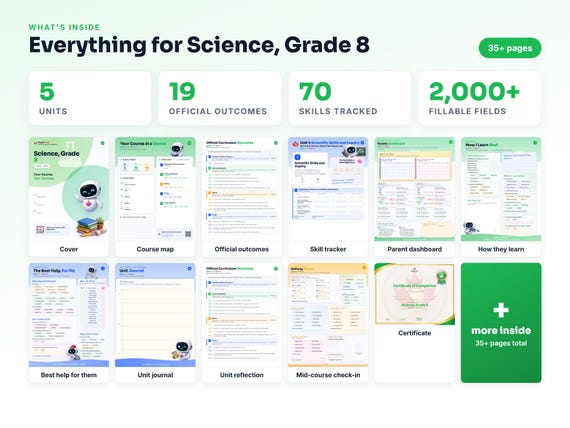


Printable workbook · A keepsake of the year
A Science, Grade 8 workbook worth keeping
Built from the same official curriculum as this page. Before and after each skill above, your student colours in how sure they feel — so the two of you can see, on one page, what's clicking and what needs another look. It's a quiet way to follow how the year is really going.
By June it's full of their own handwriting: units worked through, confidence grown, a mid-year check-in, notes from parent-teacher night, and a certificate at the end. Less a worksheet, more a record of the year worth keeping on the shelf.
Instant download · see every page, reviews and the full description · five or more workbooks are $2.99 each
What it looks like in the app



Common questions
Can MapleMind help me with Science, Grade 8?
Yes. MapleMind's AI tutor covers all 70 skills in Manitoba's Science, Grade 8 — you pick the exact skill, and the tutor teaches it step by step: a short lesson, a worked example, solving together, then a skill check to show it stuck.
Is MapleMind aligned to Manitoba's official curriculum?
Yes. Every skill in this course maps to an official outcome code from Manitoba's Grade 8 Science curriculum, and the ministry's own wording is quoted under each unit on this page — with the official government source linked so you can check it yourself.
What does MapleMind cost?
It's free to start — 5 tutoring chats and a practice quiz every day, no credit card. A Pro subscription ($9.99/month or $49.99/year CAD, 7-day free trial) unlocks unlimited tutoring, practice, and exam simulations.
What if I'm stuck on just one topic?
That's the point of skill-level tutoring: open Science, Grade 8 in the app, tap the exact skill from the list on this page, and the tutor teaches just that — no wading through lessons you don't need.
Does MapleMind work in French or other languages?
Yes — 14 languages, including French. Both the app and the tutor's explanations switch to the language you choose.
Where can I see the official Manitoba curriculum for Science, Grade 8?
The official source is linked on this page — Manitoba's official curriculum. The outline here follows it: every MapleMind skill carries its official outcome code, and the ministry's own wording is quoted under each unit.
Keep exploring
Ready when you are
Pick a skill from this page and see it taught properly — free, in the browser, in under a minute.