Get help with Science, Grade 9 (Senior 1)
Most tutoring makes you sit through material you already know. MapleMind flips that: pick the exact skill that's causing trouble — any of the 70 below — and the tutor teaches just that one, step by step, as many times as it takes. Ask questions in plain words, any time of day, in English, French, or 12 other languages.
The official Manitoba Science, Grade 9 (Senior 1) curriculum
Manitoba defines Science, Grade 9 (Senior 1) by strands and outcomes. MapleMind teaches the same curriculum reorganized for one-skill-at-a-time tutoring — the table shows exactly where every official strand lands, and the ministry's own wording is quoted under each unit below.
Official source Manitoba's official curriculumRead it on the government site — edu.gov.mb.ca ↗| Official strand | Outcomes | Where MapleMind teaches it |
|---|---|---|
| Strand 0 | 3 | Scientific Skills and Inquiry |
| Strand 1 | 18 | Reproduction |
| Strand 2 | 14 | Atoms and Elements |
| Strand 3 | 24 | Nature of Electricity |
| Strand 4 | 11 | Exploration of the Universe |
Every skill below, taught one on one.
 Try the first session free
How MapleMind teaches Science, Grade 9 (Senior 1) — every unit, lesson, and skill
Every skill below runs as a short session: a plain-words lesson, a worked example, solving it together, then a five-question skill check that earns up to three stars. Guided Mode keeps it teaching instead of answer-handing — turning it off needs a parent's password.
Unit 1Scientific Skills and InquiryOfficial strand · Strand 0
The senior-years doing of science in Senior 1 - selecting methods and tools for collecting data, measuring accurately in SI units, and recording and displaying data.
Doing Science: Measuring, Graphing, and Designing
- Select and use appropriate methods and tools for collectingS1-0-5a — Select and use appropriate methods and tools for collecting data or information.
- Estimate and measure accurately using Système International (SI) and other standard unitsS1-0-5b — Estimate and measure accurately using Système International (SI) and other standard units. Include: SI conversions.
- Record, organize, and display data using an appropriate format.S1-0-5c — Record, organize, and display data using an appropriate format. Include: labelled diagrams, graphs, multimedia.
The official wording — 3 outcomes in this unit
- S1-0-5a
Select and use appropriate methods and tools for collecting data or information
- S1-0-5b
Estimate and measure accurately using Système International (SI) and other standard units
- S1-0-5c
Record, organize, and display data using an appropriate format
Unit 2ReproductionOfficial strand · Strand 1
Mitosis and meiosis, asexual and sexual reproduction, human reproductive systems and development, single-trait inheritance, DNA and genes, and biotechnology issues.
Reproduction: Part 1
- Illustrate and explain the process of mitotic cell divisionS1-1-01 — Illustrate and explain the process of mitotic cell division in plants and animals. Include: chromosomes, mitosis, cytoplasmic division, cell cycle.
- Observe and explain the dynamic nature of cell divisionS1-1-02 — Observe and explain the dynamic nature of cell division.
- Describe various types of asexual reproduction that occur in plant and animal speciesS1-1-03 — Describe various types of asexual reproduction that occur in plant and animal species.
- Investigate and describe agricultural applications of asexual reproductionS1-1-04 — Investigate and describe agricultural applications of asexual reproduction.
- Illustrate and explain the production of male and femaleS1-1-05 — Illustrate and explain the production of male and female gametes by meiosis.
Reproduction: Part 2
- Compare and contrast the functions of mitosis to that of meiosisS1-1-06 — Compare and contrast the functions of mitosis to that of meiosis. Include: diploid cells, haploid cells.
- Compare sexual and asexual reproduction in terms of their advantages and disadvantages for plantS1-1-07 — Compare sexual and asexual reproduction in terms of their advantages and disadvantages for plant and animal species.
- Investigate and explain adaptations of plant and animal speciesS1-1-08 — Investigate and explain adaptations of plant and animal species which enhance reproductive success.
- Describe the structure and function of the male and female human reproductive systemsS1-1-09 — Describe the structure and function of the male and female human reproductive systems. Include: role of hormones.
- Outline human development from conception through birth. Include: XS1-1-10 — Outline human development from conception through birth. Include: X and Y chromosomes, zygote, embryo, fetus.
Reproduction: Part 3
- Observe, collect, and analyze class data of single traitS1-1-11 — Observe, collect, and analyze class data of single trait inheritance.
- Differentiate between dominant and recessive genes. Include: genotype, phenotypeS1-1-12 — Differentiate between dominant and recessive genes. Include: genotype, phenotype.
- Describe the relationship among DNA, chromosomes, genes, and the expression of traitsS1-1-13 — Describe the relationship among DNA, chromosomes, genes, and the expression of traits. Include: genetic similarity among all humans.
- Explain the inheritance of sex-linked traits in humans and use a pedigree to track the inheritanceS1-1-14 — Explain the inheritance of sex-linked traits in humans and use a pedigree to track the inheritance of a single trait.
- Investigate and describe environmental factors and personal choices that may lead to a geneticS1-1-15 — Investigate and describe environmental factors and personal choices that may lead to a genetic mutation or changes in an organism's development.
Reproduction: Part 4
- Investigate Canadian and international contributions to research and technologicalS1-1-16 — Investigate Canadian and international contributions to research and technological development in the field of genetics and reproduction.
- Discuss current and potential applications and implications of biotechnologiesS1-1-17 — Discuss current and potential applications and implications of biotechnologies including their effects upon personal and public decision-making. Include: genetic engineering, genetic screening, cloning, DNA fingerprinting.
- Use the decision-making process to address a current biotechnologyS1-1-18 — Use the decision-making process to address a current biotechnology issue.
The official wording — 18 outcomes in this unit
- S1-1-01
Illustrate and explain the process of mitotic cell division in plants and animals
- S1-1-02
Observe and explain the dynamic nature of cell division
- S1-1-03
Describe various types of asexual reproduction that occur in plant and animal species
- S1-1-04
Investigate and describe agricultural applications of asexual reproduction
- S1-1-05
Illustrate and explain the production of male and female gametes by meiosis
- S1-1-06
Compare and contrast the functions of mitosis to that of meiosis
- S1-1-07
Compare sexual and asexual reproduction in terms of their advantages and disadvantages for plant and animal species
- S1-1-08
Investigate and explain adaptations of plant and animal species which enhance reproductive success
- S1-1-09
Describe the structure and function of the male and female human reproductive systems
- S1-1-10
Outline human development from conception through birth
- S1-1-11
Observe, collect, and analyze class data of single trait inheritance
- S1-1-12
Differentiate between dominant and recessive genes
- S1-1-13
Describe the relationship among DNA, chromosomes, genes, and the expression of traits
- S1-1-14
Explain the inheritance of sex-linked traits in humans and use a pedigree to track the inheritance of a single trait
- S1-1-15
Investigate and describe environmental factors and personal choices that may lead to a genetic mutation or changes in an organism's development
- S1-1-16
Investigate Canadian and international contributions to research and technological development in the field of genetics and reproduction
- S1-1-17
Discuss current and potential applications and implications of biotechnologies including their effects upon personal and public decision-making
- S1-1-18
Use the decision-making process to address a current biotechnology issue
Unit 3Atoms and ElementsOfficial strand · Strand 2
Historical models of matter and the atom, elements and symbols, atomic structure, Bohr models, the periodic table, metals and non-metals, compounds and formulas, and chemical change.
Atoms and Elements: Part 1
- Describe how historical ideas and models furthered our understandingS1-2-01 — Describe how historical ideas and models furthered our understanding of the nature of matter. Include: Greek ideas, alchemy, Lavoisier.
- Investigate the historical progression of the atomic model. Include:S1-2-02 — Investigate the historical progression of the atomic model. Include: Dalton, Thompson, Rutherford, Bohr, quantum model.
- Define element and identify symbols of some common elements.S1-2-03 — Define element and identify symbols of some common elements. Include: the first 18 elements, K, Ca, Fe, Ni, Cu, Zn, I, Ag, Sn, Au, W, Hg, Pb, U.
- Explain the atomic structure of an atom in termsS1-2-04 — Explain the atomic structure of an atom in terms of the number of protons, electrons, and neutrons, and explain how those numbers define atomic number and atomic mass.
- Assemble or draw Bohr atomic models for the firstS1-2-05 — Assemble or draw Bohr atomic models for the first 18 elements and group them according to the number of outer shell electrons.
Atoms and Elements: Part 2
- Investigate the development of the periodic table as aS1-2-06 — Investigate the development of the periodic table as a method of organizing elements. Include: periods, families (groups).
- Investigate the characteristic properties of metals, non-metals, and metalloidsS1-2-07 — Investigate the characteristic properties of metals, non-metals, and metalloids and classify elements according to these properties.
- Relate the reactivity and stability of different families of elements to their atomic structureS1-2-08 — Relate the reactivity and stability of different families of elements to their atomic structure. Include: alkali metals, alkaline earths, chalcogens, halogens, noble gases.
- Compare elements to compounds. Include: atoms, moleculesS1-2-09 — Compare elements to compounds. Include: atoms, molecules.
- Interpret chemical formulas of elements and compounds in termsS1-2-10 — Interpret chemical formulas of elements and compounds in terms of the number of atoms of each element.
Atoms and Elements: Part 3
- Investigate properties of substances and explain the importance of knowing these propertiesS1-2-11 — Investigate properties of substances and explain the importance of knowing these properties.
- Differentiate between physical and chemical changesS1-2-12 — Differentiate between physical and chemical changes.
- Experiment to determine indicators of chemical changeS1-2-13 — Experiment to determine indicators of chemical change.
- Investigate technologies and natural phenomena that demonstrate chemical changeS1-2-14 — Investigate technologies and natural phenomena that demonstrate chemical change in everyday situations.
The official wording — 14 outcomes in this unit
- S1-2-01
Describe how historical ideas and models furthered our understanding of the nature of matter
- S1-2-02
Investigate the historical progression of the atomic model
- S1-2-03
Define element and identify symbols of some common elements
- S1-2-04
Explain the atomic structure of an atom in terms of the number of protons, electrons, and neutrons, and explain how those numbers define atomic number and atomic mass
- S1-2-05
Assemble or draw Bohr atomic models for the first 18 elements and group them according to the number of outer shell electrons
- S1-2-06
Investigate the development of the periodic table as a method of organizing elements
- S1-2-07
Investigate the characteristic properties of metals, non-metals, and metalloids and classify elements according to these properties
- S1-2-08
Relate the reactivity and stability of different families of elements to their atomic structure
- S1-2-09
Compare elements to compounds
- S1-2-10
Interpret chemical formulas of elements and compounds in terms of the number of atoms of each element
- S1-2-11
Investigate properties of substances and explain the importance of knowing these properties
- S1-2-12
Differentiate between physical and chemical changes
- S1-2-13
Experiment to determine indicators of chemical change
- S1-2-14
Investigate technologies and natural phenomena that demonstrate chemical change in everyday situations
Unit 4Nature of ElectricityOfficial strand · Strand 3
Two types of charge, the particle model of electricity, electrostatics, current, voltage and resistance, circuits, household wiring and safety, electrical power, and energy conservation.
Nature of Electricity: Part 1
- Demonstrate evidence for the existence of two types of chargeS1-3-01 — Demonstrate evidence for the existence of two types of charge.
- Discuss early models of electricity to support the premiseS1-3-02 — Discuss early models of electricity to support the premise that models in science change. Include: one-fluid model, two-fluid model, particle model.
- Explain how a discrepant event can be used to evaluate the particle model of electricityS1-3-03 — Explain how a discrepant event can be used to evaluate the particle model of electricity. Include: the attraction of neutral objects to charged objects.
- Relate the particle model of electricity to atomic structureS1-3-04 — Relate the particle model of electricity to atomic structure.
- Investigate and explain electrostatic phenomena using the particle modelS1-3-05 — Investigate and explain electrostatic phenomena using the particle model of electricity. Include: conservation of charge, conduction, grounding, attraction of a neutral insulator, induction.
Nature of Electricity: Part 2
- Investigate common electrostatic technologies and phenomena and describe measuresS1-3-06 — Investigate common electrostatic technologies and phenomena and describe measures which reduce dangers associated with electrostatics.
- Construct one or more electrostatic apparatus and explain howS1-3-07 — Construct one or more electrostatic apparatus and explain how they function using the particle model of electricity. Include: pie-plate electrophorus.
- Demonstrate and explain the like nature of electrostatics and current electricityS1-3-08 — Demonstrate and explain the like nature of electrostatics and current electricity. Include: discharge an electrophorus through a neon bulb.
- Define electric current as charge per unit time and solve related problemsS1-3-09 — Define electric current as charge per unit time and solve related problems. Include: I=Q/t.
- Define voltage (electric potential difference) as the energy perS1-3-10 — Define voltage (electric potential difference) as the energy per unit charge between two points along a conductor and solve related problems. Include: V=E/Q.
Nature of Electricity: Part 3
- Identify the five sources of electrical energy and someS1-3-11 — Identify the five sources of electrical energy and some associated technologies. Include: chemical, photo, thermo, electromagnetic, piezo.
- Describe resistance in terms of the particle model of electricityS1-3-12 — Describe resistance in terms of the particle model of electricity.
- Construct electric circuits using schematic diagrams. Include: series, parallelS1-3-13 — Construct electric circuits using schematic diagrams. Include: series, parallel.
- Use appropriate instruments and units to measure voltage (electricS1-3-14 — Use appropriate instruments and units to measure voltage (electric potential difference), current, and resistance.
- Compare and contrast voltage and current in series and parallel circuitsS1-3-15 — Compare and contrast voltage and current in series and parallel circuits. Include: cells, resistance.
Nature of Electricity: Part 4
- Investigate and describe qualitatively the relationship among current, voltageS1-3-16 — Investigate and describe qualitatively the relationship among current, voltage (electric potential difference), and resistance in a simple electric circuit.
- Relate the energy dissipated in a circuit to the resistance, current, and brightness of bulbsS1-3-17 — Relate the energy dissipated in a circuit to the resistance, current, and brightness of bulbs.
- Explain the parallel circuits, the components, and the safetyS1-3-18 — Explain the parallel circuits, the components, and the safety aspects of household wiring. Include: switches, fuses, circuit breakers, outlets.
- Explain safety considerations of some common household electrical appliancesS1-3-19 — Explain safety considerations of some common household electrical appliances.
- Define electrical power as energy per unit time, and solve related problemsS1-3-20 — Define electrical power as energy per unit time, and solve related problems. Include: P=E/t.
Nature of Electricity: Part 5
- Develop a formula for domestic power consumption costs, and solve related problemsS1-3-21 — Develop a formula for domestic power consumption costs, and solve related problems. Include: Cost = Power x time x unit price/kWh.
- Analyze the electrical energy consumption of a household appliance.S1-3-22 — Analyze the electrical energy consumption of a household appliance. Include: calculate consumption using Energuide labels, read hydro meter, interpret monthly hydro bill.
- Recognize and explain the importance of incorporating principles of electrical energy conservationS1-3-23 — Recognize and explain the importance of incorporating principles of electrical energy conservation into the decision-making process.
- Use the decision-making process to address an issue associatedS1-3-24 — Use the decision-making process to address an issue associated with the generation and transmission of electricity in Manitoba. Include: hydroelectric power, sustainability.
The official wording — 24 outcomes in this unit
- S1-3-01
Demonstrate evidence for the existence of two types of charge
- S1-3-02
Discuss early models of electricity to support the premise that models in science change
- S1-3-03
Explain how a discrepant event can be used to evaluate the particle model of electricity
- S1-3-04
Relate the particle model of electricity to atomic structure
- S1-3-05
Investigate and explain electrostatic phenomena using the particle model of electricity
- S1-3-06
Investigate common electrostatic technologies and phenomena and describe measures which reduce dangers associated with electrostatics
- S1-3-07
Construct one or more electrostatic apparatus and explain how they function using the particle model of electricity
- S1-3-08
Demonstrate and explain the like nature of electrostatics and current electricity
- S1-3-09
Define electric current as charge per unit time and solve related problems
- S1-3-10
Define voltage (electric potential difference) as the energy per unit charge between two points along a conductor and solve related problems
- S1-3-11
Identify the five sources of electrical energy and some associated technologies
- S1-3-12
Describe resistance in terms of the particle model of electricity
- S1-3-13
Construct electric circuits using schematic diagrams
- S1-3-14
Use appropriate instruments and units to measure voltage (electric potential difference), current, and resistance
- S1-3-15
Compare and contrast voltage and current in series and parallel circuits
- S1-3-16
Investigate and describe qualitatively the relationship among current, voltage (electric potential difference), and resistance in a simple electric circuit
- S1-3-17
Relate the energy dissipated in a circuit to the resistance, current, and brightness of bulbs
- S1-3-18
Explain the parallel circuits, the components, and the safety aspects of household wiring
- S1-3-19
Explain safety considerations of some common household electrical appliances
- S1-3-20
Define electrical power as energy per unit time, and solve related problems
- S1-3-21
Develop a formula for domestic power consumption costs, and solve related problems
- S1-3-22
Analyze the electrical energy consumption of a household appliance
- S1-3-23
Recognize and explain the importance of incorporating principles of electrical energy conservation into the decision-making process
- S1-3-24
Use the decision-making process to address an issue associated with the generation and transmission of electricity in Manitoba
Unit 5Exploration of the UniverseOfficial strand · Strand 4
Locating celestial objects, apparent motion, historical Earth-space models, astronomical distances, components of the universe, and space technologies.
Exploration of the Universe: Part 1
- Use a coordinate system to locate visible celestial objects,S1-4-01 — Use a coordinate system to locate visible celestial objects, and construct an astrolabe to determine the position of these objects. Include: altitude, azimuth.
- Observe the motion of visible celestial objects and organizeS1-4-02 — Observe the motion of visible celestial objects and organize collected data.
- Investigate how various cultures used knowledge of the positionS1-4-03 — Investigate how various cultures used knowledge of the position and motion of visible celestial objects for navigation.
- Compare and contrast historical perspectives on the relationship betweenS1-4-04 — Compare and contrast historical perspectives on the relationship between Earth and space. Include: geocentric model, heliocentric model.
- Explain reasons for the apparent motion of the Sun,S1-4-05 — Explain reasons for the apparent motion of the Sun, stars, planets, and the Moon as seen from Earth. Include: daily rising and setting, seasonal constellations, retrograde motion.
Exploration of the Universe: Part 2
- Differentiate between units of measure used for astronomical distances,S1-4-06 — Differentiate between units of measure used for astronomical distances, and perform simple calculations using these units. Include: astronomical unit, light year.
- Compare and contrast scientific and cultural perspectives on the origin and evolutionS1-4-07 — Compare and contrast scientific and cultural perspectives on the origin and evolution of the universe.
- Differentiate between the major components of the universe. Include:S1-4-08 — Differentiate between the major components of the universe. Include: planets, moons, comets and asteroids, nebulae, stars, galaxies, black holes.
- Explain how various technologies have extended our ability to explore and understand spaceS1-4-09 — Explain how various technologies have extended our ability to explore and understand space.
- Investigate ways in which Canada participates in space researchS1-4-10 — Investigate ways in which Canada participates in space research and in international space programs, then use the decision-making process to address a related issue.
Exploration of the Universe: Part 3
- Evaluate the impact of space science and technologies in terms of their benefits and risks to humansS1-4-11 — Evaluate the impact of space science and technologies in terms of their benefits and risks to humans.
The official wording — 11 outcomes in this unit
- S1-4-01
Use a coordinate system to locate visible celestial objects, and construct an astrolabe to determine the position of these objects
- S1-4-02
Observe the motion of visible celestial objects and organize collected data
- S1-4-03
Investigate how various cultures used knowledge of the position and motion of visible celestial objects for navigation
- S1-4-04
Compare and contrast historical perspectives on the relationship between Earth and space
- S1-4-05
Explain reasons for the apparent motion of the Sun, stars, planets, and the Moon as seen from Earth
- S1-4-06
Differentiate between units of measure used for astronomical distances, and perform simple calculations using these units
- S1-4-07
Compare and contrast scientific and cultural perspectives on the origin and evolution of the universe
- S1-4-08
Differentiate between the major components of the universe
- S1-4-09
Explain how various technologies have extended our ability to explore and understand space
- S1-4-10
Investigate ways in which Canada participates in space research and in international space programs, then use the decision-making process to address a related issue
- S1-4-11
Evaluate the impact of space science and technologies in terms of their benefits and risks to humans

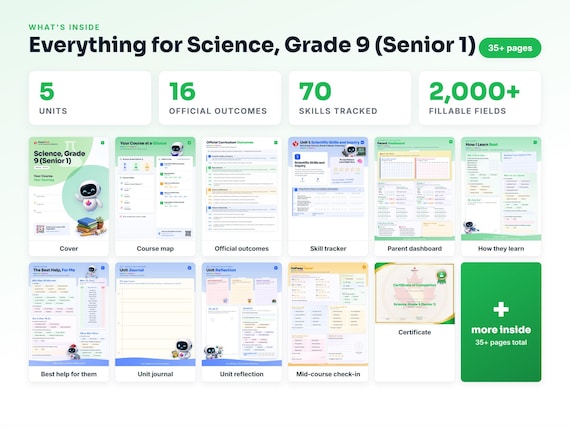

Printable workbook · A keepsake of the year
A Science, Grade 9 (Senior 1) workbook worth keeping
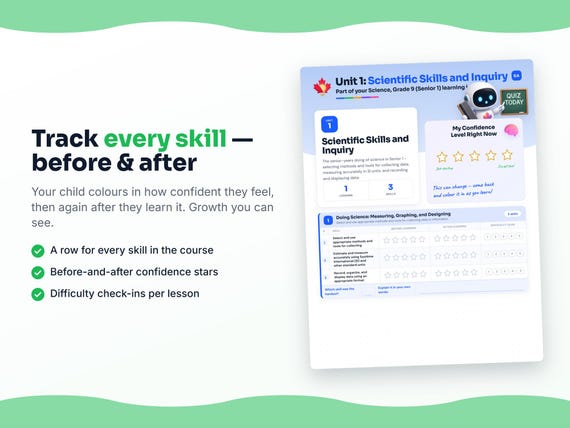
Built from the same official curriculum as this page. Before and after each skill above, your student colours in how sure they feel — so the two of you can see, on one page, what's clicking and what needs another look. It's a quiet way to follow how the year is really going.
By June it's full of their own handwriting: units worked through, confidence grown, a mid-year check-in, notes from parent-teacher night, and a certificate at the end. Less a worksheet, more a record of the year worth keeping on the shelf.
Instant download · see every page, reviews and the full description · five or more workbooks are $2.99 each
What it looks like in the app



Common questions
Can MapleMind help me with Science, Grade 9 (Senior 1)?
Yes. MapleMind's AI tutor covers all 70 skills in Manitoba's Science, Grade 9 (Senior 1) — you pick the exact skill, and the tutor teaches it step by step: a short lesson, a worked example, solving together, then a skill check to show it stuck.
Is MapleMind aligned to Manitoba's official curriculum?
Yes. Every skill in this course maps to an official outcome code from Manitoba's Grade 9 Science curriculum, and the ministry's own wording is quoted under each unit on this page — with the official government source linked so you can check it yourself.
What does MapleMind cost?
It's free to start — 5 tutoring chats and a practice quiz every day, no credit card. A Pro subscription ($9.99/month or $49.99/year CAD, 7-day free trial) unlocks unlimited tutoring, practice, and exam simulations.
What if I'm stuck on just one topic?
That's the point of skill-level tutoring: open Science, Grade 9 (Senior 1) in the app, tap the exact skill from the list on this page, and the tutor teaches just that — no wading through lessons you don't need.
Does MapleMind work in French or other languages?
Yes — 14 languages, including French. Both the app and the tutor's explanations switch to the language you choose.
Where can I see the official Manitoba curriculum for Science, Grade 9 (Senior 1)?
The official source is linked on this page — Manitoba's official curriculum. The outline here follows it: every MapleMind skill carries its official outcome code, and the ministry's own wording is quoted under each unit.
Keep exploring
Ready when you are
Pick a skill from this page and see it taught properly — free, in the browser, in under a minute.