Get help with Science, Grade 10 (Senior 2)
Most tutoring makes you sit through material you already know. MapleMind flips that: pick the exact skill that's causing trouble — any of the 46 below — and the tutor teaches just that one, step by step, as many times as it takes. Ask questions in plain words, any time of day, in English, French, or 12 other languages.
The official Manitoba Science, Grade 10 (Senior 2) curriculum
Manitoba defines Science, Grade 10 (Senior 2) by strands and outcomes. MapleMind teaches the same curriculum reorganized for one-skill-at-a-time tutoring — the table shows exactly where every official strand lands, and the ministry's own wording is quoted under each unit below.
Official source Manitoba's official curriculumRead it on the government site — edu.gov.mb.ca ↗| Official strand | Outcomes | Where MapleMind teaches it |
|---|---|---|
| Strand 0 | 3 | Scientific Skills and Inquiry |
| Strand 1 | 10 | Dynamics of Ecosystems |
| Strand 2 | 12 | Chemistry in Action |
| Strand 3 | 13 | In Motion |
| Strand 4 | 8 | Weather Dynamics |
Every skill below, taught one on one.
 Try the first session free
How MapleMind teaches Science, Grade 10 (Senior 2) — every unit, lesson, and skill
Every skill below runs as a short session: a plain-words lesson, a worked example, solving it together, then a five-question skill check that earns up to three stars. Guided Mode keeps it teaching instead of answer-handing — turning it off needs a parent's password.
Unit 1Scientific Skills and InquiryOfficial strand · Strand 0
The senior-years doing of science in Senior 2 - selecting methods and tools for sampling data, measuring accurately in SI units, and recording and displaying data.
Doing Science: Measuring, Graphing, and Designing
- Select and use appropriate methods and tools for samplingS2-0-5a — Select and use appropriate methods and tools for sampling data or collecting.
- Estimate and measure accurately using Système International (SI) and other standard unitsS2-0-5b — Estimate and measure accurately using Système International (SI) and other standard units. Include: SI conversions.
- Record, organize, and display data using an appropriate format.S2-0-5c — Record, organize, and display data using an appropriate format. Include: labelled diagrams, tables, graphs, multimedia.
The official wording — 3 outcomes in this unit
- S2-0-5a
Select and use appropriate methods and tools for sampling data or collecting
- S2-0-5b
Estimate and measure accurately using Système International (SI) and other standard units
- S2-0-5c
Record, organize, and display data using an appropriate format
Unit 2Dynamics of EcosystemsOfficial strand · Strand 1
Biogeochemical cycles, bioaccumulation, carrying capacity and limiting factors, population dynamics, biodiversity and sustainability, and human impact.
Dynamics of Ecosystems: Part 1
- Illustrate and explain how carbon, nitrogen, and oxygen areS2-1-01 — Illustrate and explain how carbon, nitrogen, and oxygen are cycled through an ecosystem.
- Discuss factors that may disturb biogeochemical cycles. Include: naturalS2-1-02 — Discuss factors that may disturb biogeochemical cycles. Include: natural events, human activities.
- Describe bioaccumulation and explain its potential impact on consumersS2-1-03 — Describe bioaccumulation and explain its potential impact on consumers.
- Describe the carrying capacity of an ecosystemS2-1-04 — Describe the carrying capacity of an ecosystem.
- Investigate and discuss various limiting factors that influence populationS2-1-05 — Investigate and discuss various limiting factors that influence population dynamics. Include: density-dependent and density-independent factors.
Dynamics of Ecosystems: Part 2
- Construct and interpret graphs of population dynamicsS2-1-06 — Construct and interpret graphs of population dynamics.
- Describe potential consequences of introducing new species and speciesS2-1-07 — Describe potential consequences of introducing new species and species extinction on an ecosystem.
- Observe and document a range of organisms that illustrateS2-1-08 — Observe and document a range of organisms that illustrate the biodiversity within a local or regional ecosystem.
- Explain how the biodiversity of an ecosystem contributes to its sustainabilityS2-1-09 — Explain how the biodiversity of an ecosystem contributes to its sustainability.
- Investigate how human activities affect an ecosystem and useS2-1-10 — Investigate how human activities affect an ecosystem and use the decision-making process to propose a course of action to enhance its sustainability. Include: impact on biogeochemical cycling, population dynamics, and biodiversity.
The official wording — 10 outcomes in this unit
- S2-1-01
Illustrate and explain how carbon, nitrogen, and oxygen are cycled through an ecosystem
- S2-1-02
Discuss factors that may disturb biogeochemical cycles
- S2-1-03
Describe bioaccumulation and explain its potential impact on consumers
- S2-1-04
Describe the carrying capacity of an ecosystem
- S2-1-05
Investigate and discuss various limiting factors that influence population dynamics
- S2-1-06
Construct and interpret graphs of population dynamics
- S2-1-07
Describe potential consequences of introducing new species and species extinction on an ecosystem
- S2-1-08
Observe and document a range of organisms that illustrate the biodiversity within a local or regional ecosystem
- S2-1-09
Explain how the biodiversity of an ecosystem contributes to its sustainability
- S2-1-10
Investigate how human activities affect an ecosystem and use the decision-making process to propose a course of action to enhance its sustainability
Unit 3Chemistry in ActionOfficial strand · Strand 2
Valence and the periodic table, ionic and covalent bonding, naming compounds, conservation of mass, balancing equations, reaction types, acids and bases, and air pollution.
Chemistry in Action: Part 1
- Relate an element's position in the periodic table to its combining capacity (valence)S2-2-01 — Relate an element's position in the periodic table to its combining capacity (valence). Include: alkali metals, alkaline earths, chalcogens, halogens, noble gases.
- Explain, using the periodic table, how and why elementsS2-2-02 — Explain, using the periodic table, how and why elements combine in specific ratios to form compounds. Include: ionic bonds, covalent bonds.
- Write formulas and names of binary ionic compounds. Include:S2-2-03 — Write formulas and names of binary ionic compounds. Include: IUPAC guidelines and rationale for their use.
- Write formulas and names for covalent compounds using prefixes.S2-2-04 — Write formulas and names for covalent compounds using prefixes. Include: mono, di, tri, tetra.
- Investigate the Law of Conservation of Mass, and recognizeS2-2-05 — Investigate the Law of Conservation of Mass, and recognize that mass is conserved in chemical reactions.
Chemistry in Action: Part 2
- Balance chemical equationsS2-2-06 — Balance chemical equations. Include: translation of word equations to balanced chemical equations, and balanced chemical equations to word equations.
- Investigate and classify reactions as synthesis, decomposition, single displacement,S2-2-07 — Investigate and classify reactions as synthesis, decomposition, single displacement, double displacement, or combustion.
- Experiment to classify acids and bases using their characteristicS2-2-08 — Experiment to classify acids and bases using their characteristic properties. Include: pH, indicators,.
- Discuss the occurrence of acids and bases in biologicalS2-2-09 — Discuss the occurrence of acids and bases in biological systems, industrial processes, and domestic applications. Include: environmental, health, and safety issues.
- Explain how acids and bases interact to form aS2-2-10 — Explain how acids and bases interact to form a salt and water in the process of neutralization.
Chemistry in Action: Part 3
- Describe the formation and the environmental impact of variousS2-2-11 — Describe the formation and the environmental impact of various types of air pollution.
- Investigate technologies that are used to reduce emissions of potential air pollutantsS2-2-12 — Investigate technologies that are used to reduce emissions of potential air pollutants.
The official wording — 12 outcomes in this unit
- S2-2-01
Relate an element's position in the periodic table to its combining capacity (valence)
- S2-2-02
Explain, using the periodic table, how and why elements combine in specific ratios to form compounds
- S2-2-03
Write formulas and names of binary ionic compounds
- S2-2-04
Write formulas and names for covalent compounds using prefixes
- S2-2-05
Investigate the Law of Conservation of Mass, and recognize that mass is conserved in chemical reactions
- S2-2-06
Balance chemical equations
- S2-2-07
Investigate and classify reactions as synthesis, decomposition, single displacement, double displacement, or combustion
- S2-2-08
Experiment to classify acids and bases using their characteristic properties
- S2-2-09
Discuss the occurrence of acids and bases in biological systems, industrial processes, and domestic applications
- S2-2-10
Explain how acids and bases interact to form a salt and water in the process of neutralization
- S2-2-11
Describe the formation and the environmental impact of various types of air pollution
- S2-2-12
Investigate technologies that are used to reduce emissions of potential air pollutants
Unit 4In MotionOfficial strand · Strand 3
Displacement, time, and velocity, acceleration, Newton's laws, inertia, momentum and impulse, energy in collisions, friction, and braking distance.
In Motion: Part 1
- Analyze the relationship among displacement, time, and velocity for an object in uniform motionS2-3-01 — Analyze the relationship among displacement, time, and velocity for an object in uniform motion. Include: visual, numeric, graphical, symbolic (velocity = delta d/delta t).
- Collect displacement data to calculate and graph velocity versusS2-3-02 — Collect displacement data to calculate and graph velocity versus time for an object that is accelerating at a constant rate.
- Analyze the relationships among velocity, timeS2-3-03 — Analyze the relationships among velocity, time, and acceleration for an object that is accelerating at a constant rate. Include: visual, numeric, graphical, symbolic (acceleration = delta v/ delta t).
- Outline the historical development of the concepts of forceS2-3-04 — Outline the historical development of the concepts of force and "natural" motion. Include: Aristotle, Galileo, Newton's First Law.
- Experiment to illustrate the effects of inertia in carS2-3-05 — Experiment to illustrate the effects of inertia in car collisions. Include: distance travelled (of an unrestrained passenger) is proportional to velocity.
In Motion: Part 2
- Investigate and describe qualitatively Newton's Third LawS2-3-07 — Investigate and describe qualitatively Newton's Third Law.
- Define momentum and impulse and qualitatively relate impulse to change in momentum for everydayS2-3-08 — Define momentum and impulse and qualitatively relate impulse to change in momentum for everyday situations. Include: car collisions, bumpers, restraints, air bags, size and type of vehicle.
- Investigate the conservation of energy in a motor vehicleS2-3-09 — Investigate the conservation of energy in a motor vehicle collision. Include: kinetic energy, heat energy, sound.
- Investigate conditions that illustrate the effects of friction on motionS2-3-10 — Investigate conditions that illustrate the effects of friction on motion. Include: weather conditions, surface materials.
In Motion: Part 3
- Investigate the factors that influence braking distance. Include: reactionS2-3-11 — Investigate the factors that influence braking distance. Include: reaction time, friction, condition of driver, speed.
- Using the relationship between displacement, velocity, and friction (S2-3-12 — Using the relationship between displacement, velocity, and friction ( d=kv squared ), calculate the braking distance of a motor vehicle.
- Use the decision-making process to address an STSE issueS2-3-13 — Use the decision-making process to address an STSE issue related to safe driving conditions.
The official wording — 13 outcomes in this unit
- S2-3-01
Analyze the relationship among displacement, time, and velocity for an object in uniform motion
- S2-3-02
Collect displacement data to calculate and graph velocity versus time for an object that is accelerating at a constant rate
- S2-3-03
Analyze the relationships among velocity, time, and acceleration for an object that is accelerating at a constant rate
- S2-3-04
Outline the historical development of the concepts of force and "natural" motion
- S2-3-05
Experiment to illustrate the effects of inertia in car collisions
- S2-3-06
Describe qualitatively how force is related to motion
- S2-3-07
Investigate and describe qualitatively Newton's Third Law
- S2-3-08
Define momentum and impulse and qualitatively relate impulse to change in momentum for everyday situations
- S2-3-09
Investigate the conservation of energy in a motor vehicle collision
- S2-3-10
Investigate conditions that illustrate the effects of friction on motion
- S2-3-11
Investigate the factors that influence braking distance
- S2-3-12
Using the relationship between displacement, velocity, and friction ( d=kv squared ), calculate the braking distance of a motor vehicle
- S2-3-13
Use the decision-making process to address an STSE issue related to safe driving conditions
Unit 5Weather DynamicsOfficial strand · Strand 4
The hydrosphere and atmosphere, Earth's radiation budget, heat transfer and winds, severe weather, meteorological data, and climate change.
Weather Dynamics: Part 1
- Illustrate the composition and organization of the hydrosphere and the atmosphereS2-4-01 — Illustrate the composition and organization of the hydrosphere and the atmosphere. Include: salt water, fresh water, polar ice caps/glaciers, troposphere, stratosphere.
- Outline factors influencing the Earth's radiation budget. Include: solarS2-4-02 — Outline factors influencing the Earth's radiation budget. Include: solar radiation, cloud cover, surface and atmospheric reflectance (albedo), absorption, latitude.
- Explain effects of heat transfer within the atmosphere and hydrosphere on the developmentS2-4-03 — Explain effects of heat transfer within the atmosphere and hydrosphere on the development and movement of wind and ocean currents. Include: Coriolis effect and atmospheric convection, prevailing winds, jet streams, El Niño.
- Explain the formation and dynamics of selected severe weatherS2-4-04 — Explain the formation and dynamics of selected severe weather phenomena.
Weather Dynamics: Part 2
- Investigate and evaluate evidence that climate change occurs naturallyS2-4-07 — Investigate and evaluate evidence that climate change occurs naturally and could be influenced by human activities. Include: the use of technology in gathering and interpreting current and historical data.
- Discuss potential consequences of climate changeS2-4-08 — Discuss potential consequences of climate change.
The official wording — 8 outcomes in this unit
- S2-4-01
Illustrate the composition and organization of the hydrosphere and theatmosphere
- S2-4-02
Outline factors influencing the Earth's radiation budget
- S2-4-03
Explain effects of heat transfer within the atmosphere and hydrosphere on the development and movement of wind and ocean currents
- S2-4-04
Explain the formation and dynamics of selected severe weather phenomena
- S2-4-05
Collect, interpret, and analyze meteorological data related to a severe weather event
- S2-4-06
Investigate the social, economic, and environmental impacts of a recent severe weather event
- S2-4-07
Investigate and evaluate evidence that climate change occurs naturally and could be influenced by human activities
- S2-4-08
Discuss potential consequences of climate change


Printable workbook · A keepsake of the year
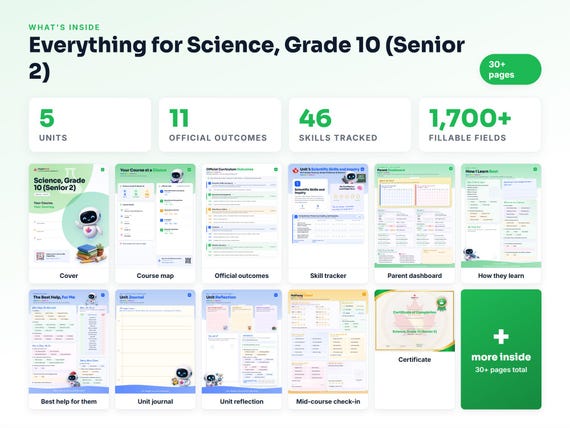
A Science, Grade 10 (Senior 2) workbook worth keeping
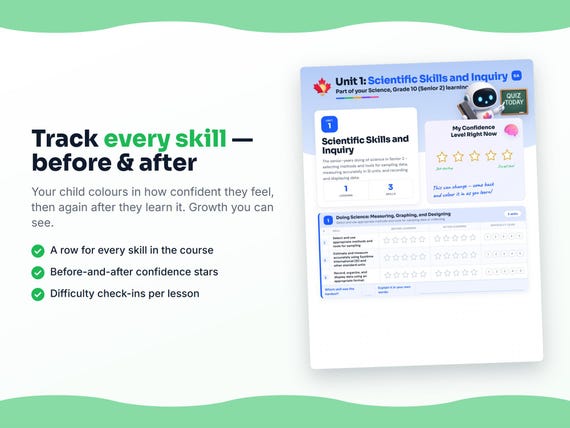
Built from the same official curriculum as this page. Before and after each skill above, your student colours in how sure they feel — so the two of you can see, on one page, what's clicking and what needs another look. It's a quiet way to follow how the year is really going.
By June it's full of their own handwriting: units worked through, confidence grown, a mid-year check-in, notes from parent-teacher night, and a certificate at the end. Less a worksheet, more a record of the year worth keeping on the shelf.
Instant download · see every page, reviews and the full description · five or more workbooks are $2.99 each
What it looks like in the app



Common questions
Can MapleMind help me with Science, Grade 10 (Senior 2)?
Yes. MapleMind's AI tutor covers all 46 skills in Manitoba's Science, Grade 10 (Senior 2) — you pick the exact skill, and the tutor teaches it step by step: a short lesson, a worked example, solving together, then a skill check to show it stuck.
Is MapleMind aligned to Manitoba's official curriculum?
Yes. Every skill in this course maps to an official outcome code from Manitoba's Grade 10 Science curriculum, and the ministry's own wording is quoted under each unit on this page — with the official government source linked so you can check it yourself.
What does MapleMind cost?
It's free to start — 5 tutoring chats and a practice quiz every day, no credit card. A Pro subscription ($9.99/month or $49.99/year CAD, 7-day free trial) unlocks unlimited tutoring, practice, and exam simulations.
What if I'm stuck on just one topic?
That's the point of skill-level tutoring: open Science, Grade 10 (Senior 2) in the app, tap the exact skill from the list on this page, and the tutor teaches just that — no wading through lessons you don't need.
Does MapleMind work in French or other languages?
Yes — 14 languages, including French. Both the app and the tutor's explanations switch to the language you choose.
Where can I see the official Manitoba curriculum for Science, Grade 10 (Senior 2)?
The official source is linked on this page — Manitoba's official curriculum. The outline here follows it: every MapleMind skill carries its official outcome code, and the ministry's own wording is quoted under each unit.
Keep exploring
Ready when you are
Pick a skill from this page and see it taught properly — free, in the browser, in under a minute.