Get help with Biology, Grade 11 (Biology 30S)
Most tutoring makes you sit through material you already know. MapleMind flips that: pick the exact skill that's causing trouble — any of the 62 below — and the tutor teaches just that one, step by step, as many times as it takes. Ask questions in plain words, any time of day, in English, French, or 12 other languages.
The official Manitoba Biology, Grade 11 (Biology 30S) curriculum
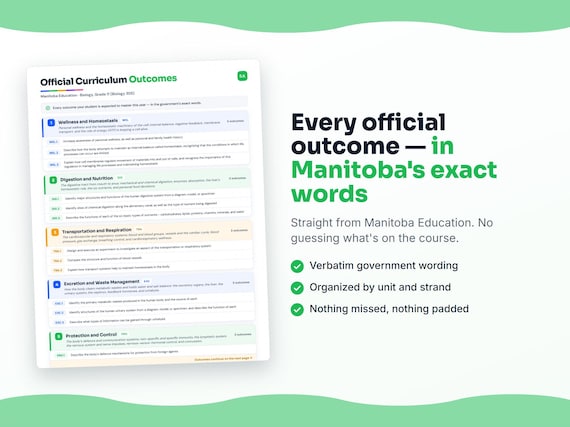
Manitoba defines Biology, Grade 11 (Biology 30S) by strands and outcomes. MapleMind teaches the same curriculum reorganized for one-skill-at-a-time tutoring — the table shows exactly where every official strand lands, and the ministry's own wording is quoted under each unit below.
Official source Manitoba's official curriculumRead it on the government site — edu.gov.mb.ca ↗| Official strand | Outcomes | Where MapleMind teaches it |
|---|---|---|
| Strand 1 | 9 | Wellness and Homeostasis |
| Strand 2 | 12 | Digestion and Nutrition |
| Strand 3 | 17 | Transportation and Respiration |
| Strand 4 | 8 | Excretion and Waste Management |
| Strand 5 | 11 | Protection and Control |
| Strand 6 | 5 | Wellness and Homeostatic Changes |
Every skill below, taught one on one.
 Try the first session free
How MapleMind teaches Biology, Grade 11 (Biology 30S) — every unit, lesson, and skill
Every skill below runs as a short session: a plain-words lesson, a worked example, solving it together, then a five-question skill check that earns up to three stars. Guided Mode keeps it teaching instead of answer-handing — turning it off needs a parent's password.
Unit 1Wellness and HomeostasisOfficial strand · Strand 1
Personal wellness and the homeostatic machinery of the cell: internal balance, negative feedback, membrane transport, and the role of energy (ATP) in keeping a cell alive.
Personal Wellness
- Increase awareness of personal wellness, as well as personal and family health historyB11-1-01 — Increase awareness of personal wellness, as well as personal and family health history.
- Develop a personal wellness planB11-1-02 — Develop a personal wellness plan.
- Recognize how individual wellness choices affect othersB11-1-03 — Recognize how individual wellness choices affect others.
Homeostasis and Negative Feedback
- Describe how the body attempts to maintain an internal balance calledB11-1-04 — Describe how the body attempts to maintain an internal balance called homeostasis, recognizing that the conditions in which life processes can occur are limited.
- Explain the principle of negative feedback and identify how the bodyB11-1-05 — Explain the principle of negative feedback and identify how the body stabilizes systems against excessive change.
- Identify life processes that individual cells, as well as complexB11-1-06 — Identify life processes that individual cells, as well as complex organisms, need to manage.
Membranes and Cellular Energy
- Explain how cell membranes regulate movement of materials into and out of cellsB11-1-07 — Explain how cell membranes regulate movement of materials into and out of cells, and recognize the importance of this regulation in managing life processes and maintaining homeostasis.
- Identify factors that influence movement of substances across aB11-1-08 — Identify factors that influence movement of substances across a membrane, recognizing that movement of these substances is important for the internal balance of the cell.
- Explain the role of energy in maintaining an internal balance in the cellB11-1-09 — Explain the role of energy in maintaining an internal balance in the cell.
The official wording — 9 outcomes in this unit
- B11-1-01
Increase awareness of personal wellness, as well as personal and family health history
- B11-1-02
Develop a personal wellness plan
- B11-1-03
Recognize how individual wellness choices affect others
- B11-1-04
Describe how the body attempts to maintain an internal balance called homeostasis, recognizing that the conditions in which life processes can occur are limited
- B11-1-05
Explain the principle of negative feedback and identify how the body stabilizes systems against excessive change
- B11-1-06
Identify life processes that individual cells, as well as complex organisms, need to manage
- B11-1-07
Explain how cell membranes regulate movement of materials into and out of cells, and recognize the importance of this regulation in managing life processes and maintaining homeostasis
- B11-1-08
Identify factors that influence movement of substances across a membrane, recognizing that movement of these substances is important for the internal balance of the cell
- B11-1-09
Explain the role of energy in maintaining an internal balance in the cell
Unit 2Digestion and NutritionOfficial strand · Strand 2
The digestive tract from mouth to anus: mechanical and chemical digestion, enzymes, absorption, the liver's homeostatic role, the six nutrients, and personal food decisions.
The Digestive Tract
- Identify major structures and functions of the human digestive systemB11-2-01 — Identify major structures and functions of the human digestive system from a diagram, model, or specimen.
- Describe the processes of mechanical digestion that take place at various sites alongB11-2-02 — Describe the processes of mechanical digestion that take place at various sites along the alimentary canal.
- Identify functions of secretions along the digestive tractB11-2-03 — Identify functions of secretions along the digestive tract.
Chemical Digestion and Enzymes
- Identify sites of chemical digestion along the alimentary canal, asB11-2-04 — Identify sites of chemical digestion along the alimentary canal, as well as the type of nutrient being digested.
- Explain the role of enzymes in the chemical digestion of nutrientsB11-2-05 — Explain the role of enzymes in the chemical digestion of nutrients and identify factors that influence their action.
- Describe the processes of absorption that take place at various sitesB11-2-06 — Describe the processes of absorption that take place at various sites along the alimentary canal.
- Describe the homeostatic role of the liver with respect to the regulation of nutrient levelsB11-2-07 — Describe the homeostatic role of the liver with respect to the regulation of nutrient levels in the blood and nutrient storage.
Nutrients and Food Decisions
- Describe the functions of each of the six basic types of nutrients—B11-2-08 — Describe the functions of each of the six basic types of nutrients— carbohydrates, lipids, proteins, vitamins, minerals, and water.
- Identify dietary sources for each of the six basic types of nutrients— carbohydrates, lipidsB11-2-09 — Identify dietary sources for each of the six basic types of nutrients— carbohydrates, lipids, proteins, vitamins, minerals, and water.
- Investigate and describe conditions/disorders that affect the digestive processB11-2-11 — Investigate and describe conditions/disorders that affect the digestive process.
- Use the decision-making process to investigate an issue related to digestion and nutritionB11-2-12 — Use the decision-making process to investigate an issue related to digestion and nutrition.
The official wording — 12 outcomes in this unit
- B11-2-01
Identify major structures and functions of the human digestive system from a diagram, model, or specimen
- B11-2-02
Describe the processes of mechanical digestion that take place at various sites along the alimentary canal
- B11-2-03
Identify functions of secretions along the digestive tract
- B11-2-04
Identify sites of chemical digestion along the alimentary canal, as well as the type of nutrient being digested
- B11-2-05
Explain the role of enzymes in the chemical digestion of nutrients and identify factors that influence their action
- B11-2-06
Describe the processes of absorption that take place at various sites along the alimentary canal
- B11-2-07
Describe the homeostatic role of the liver with respect to the regulation of nutrient levels in the blood and nutrient storage
- B11-2-08
Describe the functions of each of the six basic types of nutrients— carbohydrates, lipids, proteins, vitamins, minerals, and water
- B11-2-09
Identify dietary sources for each of the six basic types of nutrients— carbohydrates, lipids, proteins, vitamins, minerals, and water
- B11-2-10
Evaluate personal food intake and related food decisions
- B11-2-11
Investigate and describe conditions/disorders that affect the digestive process
- B11-2-12
Use the decision-making process to investigate an issue related to digestion and nutrition
Unit 3Transportation and RespirationOfficial strand · Strand 3
The cardiovascular and respiratory systems: blood and blood groups, vessels and the cardiac cycle, blood pressure, gas exchange, breathing control, and cardiorespiratory wellness.
Blood and Blood Groups
- Design and execute an experiment to investigate an aspect of the transportation or respiratoryB11-3-01 — Design and execute an experiment to investigate an aspect of the transportation or respiratory system.
- Compare the characteristics of blood components in terms of appearance, origin, numbersB11-3-02 — Compare the characteristics of blood components in terms of appearance, origin, numbers, relative size, and function in the body.
- Compare and contrast the characteristics of different blood groupsB11-3-03 — Compare and contrast the characteristics of different blood groups.
- Predict the physiological consequences of blood transfusionsB11-3-04 — Predict the physiological consequences of blood transfusions involving different blood groups.
The Heart, Vessels, and Blood Pressure
- Compare the structure and function of blood vesselsB11-3-06 — Compare the structure and function of blood vessels.
- Identify the materials transported between cells and capillariesB11-3-07 — Identify the materials transported between cells and capillaries.
- Describe the cardiac cycleB11-3-08 — Describe the cardiac cycle.
- Describe, in general terms, the nervous and chemical control of heartbeatB11-3-09 — Describe, in general terms, the nervous and chemical control of heartbeat.
- Explain the meaning of blood pressure readings and identify the normal rangeB11-3-10 — Explain the meaning of blood pressure readings and identify the normal range.
- Identify factors that affect blood pressure or cardiac function and describe their effectsB11-3-11 — Identify factors that affect blood pressure or cardiac function and describe their effects.
Respiration and Cardiorespiratory Wellness
- Explain how transport systems help to maintain homeostasis in the bodyB11-3-12 — Explain how transport systems help to maintain homeostasis in the body.
- Distinguish between cellular respiration, internal respiration, and external respirationB11-3-13 — Distinguish between cellular respiration, internal respiration, and external respiration.
- Identify major structures and functions of the human respiratoryB11-3-14 — Identify major structures and functions of the human respiratory system from a diagram, model, or specimen.
- Describe how breathing is controlled to help maintain homeostasis in the human bodyB11-3-15 — Describe how breathing is controlled to help maintain homeostasis in the human body.
- Investigate and describe conditions/disorders associated with transportation and/or respirationB11-3-16 — Investigate and describe conditions/disorders associated with transportation and/or respiration in the human body.
- Identify personal lifestyle choices that contribute to cardiovascularB11-3-17 — Identify personal lifestyle choices that contribute to cardiovascular and respiratory wellness.
The official wording — 17 outcomes in this unit
- B11-3-01
Design and execute an experiment to investigate an aspect of the transportation or respiratory system
- B11-3-02
Compare the characteristics of blood components in terms of appearance, origin, numbers, relative size, and function in the body
- B11-3-03
Compare and contrast the characteristics of different blood groups
- B11-3-04
Predict the physiological consequences of blood transfusions involving different blood groups
- B11-3-05
Describe the blood donation process and investigate related issues
- B11-3-06
Compare the structure and function of blood vessels
- B11-3-07
Identify the materials transported between cells and capillaries
- B11-3-08
Describe the cardiac cycle
- B11-3-09
Describe, in general terms, the nervous and chemical control of heartbeat
- B11-3-10
Explain the meaning of blood pressure readings and identify the normal range
- B11-3-11
Identify factors that affect blood pressure or cardiac function and describe their effects
- B11-3-12
Explain how transport systems help to maintain homeostasis in the body
- B11-3-13
Distinguish between cellular respiration, internal respiration, and external respiration
- B11-3-14
Identify major structures and functions of the human respiratory system from a diagram, model, or specimen
- B11-3-15
Describe how breathing is controlled to help maintain homeostasis in the human body
- B11-3-16
Investigate and describe conditions/disorders associated with transportation and/or respiration in the human body
- B11-3-17
Identify personal lifestyle choices that contribute to cardiovascular and respiratory wellness
Unit 4Excretion and Waste ManagementOfficial strand · Strand 4
How the body clears metabolic wastes and holds water and salt balance: the excretory organs, the liver, the urinary system, the nephron, feedback hormones, and urinalysis.
Metabolic Wastes and Excretory Organs
- Identify the primary metabolic wastes produced in the human body and the source of eachB11-4-01 — Identify the primary metabolic wastes produced in the human body and the source of each.
- Describe the roles of the major excretory structures in eliminatingB11-4-02 — Describe the roles of the major excretory structures in eliminating wastes and helping the body maintain homeostasis.
- Describe the important role of the liver in the process of excretionB11-4-03 — Describe the important role of the liver in the process of excretion and the maintenance of homeostasis.
The Urinary System and the Nephron
- Identify structures of the human urinary system from a diagramB11-4-04 — Identify structures of the human urinary system from a diagram, model, or specimen, and describe the function of each.
- Explain the processes of filtration, reabsorption, and secretion in the nephronB11-4-05 — Explain the processes of filtration, reabsorption, and secretion in the nephron.
- Describe the feedback mechanisms associated with water and saltB11-4-06 — Describe the feedback mechanisms associated with water and salt balance and their role in the maintenance of homeostasis in the human body.
Urinalysis and Kidney Health
- Describe what types of information can be gained through urinalysisB11-4-07 — Describe what types of information can be gained through urinalysis.
The official wording — 8 outcomes in this unit
- B11-4-01
Identify the primary metabolic wastes produced in the human body and the source of each
- B11-4-02
Describe the roles of the major excretory structures in eliminating wastes and helping the body maintain homeostasis
- B11-4-03
Describe the important role of the liver in the process of excretion and the maintenance of homeostasis
- B11-4-04
Identify structures of the human urinary system from a diagram, model, or specimen, and describe the function of each
- B11-4-05
Explain the processes of filtration, reabsorption, and secretion in the nephron
- B11-4-06
Describe the feedback mechanisms associated with water and salt balance and their role in the maintenance of homeostasis in the human body
- B11-4-07
Describe what types of information can be gained through urinalysis
- B11-4-08
Investigate and describe issues related to kidney failure and treatment options available
Unit 5Protection and ControlOfficial strand · Strand 5
The body's defence and communication systems: non-specific and specific immunity, the lymphatic system, the nervous system and nerve impulses, nervous-versus-hormonal control, and concussion.
Defences and Immunity
- Describe the body's defence mechanisms for protection from foreignB11-5-01 — Describe the body's defence mechanisms for protection from foreign agents.
- Describe the body's response to allergens, vaccines, and viruses/bacteriaB11-5-02 — Describe the body's response to allergens, vaccines, and viruses/bacteria.
- Explain the role of the lymphatic system in protecting the human bodyB11-5-03 — Explain the role of the lymphatic system in protecting the human body.
The Nervous System
- Describe the major organization of the nervous systemB11-5-05 — Describe the major organization of the nervous system.
- Identify the functional regions of the brainB11-5-06 — Identify the functional regions of the brain.
- Explain how a nerve impulse travels a particular pathway usingB11-5-07 — Explain how a nerve impulse travels a particular pathway using chemical and electrical signals.
- Compare the general roles of nervous and hormonal controlsB11-5-08 — Compare the general roles of nervous and hormonal controls, recognizing that the nervous and endocrine systems interact to maintain homeostasis in the human body.
Brain Health and Lifestyle
- Explain the effects of a concussion on brain function and the implications of multiple concussionsB11-5-09 — Explain the effects of a concussion on brain function and the implications of multiple concussions.
- Describe how personal lifestyle choices can influence the functioningB11-5-10 — Describe how personal lifestyle choices can influence the functioning of protection and/or control systems.
- Investigate and describe conditions/disorders that affect protectionB11-5-11 — Investigate and describe conditions/disorders that affect protection and/or control in the human body.
The official wording — 11 outcomes in this unit
- B11-5-01
Describe the body's defence mechanisms for protection from foreign agents
- B11-5-02
Describe the body's response to allergens, vaccines, and viruses/bacteria
- B11-5-03
Explain the role of the lymphatic system in protecting the human body
- B11-5-04
Investigate issues related to the immune system and the protection of public health
- B11-5-05
Describe the major organization of the nervous system
- B11-5-06
Identify the functional regions of the brain
- B11-5-07
Explain how a nerve impulse travels a particular pathway using chemical and electrical signals
- B11-5-08
Compare the general roles of nervous and hormonal controls, recognizing that the nervous and endocrine systems interact to maintain homeostasis in the human body
- B11-5-09
Explain the effects of a concussion on brain function and the implications of multiple concussions
- B11-5-10
Describe how personal lifestyle choices can influence the functioning of protection and/or control systems
- B11-5-11
Investigate and describe conditions/disorders that affect protection and/or control in the human body
Unit 6Wellness and Homeostatic ChangesOfficial strand · Strand 6
Systems working together and how homeostasis changes over a lifetime: integrated responses, aging, defining death, the social issues of dying, and wellness technology.
Integration and Aging
- Analyze examples of how different body systems work together to maintain homeostasis under variousB11-6-01 — Analyze examples of how different body systems work together to maintain homeostasis under various conditions.
- Recognize that aging is a progressive failure of the body'sB11-6-02 — Recognize that aging is a progressive failure of the body's homeostatic responses and describe some changes that take place in different body systems as we age.
Defining Death and Wellness Technology
- Recognize the difficulties faced in defining “death” and identifyB11-6-03 — Recognize the difficulties faced in defining “death” and identify some of the different definitions in use today.
- Describe how technology has allowed us to control our wellnessB11-6-05 — Describe how technology has allowed us to control our wellness, and describe the ethical dilemmas that the use of technology can create.
The official wording — 5 outcomes in this unit
- B11-6-01
Analyze examples of how different body systems work together to maintain homeostasis under various conditions
- B11-6-02
Recognize that aging is a progressive failure of the body's homeostatic responses and describe some changes that take place in different body systems as we age
- B11-6-03
Recognize the difficulties faced in defining “death” and identify some of the different definitions in use today
- B11-6-04
Identify and analyze social issues related to the process of dying
- B11-6-05
Describe how technology has allowed us to control our wellness, and describe the ethical dilemmas that the use of technology can create
Printable workbook · A keepsake of the year
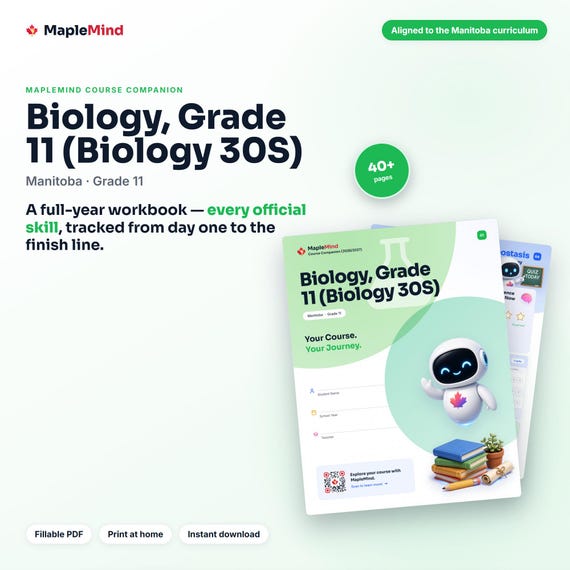
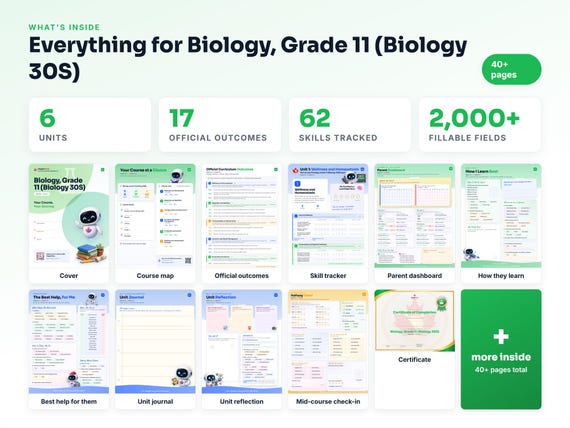
A Biology, Grade 11 (Biology 30S) workbook worth keeping
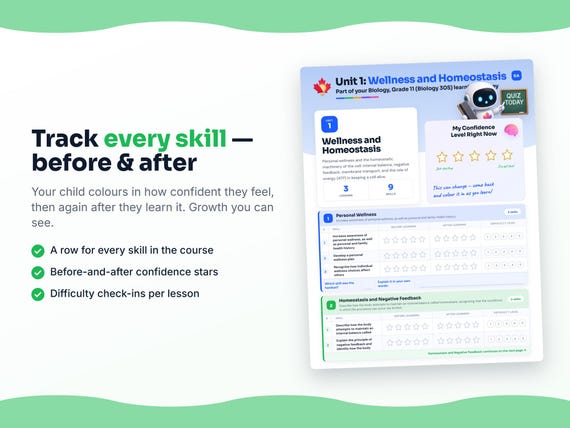
Built from the same official curriculum as this page. Before and after each skill above, your student colours in how sure they feel — so the two of you can see, on one page, what's clicking and what needs another look. It's a quiet way to follow how the year is really going.
By June it's full of their own handwriting: units worked through, confidence grown, a mid-year check-in, notes from parent-teacher night, and a certificate at the end. Less a worksheet, more a record of the year worth keeping on the shelf.
Instant download · see every page, reviews and the full description · five or more workbooks are $2.99 each
What it looks like in the app



Common questions
Can MapleMind help me with Biology, Grade 11 (Biology 30S)?
Yes. MapleMind's AI tutor covers all 62 skills in Manitoba's Biology, Grade 11 (Biology 30S) — you pick the exact skill, and the tutor teaches it step by step: a short lesson, a worked example, solving together, then a skill check to show it stuck.
Is MapleMind aligned to Manitoba's official curriculum?
Yes. Every skill in this course maps to an official outcome code from Manitoba's Grade 11 Science curriculum, and the ministry's own wording is quoted under each unit on this page — with the official government source linked so you can check it yourself.
What does MapleMind cost?
It's free to start — 5 tutoring chats and a practice quiz every day, no credit card. A Pro subscription ($9.99/month or $49.99/year CAD, 7-day free trial) unlocks unlimited tutoring, practice, and exam simulations.
What if I'm stuck on just one topic?
That's the point of skill-level tutoring: open Biology, Grade 11 (Biology 30S) in the app, tap the exact skill from the list on this page, and the tutor teaches just that — no wading through lessons you don't need.
Does MapleMind work in French or other languages?
Yes — 14 languages, including French. Both the app and the tutor's explanations switch to the language you choose.
Where can I see the official Manitoba curriculum for Biology, Grade 11 (Biology 30S)?
The official source is linked on this page — Manitoba's official curriculum. The outline here follows it: every MapleMind skill carries its official outcome code, and the ministry's own wording is quoted under each unit.
Keep exploring
Ready when you are
Pick a skill from this page and see it taught properly — free, in the browser, in under a minute.