Get help with Chemistry, Grade 12
Most tutoring makes you sit through material you already know. MapleMind flips that: pick the exact skill that's causing trouble — any of the 65 below — and the tutor teaches just that one, step by step, as many times as it takes. Ask questions in plain words, any time of day, in English, French, or 12 other languages.
The official Manitoba Chemistry, Grade 12 curriculum
Manitoba defines Chemistry, Grade 12 by strands and outcomes. MapleMind teaches the same curriculum reorganized for one-skill-at-a-time tutoring — the table shows exactly where every official strand lands, and the ministry's own wording is quoted under each unit below.
Official source Manitoba's official curriculumRead it on the government site — edu.gov.mb.ca ↗| Official strand | Outcomes | Where MapleMind teaches it |
|---|---|---|
| Strand 1 | 12 | Topic 1: Reactions in Aqueous Solutions |
| Strand 2 | 7 | Topic 2: Atomic Structure |
| Strand 3 | 10 | Topic 3: Chemical Kinetics |
| Strand 4 | 13 | Topic 4: Chemical Equilibrium |
| Strand 5 | 11 | Topic 5: Acids and Bases |
| Strand 6 | 12 | Topic 6: Electrochemistry |
Every skill below, taught one on one.
 Try the first session free
How MapleMind teaches Chemistry, Grade 12 — every unit, lesson, and skill
Every skill below runs as a short session: a plain-words lesson, a worked example, solving it together, then a five-question skill check that earns up to three stars. Guided Mode keeps it teaching instead of answer-handing — turning it off needs a parent's password.
Unit 1Topic 1: Reactions in Aqueous SolutionsOfficial strand · Strand 1
Solubility and precipitation, solubility rules, neutralization reactions and titration stoichiometry, identifying unknown solutions, and oxidation-reduction: oxidation numbers, identifying and balancing redox reactions, and their applications.
Solubility and Precipitation
- Solubility and precipitationC12-1-01 — Explain examples of solubility and precipitation at the particulate and symbolic levels.
- Developing solubility rulesC12-1-02 — Perform a laboratory activity to develop a set of solubility rules.
- Predicting a precipitateC12-1-03 — Use a table of solubility rules to predict the formation of a precipitate.
Neutralization and Titration
- Neutralization equationsC12-1-04 — Write balanced neutralization reactions involving strong acids and bases.
- Stoichiometry of neutralizationC12-1-05 — Perform a laboratory activity to demonstrate the stoichiometry of a neutralization reaction between a strong base and a strong acid.
- Titration calculationsC12-1-06 — Calculate the concentration or volume of an acid or base from the concentration and volume required for neutralization.
- Identifying unknown solutionsC12-1-07 — Design and test a procedure to determine the identity of a variety of unknown solutions.
Oxidation and Reduction
- Understanding oxidation and reductionC12-1-08 — Outline the development of scientific understanding of oxidation and reduction reactions, including electron gain and loss and oxidizing and reducing agents.
- Assigning oxidation numbersC12-1-09 — Determine the oxidation numbers for atoms in compounds and ions.
- Identifying redox reactionsC12-1-10 — Identify reactions as redox or non-redox, including oxidizing and reducing agents and the oxidized and reduced substances.
- Balancing redox reactionsC12-1-11 — Balance oxidation-reduction reactions using redox methods, in acidic and basic solutions.
- Applications of redox reactionsC12-1-12 — Research practical applications of redox reactions.
The official wording — 12 outcomes in this unit
- C12-1-01
Explain examples of solubility and precipitation at the particulate and symbolic levels.
- C12-1-02
Perform a laboratory activity to develop a set of solubility rules.
- C12-1-03
Use a table of solubility rules to predict the formation of a precipitate.
- C12-1-04
Write balanced neutralization reactions involving strong acids and bases.
- C12-1-05
Perform a laboratory activity to demonstrate the stoichiometry of a neutralization reaction between a strong base and a strong acid.
- C12-1-06
Calculate the concentration or volume of an acid or a base from the concentration and volume of an acid or a base required for neutralization.
- C12-1-07
Design and test a procedure to determine the identity of a variety of unknown solutions.
- C12-1-08
Outline the development of scientific understanding of oxidation and reduction reactions. Include: gain and loss of electrons, oxidizing agent, and reducing agent
- C12-1-09
Determine the oxidation numbers for atoms in compounds and ions.
- C12-1-10
Identify reactions as redox or non-redox. Include: oxidizing agent, reducing agent, oxidized substance, and reduced substance
- C12-1-11
Balance oxidation-reduction reactions using redox methods. Include: acidic and basic solutions
- C12-1-12
Research practical applications of redox reactions. Examples: rocket fuels, fireworks, household bleach, photography, metal recovery from ores, steel making, aluminum recycling, fuel cells, batteries, tarnish removal, fruit clocks, forensic blood detection using luminol, chemiluminescence/bioluminescence, electrolytic cleaning, electrodeposition, photochemical etching, antioxidants/ preservatives . . .
Unit 2Topic 2: Atomic StructureOfficial strand · Strand 2
The electromagnetic spectrum and line spectra, the quantum mechanical model of the atom, writing electron configurations, relating configuration to periodic-table position, and periodic trends in atomic and ionic radii, ionization energy, and electronegativity.
Light and Line Spectra
- The electromagnetic spectrumC12-2-01 — Describe qualitatively the electromagnetic spectrum in terms of frequency, wavelength, and energy.
- Observing line spectraC12-2-02 — Recognize, through direct observation, that elements have unique line spectra.
- Applications of line spectraC12-2-03 — Describe applications and/or natural occurrences of line spectra.
The Quantum Model and Periodic Trends
- History of the quantum mechanical modelC12-2-04 — Outline the historical development of the quantum mechanical model of the atom.
- Writing electron configurationsC12-2-05 — Write electron configurations for elements of the periodic table, including selected elements up to atomic number 36.
- Configuration and the periodic tableC12-2-06 — Relate the electron configuration of an element to its valence electrons and its position on the periodic table.
- Periodic trendsC12-2-07 — Identify and account for periodic trends among element properties and relate them to electron configuration, including atomic and ionic radii, ionization energy, and electronegativity.
The official wording — 7 outcomes in this unit
- C12-2-01
Describe qualitatively the electromagnetic spectrum in terms of frequency, wavelength, and energy.
- C12-2-02
Recognize, through direct observation, that elements have unique line spectra. Include: flame tests or gas discharge tubes and spectroscopes or diffraction gratings
- C12-2-03
Describe applications and/or natural occurrences of line spectra. Examples: astronomy, aurora borealis, fireworks, neon lights . . .
- C12-2-04
Outline the historical development of the quantum mechanical model of the atom.
- C12-2-05
Write electron configurations for elements of the periodic table. Include: selected elements up to atomic number 36 (krypton)
- C12-2-06
Relate the electron configuration of an element to its valence electron(s) and its position on the periodic table.
- C12-2-07
Identify and account for periodic trends among the properties of elements, and relate the properties to electron configuration. Include: atomic radii, ionic radii, ionization energy, and electronegativity
Unit 3Topic 3: Chemical KineticsOfficial strand · Strand 3
Reaction rate and the variables that monitor it, measuring average and instantaneous rates, relating product and reactant rates, factors affecting rate and the collision theory, potential-energy diagrams, reaction mechanisms, and determining rate laws and reaction order.
Measuring Reaction Rates
- Defining reaction rateC12-3-01 — Formulate an operational definition of reaction rate, with examples of reactions at different rates.
- Variables for monitoring rateC12-3-02 — Identify variables used to monitor reaction rates (change per unit of time).
- Average and instantaneous rateC12-3-03 — Perform a laboratory activity to measure the average and instantaneous rates of a chemical reaction, including the initial reaction rate.
- Relating product and reactant ratesC12-3-04 — Relate the rate of formation of a product to the rate of disappearance of a reactant, given experimental rate data and reaction stoichiometry.
Collision Theory and Rate Laws
- Factors affecting reaction rateC12-3-05 — Perform a laboratory activity to identify factors that affect the rate of a chemical reaction.
- Explaining rate with collision theoryC12-3-06 — Use the collision theory to explain the factors that affect the rate of chemical reactions, including activation energy and molecular orientation.
- Potential energy diagramsC12-3-07 — Draw potential energy diagrams for endothermic and exothermic reactions, showing activation energy, catalysts, and heat of reaction.
- Qualitative rate and collision theoryC12-3-08 — Describe qualitatively the relationship between factors that affect reaction rate and the relative rate, using the collision theory.
- Reaction mechanismsC12-3-09 — Explain the concept of a reaction mechanism, including the rate-determining step.
- Rate law and reaction orderC12-3-10 — Determine the rate law and order of a chemical reaction from experimental data, including zero-, first-, and second-order reactions.
The official wording — 10 outcomes in this unit
- C12-3-01
Formulate an operational definition of reaction rate. Include: examples of chemical reactions that occur at different rates
- C12-3-02
Identify variables used to monitor reaction rates (i.e., change per unit of time, Dx/Dt). Examples: pressure, temperature, pH, conductivity, colour . . .
- C12-3-03
Perform a laboratory activity to measure the average and instantaneous rates of a chemical reaction. Include: initial reaction rate
- C12-3-04
Relate the rate of formation of a product to the rate of disappearance of a reactant, given experimental rate data and reaction stoichiometry. Include: descriptive treatment at the particulate level
- C12-3-05
Perform a laboratory activity to identify factors that affect the rate of a chemical reaction. Include: nature of reactants, surface area, concentration, pressure, volume, temperature, and presence of a catalyst
- C12-3-06
Use the collision theory to explain the factors that affect the rate of chemical reactions. Include: activation energy and orientation of molecules
- C12-3-07
Draw potential energy diagrams for endothermic and exothermic reactions. Include: relative rates, effect of a catalyst, and heat of reaction (enthalpy change)
- C12-3-08
Describe qualitatively the relationship between factors that affect the rate of chemical reactions and the relative rate of a reaction, using the collision theory.
- C12-3-09
Explain the concept of a reaction mechanism. Include: rate-determining step
- C12-3-10
Determine the rate law and order of a chemical reaction from experimental data. Include: zero-, first-, and second-order reactions and reaction rate versus concentration graphs
Unit 4Topic 4: Chemical EquilibriumOfficial strand · Strand 4
Dynamic equilibrium, the equilibrium law expression and constant Keq, solving equilibrium problems, Le Châtelier's principle and shifting equilibria, concentration-time graphs, practical applications, and solubility equilibria with Ksp.
Equilibrium and Keq
- The concept of equilibriumC12-4-01 — Relate the concept of equilibrium to physical and chemical systems, including the conditions necessary to achieve equilibrium.
- The equilibrium law expressionC12-4-02 — Write equilibrium law expressions from balanced chemical equations for heterogeneous and homogeneous systems.
- Interpreting the equilibrium constantC12-4-03 — Use the value of the equilibrium constant to explain how far a system at equilibrium has gone towards completion.
- Solving equilibrium problemsC12-4-04 — Solve problems involving equilibrium constants.
- Determining Keq experimentallyC12-4-05 — Perform a laboratory activity to determine the equilibrium constant of an equilibrium system.
Le Châtelier's Principle
- Predicting equilibrium shiftsC12-4-06 — Use Le Châtelier's principle to predict and explain shifts in equilibrium.
- Demonstrating Le Châtelier's principleC12-4-07 — Perform a laboratory activity to demonstrate Le Châtelier's principle.
- Concentration versus time graphsC12-4-08 — Interpret concentration versus time graphs, including temperature and concentration changes and the addition of a catalyst.
- Applications of Le Châtelier's principleC12-4-09 — Describe practical applications of Le Châtelier's principle.
Solubility Equilibrium and Ksp
- Solubility product expressionsC12-4-10 — Write solubility product expressions from balanced chemical equations for salts with low solubility.
- Solving Ksp problemsC12-4-11 — Solve problems involving Ksp, including common ion problems.
- Applications of low-solubility saltsC12-4-12 — Describe examples of practical applications of salts with low solubility.
- Determining Ksp experimentallyC12-4-13 — Perform a laboratory activity to determine the Ksp of a salt with low solubility.
The official wording — 13 outcomes in this unit
- C12-4-01
Relate the concept of equilibrium to physical and chemical systems. Include: conditions necessary to achieve equilibrium
- C12-4-02
Write equilibrium law expressions from balanced chemical equations for heterogeneous and homogeneous systems. Include: mass action expression
- C12-4-03
Use the value of the equilibrium constant (Keq ) to explain how far a system at equilibrium has gone towards completion.
- C12-4-04
Solve problems involving equilibrium constants.
- C12-4-05
Perform a laboratory activity to determine the equilibrium constant of an equilibrium system.
- C12-4-06
Use Le Châtelier’s principle to predict and explain shifts in equilibrium. Include: temperature changes, pressure/volume changes, changes in reactant/product concentration, the addition of a catalyst, the addition of an inert gas, and the effects of various stresses on the equilibrium constant
- C12-4-07
Perform a laboratory activity to demonstrate Le Châtelier’s principle.
- C12-4-08
Interpret concentration versus time graphs. Include: temperature changes, concentration changes, and the addition of a catalyst
- C12-4-09
Describe practical applications of Le Châtelier’s principle. Examples: Haber process, hemoglobin production at high altitude, carbonated beverages, eyes adjusting to light, blood pH, recharging of batteries, turbocharged/supercharged engines, ester synthesis, weather indicators, arrangement of produce, carbonated beverages in a hen’s diet . . .
- C12-4-10
Write solubility product (Ksp ) expressions from balanced chemical equations for salts with low solubility.
- C12-4-11
Solve problems involving Ksp . Include: common ion problems
- C12-4-12
Describe examples of the practical applications of salts with low solubility. Examples: kidney stones, limestone caverns, osteoporosis, tooth decay . . .
- C12-4-13
Perform a laboratory activity to determine the Ksp of a salt with low solubility.
Unit 5Topic 5: Acids and BasesOfficial strand · Strand 5
Historical acid-base theories, writing acid-base equations and conjugate pairs, the ion product of water, the pH scale, indicators, strong versus weak acids and bases, the acid and base equilibrium constants Ka and Kb, and predicting the pH of salt solutions.
Acid-Base Theories and pH
- Historical acid-base theoriesC12-5-01 — Outline the historical development of acid-base theories, including the Arrhenius, Brønsted-Lowry, and Lewis theories.
- Acid-base equations and conjugate pairsC12-5-02 — Write balanced acid-base chemical equations, including conjugate acid-base pairs and amphoteric behaviour.
- The ion product of waterC12-5-03 — Describe the relationship between the hydronium and hydroxide ion concentrations in water, including the ion product of water.
- An operational definition of pHC12-5-04 — Perform a laboratory activity to formulate an operational definition of pH.
- How acid-base indicators workC12-5-05 — Describe how an acid-base indicator works in terms of colour shifts and Le Châtelier's principle.
- Solving pH problemsC12-5-06 — Solve problems involving pH.
Strong and Weak Acids and Bases
- Strong and weak acids and basesC12-5-07 — Distinguish between strong and weak acids and bases, including electrolytes and non-electrolytes.
- Ka and Kb expressionsC12-5-08 — Write the equilibrium expression (Ka or Kb) from a balanced chemical equation.
- Solving Ka and Kb problemsC12-5-09 — Use Ka or Kb to solve problems for pH, percent dissociation, and concentration.
- Finding an unknown concentration by titrationC12-5-10 — Perform a laboratory activity to determine the concentration of an unknown acid or base using a standardized acid or base.
- Predicting the pH of a salt solutionC12-5-11 — Predict whether an aqueous solution of a given ionic compound will be acidic, basic, or neutral, given the formula.
The official wording — 11 outcomes in this unit
- C12-5-01
Outline the historical development of acid-base theories. Include: the Arrhenius, Brønsted-Lowry, and Lewis theories
- C12-5-02
Write balanced acid-base chemical equations. Include: conjugate acid-base pairs and amphoteric behaviour
- C12-5-03
Describe the relationship between the hydronium and hydroxide ion concentrations in water. Include: the ion product of water, Kw
- C12-5-04
Perform a laboratory activity to formulate an operational definition of pH.
- C12-5-05
Describe how an acid-base indicator works in terms of colour shifts and Le Châtelier’s principle.
- C12-5-06
Solve problems involving pH.
- C12-5-07
Distinguish between strong and weak acids and bases. Include: electrolytes and non-electrolytes
- C12-5-08
Write the equilibrium expression (Ka or Kb ) from a balanced chemical equation.
- C12-5-09
Use Ka or Kb to solve problems for pH, percent dissociation, and concentration.
- C12-5-10
Perform a laboratory activity to determine the concentration of an unknown acid or base, using a standardized acid or base.
- C12-5-11
Predict whether an aqueous solution of a given ionic compound will be acidic, basic, or neutral, given the formula.
Unit 6Topic 6: ElectrochemistryOfficial strand · Strand 6
The activity series and reaction spontaneity, voltaic (galvanic) cells and half-cell notation, standard electrode potentials and cell-potential calculations, comparing voltaic and electrolytic cells, the operation and uses of electrolytic cells, and Faraday's law.
The Activity Series and Voltaic Cells
- Developing an activity seriesC12-6-01 — Develop an activity series experimentally.
- Spontaneity from the activity seriesC12-6-02 — Predict the spontaneity of reactions using an activity series.
- History of voltaic cellsC12-6-03 — Outline the historical development of voltaic (galvanic) cells, including the contributions of Galvani and Volta.
- How a voltaic cell operatesC12-6-04 — Explain the operation of a voltaic cell at the visual, particulate, and symbolic levels, including half-cell reactions and line notation.
- Building a voltaic cellC12-6-05 — Construct a functioning voltaic (galvanic) cell and measure its potential.
Cell Potentials
- Standard electrode potentialC12-6-06 — Define standard electrode potential, using the hydrogen electrode as a reference.
- Calculating standard cell potentialsC12-6-07 — Calculate standard cell potentials, given standard electrode potentials.
- Predicting spontaneity from potentialsC12-6-08 — Predict the spontaneity of reactions using standard electrode potentials.
Electrolytic Cells
- Voltaic versus electrolytic cellsC12-6-09 — Compare and contrast voltaic (galvanic) and electrolytic cells.
- How an electrolytic cell operatesC12-6-10 — Explain the operation of an electrolytic cell at the visual, particulate, and symbolic levels, for molten and aqueous ionic compounds.
- Uses of electrolytic cellsC12-6-11 — Describe practical uses of electrolytic cells.
- Faraday's lawC12-6-12 — Solve problems related to electrolytic cells using Faraday's law.
The official wording — 12 outcomes in this unit
- C12-6-01
Develop an activity series experimentally.
- C12-6-02
Predict the spontaneity of reactions using an activity series.
- C12-6-03
Outline the historical development of voltaic (galvanic) cells. Include: contributions of Luigi Galvani and Alessandro Volta
- C12-6-04
Explain the operation of a voltaic (galvanic) cell at the visual, particulate, and symbolic levels. Include: writing half-cell reactions, the overall reaction, and shorthand (line) notation
- C12-6-05
Construct a functioning voltaic (galvanic) cell and measure its potential.
- C12-6-06
Define standard electrode potential. Include: hydrogen electrode as a reference
- C12-6-07
Calculate standard cell potentials, given standard electrode potentials.
- C12-6-08
Predict the spontaneity of reactions using standard electrode potentials.
- C12-6-09
Compare and contrast voltaic (galvanic) and electrolytic cells.
- C12-6-10
Explain the operation of an electrolytic cell at the visual, particulate, and symbolic levels. Include: a molten ionic compound and an aqueous ionic compound
- C12-6-11
Describe practical uses of electrolytic cells. Examples: electrolysis of water, electrolysis of brine, electroplating, production and purification of metals . . .
- C12-6-12
Solve problems related to electrolytic cells, using Faraday’s law.

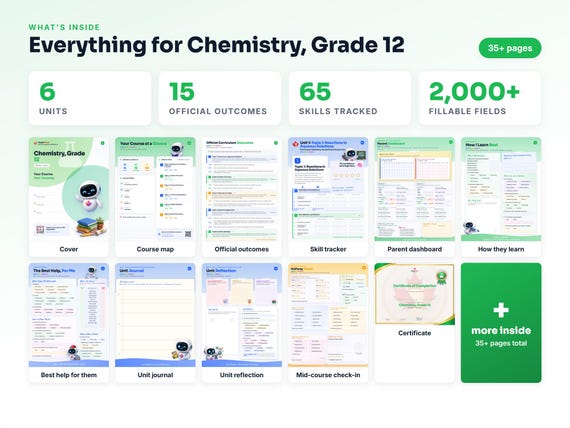


Printable workbook · A keepsake of the year
A Chemistry, Grade 12 workbook worth keeping
Built from the same official curriculum as this page. Before and after each skill above, your student colours in how sure they feel — so the two of you can see, on one page, what's clicking and what needs another look. It's a quiet way to follow how the year is really going.
By June it's full of their own handwriting: units worked through, confidence grown, a mid-year check-in, notes from parent-teacher night, and a certificate at the end. Less a worksheet, more a record of the year worth keeping on the shelf.
Instant download · see every page, reviews and the full description · five or more workbooks are $2.99 each
What it looks like in the app



Common questions
Can MapleMind help me with Chemistry, Grade 12?
Yes. MapleMind's AI tutor covers all 65 skills in Manitoba's Chemistry, Grade 12 — you pick the exact skill, and the tutor teaches it step by step: a short lesson, a worked example, solving together, then a skill check to show it stuck.
Is MapleMind aligned to Manitoba's official curriculum?
Yes. Every skill in this course maps to an official outcome code from Manitoba's Grade 12 Science curriculum, and the ministry's own wording is quoted under each unit on this page — with the official government source linked so you can check it yourself.
What does MapleMind cost?
It's free to start — 5 tutoring chats and a practice quiz every day, no credit card. A Pro subscription ($9.99/month or $49.99/year CAD, 7-day free trial) unlocks unlimited tutoring, practice, and exam simulations.
What if I'm stuck on just one topic?
That's the point of skill-level tutoring: open Chemistry, Grade 12 in the app, tap the exact skill from the list on this page, and the tutor teaches just that — no wading through lessons you don't need.
Does MapleMind work in French or other languages?
Yes — 14 languages, including French. Both the app and the tutor's explanations switch to the language you choose.
Where can I see the official Manitoba curriculum for Chemistry, Grade 12?
The official source is linked on this page — Manitoba's official curriculum. The outline here follows it: every MapleMind skill carries its official outcome code, and the ministry's own wording is quoted under each unit.
Keep exploring
Ready when you are
Pick a skill from this page and see it taught properly — free, in the browser, in under a minute.