Manitoba · For parents

What your child learns in Grade 12 in Manitoba

Every subject, unit by unit, from Manitoba’s curriculum: 499 skills in plain words.

Subjects
5
Skills
499
Provincial exams
6
Official curriculum
edu.gov.mb.ca

Math in Grade 12

4 courses. Choose the one your child takes.

Applied Mathematics, Grade 12 (40S)

6 units · 27 skills

  1. Unit 1

    Financial Mathematics

    Compound interest earns interest on previously earned interest; simple interest does not.

    • Compound versus simple interest
    • Loan costs and credit options
    • Appreciation, depreciation, and comparing options
    3 more skills
    • Justifying a rent, lease, or buy decision
    • Investment value and the Rule of 72
    • Strategies and comparing portfolios
  2. Unit 2

    Logical Reasoning

    Strategies include guess-and-check, looking for a pattern, working backward, and eliminating possibilities.

    • Strategies for puzzles and games
    • Sets and Venn diagram operations
    • Solving problems with sets
    2 more skills
    • If-then statements and their forms
    • Biconditionals and truth tables
  3. Unit 3

    Probability

    Probability compares favourable outcomes to the whole (part-whole).

    • Interpreting odds and probability
    • Mutually exclusive and non-mutually exclusive events
    • Independent and dependent events
    4 more skills
    • The fundamental counting principle
    • Permutations with factorial notation
    • Permutations with identical elements
    • Combinations
  4. Unit 4

    Relations and Functions

    A polynomial regression finds the curve of best fit for data that bends.

    • Modelling data with polynomial functions
    • Modelling data with exponential functions
    • Modelling data with logarithmic functions
    1 more skill
    • Modelling data with sinusoidal functions
  5. Unit 5

    Mathematics Research Project

    A good topic is a real current event with mathematics behind it.

    • Designing the project and collecting data
    • Assessing and analyzing the data
    • Organizing and presenting the project
  6. Unit 6

    Design and Measurement

    Cost is found by multiplying a measured quantity (area, volume) by a unit price.

    • Costing with measurement and unit prices
    • Designing within a budget

Essential Mathematics, Grade 12 (40S)

9 units · 24 skills

  1. Unit 1

    Analysis of Games and Numbers

    Strategies include guess-and-check, looking for a pattern, working backward, and eliminating possibilities.

    • Strategies for puzzles and games
    • Applying strategies to a new game
  2. Unit 2

    Vehicle Finance

    Buying builds ownership; leasing pays for use over a term.

    • Buying, leasing, or leasing to buy
    • Operating and insuring a vehicle
    • Justifying a vehicle decision
  3. Unit 3

    Statistics

    The mean is the balance point; the median is the middle; the mode is the most common value.

    • Mean, median, mode, and outliers
    • Weighted and trimmed mean
    • Understanding percentiles
    1 more skill
    • Percentile rank and decisions
  4. Unit 4

    Precision Measurement

    Precision is how finely an instrument measures; accuracy is how close it is to the true value.

    • Precision versus accuracy
    • Uncertainty and tolerance
  5. Unit 5

    Career Life

    Career choice weighs job description, education, aptitude, values, and pay.

    • Choosing a career and preparing a resume
    • Budgeting for a career and lifestyle
  6. Unit 6

    Home Finance

    A mortgage is a long-term loan repaid with interest over many years.

    • Mortgages and purchase costs
    • Home insurance and owning versus renting
    • Property tax, maintenance, and feasibility
  7. Unit 7

    Geometry and Trigonometry

    The sine law relates sides to the sines of opposite angles.

    • Solving triangles with the sine and cosine law
    • Triangles and quadrilaterals
    • Regular polygons and applications
  8. Unit 8

    Business Finance

    Expenses include supplies, rent, wages, and equipment.

    • Business expenses and feasible options
    • Break-even and profitability
    • Business taxation forms and deductions
  9. Unit 9

    Probability

    A probability from data is the fraction of outcomes that are favourable.

    • Probability and odds
    • Expected gain or loss and applications

Introduction to Calculus, Grade 12 (40S)

45S · 4 units · 19 skills

  1. Unit 1

    Limits

    A limit is the value a function approaches as x gets close to a point.

    • Understanding limits graphically
    • One-sided limits and existence
    • Evaluating limits algebraically
    2 more skills
    • Limits at infinity
    • Continuity of a function
  2. Unit 2

    Derivatives

    A secant line's slope is the average rate of change between two points.

    • From secant slope to tangent slope
    • The limit definition of the derivative
    • Power, constant, and sum rules
    3 more skills
    • Product and quotient rules
    • The chain rule
    • Implicit differentiation
  3. Unit 3

    Applications of Derivatives

    Velocity is the derivative of position with respect to time.

    • Velocity and acceleration
    • Increasing, decreasing, and extrema
    • Concavity and sketching the curve
    2 more skills
    • Optimization
    • Related rates
  4. Unit 4

    Integration (Integrals)

    Antidifferentiation reverses differentiation to recover a function.

    • Antiderivatives and integration
    • Understanding the definite integral
    • Solving problems with integration

Pre-Calculus Mathematics, Grade 12 (40S)

3 units · 34 skills

  1. Unit 1

    Trigonometry

    An angle in standard position has its vertex at the origin and initial arm on the positive x-axis.

    • Sketching and converting angles
    • Coterminal angles and arc length
    • The equation of the unit circle
    8 more skills
    • Exact trigonometric ratios
    • Solving with trigonometric ratios
    • Graphs of sine, cosine, and tangent
    • Transforming trigonometric graphs
    • Solving trigonometric equations
    • General solutions and identities in equations
    • Proving with reciprocal, quotient, and Pythagorean identities
    • Sum, difference, and double-angle identities
  2. Unit 2

    Relations and Functions

    Functions combine value by value: (f + g)(x) = f(x) + g(x).

    • Operations on functions
    • Compositions of functions
    • Translations of graphs
    15 more skills
    • Compressions and stretches
    • Combining transformations
    • Reflections of graphs
    • Inverses of relations
    • Understanding logarithms
    • Laws of logarithms
    • Graphing exponential functions
    • Graphing logarithmic functions
    • Solving exponential and logarithmic equations
    • Applications of exponential and logarithmic equations
    • Long and synthetic division of polynomials
    • The remainder and factor theorems
    • Graphing polynomial functions
    • Radical functions
    • Rational functions
  3. Unit 3

    Permutations, Combinations and Binomial Theorem

    When choices are made in sequence, the counts multiply.

    • The fundamental counting principle
    • Permutations
    • Combinations
    2 more skills
    • Pascal's triangle and binomial patterns
    • Expanding with the binomial theorem

Science in Grade 12

3 courses. Choose the one your child takes.

Biology, Grade 12 (Biology 40S)

5 units · 45 skills

  1. Unit 1

    Understanding Biological Inheritance

    Mendel crossed pea plants and counted thousands of offspring; he knew nothing of chromosomes, genes or DNA and worked out his principles from the numbers alone, and his work, ignored for 35 years and rediscovered in 1900, became the foundation of genetics.

    • Outline Gregor Mendel's principles of inheritance
    • Explain what is meant by the terms heterozygous and homozygous
    • Distinguish between genotype and phenotype, and use these terms in discussing genetic crosses
    9 more skills
    • Use Punnett squares to solve a variety of autosomal inheritance problems
    • Describe examples of and solve problems involving traits that do not follow a dominant-recessive pattern
    • Explain the basis for sex determination in humans
    • Describe examples of and solve problems involving sex-linked genes
    • Use pedigree charts to illustrate the inheritance of genetically determined traits in a family tree
    • Discuss ethical issues that may arise as a result of genetic testing
    • Discuss the role of meiosis and sexual reproduction in producing genetic variability
    • Explain how chromosome mutations may arise during meiosis
    • Identify monosomy and trisomy chromosome mutations from karyotypes
  2. Unit 2

    Mechanisms of Inheritance

    Understanding DNA took about 85 years and many scientists: Miescher isolated it from cell nuclei in 1869, Levene showed it is a chain of nucleotides, and Sutton, Boveri and Morgan tied genes to chromosomes.

    • Outline significant scientific contributions and discoveries that led to the current understanding of DNA
    • Describe the structure of a DNA nucleotide
    • Describe the structure of a DNA molecule
    7 more skills
    • Describe the process of DNA replication
    • Compare DNA and RNA in terms of their structure, use, and location in the cell
    • Outline the steps involved in protein synthesis
    • Relate the consequences of gene mutation to the final protein product
    • Discuss implications of gene mutation for genetic variation
    • Investigate an issue related to the application of gene technology in bioresources
    • Investigate an issue related to the application of gene technology in humans
  3. Unit 3

    Evolutionary Theory and Biodiversity

    Evolution is a change in the frequencies of alleles in a population's gene pool over generations: populations evolve, individuals do not.

    • Define the term evolution, explaining how evolution has led to biodiversity by altering populations
    • Describe and explain the process of discovery that led Charles Darwin to formulate his theory of evolution by natural selection
    • Outline the main points of Darwin's theory of evolution by natural selection
    9 more skills
    • Demonstrate, through examples, what the term fittest means in the phrase “survival of the fittest.”
    • Explain how natural selection leads to changes in populations
    • Describe how disruptive, stabilizing, and directional natural selection act on variation
    • Distinguish between natural selection and artificial selection
    • Outline how scientists determine whether a gene pool has changed
    • Discuss how genetic variation in a gene pool can be altered
    • Describe how populations can become reproductively isolated
    • With the use of examples, differentiate between convergent and divergent evolution (adaptive radiation)
    • Distinguish between the two models for the pace of evolutionary change: punctuated equilibrium and gradualism
  4. Unit 4

    Organizing Biodiversity

    Biodiversity is the variety of life in an area, measured at three levels: ecosystem diversity, species diversity and genetic diversity.

    • Define the concept of biodiversity in terms of ecosystem, species and genetic diversity
    • Explain why it is difficult to determine a definition of species
    • Describe the dynamic nature of classification
    4 more skills
    • Describe types of evidence used to classify organisms and determine evolutionary relationships
    • Compare the characteristics of the domains of life
    • Compare the characteristics of the kingdoms in the Eukarya domain
    • Investigate an evolutionary trend in a group of organisms
  5. Unit 5

    Conservation of Biodiversity

    A diverse gene pool lets a species survive disease and change: genetically varied crops and their wild relatives hold alleles for resistance to new pests and diseases.

    • Discuss a variety of reasons for maintaining biodiversity
    • Describe strategies used to conserve biodiversity
    • Select and use appropriate tools or procedures to determine and monitor biodiversity in an area
    1 more skill
    • Investigate an issue related to the conservation of biodiversity

Chemistry, Grade 12

40S · 6 units · 65 skills

  1. Unit 1

    Topic 1: Reactions in Aqueous Solutions

    When ions in solution combine to form an insoluble compound, a precipitate forms.

    • Solubility and precipitation
    • Developing solubility rules
    • Predicting a precipitate
    9 more skills
    • Neutralization equations
    • Stoichiometry of neutralization
    • Titration calculations
    • Identifying unknown solutions
    • Understanding oxidation and reduction
    • Assigning oxidation numbers
    • Identifying redox reactions
    • Balancing redox reactions
    • Applications of redox reactions
  2. Unit 2

    Topic 2: Atomic Structure

    The electromagnetic spectrum ranges from radio waves to gamma rays.

    • The electromagnetic spectrum
    • Observing line spectra
    • Applications of line spectra
    4 more skills
    • History of the quantum mechanical model
    • Writing electron configurations
    • Configuration and the periodic table
    • Periodic trends
  3. Unit 3

    Topic 3: Chemical Kinetics

    Reaction rate is the change in concentration of a reactant or product per unit time.

    • Defining reaction rate
    • Variables for monitoring rate
    • Average and instantaneous rate
    7 more skills
    • Relating product and reactant rates
    • Factors affecting reaction rate
    • Explaining rate with collision theory
    • Potential energy diagrams
    • Qualitative rate and collision theory
    • Reaction mechanisms
    • Rate law and reaction order
  4. Unit 4

    Topic 4: Chemical Equilibrium

    At dynamic equilibrium the forward and reverse reactions occur at equal rates, so concentrations stay constant.

    • The concept of equilibrium
    • The equilibrium law expression
    • Interpreting the equilibrium constant
    10 more skills
    • Solving equilibrium problems
    • Determining Keq experimentally
    • Predicting equilibrium shifts
    • Demonstrating Le Châtelier's principle
    • Concentration versus time graphs
    • Applications of Le Châtelier's principle
    • Solubility product expressions
    • Solving Ksp problems
    • Applications of low-solubility salts
    • Determining Ksp experimentally
  5. Unit 5

    Topic 5: Acids and Bases

    Arrhenius defined acids by H⁺ and bases by OH⁻; Brønsted-Lowry by proton transfer; Lewis by electron-pair donation.

    • Historical acid-base theories
    • Acid-base equations and conjugate pairs
    • The ion product of water
    8 more skills
    • An operational definition of pH
    • How acid-base indicators work
    • Solving pH problems
    • Strong and weak acids and bases
    • Ka and Kb expressions
    • Solving Ka and Kb problems
    • Finding an unknown concentration by titration
    • Predicting the pH of a salt solution
  6. Unit 6

    Topic 6: Electrochemistry

    An activity series ranks metals by how readily they lose electrons (are oxidized).

    • Developing an activity series
    • Spontaneity from the activity series
    • History of voltaic cells
    9 more skills
    • How a voltaic cell operates
    • Building a voltaic cell
    • Standard electrode potential
    • Calculating standard cell potentials
    • Predicting spontaneity from potentials
    • Voltaic versus electrolytic cells
    • How an electrolytic cell operates
    • Uses of electrolytic cells
    • Faraday's law

Physics, Grade 12

40S · 4 units · 79 skills

  1. Unit 1

    Unit 1: Mechanics

    The constant-acceleration equations relate displacement, velocity, acceleration, and time.

    • Deriving the constant-acceleration equations
    • Solving straight-line motion problems
    • Relative motion
    30 more skills
    • Objects in equilibrium
    • Forces on an inclined plane
    • Components of an applied force on an incline
    • Friction problems on horizontal and inclined surfaces
    • Newton's law with combined systems
    • Investigating forces on an object
    • The impulse-momentum equation
    • Impulse from a force-time graph
    • Conservation of momentum lab
    • Solving momentum problems
    • Impulse in real-life situations
    • Projectile motion components
    • Free-body diagrams for projectiles
    • Calculating projectile components
    • Range, height, and time of flight
    • Centripetal acceleration
    • Centrifugal effects and Newton's laws
    • Free-body diagrams of circular motion
    • Investigating circular motion
    • The circular-motion equations
    • Solving circular-motion problems
    • Defining work
    • Work from a force-position graph
    • Work as a transfer of energy
    • Forms of energy
    • Deriving kinetic energy
    • Gravitational potential energy
    • Hooke's Law
    • Spring potential energy
    • Conservation of energy problems
  2. Unit 2

    Unit 2: Fields

    Space exploration brings technological advances and global cooperation but also high costs and risks.

    • Issues of space exploration
    • Kepler's laws of planetary motion
    • Newton's Law of Universal Gravitation
    19 more skills
    • Gravitational potential energy in space
    • Escape velocity
    • Universal gravitation and weight
    • Newton's thought experiment on orbit
    • Calculating satellite motion
    • Defining microgravity
    • Producing microgravity
    • Re-entry into the atmosphere
    • Challenges of deep-space exploration
    • Inverse-square gravitational and electric fields
    • Coulomb's Law
    • Uniform field between parallel plates
    • Electric potential energy between plates
    • Electric potential
    • The volt
    • Potential difference and field between plates
    • Charges moving through plates
    • Hand rules for fields and charges
    • Technologies using electric and magnetic fields
  3. Unit 3

    Unit 3: Electricity

    Conventional current is defined as the flow of positive charge, from the positive to the negative terminal.

    • Conventional current
    • History of Ohm's Law
    • Resistance and resistivity
    12 more skills
    • Building circuits from diagrams
    • Total resistance in series and parallel
    • Calculating circuit quantities
    • Magnetic flux
    • Inducing voltage from changing flux
    • Calculating induced voltage
    • Lenz's Law
    • The AC generator
    • Graphing AC voltage
    • Transformers
    • The transformer ratio
    • Electricity distribution in Manitoba
  4. Unit 4

    Unit 4: Medical Physics

    An atom has a dense nucleus of protons and neutrons surrounded by electrons.

    • The nuclear model of the atom
    • Defining radioactivity
    • Half-life calculations
    6 more skills
    • Types of radiation
    • Ionizing and non-ionizing radiation
    • Applications of non-ionizing radiation
    • Applications of ionizing radiation
    • Effects of radiation on the body
    • Radiation in medical imaging and treatment

English in Grade 12

English Language Arts, Grade 12

40S · 4 units · 47 skills

  1. Unit 1

    Explore and Discover Language and Literacy

    • Listening critically to oral texts
    • Using non-verbal cues and inclusive conventions when listening
    • Adjusting language to foster inclusive interaction
    6 more skills
    • Asking questions to explore and challenge ideas
    • Using the rules and structures of oral language
    • Adapting spoken language to situation and audience
    • Applying morphology to understand and spell words
    • Building and refining precise vocabulary
    • Applying fluency to comprehend complex text
  2. Unit 2

    Comprehend and Respond to Multimodal Texts

    • Activating prior knowledge to build understanding
    • Creating focused questions to drive inquiry
    • Engaging with a variety of multimodal texts
    12 more skills
    • Analyzing and synthesizing information across sources
    • Analyzing and critiquing text cues
    • Using textual cues and organizational patterns to construct meaning
    • Making and testing predictions with text evidence
    • Making connections to deepen understanding
    • Selecting and integrating comprehension strategies
    • Summarizing and synthesizing complex texts
    • Consolidating and communicating new knowledge
    • Analyzing how texts portray diversity and equity
    • Differentiating facts, opinions and bias
    • Examining point of view and viewpoint credibility
    • Responding critically to bias and prejudice
  3. Unit 3

    Compose and Create Multimodal Texts

    • Selecting and focusing a topic
    • Researching and evaluating sources
    • Planning with strategies and tools
    12 more skills
    • Choosing and blending forms purposefully
    • Drafting complex multimodal texts
    • Organizing ideas with structure and transitions
    • Crafting sentences for meaning and style
    • Choosing precise, discipline-specific words
    • Controlling voice for purpose and audience
    • Revising for clarity, coherence and logic
    • Producing legible, well-formatted text
    • Applying spelling strategies and word structure
    • Applying capitalization conventions
    • Applying punctuation for clarity and effect
    • Publishing a polished multimodal project
  4. Unit 4

    Communicate Ideas and Build New Understandings

    • Using tone, volume and expression for delivery
    • Combining visuals and media for polished messages
    • Structuring a presentation to engage an audience
    5 more skills
    • Reflecting on and reviewing personal growth
    • Using criteria and tools to assess your learning
    • Using feedback to refine strategies
    • Setting learning goals and planning steps
    • Monitoring progress toward goals

French in Grade 12

Core French, Grade 12

40S · 4 units · 26 skills

  1. Unit 1

    Oral Communication

    Building on Grade 11, recognize POINT OF VIEW, BIAS, and language register of a message.

    • Understanding and interpreting oral messages
    • Listening strategies
    • Talking about the past
    5 more skills
    • Giving advice and making predictions
    • Justifying a viewpoint
    • Talking about the future
    • Fluency
    • Accuracy
  2. Unit 2

    Reading

    Building on Grade 11, read texts on LESS FAMILIAR topics whose purpose is to increase knowledge, INCITE ACTION, MODIFY OPINIONS, or entertain.

    • Reading for purpose across text types
    • Summarizing and analyzing relationships
    • Responding to and connecting with text
    2 more skills
    • Inferring and evaluating text
    • Reading aloud with fluency and accuracy
  3. Unit 3

    Writing

    Building on Grade 11, apply FULL conventions - a complete formal letter and CITED SOURCES in a report.

    • Purpose, conventions, and describing
    • Writing about the past
    • Writing advice and predictions
    5 more skills
    • Justifying a viewpoint in writing
    • Sharing information: reports, resumes, cover letters
    • Organizing varied, coherent texts
    • Writing devices and synchronizing tenses
    • Accuracy: grammar and syntax
  4. Unit 4

    Culture

    Building on Grade 11, RESEARCH francophone topics deeply: 'What politicians in Manitoba speak languages other than English?'; 'How do francophones in Belgium celebrate high school graduation?'.

    • Explaining and researching francophone cultures
    • Connecting to francophone youth
    • Formal register and language comparison
    2 more skills
    • Personal reasons and benefits of French
    • French beyond the classroom and empathy

Social studies in Grade 12

3 courses. Choose the one your child takes.

First Nations, Métis, and Inuit Studies, Grade 12

40S · 5 units · 28 skills

  1. Unit 1

    Image and Identity

    Indigenous peoples face present-day issues such as land and treaty rights, self-government, and access to services.

    • Contemporary issues facing Indigenous peoples
    • Why these issues matter to all Canadians
    • Three distinct peoples
    3 more skills
    • Diversity within each people
    • Stereotypes and media images
    • Image versus reality and its harm
  2. Unit 2

    A Profound Ambivalence: First Nations, Métis, and Inuit Relations with Government

    Indigenous nations and Europeans were interdependent partners in the fur trade.

    • Alliance and the fur-trade relationship
    • Pre-Confederation treaties
    • The treaties and differing understandings
    7 more skills
    • We Are All Treaty People
    • How the Indian Act controlled First Nations
    • The loss of autonomy and its legacy
    • Origins of the Métis nation
    • Métis culture and identity
    • Land claims and Aboriginal and treaty rights
    • Self-government and self-determination
  3. Unit 3

    Toward a Just Society

    Traditional education passed on language, values, skills, and identity within community.

    • Colonization and residential schools
    • Restoring the purpose of education
    • Colonization and health
    5 more skills
    • Restoring health and wellness
    • Colonialism and the justice system
    • Responses and Indigenous justice
    • Colonial disruption of economies
    • Rebuilding Indigenous economies
  4. Unit 4

    Indigenous Peoples of the World

    Language and culture carry identity, knowledge, worldview, and connection to the land.

    • Why preservation matters for Indigenous peoples
    • Why it matters for all citizens and the world
  5. Unit 5

    A Festival of Learning

    Indigenous traditions — language, ceremony, story, art — are living and continuing.

    • Living tradition
    • Adaptation for a better tomorrow

Global Issues: Citizenship and Sustainability, Grade 12

40S · 3 units · 20 skills

  1. Unit 1

    Ecological Sustainability

    The ecological footprint measures the demand humans place on the Earth's resources.

    • The ecological footprint
    • Living more responsibly
    • Decisions and their consequences
    5 more skills
    • Acting for a sustainable, just future
    • Why consumerism is unsustainable
    • Ethical consumption choices
    • Development, benefits, and harms
    • Assessing sustainability of development
  2. Unit 2

    Media, Power, and Political Systems

    Individuals, groups, governments, and corporations all have power to effect change.

    • Power and responsibility to effect change
    • Being an ethical decision-maker
    • Media are not neutral
    3 more skills
    • Critically questioning media
    • How systems distribute power
    • Vigilant democratic citizenship
  3. Unit 3

    Human Dignity and Indigenous Knowledge

    Indigenous world views often see people as part of an interconnected natural world.

    • Indigenous knowledge as an alternative
    • Exploring Indigenous perspectives
    • A just society and human rights
    3 more skills
    • Committing to universal human rights
    • One interdependent human family
    • Building community and solidarity

Law, Grade 12

40S · 10 units · 85 skills

  1. Unit 1

    Foundations of Law

    Law is a system of enforceable rules that orders society and resolves disputes.

    • Defining law and its history
    • Classifications of law
    • Law, mores, and inherent rights
    6 more skills
    • First Nations, Métis, and Inuit legal practices
    • How and why laws change
    • Origins of Canada's legal system
    • Jurisdiction and the court hierarchy
    • Roles in the judiciary
    • Key legal concepts and terminology
  2. Unit 2

    Canadian Charter of Rights and Freedoms

    Rights in Canada evolved through milestones like the Persons Case and the Bill of Rights.

    • History and evolution of rights
    • Charter sections and their impact
    • Limits, the notwithstanding clause, and the Supreme Court
    6 more skills
    • The Charter and Aboriginal rights
    • Democratic and mobility rights
    • Legal and procedural rights
    • Equality and equity under Section 15
    • Minority language rights
    • The Charter as a living document
  3. Unit 3

    Criminal Law

    Criminal law protects society by prohibiting and punishing serious wrongful conduct.

    • Purpose and characteristics of criminal law
    • The Youth Criminal Justice Act
    • Retribution versus rehabilitation
    12 more skills
    • Elements of a criminal offence
    • Offences against people
    • Offences against property and other crimes
    • Parties to an offence
    • Investigation and arrest
    • Defences for the accused
    • The criminal court system
    • Steps of a criminal trial
    • Goals and types of sentencing
    • Youth sentencing
    • Restorative justice
    • Indigenous overrepresentation in the justice system
  4. Unit 4

    Civil Law

    Civil law resolves disputes between private parties and seeks remedies, not punishment.

    • Civil versus criminal law
    • Elements of civil procedure
    • Compensation and dispute resolution
    3 more skills
    • Indigenous rights, land, and civil actions
    • Torts
    • Contracts
  5. Unit 5

    Family Law

    Family law covers marriage, child protection, and the division of family assets.

    • The legal definition of family
    • Marriage and common-law relationships
    • Separation and divorce
    4 more skills
    • Rights of parents and children
    • Custody and child support
    • Indigenous families and past policies
    • Current issues in family law
  6. Unit 6

    International Law

    International law governs relations between states through treaties and custom.

    • Nature and principles of international law
    • Issues in international law
    • Diplomatic immunity and extradition
    4 more skills
    • International judicial bodies
    • Implementing international law
    • Violations of international law
    • UNDRIP and Canadian law
  7. Unit 7

    Human Rights Law

    The UDHR arose after the Second World War to affirm universal human dignity.

    • The Universal Declaration of Human Rights
    • Comparing the Charter and the UDHR
    • Exercising rights and human-rights bodies
    6 more skills
    • Limits and responsibilities of rights
    • When rights conflict
    • Rights that have not been respected
    • The Indian Act and treaty obligations
    • Key people and organizations
    • Collective action and legal change
  8. Unit 8

    Youth and the Law

    The Declaration of the Rights of the Child sets out fundamental protections for children.

    • Children's rights and YCJA principles
    • Effectiveness of children's-rights laws
    • Educational inequities on reserves
    6 more skills
    • Why youth are treated differently
    • Evolution of youth law
    • Elements of the YCJA and the debate
    • Criminal law affecting minors beyond the YCJA
    • Resources for young victims
    • Comparing adult and minor treatment
  9. Unit 9

    Labour Law

    Labour law protects workers' safety, hygiene, and basic rights.

    • Why labour law is required
    • Federal and provincial roles
    • Worker protections and legislation
    5 more skills
    • Workers' rights and collective bargaining
    • Legal recourses for workers
    • Globalization and the future of work
    • Employment equity
    • Migrant workers
  10. Unit 10

    Environmental Law

    Environmental law protects air, water, land, and species from harm.

    • The need for environmental law
    • Division of environmental powers
    • International environmental agreements
    3 more skills
    • Individuals and NGOs in environmental protection
    • First Nations, Métis, and Inuit environmental leadership
    • Environmental law cases

Provincial exams in Grade 12

MapleMind

See Grade 12 in MapleMind

Real screens from the app your child would use.

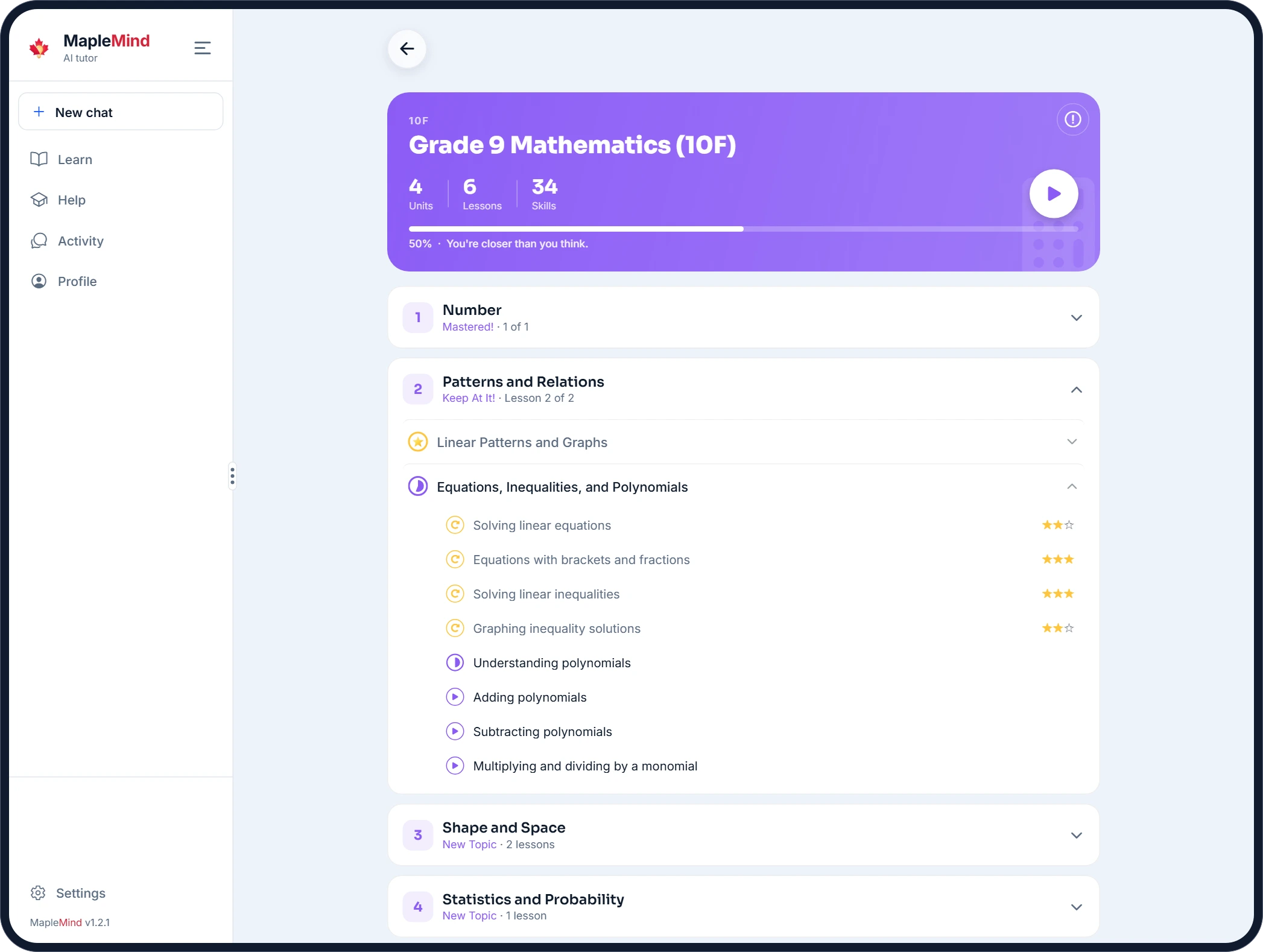
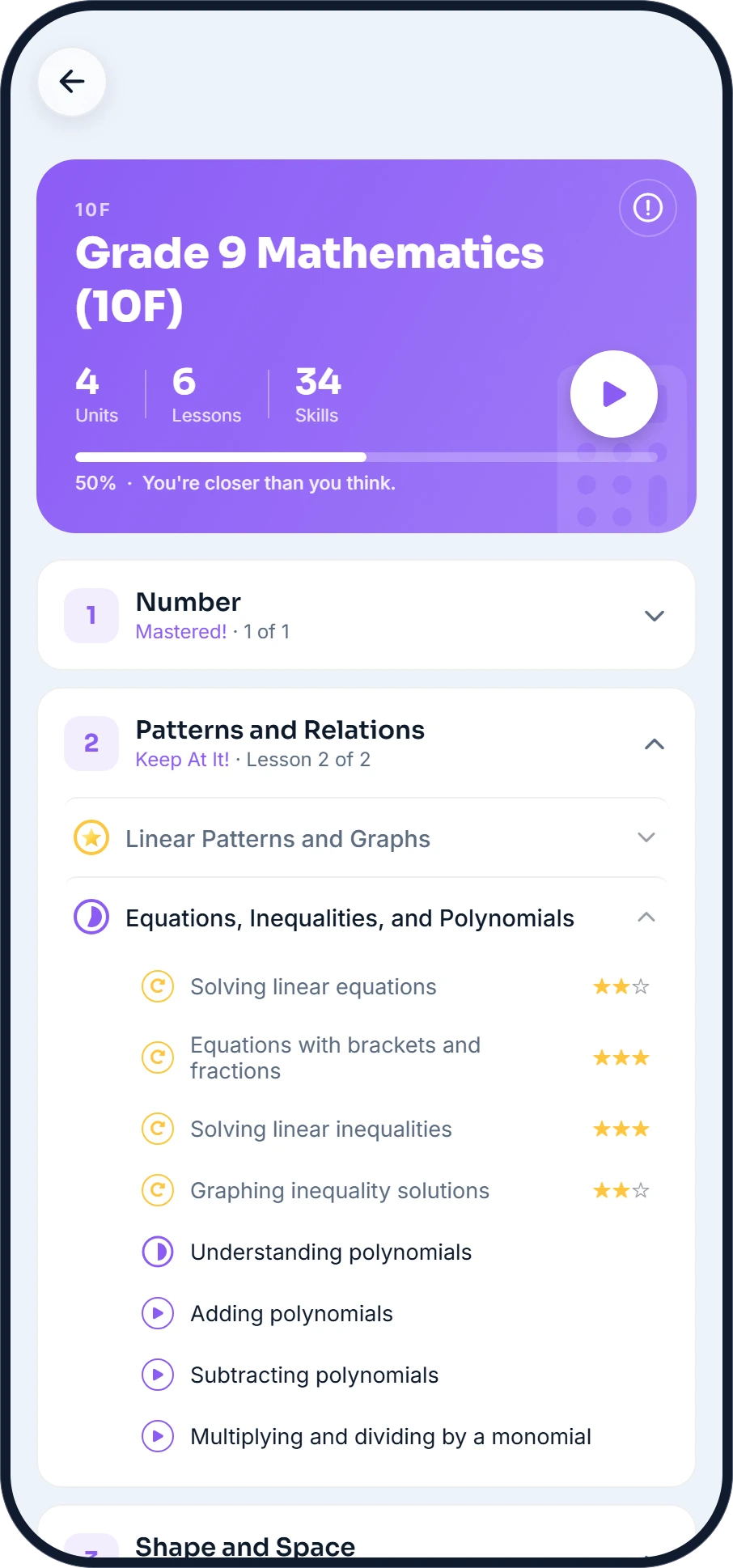
Grade 9 Mathematics (10F) in MapleMind on a tablet: its units and lessons in order, a student partway through.Grade 9 Mathematics (10F) in MapleMind on a phone: its units and lessons in order, a student partway through.
Their course, unit by unit, the way Manitoba teaches it.Shown: Grade 9 Mathematics (10F)
Homework Help on a tablet: a photo of a worksheet, the tutor’s worked example of a two-step equation, and a question back to the student.Homework Help on a phone: a photo of a worksheet, the tutor’s worked example of a two-step equation, and a question back to the student.
Homework Help: they take a photo of the question, and the tutor works through it with them.
The Parent Dashboard on a tablet: a student’s days studied, streak, lessons, quiz average and recent activity.The Parent Dashboard on a phone: a student’s days studied, streak, lessons, quiz average and recent activity.
The Parent Dashboard: how each child’s week went, in lessons, quizzes and days studied.
A Grade 9 provincial mathematics exam on a tablet: a readiness score, the exam’s time and its next sitting.A Grade 9 provincial mathematics exam on a phone: a readiness score, the exam’s time and its next sitting.
A provincial exam: a practice sitting under the real time, and how ready they are.
The Learn tab on a tablet: a four-day streak, the week’s days, Homework Help, the next lesson and a review.The Learn tab on a phone: a four-day streak, the week’s days, Homework Help, the next lesson and a review.
The Learn tab: their week so far, and the next thing to do.

Help at home

Questions parents ask

What will my child learn in Grade 12 in Manitoba?

Math: Applied Mathematics, Grade 12 (40S), Essential Mathematics, Grade 12 (40S), Introduction to Calculus, Grade 12 (40S) and Pre-Calculus Mathematics, Grade 12 (40S). Science: Biology, Grade 12 (Biology 40S), Chemistry, Grade 12 and Physics, Grade 12. English: English Language Arts, Grade 12. French: Core French, Grade 12. Social studies: First Nations, Métis, and Inuit Studies, Grade 12, Global Issues: Citizenship and Sustainability, Grade 12 and Law, Grade 12. That’s 499 skills in all, from Manitoba’s curriculum.

When is the Grade 12 Applied Mathematics Achievement Test?

It’s written January 26, 2027, and June 17, 2027.

Where does this list come from?

From Manitoba’s official curriculum, the documents its education ministry publishes for each course. Each skill here is one of their expectations, written in plain words.

Can MapleMind help my child in Grade 12?

Yes. Every course on this page is in MapleMind, with lessons, practice and a tutor that works through each step with them. A free account gets 30 messages and 4 activities a day.

Help with Grade 12, one skill at a time.

Every course on this page is in MapleMind, free with daily limits.