Get help with Biology, Grade 12 (Biology 40S)
Most tutoring makes you sit through material you already know. MapleMind flips that: pick the exact skill that's causing trouble — any of the 45 below — and the tutor teaches just that one, step by step, as many times as it takes. Ask questions in plain words, any time of day, in English, French, or 12 other languages.
The official Manitoba Biology, Grade 12 (Biology 40S) curriculum
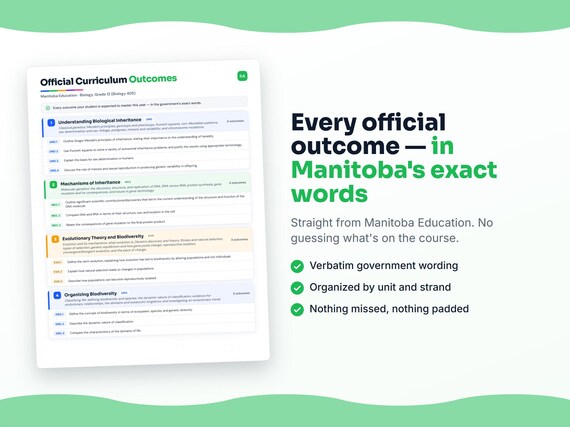
Manitoba defines Biology, Grade 12 (Biology 40S) by strands and outcomes. MapleMind teaches the same curriculum reorganized for one-skill-at-a-time tutoring — the table shows exactly where every official strand lands, and the ministry's own wording is quoted under each unit below.
Official source Manitoba's official curriculumRead it on the government site — edu.gov.mb.ca ↗| Official strand | Outcomes | Where MapleMind teaches it |
|---|---|---|
| Strand 1 | 12 | Understanding Biological Inheritance |
| Strand 2 | 10 | Mechanisms of Inheritance |
| Strand 3 | 12 | Evolutionary Theory and Biodiversity |
| Strand 4 | 7 | Organizing Biodiversity |
| Strand 5 | 4 | Conservation of Biodiversity |
Every skill below, taught one on one.
 Try the first session free
How MapleMind teaches Biology, Grade 12 (Biology 40S) — every unit, lesson, and skill
Every skill below runs as a short session: a plain-words lesson, a worked example, solving it together, then a five-question skill check that earns up to three stars. Guided Mode keeps it teaching instead of answer-handing — turning it off needs a parent's password.
Unit 1Understanding Biological InheritanceOfficial strand · Strand 1
Classical genetics: Mendel's principles, genotype and phenotype, Punnett squares, non-Mendelian patterns, sex determination and sex-linkage, pedigrees, meiosis and variability, and chromosome mutations.
Mendel and Genetic Crosses
- Outline Gregor Mendel's principles of inheritanceB12-1-01 — Outline Gregor Mendel's principles of inheritance, stating their importance to the understanding of heredity.
- Explain what is meant by the terms heterozygous and homozygousB12-1-02 — Explain what is meant by the terms heterozygous and homozygous.
- Distinguish between genotype and phenotype, and use these termsB12-1-03 — Distinguish between genotype and phenotype, and use these terms appropriately when discussing the outcomes of genetic crosses.
Punnett Squares and Inheritance Patterns
- Use Punnett squares to solve a variety of autosomal inheritanceB12-1-04 — Use Punnett squares to solve a variety of autosomal inheritance problems, and justify the results using appropriate terminology.
- Describe examples of and solve problems involving the inheritance of phenotypic traits that do notB12-1-05 — Describe examples of and solve problems involving the inheritance of phenotypic traits that do not follow a dominant-recessive pattern.
Sex Determination, Sex-Linkage, and Pedigrees
- Explain the basis for sex determination in humansB12-1-06 — Explain the basis for sex determination in humans.
- Describe examples of and solve problems involving sex-linked genesB12-1-07 — Describe examples of and solve problems involving sex-linked genes.
- Use pedigree charts to illustrate the inheritance of geneticallyB12-1-08 — Use pedigree charts to illustrate the inheritance of genetically determined traits in a family tree and to determine the probability of certain offspring having particular traits.
- Discuss ethical issues that may arise as a result of genetic testingB12-1-09 — Discuss ethical issues that may arise as a result of genetic testing for inherited conditions or disorders.
Meiosis and Chromosome Mutations
- Discuss the role of meiosis and sexual reproduction in producingB12-1-10 — Discuss the role of meiosis and sexual reproduction in producing genetic variability in offspring.
- Explain how chromosome mutations may arise during meiosisB12-1-11 — Explain how chromosome mutations may arise during meiosis.
- Identify monosomy and trisomy chromosome mutations from karyotypesB12-1-12 — Identify monosomy and trisomy chromosome mutations from karyotypes.
The official wording — 12 outcomes in this unit
- B12-1-01
Outline Gregor Mendel's principles of inheritance, stating their importance to the understanding of heredity
- B12-1-02
Explain what is meant by the terms heterozygous and homozygous
- B12-1-03
Distinguish between genotype and phenotype, and use these terms appropriately when discussing the outcomes of genetic crosses
- B12-1-04
Use Punnett squares to solve a variety of autosomal inheritance problems, and justify the results using appropriate terminology
- B12-1-05
Describe examples of and solve problems involving the inheritance of phenotypic traits that do not follow a dominant-recessive pattern
- B12-1-06
Explain the basis for sex determination in humans
- B12-1-07
Describe examples of and solve problems involving sex-linked genes
- B12-1-08
Use pedigree charts to illustrate the inheritance of genetically determined traits in a family tree and to determine the probability of certain offspring having particular traits
- B12-1-09
Discuss ethical issues that may arise as a result of genetic testing for inherited conditions or disorders
- B12-1-10
Discuss the role of meiosis and sexual reproduction in producing genetic variability in offspring
- B12-1-11
Explain how chromosome mutations may arise during meiosis
- B12-1-12
Identify monosomy and trisomy chromosome mutations from karyotypes
Unit 2Mechanisms of InheritanceOfficial strand · Strand 2
Molecular genetics: the discovery, structure, and replication of DNA, DNA versus RNA, protein synthesis, gene mutation and its consequences, and issues in gene technology.
DNA Structure and Replication
- Outline significant scientific contributions/discoveries that led to the current understandingB12-2-01 — Outline significant scientific contributions/discoveries that led to the current understanding of the structure and function of the DNA molecule.
- Describe the structure of a DNA nucleotideB12-2-02 — Describe the structure of a DNA nucleotide.
- Describe the structure of a DNA moleculeB12-2-03 — Describe the structure of a DNA molecule.
- Describe the process of DNA replicationB12-2-04 — Describe the process of DNA replication.
From Gene to Protein
- Compare DNA and RNA in terms of their structure, use, and location in the cellB12-2-05 — Compare DNA and RNA in terms of their structure, use, and location in the cell.
- Outline the steps involved in protein synthesisB12-2-06 — Outline the steps involved in protein synthesis.
Mutation and Gene Technology
- Relate the consequences of gene mutation to the final protein productB12-2-07 — Relate the consequences of gene mutation to the final protein product.
- Discuss implications of gene mutation for genetic variationB12-2-08 — Discuss implications of gene mutation for genetic variation.
The official wording — 10 outcomes in this unit
- B12-2-01
Outline significant scientific contributions/discoveries that led to the current understanding of the structure and function of the DNA molecule
- B12-2-02
Describe the structure of a DNA nucleotide
- B12-2-03
Describe the structure of a DNA molecule
- B12-2-04
Describe the process of DNA replication
- B12-2-05
Compare DNA and RNA in terms of their structure, use, and location in the cell
- B12-2-06
Outline the steps involved in protein synthesis
- B12-2-07
Relate the consequences of gene mutation to the final protein product
- B12-2-08
Discuss implications of gene mutation for genetic variation
- B12-2-09
Investigate an issue related to the application of gene technology in bioresources
- B12-2-10
Investigate an issue related to the application of gene technology in humans
Unit 3Evolutionary Theory and BiodiversityOfficial strand · Strand 3
Evolution and its mechanisms: what evolution is, Darwin's discovery and theory, fitness and natural selection, types of selection, genetic equilibrium and how gene pools change, reproductive isolation, convergent/divergent evolution, and the pace of change.
Darwin and Natural Selection
- Define the term evolution, explaining how evolution has led to biodiversity by altering populationsB12-3-01 — Define the term evolution, explaining how evolution has led to biodiversity by altering populations and not individuals.
- Describe and explain the process of discovery that led Charles DarwinB12-3-02 — Describe and explain the process of discovery that led Charles Darwin to formulate his theory of evolution by natural selection.
- Outline the main points of Darwin's theory of evolution by naturalB12-3-03 — Outline the main points of Darwin's theory of evolution by natural selection.
- Demonstrate, through examples, what the term fittest means in the phrase “survival of the fittest.”B12-3-04 — Demonstrate, through examples, what the term fittest means in the phrase “survival of the fittest.”.
Selection and Changing Gene Pools
- Explain how natural selection leads to changes in populationsB12-3-05 — Explain how natural selection leads to changes in populations.
- Describe how disruptive, stabilizing, and directional naturalB12-3-06 — Describe how disruptive, stabilizing, and directional natural selection act on variation.
- Distinguish between natural selection and artificial selectionB12-3-07 — Distinguish between natural selection and artificial selection.
- Outline how scientists determine whether a gene pool has changedB12-3-08 — Outline how scientists determine whether a gene pool has changed, according to the criteria for genetic equilibrium.
- Discuss how genetic variation in a gene pool can be alteredB12-3-09 — Discuss how genetic variation in a gene pool can be altered.
Speciation and the Pace of Evolution
- Describe how populations can become reproductively isolatedB12-3-10 — Describe how populations can become reproductively isolated.
- With the use of examples, differentiate between convergent evolutionB12-3-11 — With the use of examples, differentiate between convergent evolution and divergent evolution (adaptive radiation).
- Distinguish between the two models for the pace of evolutionaryB12-3-12 — Distinguish between the two models for the pace of evolutionary change: punctuated equilibrium and gradualism.
The official wording — 12 outcomes in this unit
- B12-3-01
Define the term evolution, explaining how evolution has led to biodiversity by altering populations and not individuals
- B12-3-02
Describe and explain the process of discovery that led Charles Darwin to formulate his theory of evolution by natural selection
- B12-3-03
Outline the main points of Darwin's theory of evolution by natural selection
- B12-3-04
Demonstrate, through examples, what the term fittest means in the phrase “survival of the fittest.”
- B12-3-05
Explain how natural selection leads to changes in populations
- B12-3-06
Describe how disruptive, stabilizing, and directional natural selection act on variation
- B12-3-07
Distinguish between natural selection and artificial selection
- B12-3-08
Outline how scientists determine whether a gene pool has changed, according to the criteria for genetic equilibrium
- B12-3-09
Discuss how genetic variation in a gene pool can be altered
- B12-3-10
Describe how populations can become reproductively isolated
- B12-3-11
With the use of examples, differentiate between convergent evolution and divergent evolution (adaptive radiation)
- B12-3-12
Distinguish between the two models for the pace of evolutionary change: punctuated equilibrium and gradualism
Unit 4Organizing BiodiversityOfficial strand · Strand 4
Classifying life: defining biodiversity and species, the dynamic nature of classification, evidence for evolutionary relationships, the domains and eukaryotic kingdoms, and investigating an evolutionary trend.
Biodiversity and Defining Species
- Define the concept of biodiversity in terms of ecosystem, speciesB12-4-01 — Define the concept of biodiversity in terms of ecosystem, species, and genetic diversity.
- Explain why it is difficult to determine a definition of speciesB12-4-02 — Explain why it is difficult to determine a definition of species.
Classification and Its Evidence
- Describe the dynamic nature of classificationB12-4-03 — Describe the dynamic nature of classification.
- Describe types of evidence used to classify organisms and determineB12-4-04 — Describe types of evidence used to classify organisms and determine evolutionary relationships.
Domains, Kingdoms, and Evolutionary Trends
- Compare the characteristics of the domains of lifeB12-4-05 — Compare the characteristics of the domains of life.
- Compare the characteristics of the kingdoms in the Eukarya domainB12-4-06 — Compare the characteristics of the kingdoms in the Eukarya domain.
- Investigate an evolutionary trend in a group of organismsB12-4-07 — Investigate an evolutionary trend in a group of organisms.
The official wording — 7 outcomes in this unit
- B12-4-01
Define the concept of biodiversity in terms of ecosystem, species, and genetic diversity
- B12-4-02
Explain why it is difficult to determine a definition of species
- B12-4-03
Describe the dynamic nature of classification
- B12-4-04
Describe types of evidence used to classify organisms and determine evolutionary relationships
- B12-4-05
Compare the characteristics of the domains of life
- B12-4-06
Compare the characteristics of the kingdoms in the Eukarya domain
- B12-4-07
Investigate an evolutionary trend in a group of organisms
Unit 5Conservation of BiodiversityOfficial strand · Strand 5
Why and how biodiversity is conserved: reasons for maintaining it, conservation strategies, tools for monitoring biodiversity, and investigating a conservation issue.
Conserving Biodiversity
- Discuss a variety of reasons for maintaining biodiversityB12-5-01 — Discuss a variety of reasons for maintaining biodiversity.
- Describe strategies used to conserve biodiversityB12-5-02 — Describe strategies used to conserve biodiversity.
- Select and use appropriate tools or procedures to determine and monitor biodiversity in an areaB12-5-03 — Select and use appropriate tools or procedures to determine and monitor biodiversity in an area.
The official wording — 4 outcomes in this unit
- B12-5-01
Discuss a variety of reasons for maintaining biodiversity
- B12-5-02
Describe strategies used to conserve biodiversity
- B12-5-03
Select and use appropriate tools or procedures to determine and monitor biodiversity in an area
- B12-5-04
Investigate an issue related to the conservation of biodiversity
Printable workbook · A keepsake of the year
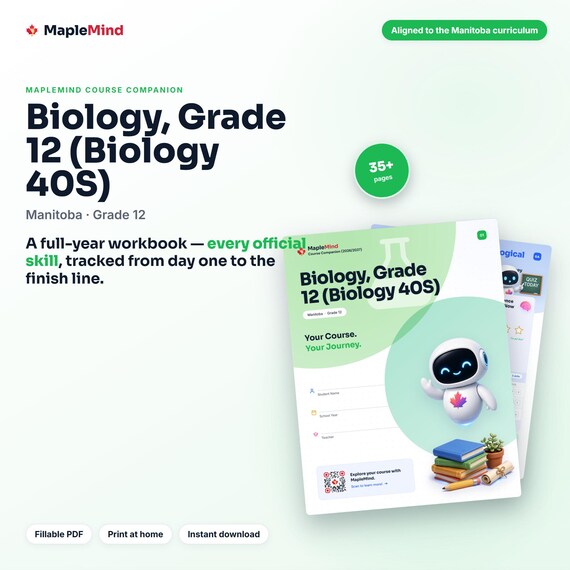
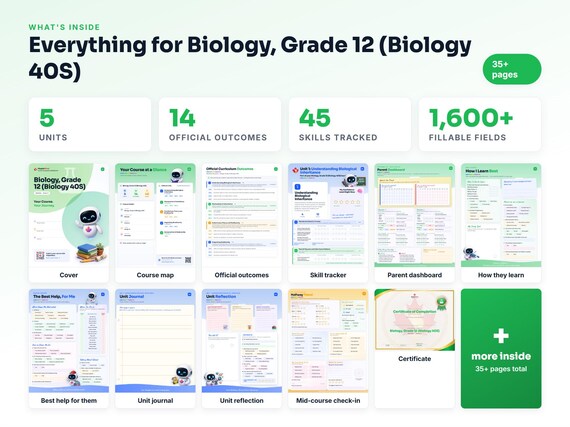
A Biology, Grade 12 (Biology 40S) workbook worth keeping
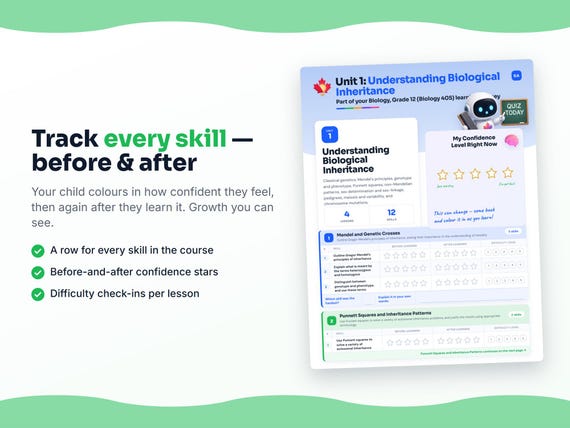
Built from the same official curriculum as this page. Before and after each skill above, your student colours in how sure they feel — so the two of you can see, on one page, what's clicking and what needs another look. It's a quiet way to follow how the year is really going.
By June it's full of their own handwriting: units worked through, confidence grown, a mid-year check-in, notes from parent-teacher night, and a certificate at the end. Less a worksheet, more a record of the year worth keeping on the shelf.
Instant download · see every page, reviews and the full description · five or more workbooks are $2.99 each
What it looks like in the app



Common questions
Can MapleMind help me with Biology, Grade 12 (Biology 40S)?
Yes. MapleMind's AI tutor covers all 45 skills in Manitoba's Biology, Grade 12 (Biology 40S) — you pick the exact skill, and the tutor teaches it step by step: a short lesson, a worked example, solving together, then a skill check to show it stuck.
Is MapleMind aligned to Manitoba's official curriculum?
Yes. Every skill in this course maps to an official outcome code from Manitoba's Grade 12 Science curriculum, and the ministry's own wording is quoted under each unit on this page — with the official government source linked so you can check it yourself.
What does MapleMind cost?
It's free to start — 5 tutoring chats and a practice quiz every day, no credit card. A Pro subscription ($9.99/month or $49.99/year CAD, 7-day free trial) unlocks unlimited tutoring, practice, and exam simulations.
What if I'm stuck on just one topic?
That's the point of skill-level tutoring: open Biology, Grade 12 (Biology 40S) in the app, tap the exact skill from the list on this page, and the tutor teaches just that — no wading through lessons you don't need.
Does MapleMind work in French or other languages?
Yes — 14 languages, including French. Both the app and the tutor's explanations switch to the language you choose.
Where can I see the official Manitoba curriculum for Biology, Grade 12 (Biology 40S)?
The official source is linked on this page — Manitoba's official curriculum. The outline here follows it: every MapleMind skill carries its official outcome code, and the ministry's own wording is quoted under each unit.
Keep exploring
Ready when you are
Pick a skill from this page and see it taught properly — free, in the browser, in under a minute.