Get help with Physics, Grade 12
Most tutoring makes you sit through material you already know. MapleMind flips that: pick the exact skill that's causing trouble — any of the 79 below — and the tutor teaches just that one, step by step, as many times as it takes. Ask questions in plain words, any time of day, in English, French, or 12 other languages.
The official Manitoba Physics, Grade 12 curriculum
Manitoba defines Physics, Grade 12 by strands and outcomes. MapleMind teaches the same curriculum reorganized for one-skill-at-a-time tutoring — the table shows exactly where every official strand lands, and the ministry's own wording is quoted under each unit below.
Official source Manitoba's official curriculumRead it on the government site — edu.gov.mb.ca ↗| Official strand | Outcomes | Where MapleMind teaches it |
|---|---|---|
| Strand 1 | 33 | Unit 1: Mechanics |
| Strand 2 | 22 | Unit 2: Fields |
| Strand 3 | 15 | Unit 3: Electricity |
| Strand 4 | 9 | Unit 4: Medical Physics |
Every skill below, taught one on one.
 Try the first session free
How MapleMind teaches Physics, Grade 12 — every unit, lesson, and skill
Every skill below runs as a short session: a plain-words lesson, a worked example, solving it together, then a five-question skill check that earns up to three stars. Guided Mode keeps it teaching instead of answer-handing — turning it off needs a parent's password.
Unit 1Unit 1: MechanicsOfficial strand · Strand 1
Advanced mechanics: the constant-acceleration equations and relative motion; dynamics on inclined planes and with combined systems; impulse and the conservation of momentum; projectile motion; uniform circular motion and centripetal force; and work, energy, and the conservation of energy including springs and Hooke's Law.
Kinematics
- Deriving the constant-acceleration equationsS4P-1-1 — Derive the special equations for constant acceleration.
- Solving straight-line motion problemsS4P-1-2 — Solve problems for objects moving in a straight line with a constant acceleration.
- Relative motionS4P-1-3 — Solve relative motion problems for constant velocities using vectors.
Dynamics
- Objects in equilibriumS4P-1-4 — Solve vector problems for objects in equilibrium.
- Forces on an inclined planeS4P-1-5 — Calculate the forces acting on an object resting on an inclined plane, including normal force, friction, and components of gravity.
- Components of an applied force on an inclineS4P-1-6 — Calculate the components of an applied force exerted on an object resting on an inclined plane.
- Friction problems on horizontal and inclined surfacesS4P-1-7 — Solve problems with friction for objects on a horizontal surface and on an inclined plane.
- Newton's law with combined systemsS4P-1-8 — Solve problems using Newton's laws and kinematics equations, including combined mass systems and inclined planes.
- Investigating forces on an objectS4P-1-9 — Perform an experiment to investigate forces acting on an object.
Momentum
- The impulse-momentum equationS4P-1-10 — Derive the impulse-momentum equation from Newton's second law.
- Impulse from a force-time graphS4P-1-11 — Determine impulse from the area under a force-time graph, for constant and uniformly changing forces.
- Conservation of momentum labS4P-1-12 — Experiment to illustrate the Law of Conservation of Momentum in one and two dimensions.
- Solving momentum problemsS4P-1-13 — Solve problems using the impulse-momentum equation and the Law of Conservation of Momentum.
- Impulse in real-life situationsS4P-1-14 — Relate the impulse-momentum equation to real-life situations.
Projectile Motion
- Projectile motion componentsS4P-1-15 — Solve simple free-fall problems using the special equations for constant acceleration, including horizontal and vertical components.
- Free-body diagrams for projectilesS4P-1-16 — Draw free-body diagrams for a projectile at various points along its path.
- Calculating projectile componentsS4P-1-17 — Calculate the horizontal and vertical components of velocity and position of a projectile at various points along its path.
- Range, height, and time of flightS4P-1-18 — Solve problems for projectiles launched horizontally and at various angles to calculate maximum height, range, and time of flight.
Circular Motion
- Centripetal accelerationS4P-1-19 — Explain qualitatively why an object moving at constant speed in a circle is accelerating toward the centre.
- Centrifugal effects and Newton's lawsS4P-1-20 — Discuss the centrifugal effects with respect to Newton's laws.
- Free-body diagrams of circular motionS4P-1-21 — Draw free-body diagrams of an object moving in uniform circular motion.
- Investigating circular motionS4P-1-22 — Experiment to determine the mathematical relationship between period and frequency and centripetal force, mass, or radius.
- The circular-motion equationsS4P-1-23 — Derive an equation for the constant speed and acceleration of an object moving in a circle.
- Solving circular-motion problemsS4P-1-24 — Solve problems for an object moving with a constant speed in a circle.
Work and Energy
- Defining workS4P-1-25 — Define work as the product of displacement and the component of force parallel to the displacement when the force is constant.
- Work from a force-position graphS4P-1-26 — Determine work from the area under the force-position graph for any force.
- Work as a transfer of energyS4P-1-27 — Describe work as a transfer of energy, including positive and negative work, kinetic energy, and conservation of energy.
- Forms of energyS4P-1-28 — Give examples of various forms of energy and describe qualitatively the means by which they can perform work.
- Deriving kinetic energyS4P-1-29 — Derive the equation for kinetic energy using work and kinematics equations.
- Gravitational potential energyS4P-1-30 — Derive the equation for gravitational potential energy near the surface of the Earth.
- Hooke's LawS4P-1-31 — Experiment to determine Hooke's Law.
- Spring potential energyS4P-1-32 — Derive an equation for the potential energy of a spring using Hooke's law and a force-displacement graph.
- Conservation of energy problemsS4P-1-33 — Solve problems related to the conservation of energy, including gravitational and spring potential and kinetic energy.
The official wording — 33 outcomes in this unit
- S4P-1-1
Derive the special equations for constant acceleration. Include:
- S4P-1-2
Solve problems for objects moving in a straight line with a constant acceleration. Include:
- S4P-1-3
Solve relative motion problems for constant velocities using vectors.
- S4P-1-4
Solve vector problems for objects in equilibrium.
- S4P-1-5
Calculate the forces acting on an object resting on an inclined plane. Include: normal force, friction, components of the gravitational force (mg)
- S4P-1-6
Calculate the components of exerted on an object resting on an inclined plane.
- S4P-1-7
Solve problems with for objects on a horizontal surface and on an inclined plane. Include: coefficient of friction
- S4P-1-8
Solve problems using and using kinematics equations from above. Include: at an angle to horizontal motion; combined mass systems; on an inclined plane; forces acting at various angles on a body
- S4P-1-9
Perform an experiment to investigate forces acting on an object.
- S4P-1-10
Derive the impulse-momentum equation from Newton’s second law.
- S4P-1-11
Determine impulse from the area under a force-time graph. Include: constant positive and negative force, uniformly changing force
- S4P-1-12
Experiment to illustrate the Law of Conservation of Momentum in one and two dimensions.
- S4P-1-13
Solve problems using the impulse-momentum equation and the Law of Conservation of Momentum.
- S4P-1-14
Relate the impulse-momentum equation to real-life situations. Examples: hitting a ball, catching a ball
- S4P-1-15
Solve simple free-fall problems using the special equations for constant acceleration. Include: horizontal and vertical components of motion of the curved path of a projectile (without air resistance).
- S4P-1-16
Draw free-body diagrams for a projectile at various points along its path (with or without air resistance).
- S4P-1-17
Calculate the horizontal and vertical components with respect to velocity and position of a projectile at various points along its path.
- S4P-1-18
Solve problems for projectiles launched horizontally and at various angles to the horizontal to calculate maximum height, range, and overall time of flight of the projectile.
- S4P-1-19
Explain qualitatively why an object moving at constant speed in a circle is accelerating toward the centre of the circle.
- S4P-1-20
Discuss the centrifugal effects with respect to Newton’s laws.
- S4P-1-21
Draw free-body diagrams of an object moving in uniform circular motion.
- S4P-1-22
Experiment to determine the mathematical relationship between period and frequency and one or more of the following: centripetal force, mass, and radius.
- S4P-1-23
Derive an equation for the constant speed and acceleration of an object moving in a circle
- S4P-1-24
Solve problems for an object moving with a constant speed in a circle using
- S4P-1-25
Define work as the product of displacement and the component of force parallel to the displacement when the force is constant.
- S4P-1-26
Determine work from the area under the force-position graph for any force. Include: positive or negative force, uniformly changing force
- S4P-1-27
Describe work as a transfer of energy. Include: positive and negative work, kinetic energy, conservation of energy
- S4P-1-28
Give examples of various forms of energy and describe qualitatively the means by which they can perform work.
- S4P-1-29
Derive the equation for kinetic energy using and kinematics equations.
- S4P-1-30
Derive the equation for gravitational potential energy near the surface of the Earth (Ep = mgh).
- S4P-1-31
Experiment to determine Hooke’s Law
- S4P-1-32
Derive an equation for the potential energy of a spring, using Hooke’s law and a force-displacement graph.
- S4P-1-33
Solve problems related to the conservation of energy. Include: gravitational and spring potential, and kinetic energy
Unit 2Unit 2: FieldsOfficial strand · Strand 2
Gravitational and electromagnetic fields beyond Earth: Kepler's laws and Newton's Law of Universal Gravitation, gravitational potential energy and escape velocity; satellites in low Earth orbit, microgravity, and re-entry; and electric and magnetic fields — Coulomb's Law, uniform fields, electric potential and voltage, and technologies using fields.
Exploration of Space
- Issues of space explorationS4P-2-1 — Identify and analyze issues pertaining to space exploration.
- Kepler's laws of planetary motionS4P-2-2 — Describe planetary motion using Kepler's three laws.
- Newton's Law of Universal GravitationS4P-2-3 — Outline Newton's Law of Universal Gravitation and solve problems using it.
- Gravitational potential energy in spaceS4P-2-4 — State the gravitational potential energy as the area under the force-separation curve and solve problems using it.
- Escape velocityS4P-2-5 — Solve problems for the escape velocity of a spacecraft, including the Law of Conservation of Energy and binding energy.
Low Earth Orbit
- Universal gravitation and weightS4P-2-6 — Compare the Law of Universal Gravitation with the weight of an object at various distances and describe the gravitational field.
- Newton's thought experiment on orbitS4P-2-7 — Outline Newton's thought experiment regarding how an artificial satellite can be made to orbit the Earth.
- Calculating satellite motionS4P-2-8 — Use the Law of Universal Gravitation and circular motion to calculate the characteristics of a satellite's motion.
- Defining microgravityS4P-2-9 — Define microgravity as an environment in which the apparent weight of a system is smaller than its actual weight.
- Producing microgravityS4P-2-10 — Describe conditions under which microgravity can be produced.
- Re-entry into the atmosphereS4P-2-11 — Outline the factors involved in the re-entry of an object into Earth's atmosphere, including friction and g-forces.
- Challenges of deep-space explorationS4P-2-12 — Describe qualitatively some of the technological challenges to exploring deep space.
Electric and Magnetic Fields
- Inverse-square gravitational and electric fieldsS4P-2-13 — Compare and contrast the inverse square nature of gravitational and electric fields.
- Coulomb's LawS4P-2-14 — State Coulomb's Law and solve problems for more than one electric force acting on a charge.
- Uniform field between parallel platesS4P-2-15 — Illustrate, using diagrams, how the charge distribution on two oppositely charged parallel plates results in a uniform field.
- Electric potential energy between platesS4P-2-16 — Derive an equation for the electric potential energy between two oppositely charged parallel plates.
- Electric potentialS4P-2-17 — Describe electric potential as the electric potential energy per unit charge.
- The voltS4P-2-18 — Identify the unit of electric potential as the volt.
- Potential difference and field between platesS4P-2-19 — Define electric potential difference (voltage) and express the electric field between parallel plates in terms of voltage and separation.
- Charges moving through platesS4P-2-20 — Solve problems for charges moving between or through parallel plates.
- Hand rules for fields and chargesS4P-2-21 — Use hand rules to describe the directional relationships between electric and magnetic fields and moving charges.
- Technologies using electric and magnetic fieldsS4P-2-22 — Describe qualitatively various technologies that use electric and magnetic fields.
The official wording — 22 outcomes in this unit
- S4P-2-1
Identify and analyze issues pertaining to space exploration. Examples: scale of the universe, technological advancement, promotion of global co-operation, social and economic benefits, allocation of resources shifted away from other pursuits, possibility of disaster
- S4P-2-2
Describe planetary motion using Kepler’s three laws. Examples: relate Kepler’s Third Law to objects other than planets, such as comets, satellites, and spacecraft
- S4P-2-3
Outline Newton’s Law of Universal Gravitation and solve problems using
- S4P-2-4
State the gravitational potential energy as the area under the force-separation curve and solve problems using
- S4P-2-5
Solve problems for the escape velocity of a spacecraft. Include: Law of Conservation of Energy, binding energy
- S4P-2-6
Compare the Law of Universal Gravitation with the weight (mg) of an object at various distances from the surface of the Earth and describe the gravitational field as
- S4P-2-7
Outline Newton’s thought experiment regarding how an artificial satellite can be made to orbit the Earth.
- S4P-2-8
Use the Law of Universal Gravitation and circular motion to calculate the characteristics of the motion of a satellite. Include: orbital period, speed, altitude above a planetary surface, mass of the central body, and the location of geosynchronous satellites
- S4P-2-9
Define microgravity as an environment in which the apparent weight of a system is smaller than its actual weight.
- S4P-2-10
Describe conditions under which microgravity can be produced. Examples: jumping off a diving board, roller-coaster, free fall, parabolic flight, orbiting spacecraft
- S4P-2-11
Outline the factors involved in the re-entry of an object into Earth’s atmosphere. Include: friction and g-forces
- S4P-2-12
Describe qualitatively some of the technological challenges to exploring deep space. Examples: communication, flyby and the “slingshot” effect, Hohmann Transfer orbits (least- energy orbits)
- S4P-2-13
Compare and contrast the inverse square nature of gravitational and electric fields.
- S4P-2-14
State Coulomb’s Law and solve problems for more than one electric force acting on a charge. Include: one and two dimensions
- S4P-2-15
Illustrate, using diagrams, how the charge distribution on two oppositely charged parallel plates results in a uniform field.
- S4P-2-16
Derive an equation for the electric potential energy between two oppositely charged parallel plates (Ee = qE∆d).
- S4P-2-17
Describe electric potential as the electric potential energy per unit charge.
- S4P-2-18
Identify the unit of electric potential as the volt.
- S4P-2-19
Define electric potential difference (voltage) and express the electric field between two oppositely charged parallel plates in terms of voltage and the separation between the plates
- S4P-2-20
Solve problems for charges moving between or through parallel plates.
- S4P-2-21
Use hand rules to describe the directional relationships between electric and magnetic fields and moving charges.
- S4P-2-22
Describe qualitatively various technologies that use electric and magnetic fields. Examples: electromagnetic devices (such as a solenoid, motor, bell, or relay), cathode ray tube, mass spectrometer, antenna
Unit 3Unit 3: ElectricityOfficial strand · Strand 3
Electric circuits — conventional current, Ohm's Law, resistance and resistivity, building series, parallel, and combined circuits, and calculating resistance, current, voltage, and power; and electromagnetic induction — magnetic flux, induced voltage, Lenz's Law, the AC generator, transformers, and electricity distribution in Manitoba.
Electric Circuits
- Conventional currentS4P-3-1 — Describe the origin of conventional current and relate its direction to the electron flow in a conductor.
- History of Ohm's LawS4P-3-2 — Describe the historical development of Ohm's Law, including the contributions of Ohm and others.
- Resistance and resistivityS4P-3-3 — Investigate the relationships among resistance, resistivity, length, cross-section, and temperature.
- Building circuits from diagramsS4P-3-4 — Demonstrate the ability to construct circuits from schematic diagrams for series, parallel, and combined networks.
- Total resistance in series and parallelS4P-3-5 — Calculate the total resistance for resistors in series and resistors in parallel.
- Calculating circuit quantitiesS4P-3-6 — Calculate the resistance, current, voltage, and power for series, parallel, and combined networks.
Electromagnetic Induction
- Magnetic fluxS4P-3-7 — Define magnetic flux.
- Inducing voltage from changing fluxS4P-3-8 — Demonstrate how a change in magnetic flux induces voltage.
- Calculating induced voltageS4P-3-9 — Calculate the magnitude of the induced voltage in coils.
- Lenz's LawS4P-3-10 — Outline Lenz's Law and apply it to related problems.
- The AC generatorS4P-3-11 — Describe the operation of an AC generator.
- Graphing AC voltageS4P-3-12 — Graph voltage versus angle for the AC cycle.
- TransformersS4P-3-13 — Describe the operation of transformers.
- The transformer ratioS4P-3-14 — Solve problems using the transformer ratio.
- Electricity distribution in ManitobaS4P-3-15 — Describe the generation, transmission, and distribution of electricity in Manitoba, including transformers and power transfer.
The official wording — 15 outcomes in this unit
- S4P-3-1
Describe the origin of conventional current and relate its direction to the electron flow in a conductor.
- S4P-3-2
Describe the historical development of Ohm’s Law. Include: contributions of Gray, Ohm, Joule, and Kirchoff
- S4P-3-3
Investigate the relationships among resistance and resistivity, length, cross- section, and temperature. Include:
- S4P-3-4
Demonstrate the ability to construct circuits from schematic diagrams for series, parallel, and combined networks. Include: correct placement of ammeters and voltmeters
- S4P-3-5
Calculate the total resistance for resistors in series and resistors in parallel.
- S4P-3-6
Calculate the resistance, current, voltage, and power for series, parallel, and combined networks. Include:
- S4P-3-7
Define magnetic flux
- S4P-3-8
Demonstrate how a change in magnetic flux induces voltage.
- S4P-3-9
Calculate the magnitude of the induced voltage in coils using
- S4P-3-10
Outline Lenz’s Law and apply to related problems.
- S4P-3-11
Describe the operation of an AC generator.
- S4P-3-12
Graph voltage versus angle for the AC cycle.
- S4P-3-13
Describe the operation of transformers.
- S4P-3-14
Solve problems using the transformer ratio of
- S4P-3-15
Describe the generation, transmission, and distribution of electricity in Manitoba. Include: step-up and step-down transformers, power transfer, High Voltage Direct Current
Unit 4Unit 4: Medical PhysicsOfficial strand · Strand 4
The physics of radiation and its medical uses: the nuclear model of the atom, radioactivity and half-life, decay calculations, types of radiation, ionizing versus non-ionizing radiation and their sources and applications, the effects of radiation on the body, and diagnostic imaging and treatment techniques.
Radioactivity and Half-Life
- The nuclear model of the atomS4P-4-1 — Describe the nuclear model of the atom, including protons, neutrons, the nucleus, isotopes, and ions.
- Defining radioactivityS4P-4-2 — Define radioactivity as a nuclear change that releases energy, including radioactive decay and half-life.
- Half-life calculationsS4P-4-3 — Perform decay calculations using integer numbers of half life.
- Types of radiationS4P-4-4 — Describe the types of radiation: alpha, beta, and electromagnetic radiation.
Radiation and Health
- Ionizing and non-ionizing radiationS4P-4-5 — Compare and contrast sources and characteristics of ionizing and non-ionizing radiation.
- Applications of non-ionizing radiationS4P-4-6 — Describe various applications of non-ionizing radiation.
- Applications of ionizing radiationS4P-4-7 — Describe various applications of ionizing radiation.
- Effects of radiation on the bodyS4P-4-8 — Describe the effects of non-ionizing and ionizing radiation on the human body.
- Radiation in medical imaging and treatmentS4P-4-9 — Research, identify, and examine the application of radiation to diagnostic imaging and treatment techniques.
The official wording — 9 outcomes in this unit
- S4P-4-1
Describe the nuclear model of the atom. Include: proton, neutron, nucleus, nuclear forces, stability, isotope, mass number, electron, ion
- S4P-4-2
Define radioactivity as a nuclear change that releases energy. Include: Becquerel units, radioactive decay, half life
- S4P-4-3
Perform decay calculations using integer numbers of half life.
- S4P-4-4
Describe the following types of radiation: alpha, beta, and electromagnetic radiation. Include: particle radiation, wave radiation, electromagnetic spectrum, linear energy transfer
- S4P-4-5
Compare and contrast sources and characteristics of ionizing radiation and non- ionizing radiation. Include: NORM (Naturally Occurring Radioactive Materials), radon, background radiation, incandescent light bulb, hot objects
- S4P-4-6
Describe various applications of non-ionizing radiation. Examples: communications, microwave oven, laser, tanning bed
- S4P-4-7
Describe various applications of ionizing radiation. Examples: food irradiation, sterilization, smoke alarm
- S4P-4-8
Describe the effects of non-ionizing and ionizing radiation on the human body. Include: equivalency of sievert (Sv) and rem units, solar erythema (sunburn)
- S4P-4-9
Research, identify, and examine the application of radiation to diagnostic imaging and treatment techniques. Examples: nuclear medicine imaging techniques such as MRI, ultrasound, endoscopy, X-ray, CT scanning, PET, heavy isotopes such as Ba; nuclear medicine therapies such as brachitherapy, external beam, gamma knife



Printable workbook · A keepsake of the year
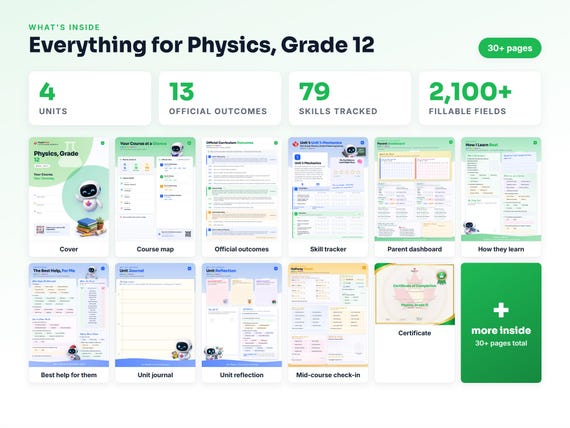
A Physics, Grade 12 workbook worth keeping
Built from the same official curriculum as this page. Before and after each skill above, your student colours in how sure they feel — so the two of you can see, on one page, what's clicking and what needs another look. It's a quiet way to follow how the year is really going.
By June it's full of their own handwriting: units worked through, confidence grown, a mid-year check-in, notes from parent-teacher night, and a certificate at the end. Less a worksheet, more a record of the year worth keeping on the shelf.
Instant download · see every page, reviews and the full description · five or more workbooks are $2.99 each
What it looks like in the app



Common questions
Can MapleMind help me with Physics, Grade 12?
Yes. MapleMind's AI tutor covers all 79 skills in Manitoba's Physics, Grade 12 — you pick the exact skill, and the tutor teaches it step by step: a short lesson, a worked example, solving together, then a skill check to show it stuck.
Is MapleMind aligned to Manitoba's official curriculum?
Yes. Every skill in this course maps to an official outcome code from Manitoba's Grade 12 Science curriculum, and the ministry's own wording is quoted under each unit on this page — with the official government source linked so you can check it yourself.
What does MapleMind cost?
It's free to start — 5 tutoring chats and a practice quiz every day, no credit card. A Pro subscription ($9.99/month or $49.99/year CAD, 7-day free trial) unlocks unlimited tutoring, practice, and exam simulations.
What if I'm stuck on just one topic?
That's the point of skill-level tutoring: open Physics, Grade 12 in the app, tap the exact skill from the list on this page, and the tutor teaches just that — no wading through lessons you don't need.
Does MapleMind work in French or other languages?
Yes — 14 languages, including French. Both the app and the tutor's explanations switch to the language you choose.
Where can I see the official Manitoba curriculum for Physics, Grade 12?
The official source is linked on this page — Manitoba's official curriculum. The outline here follows it: every MapleMind skill carries its official outcome code, and the ministry's own wording is quoted under each unit.
Keep exploring
Ready when you are
Pick a skill from this page and see it taught properly — free, in the browser, in under a minute.