Get help with Chemistry, Grade 11
Most tutoring makes you sit through material you already know. MapleMind flips that: pick the exact skill that's causing trouble — any of the 76 below — and the tutor teaches just that one, step by step, as many times as it takes. Ask questions in plain words, any time of day, in English, French, or 12 other languages.
The official Manitoba Chemistry, Grade 11 curriculum
Manitoba defines Chemistry, Grade 11 by strands and outcomes. MapleMind teaches the same curriculum reorganized for one-skill-at-a-time tutoring — the table shows exactly where every official strand lands, and the ministry's own wording is quoted under each unit below.
Official source Manitoba's official curriculumRead it on the government site — edu.gov.mb.ca ↗| Official strand | Outcomes | Where MapleMind teaches it |
|---|---|---|
| Strand 1 | 8 | Topic 1: Physical Properties of Matter |
| Strand 2 | 9 | Topic 2: Gases and the Atmosphere |
| Strand 3 | 16 | Topic 3: Chemical Reactions |
| Strand 4 | 19 | Topic 4: Solutions |
| Strand 5 | 24 | Topic 5: Organic Chemistry |
Every skill below, taught one on one.
 Try the first session free
How MapleMind teaches Chemistry, Grade 11 — every unit, lesson, and skill
Every skill below runs as a short session: a plain-words lesson, a worked example, solving it together, then a five-question skill check that earns up to three stars. Guided Mode keeps it teaching instead of answer-handing — turning it off needs a parent's password.
Unit 1Topic 1: Physical Properties of MatterOfficial strand · Strand 1
The states of matter and the Kinetic Molecular Theory: how random molecular motion, intermolecular forces, and energy explain the properties of gases, liquids, and solids, changes of state, and vapour pressure.
States of Matter and the Kinetic Molecular Theory
- Properties of gases, liquids, solids, and plasmaC11-1-01 — Describe the physical properties of the four states of matter — including density, compressibility, and diffusion.
- Kinetic Molecular Theory of gasesC11-1-02 — Use the Kinetic Molecular Theory to explain the properties of gases through random motion, intermolecular forces, elastic collisions, and average kinetic energy.
- Kinetic Molecular Theory of liquids and solidsC11-1-03 — Explain the properties of liquids and solids using the Kinetic Molecular Theory.
- Melting, freezing, sublimation, and depositionC11-1-04 — Explain melting, solidification, sublimation, and deposition using the Kinetic Molecular Theory, including freezing point and exothermic and endothermic changes.
- Evaporation and condensationC11-1-05 — Use the Kinetic Molecular Theory to explain evaporation and condensation, including intermolecular forces, volatility, and dynamic equilibrium.
- Defining vapour pressureC11-1-06 — Operationally define vapour pressure in terms of observable and measurable properties.
- Normal boiling point and vapour pressureC11-1-07 — Operationally define normal boiling point temperature in terms of vapour pressure.
- Reading vapour pressure and boiling temperature graphsC11-1-08 — Interpolate and extrapolate the vapour pressure and boiling temperature of substances from pressure versus temperature graphs.
The official wording — 8 outcomes in this unit
- C11-1-01
Describe the properties of gases, liquids, solids, and plasma. Include: density, compressibility, diffusion
- C11-1-02
Use the Kinetic Molecular Theory to explain properties of gases. Include: random motion, intermolecular forces, elastic collisions, average kinetic energy, temperature
- C11-1-03
Explain the properties of liquids and solids using the Kinetic Molecular Theory.
- C11-1-04
Explain the process of melting, solidification, sublimation, and deposition in terms of the Kinetic Molecular Theory. Include: freezing point, exothermic, endothermic
- C11-1-05
Use the Kinetic Molecular Theory to explain the processes of evaporation and condensation. Include: intermolecular forces, random motion, volatility, dynamic equilibrium
- C11-1-06
Operationally define vapour pressure in terms of observable and measurable properties.
- C11-1-07
Operationally define normal boiling point temperature in terms of vapour pressure.
- C11-1-08
Interpolate and extrapolate the vapour pressure and boiling temperature of various substances from pressure versus temperature graphs.
Unit 2Topic 2: Gases and the AtmosphereOfficial strand · Strand 2
The composition and history of the atmosphere, the measurement and units of pressure, the gas laws relating pressure, volume, and temperature (Boyle's, Charles's, Gay-Lussac's), quantitative gas-law problem solving, and applications of gases.
The Atmosphere and Measuring Pressure
- Composition and history of the atmosphereC11-2-01 — Identify the abundances of naturally occurring atmospheric gases and examine how they changed over geologic time, including the oxygenation of Earth's atmosphere.
- Initiatives to improve air qualityC11-2-02 — Research Canadian and global initiatives to improve air quality.
- The historical measurement of pressureC11-2-03 — Examine the historical development of the measurement of pressure, including the contributions of scientists such as Torricelli and Pascal.
- Units used to measure pressureC11-2-04 — Describe the various units used to measure pressure, including atmospheres, kilopascals, millimetres of mercury, and millibars.
The Gas Laws
- Pressure and volume (Boyle's Law)C11-2-05 — Experiment to develop the relationship between the pressure and volume of a gas using visual, numeric, and graphical representations.
- Volume and temperature (Charles's Law)C11-2-06 — Experiment to develop the relationship between the volume and temperature of a gas, including the determination of absolute zero and the Kelvin scale.
- Pressure and temperature (Gay-Lussac's Law)C11-2-07 — Experiment to develop the relationship between the pressure and temperature of a gas.
- Solving combined gas law problemsC11-2-08 — Solve quantitative problems involving the relationships among the pressure, temperature, and volume of a gas using dimensional analysis.
- Applications of gasesC11-2-09 — Identify various industrial, environmental, and recreational applications of gases.
The official wording — 9 outcomes in this unit
- C11-2-01
Identify the abundances of the naturally occurring gases in the atmosphere and examine how these abundances have changed over geologic time. Include: oxygenation of Earth’s atmosphere, the role of biota in oxygenation, changes in carbon dioxide content over time
- C11-2-02
Research Canadian and global initiatives to improve air quality.
- C11-2-03
Examine the historical development of the measurement of pressure. Examples: the contributions of Galileo Galilei, Evangelista Torricelli, Otto von Guericke, Blaise Pascal, Christiaan Huygens, John Dalton, Joseph Louis Gay-Lussac, Amadeo Avogadro…
- C11-2-04
Describe the various units used to measure pressure. Include: atmospheres (atm), kilopascals (kPa), millimetres of mercury (mmHg), millibars (mb)
- C11-2-05
Experiment to develop the relationship between the pressure and volume of a gas using visual, numeric, and graphical representations. Include: historical contributions of Robert Boyle
- C11-2-06
Experiment to develop the relationship between the volume and temperature of a gas using visual, numeric, and graphical representations. Include: historical contributions of Jacques Charles, the determination of absolute zero, the Kelvin temperature scale
- C11-2-07
Experiment to develop the relationship between the pressure and temperature of a gas using visual, numeric, and graphical representations. Include: historical contributions of Joseph Louis Gay-Lussac
- C11-2-08
Solve quantitative problems involving the relationships among the pressure, temperature, and volume of a gas using dimensional analysis. Include: symbolic relationships
- C11-2-09
Identify various industrial, environmental, and recreational applications of gases. Examples: self-contained underwater breathing apparatus (scuba), anaesthetics, air bags, acetylene welding, propane appliances, hyperbaric chambers…
Unit 3Topic 3: Chemical ReactionsOfficial strand · Strand 3
Average atomic mass and isotopes, IUPAC nomenclature of polyatomic compounds, the mole and molar mass, mole-mass-volume-particle interconversions, empirical and molecular formulas, balancing and classifying equations, and stoichiometry including limiting reactant and yield.
Atomic Mass and Naming Compounds
- Average atomic mass from isotopesC11-3-01 — Determine average atomic mass using isotopes and their relative abundance, using the atomic mass unit.
- Applications of isotopesC11-3-02 — Research the importance and applications of isotopes, such as in nuclear medicine and dating techniques.
- Naming polyatomic compounds (IUPAC)C11-3-03 — Write formulas and names for polyatomic compounds using IUPAC nomenclature.
- Mass of compounds in atomic mass unitsC11-3-04 — Calculate the mass of compounds in atomic mass units.
Balancing and Predicting Reactions
- Balancing and classifying equationsC11-3-05 — Write and classify balanced chemical equations from written descriptions of reactions, including polyatomic ions.
- Predicting the products of reactionsC11-3-06 — Predict the products of chemical reactions, given the reactants and type of reaction, including polyatomic ions.
The Mole and Molar Mass
- The mole and its importanceC11-3-07 — Describe the concept of the mole and its importance to measurement in chemistry.
- Calculating molar massC11-3-08 — Calculate the molar mass of various substances.
- Molar volume of a gasC11-3-09 — Calculate the volume of a given mass of a gaseous substance from its density at a given temperature and pressure.
- Interconverting moles, mass, volume, and particlesC11-3-10 — Solve problems requiring interconversions between moles, mass, volume, and number of particles.
- Empirical and molecular formulasC11-3-11 — Determine empirical and molecular formulas from percent composition or mass data.
Stoichiometry
- Interpreting a balanced equationC11-3-12 — Interpret a balanced equation in terms of moles, mass, and volumes of gases.
- Solving stoichiometric problemsC11-3-13 — Solve stoichiometric problems involving moles, mass, and volume, given the reactants and products in a balanced chemical reaction.
- Limiting reactant and product massC11-3-14 — Identify the limiting reactant and calculate the mass of a product, given the reaction equation and reactant data.
- Limiting reactant and yield in the labC11-3-15 — Perform a lab involving mass-mass or mass-volume relations, identifying the limiting reactant and calculating the mole ratio, theoretical yield, and experimental yield.
- Stoichiometry in industryC11-3-16 — Discuss the importance of stoichiometry in industry and describe specific applications.
The official wording — 16 outcomes in this unit
- C11-3-01
Determine average atomic mass using isotopes and their relative abundance. Include: atomic mass unit (amu)
- C11-3-02
Research the importance and applications of isotopes. Examples: nuclear medicine, stable isotopes in climatology, dating techniques…
- C11-3-03
Write formulas and names for polyatomic compounds using International Union of Pure and Applied Chemistry (IUPAC) nomenclature.
- C11-3-04
Calculate the mass of compounds in atomic mass units.
- C11-3-05
Write and classify balanced chemical equations from written descriptions of reactions. Include: polyatomic ions
- C11-3-06
Predict the products of chemical reactions, given the reactants and type of reaction. Include: polyatomic ions
- C11-3-07
Describe the concept of the mole and its importance to measurement in chemistry.
- C11-3-08
Calculate the molar mass of various substances.
- C11-3-09
Calculate the volume of a given mass of a gaseous substance from its density at a given temperature and pressure. Include: molar volume calculation
- C11-3-10
Solve problems requiring interconversions between moles, mass, volume, and number of particles.
- C11-3-11
Determine empirical and molecular formulas from percent composition or mass data.
- C11-3-12
Interpret a balanced equation in terms of moles, mass, and volumes of gases.
- C11-3-13
Solve stoichiometric problems involving moles, mass, and volume, given the reactants and products in a balanced chemical reaction. Include: heat of reaction problems
- C11-3-14
Identify the limiting reactant and calculate the mass of a product, given the reaction equation and reactant data.
- C11-3-15
Perform a lab involving mass-mass or mass-volume relations, identifying the limiting reactant and calculating the mole ratio. Include: theoretical yield, experimental yield
- C11-3-16
Discuss the importance of stoichiometry in industry and describe specific applications. Examples: analytical chemistry, chemical engineering, industrial chemistry…
Unit 4Topic 4: SolutionsOfficial strand · Strand 4
Types of solutions, the polar water molecule and the dissolving process, heat of solution, solubility curves and saturation, the effect of temperature and pressure on gas solubility, colligative properties, concentration units and calculations, dilution, and water treatment.
Water and the Dissolving Process
- Types of solutionsC11-4-01 — Describe and give examples of various types of solutions, including all nine possible types.
- The polar structure of waterC11-4-02 — Describe the structure of water in terms of electronegativity and the polarity of its chemical bonds.
- The solution processC11-4-03 — Explain the solution process of simple ionic and covalent compounds using particulate representations and chemical equations.
- Heat of solutionC11-4-04 — Explain heat of solution with reference to specific applications such as cold packs and hot packs.
- Polar and non-polar solubility labC11-4-05 — Perform a lab to illustrate the formation of solutions in terms of the polar and non-polar nature of substances.
Solubility and Saturation
- Constructing a solubility curveC11-4-06 — Construct, from experimental data, a solubility curve of a pure substance in water.
- Saturated, unsaturated, and supersaturatedC11-4-07 — Differentiate among saturated, unsaturated, and supersaturated solutions.
- Solving problems with solubility dataC11-4-08 — Use a graph of solubility data to solve problems.
- Temperature and gas solubilityC11-4-09 — Explain how a change in temperature affects the solubility of gases.
- Pressure and gas solubilityC11-4-10 — Explain how a change in pressure affects the solubility of gases.
Colligative Properties
- Freezing-point and boiling-point labC11-4-11 — Perform a lab to demonstrate freezing-point depression and boiling-point elevation.
- Explaining colligative propertiesC11-4-12 — Explain freezing-point depression and boiling-point elevation at the molecular level.
Concentration and Dilution
- Representations of concentrationC11-4-13 — Differentiate among various representations of concentration, including g/L, percent, ppm, and molarity.
- Concentration calculationsC11-4-14 — Solve problems involving calculation for concentration, moles, mass, and volume.
- Preparing a solution of known concentrationC11-4-15 — Prepare a solution given the mass of solute and volume, and determine the concentration in moles per litre.
- Dilution problemsC11-4-16 — Solve problems involving the dilution of solutions, including dilution of stock solutions and mixing solutions.
- Performing a dilutionC11-4-17 — Perform a dilution from a solution of known concentration.
- Where known concentrations matterC11-4-18 — Describe examples of situations where solutions of known concentration are important.
- Treating a water supplyC11-4-19 — Describe the process of treating a water supply, identifying allowable concentrations of species in drinking water.
The official wording — 19 outcomes in this unit
- C11-4-01
Describe and give examples of various types of solutions. Include: all nine possible types
- C11-4-02
Describe the structure of water in terms of electronegativity and the polarity of its chemical bonds.
- C11-4-03
Explain the solution process of simple ionic and covalent compounds, using visual, particulate representations and chemical equations. Include: crystal structure, dissociation, hydration
- C11-4-04
Explain heat of solution with reference to specific applications. Examples: cold packs, hot packs…
- C11-4-05
Perform a lab to illustrate the formation of solutions in terms of the polar and non-polar nature of substances. Include: soluble, insoluble, miscible, immiscible
- C11-4-06
Construct, from experimental data, a solubility curve of a pure substance in water.
- C11-4-07
Differentiate among saturated, unsaturated, and supersaturated solutions.
- C11-4-08
Use a graph of solubility data to solve problems.
- C11-4-09
Explain how a change in temperature affects the solubility of gases.
- C11-4-10
Explain how a change in pressure affects the solubility of gases.
- C11-4-11
Perform a lab to demonstrate freezing-point depression and boiling-point elevation.
- C11-4-12
Explain freezing-point depression and boiling-point elevation at the molecular level. Examples: antifreeze, road salt…
- C11-4-13
Differentiate among, and give examples of, the use of various representations of concentration. Include: grams per litre (g/L), % weight-weight (% w/w), % weight-volume (% w/v), % volume/volume (% v/v), parts per million (ppm), parts per billion (ppb), moles per litre (mol/L) (molarity)
- C11-4-14
Solve problems involving calculation for concentration, moles, mass, and volume.
- C11-4-15
Prepare a solution, given the amount of solute (in grams) and the volume of solution (in millilitres), and determine the concentration in moles/litre.
- C11-4-16
Solve problems involving the dilution of solutions. Include: dilution of stock solutions, mixing common solutions with different volumes and concentrations
- C11-4-17
Perform a dilution from a solution of known concentration.
- C11-4-18
Describe examples of situations where solutions of known concentration are important. Examples: pharmaceutical preparations, administration of drugs, aquaria, swimming- pool disinfectants, gas mixes for scuba, radiator antifreeze…
- C11-4-19
Describe the process of treating a water supply, identifying the allowable concentrations of metallic and organic species in water suitable for consumption.
Unit 5Topic 5: Organic ChemistryOfficial strand · Strand 5
The chemistry of carbon: sources of organic compounds, carbon's bonding, the alkane/alkene/alkyne hydrocarbon families and their IUPAC nomenclature, isomers, aromatic hydrocarbons, alcohols, organic acids, esters, polymers, and the impact of organic products on society.
Carbon and the Hydrocarbon Families
- Inorganic versus organic chemistryC11-5-01 — Compare and contrast inorganic and organic chemistry, including the overturn of vitalism.
- Sources of hydrocarbonsC11-5-02 — Identify the origins and major sources of hydrocarbons and other organic compounds.
- The bonding of carbonC11-5-03 — Describe the structural characteristics of carbon, including its single, double, and triple bonding in hydrocarbons.
- Alkanes, alkenes, and alkynesC11-5-04 — Compare and contrast the molecular structures of alkanes, alkenes, and alkynes, including trends in alkane melting and boiling points.
- Naming the first ten alkanesC11-5-05 — Name, draw, and construct structural models of the first 10 alkanes using IUPAC nomenclature and the general formula CnH(2n+2).
- Naming branched alkanesC11-5-06 — Name, draw, and construct structural models of branched alkanes using IUPAC nomenclature.
- Isomers of alkanesC11-5-07 — Name, draw, and construct structural models of isomers for alkanes up to six carbon atoms.
- Transforming alkanes and alkenesC11-5-08 — Outline the transformation of alkanes to alkenes and vice versa through dehydrogenation and hydrogenation.
- Naming alkenesC11-5-09 — Name, draw, and construct molecular models of alkenes and branched alkenes using the general formula CnH2n.
- Saturated versus unsaturated hydrocarbonsC11-5-10 — Differentiate between saturated and unsaturated hydrocarbons.
- Transforming alkenes and alkynesC11-5-11 — Outline the transformation of alkenes to alkynes and vice versa through dehydrogenation and hydrogenation.
- Naming alkynesC11-5-12 — Name, draw, and construct structural models of alkynes and branched alkynes using the general formula CnH2n-2.
Aromatics, Alcohols, Acids, and Esters
- Aromatic and aliphatic hydrocarbonsC11-5-13 — Compare and contrast the structure of aromatic and aliphatic hydrocarbons.
- Uses of aromatic hydrocarbonsC11-5-14 — Describe uses of aromatic hydrocarbons.
- Naming alcoholsC11-5-15 — Write condensed structural formulas for and name common alcohols using IUPAC nomenclature.
- Uses of common alcoholsC11-5-16 — Describe uses of methyl, ethyl, and isopropyl alcohols.
- Naming organic acidsC11-5-17 — Write condensed structural formulas for and name organic acids using IUPAC nomenclature.
- Uses of organic acidsC11-5-18 — Describe uses or functions of common organic acids.
- Esterification labC11-5-19 — Perform a lab involving the formation of esters and examine the process of esterification.
- Naming estersC11-5-20 — Write condensed structural formulas for and name esters using IUPAC nomenclature.
- Uses of estersC11-5-21 — Describe uses of common esters.
Polymers and Society
- PolymerizationC11-5-22 — Describe the process of polymerization and identify important natural and synthetic polymers.
- Organic products and quality of lifeC11-5-23 — Describe how the products of organic chemistry have influenced quality of life.
- Investigating an organic chemistry issueC11-5-24 — Use the decision-making process to investigate an issue related to organic chemistry.
The official wording — 24 outcomes in this unit
- C11-5-01
Compare and contrast inorganic and organic chemistry. Include: the contributions of Friedrich Wöhler to the overturn of vitalism
- C11-5-02
Identify the origins and major sources of hydrocarbons and other organic compounds. Include: natural and synthetic sources
- C11-5-03
Describe the structural characteristics of carbon. Include: bonding characteristics of the carbon atom in hydrocarbons (single, double, triple bonds)
- C11-5-04
Compare and contrast the molecular structures of alkanes, alkenes, and alkynes. Include: trends in melting points and boiling points of alkanes only
- C11-5-05
Name, draw, and construct structural models of the first 10 alkanes. Include: IUPAC nomenclature, structural formulas, condensed structural formulas, molecular formulas, general formula Cn H(2n+2)
- C11-5-06
Name, draw, and construct structural models of branched alkanes. Include: six-carbon parent chain, methyl and ethyl substituent groups, IUPAC nomenclature
- C11-5-07
Name, draw, and construct structural models of isomers for alkanes up to six-carbon atoms. Include: condensed structural formulas
- C11-5-08
Outline the transformation of alkanes to alkenes and vice versa. Include: dehydrogenation/hydrogenation, molecular models
- C11-5-09
Name, draw, and construct molecular models of alkenes and branched alkenes. Include: six-carbon parent chain, methyl and ethyl substituent groups, IUPAC nomenclature, structural formulas, condensed structural formulas, molecular formulas, general formula Cn H2n
- C11-5-10
Differentiate between saturated and unsaturated hydrocarbons.
- C11-5-11
Outline the transformation of alkenes to alkynes and vice versa. Include: dehydrogenation/hydrogenation, molecular models
- C11-5-12
Name, draw, and construct structural models of alkynes and branched alkynes. Include: six-carbon parent chain, methyl and ethyl substituent groups, IUPAC nomenclature, structural formulas, condensed structural formulas, molecular formulas, general formula Cn H2n-2
- C11-5-13
Compare and contrast the structure of aromatic and aliphatic hydrocarbons. Include: molecular models, condensed structural formulas
- C11-5-14
Describe uses of aromatic hydrocarbons. Examples: polychlorinated biphenyls, caffeine, steroids, organic solvents (toluene, xylene)…
- C11-5-15
Write condensed structural formulas for and name common alcohols. Include: maximum of six-carbon parent chain, IUPAC nomenclature
- C11-5-16
Describe uses of methyl, ethyl, and isopropyl alcohols.
- C11-5-17
Write condensed structural formulas for and name organic acids. Include: maximum of six-carbon parent chain, IUPAC nomenclature
- C11-5-18
Describe uses or functions of common organic acids. Examples: acetic, ascorbic, citric, formic, acetylsalicylic (ASA), lactic…
- C11-5-19
Perform a lab involving the formation of esters, and examine the process of esterification.
- C11-5-20
Write condensed structural formulas for and name esters. Include: up to 6-C alcohols and 6-C organic acids, IUPAC nomenclature
- C11-5-21
Describe uses of common esters. Examples: pheromones, artificial flavourings…
- C11-5-22
Describe the process of polymerization and identify important natural and synthetic polymers. Examples: polyethylene, polypropylene, polystyrene, polytetrafluoroethylene (Teflon®)…
- C11-5-23
Describe how the products of organic chemistry have influenced quality of life. Examples: synthetic rubber, nylon, medicines, polytetrafluoroethylene (Teflon®)…
- C11-5-24
Use the decision-making process to investigate an issue related to organic chemistry. Examples: gasohol production, alternative energy sources, recycling of plastics…


Printable workbook · A keepsake of the year
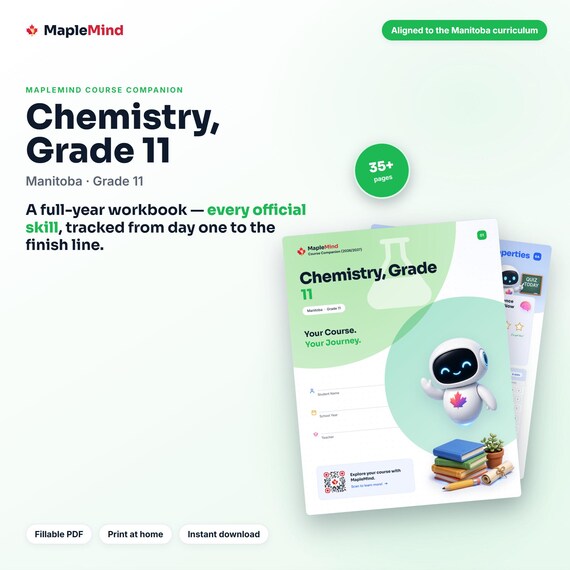
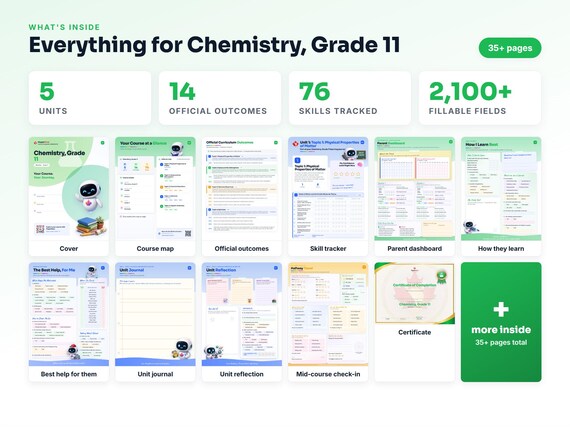
A Chemistry, Grade 11 workbook worth keeping
Built from the same official curriculum as this page. Before and after each skill above, your student colours in how sure they feel — so the two of you can see, on one page, what's clicking and what needs another look. It's a quiet way to follow how the year is really going.
By June it's full of their own handwriting: units worked through, confidence grown, a mid-year check-in, notes from parent-teacher night, and a certificate at the end. Less a worksheet, more a record of the year worth keeping on the shelf.
Instant download · see every page, reviews and the full description · five or more workbooks are $2.99 each
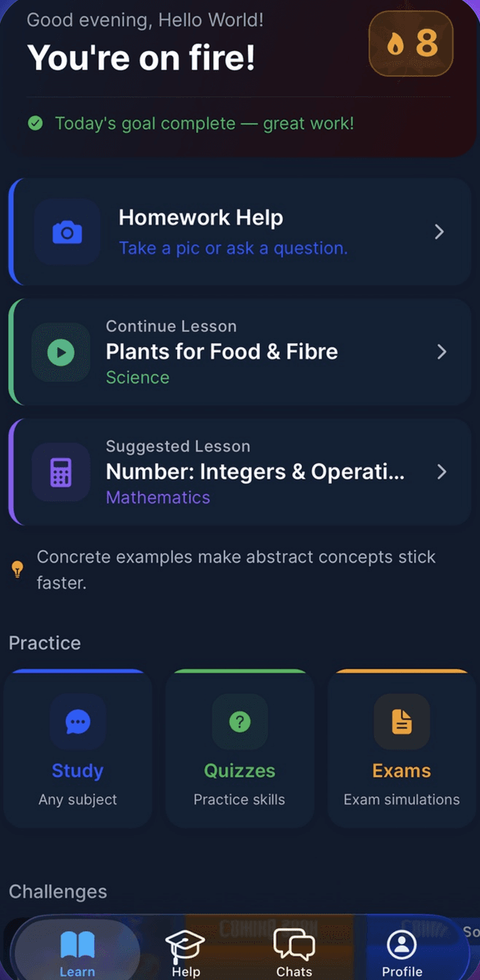
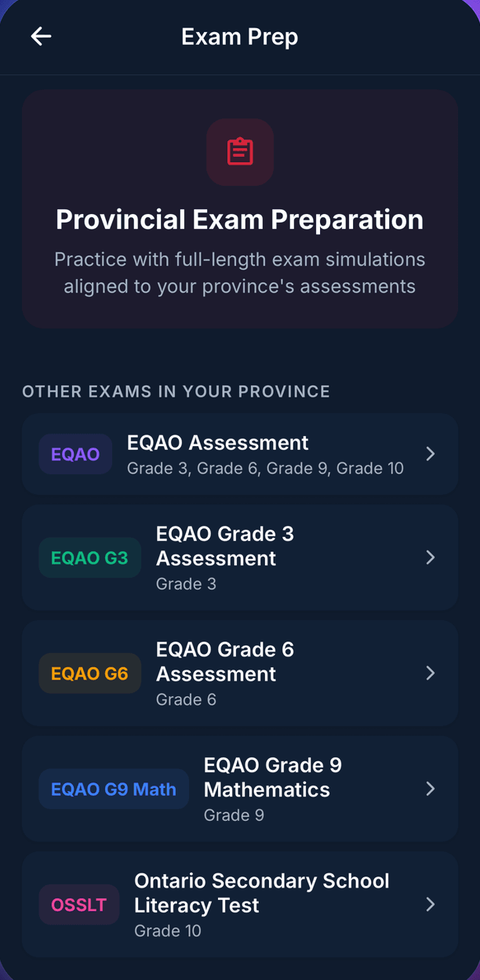
What it looks like in the app

Common questions
Can MapleMind help me with Chemistry, Grade 11?
Yes. MapleMind's AI tutor covers all 76 skills in Manitoba's Chemistry, Grade 11 — you pick the exact skill, and the tutor teaches it step by step: a short lesson, a worked example, solving together, then a skill check to show it stuck.
Is MapleMind aligned to Manitoba's official curriculum?
Yes. Every skill in this course maps to an official outcome code from Manitoba's Grade 11 Science curriculum, and the ministry's own wording is quoted under each unit on this page — with the official government source linked so you can check it yourself.
What does MapleMind cost?
It's free to start — 5 tutoring chats and a practice quiz every day, no credit card. A Pro subscription ($9.99/month or $49.99/year CAD, 7-day free trial) unlocks unlimited tutoring, practice, and exam simulations.
What if I'm stuck on just one topic?
That's the point of skill-level tutoring: open Chemistry, Grade 11 in the app, tap the exact skill from the list on this page, and the tutor teaches just that — no wading through lessons you don't need.
Does MapleMind work in French or other languages?
Yes — 14 languages, including French. Both the app and the tutor's explanations switch to the language you choose.
Where can I see the official Manitoba curriculum for Chemistry, Grade 11?
The official source is linked on this page — Manitoba's official curriculum. The outline here follows it: every MapleMind skill carries its official outcome code, and the ministry's own wording is quoted under each unit.
Keep exploring
Ready when you are
Pick a skill from this page and see it taught properly — free, in the browser, in under a minute.