Get help with Physics, Grade 11
Most tutoring makes you sit through material you already know. MapleMind flips that: pick the exact skill that's causing trouble — any of the 90 below — and the tutor teaches just that one, step by step, as many times as it takes. Ask questions in plain words, any time of day, in English, French, or 12 other languages.
The official Manitoba Physics, Grade 11 curriculum
Manitoba defines Physics, Grade 11 by strands and outcomes. MapleMind teaches the same curriculum reorganized for one-skill-at-a-time tutoring — the table shows exactly where every official strand lands, and the ministry's own wording is quoted under each unit below.
Official source Manitoba's official curriculumRead it on the government site — edu.gov.mb.ca ↗| Official strand | Outcomes | Where MapleMind teaches it |
|---|---|---|
| Strand 1 | 28 | Unit 1: Waves |
| Strand 2 | 17 | Unit 2: The Nature of Light |
| Strand 3 | 13 | Unit 3: Mechanics |
| Strand 4 | 32 | Unit 4: Fields |
Every skill below, taught one on one.
 Try the first session free
How MapleMind teaches Physics, Grade 11 — every unit, lesson, and skill
Every skill below runs as a short session: a plain-words lesson, a worked example, solving it together, then a five-question skill check that earns up to three stars. Guided Mode keeps it teaching instead of answer-handing — turning it off needs a parent's password.
Unit 1Unit 1: WavesOfficial strand · Strand 1
Waves as energy transfer: one-dimensional transverse and longitudinal waves, the wave equation, superposition; two-dimensional wavefronts, reflection, refraction (Snell's Law), diffraction, and interference; and sound — its production, resonance, speed, the Doppler effect, and musical tones.
Waves in One Dimension
- A wave as a transfer of energyS3P-1-01 — Describe a wave as a transfer of energy, including medium, mechanical wave, pulse, and periodic wave.
- Transverse and longitudinal wavesS3P-1-02 — Describe, demonstrate, and diagram the characteristics of transverse and longitudinal waves, including crest, trough, amplitude, wavelength, compression, and rarefaction.
- Frequency and periodS3P-1-03 — Compare and contrast the frequency and period of a periodic wave.
- The wave equationS3P-1-04 — Derive and solve problems using the wave equation v = fλ.
- Transmission and reflection of 1D wavesS3P-1-05 — Describe, demonstrate, and diagram the transmission and reflection of waves travelling in one dimension, at free and fixed ends and between different media.
- Superposition and standing wavesS3P-1-06 — Use the principle of superposition to illustrate graphically the result of combining two waves, including interference, nodes, antinodes, and standing waves.
- Communications technology using wavesS3P-1-07 — Investigate the historical development of a significant application of communications technology that uses waves.
Waves in Two Dimensions
- Two-dimensional wavesS3P-1-08 — Describe and give examples of two-dimensional waves.
- Wavefronts and wave raysS3P-1-09 — Compare and contrast a wavefront and a wave ray.
- Reflection of plane and circular wavesS3P-1-10 — Describe, demonstrate, and diagram the reflection of plane and circular waves, including linear and parabolic reflectors.
- Refraction of plane wavesS3P-1-11 — Describe, demonstrate, and diagram the refraction of plane waves.
- Deriving Snell's LawS3P-1-12 — Derive Snell's Law using the relationships between wavelength, velocity, and the angles of incidence and refraction.
- Demonstrating Snell's LawS3P-1-13 — Experiment to demonstrate Snell's Law.
- Diffraction of water wavesS3P-1-14 — Describe, demonstrate, and diagram diffraction of water waves.
- Two-source interference patternS3P-1-15 — Describe, demonstrate, and diagram how constructive and destructive interference produce an interference pattern from two point sources.
- Path difference in interferenceS3P-1-16 — Derive the path difference relationship for the interference pattern from two point sources.
Sound
- How sound is produced and detectedS3P-1-17 — Investigate to analyze and explain how sounds are produced, transmitted, and detected, using examples from nature and technology.
- Analyzing a noise issueS3P-1-18 — Use the decision-making process to analyze an issue related to noise in the environment.
- Designing a sound-control deviceS3P-1-19 — Design, construct, test, and demonstrate a technological device to produce, transmit, and/or control sound waves for a useful purpose.
- Sound interference and beatsS3P-1-20 — Describe and explain in qualitative terms what happens when sound waves interfere, including the production of beats.
- ResonanceS3P-1-21 — Experiment to analyze the principle of resonance and identify the conditions required for resonance to occur, including open- and closed-column resonant lengths.
- Measuring the speed of soundS3P-1-22 — Experiment to calculate the speed of sound in air.
- Speed of sound in different mediaS3P-1-23 — Compare the speed of sound in different media, and explain how the type of media and temperature affect it.
- The Doppler effectS3P-1-24 — Explain the Doppler effect and predict in qualitative terms the frequency change for a stationary and a moving observer.
- The decibel scaleS3P-1-25 — Define the decibel scale qualitatively, and give examples of sounds at various levels.
- Sound in medical technologyS3P-1-26 — Describe the diverse applications of sound waves in medical devices, and evaluate the contribution of sound-wave-based technologies to health and safety.
- Pitch, intensity, and quality of tonesS3P-1-27 — Explain in qualitative terms how frequency, amplitude, and wave shape affect the pitch, intensity, and quality of tones from musical instruments.
- The octave and the diatonic scaleS3P-1-28 — Examine the octave in a diatonic scale in terms of frequency relationships and major triads.
The official wording — 28 outcomes in this unit
- S3P-1-01
Describe a wave as a transfer of energy. Include: medium, mechanical wave, pulse, periodic wave
- S3P-1-02
Describe, demonstrate, and diagram the characteristics of transverse and longitudinal waves. Include: crest, trough, amplitude, wavelength, compression, rarefaction
- S3P-1-03
Compare and contrast the frequency and period of a periodic wave. Include: T =
- S3P-1-04
Derive and solve problems, using the wave equation (v = fλ).
- S3P-1-05
Describe, demonstrate, and diagram the transmission and reflection of waves travelling in one dimension. Include: free and fixed ends, different media
- S3P-1-06
Use the principle of superposition to illustrate graphically the result of combining two waves. Include: constructive and destructive interference, nodes, antinodes, standing waves
- S3P-1-07
Investigate the historical development of a significant application of communications technology that uses waves. Examples: telephone, radio, television, cell phone, communications satellite, motion detectors, remote controls…
- S3P-1-08
Describe and give examples of two-dimensional waves.
- S3P-1-09
Compare and contrast a wavefront and a wave ray.
- S3P-1-10
Describe, demonstrate, and diagram the reflection of plane (straight) and circular waves. Include: linear and parabolic reflectors
- S3P-1-11
Describe, demonstrate, and diagram the refraction of plane (straight) waves.
- S3P-1-12
Derive Snell’s Law using the relationships between wavelength, velocity, and the angles of incidence and refraction.
- S3P-1-13
Experiment to demonstrate Snell’s Law.
- S3P-1-14
Describe, demonstrate, and diagram diffraction of water waves.
- S3P-1-15
Describe, demonstrate, and diagram how constructive and destructive interference produce an interference pattern from two point sources.
- S3P-1-16
Derive the path difference relationship for the interference pattern from two point sources
- S3P-1-17
Investigate to analyze and explain how sounds are produced, transmitted, and detected, using examples from nature and technology. Examples: production of sound by a vibrating object, drums, guitar strings, cricket, hummingbird, dolphin, piezocrystal, speakers…
- S3P-1-18
Use the decision-making process to analyze an issue related to noise in the environment. Examples: sonic boom, traffic noise, concert halls, loudspeakers, leaf blowers…
- S3P-1-19
Design, construct (or assemble), test, and demonstrate a technological device to produce, transmit, and/or control sound waves for a useful purpose. Examples: sound barrier or protective headphones to reduce the effects of noise, electromagnetic speakers, echo chamber, microphone, musical instruments, guitar pickup, electronic tuner, sonar detector, anechoic chamber, communication devices…
- S3P-1-20
Describe and explain in qualitative terms what happens when sound waves interact (interfere) with one another. Include: production of beats
- S3P-1-21
Experiment to analyze the principle of resonance and identify the conditions required for resonance to occur. Include: open- and closed-column resonant lengths
- S3P-1-22
Experiment to calculate the speed of sound in air.
- S3P-1-23
Compare the speed of sound in different media, and explain how the type of media and temperature affect the speed of sound.
- S3P-1-24
Explain the Doppler effect, and predict in qualitative terms the frequency change that will occur for a stationary and a moving observer.
- S3P-1-25
Define the decibel scale qualitatively, and give examples of sounds at various levels.
- S3P-1-26
Describe the diverse applications of sound waves in medical devices, and evaluate the contribution to our health and safety of sound-wave- based technologies. Examples: hearing aid, ultrasound, stethoscope, cochlear implants…
- S3P-1-27
Explain in qualitative terms how frequency, amplitude, and wave shape affect the pitch, intensity, and quality of tones produced by musical instruments. Include: wind, percussion, stringed instruments
- S3P-1-28
Examine the octave in a diatonic scale in terms of frequency relationships and major triads.
Unit 2Unit 2: The Nature of LightOfficial strand · Strand 2
How models, laws, and theories are built and evaluated, then the competing particle and wave models of light: Newton's particle model and its evidence, the speed of light, discrepant phenomena, the wave model, Young's double-slit experiment, light as an electromagnetic wave, the photoelectric effect, and complementarity.
Models, Laws, and Theories
- Observations, inferences, models, and lawsS3P-2-01 — Use a mystery container activity to outline the relationships among observations, inferences, models, and laws.
- Finding a pattern as a lawS3P-2-02 — Plan and perform an experiment to identify a linear pattern between two variables and state the pattern as a mathematical relationship.
- Knowledge claims and evidenceS3P-2-03 — Describe the relationships among knowledge claims, evidence, and evidential arguments.
- The tentative nature of theoriesS3P-2-04 — Outline the tentative nature of scientific theories, including speculative and robust theories.
- Characteristics of a good theoryS3P-2-05 — Describe the characteristics of a good theory, including accuracy, simplicity, and explanatory power.
The Particle and Wave Models of Light
- Historical models of lightS3P-2-06 — Outline several historical models used to explain the nature of light, including tactile, emission, particle, and wave models.
- Evidence for Newton's particle modelS3P-2-07 — Summarize the early evidence for Newton's particle model of light, including propagation, reflection, refraction, and dispersion.
- Particle model prediction of light's velocityS3P-2-08 — Experiment to show the particle model of light predicts that the velocity of light in a refractive medium is greater than in the incident medium.
- History of measuring the speed of lightS3P-2-09 — Outline the historical contributions of scientists such as Galileo, Rœmer, and Michelson to measuring the speed of light.
- Phenomena discrepant to the particle modelS3P-2-10 — Describe phenomena that are discrepant to the particle model of light, including diffraction and partial reflection and refraction.
- Evidence for the wave modelS3P-2-11 — Summarize the evidence for the wave model of light, including propagation, reflection, refraction, diffraction, and dispersion.
- Comparing the models' velocity predictionsS3P-2-12 — Compare the velocity of light in a refractive medium predicted by the wave model with that predicted by the particle model.
- Geometry of a two-source interference patternS3P-2-13 — Outline the geometry of a two-point-source interference pattern using the wave model.
- Young's double-slit experimentS3P-2-14 — Perform Young's experiment for double-slit diffraction of light to calculate the wavelength of light.
- Light as an electromagnetic waveS3P-2-15 — Describe light as an electromagnetic wave.
- The photoelectric effectS3P-2-16 — Discuss Einstein's explanation of the photoelectric effect qualitatively.
- Complementarity and the modern viewS3P-2-17 — Evaluate the particle and wave models of light and outline the currently accepted view, including the principle of complementarity.
The official wording — 17 outcomes in this unit
- S3P-2-01
Use a mystery container activity to outline the relationships among observations, inferences, models, and laws.
- S3P-2-02
Plan and perform an experiment to identify a linear pattern between two variables and state the pattern as a mathematical relationship (law). Include: visual, numeric, graphical, and symbolic modes of representation
- S3P-2-03
Describe the relationships among knowledge claims, evidence, and evidential arguments. Include: atomic model of matter, a relevant advertising claim
- S3P-2-04
Outline the tentative nature of scientific theories. Include: speculative and robust theories
- S3P-2-05
Describe the characteristics of a good theory. Include: accuracy, simplicity, and explanatory power
- S3P-2-06
Outline several historical models used to explain the nature of light. Include: tactile, emission, particle, wave models
- S3P-2-07
Summarize the early evidence for Newton’s particle model of light. Include: propagation, reflection, refraction, dispersion
- S3P-2-08
Experiment to show the particle model of light predicts that the velocity of light in a refractive medium is greater than the velocity of light in an incident medium (v r > v i ).
- S3P-2-09
Outline the historical contribution of Galileo, Rœmer, Huygens, Fizeau, Foucault, and Michelson to the development of the measurement of the speed of light.
- S3P-2-10
Describe phenomena that are discrepant to the particle model of light. Include: diffraction, partial reflection and refraction of light
- S3P-2-11
Summarize the evidence for the wave model of light. Include: propagation, reflection, refraction, partial reflection/refraction, diffraction, dispersion
- S3P-2-12
Compare the velocity of light in a refractive medium predicted by the wave model with that predicted in the particle model.
- S3P-2-13
Outline the geometry of a two-point-source interference pattern, using the wave model.
- S3P-2-14
Perform Young’s experiment for double-slit diffraction of light to calculate the wavelength of light. Include:
- S3P-2-15
Describe light as an electromagnetic wave.
- S3P-2-16
Discuss Einstein’s explanation of the photoelectric effect qualitatively.
- S3P-2-17
Evaluate the particle and wave models of light and outline the currently accepted view. Include: the principle of complementarity
Unit 3Unit 3: MechanicsOfficial strand · Strand 3
Kinematics — scalars and vectors, position, displacement and distance, motion graphs, average and instantaneous velocity, and the equations of uniformly accelerated motion; and dynamics — the fundamental forces, Newton's Second Law, the newton, net force, free-body diagrams, and solving force problems.
Kinematics
- Scalars and vectorsS3P-3-01 — Differentiate between, and give examples of, scalar and vector quantities.
- Position, displacement, and distanceS3P-3-02 — Differentiate among position, displacement, and distance.
- An instant and an interval of timeS3P-3-03 — Differentiate between the terms 'an instant' and 'an interval' of time.
- Motion graphs of accelerated motionS3P-3-04 — Analyze the relationships among position, velocity, acceleration, and time for constant acceleration, including transformations of motion graphs using slopes and areas.
- Average and instantaneous velocityS3P-3-05 — Compare and contrast average and instantaneous velocity for non-uniform motion, using slopes of chords and tangents.
- Displacement from velocity-time graphsS3P-3-06 — Illustrate, using velocity-time graphs of uniformly accelerated motion, how average velocity is represented and how displacement is calculated.
- Solving with the kinematics equationsS3P-3-07 — Solve problems using combined forms of the kinematics equations.
Dynamics
- The four fundamental forcesS3P-3-08 — Identify the four fundamental forces of nature.
- Investigating Newton's Second LawS3P-3-09 — Perform an experiment to demonstrate Newton's Second Law.
- The newtonS3P-3-10 — Define the unit of force as the newton.
- Net forceS3P-3-11 — Define net force as the vector sum of all forces acting on a body, including friction, normal, gravitational, and applied forces.
- Free-body diagramsS3P-3-12 — Construct free-body diagrams to determine the net force for objects in various situations, including balanced and unbalanced forces and inclined planes.
- Solving problems with Newton's Second LawS3P-3-13 — Solve problems using Newton's Second Law and the kinematics equations, including forces along a straight line and perpendicular forces.
The official wording — 13 outcomes in this unit
- S3P-3-01
Differentiate between, and give examples of, scalar and vector quantities. Examples: distance, speed, mass, time, temperature, volume, weight, position, displacement, velocity, acceleration, force…
- S3P-3-02
Differentiate among position, displacement, and distance.
- S3P-3-03
Differentiate between the terms “an instant” and “an interval” of time.
- S3P-3-04
Analyze the relationships among position, velocity, acceleration, and time for an object that is accelerating at a constant rate. Include: transformations of position-time, velocity-time, and acceleration-time graphs using slopes and areas
- S3P-3-05
Compare and contrast average and instantaneous velocity for non- uniform motion. Include: slopes of chords and tangents
- S3P-3-06
Illustrate, using velocity-time graphs of uniformly accelerated motion, that average velocity can be represented as and that displacement can be calculated as
- S3P-3-07
Solve problems, using combined forms of
- S3P-3-08
Identify the four fundamental forces of nature.
- S3P-3-09
Perform an experiment to demonstrate Newton’s Second Law
- S3P-3-10
Define the unit of force as the newton.
- S3P-3-11
Define as the vector sum of all forces acting on a body. Include: force of friction, normal force, gravitational force, applied forces
- S3P-3-12
Construct free-body diagrams to determine the net force for objects in various situations. Include: balanced and unbalanced forces, inclined planes
- S3P-3-13
Solve problems, using Newton’s Second Law and the kinematics equations from S3P-3-07. Include: forces applied along a straight line and perpendicular forces
Unit 4Unit 4: FieldsOfficial strand · Strand 4
The field concept applied to gravity (gravitational field, free fall, g, terminal velocity, friction), electricity (electric field, field diagrams, force per charge, Millikan's experiment, elementary charge), magnetism (magnetic field, poles, domain theory, Earth's field), and electromagnetism (the field around currents and solenoids, electromagnets, and the force on a current-carrying conductor).
Gravitational Fields
- Gravitational field (qualitative)S3P-4-01 — Define the gravitational field qualitatively as the region around a mass where another point mass experiences a force.
- Diagramming Earth's gravitational fieldS3P-4-02 — Diagram the Earth's gravitational field using lines of force.
- Gravitational field (quantitative)S3P-4-03 — Define the gravitational field quantitatively as a force per unit mass.
- Mass and weightS3P-4-04 — Compare and contrast the terms 'mass' and 'weight'.
- Apparent weight in accelerating systemsS3P-4-05 — Describe, qualitatively and quantitatively, apparent weight changes in vertically accelerating systems.
- Acceleration due to gravityS3P-4-06 — Derive the acceleration due to gravity from free fall and Newton's laws.
- Measuring g near Earth's surfaceS3P-4-07 — Perform an experiment to calculate g near the surface of the Earth.
- Solving free-fall problemsS3P-4-08 — Solve free-fall problems.
- Terminal velocityS3P-4-09 — Describe terminal velocity, qualitatively and quantitatively.
- The coefficient of frictionS3P-4-10 — Define the coefficient of friction as the ratio of the force of friction to the normal force.
- Static and kinetic frictionS3P-4-11 — Distinguish between static and kinetic friction.
- Factors affecting frictionS3P-4-12 — Compare the effects of the normal force, materials involved, surface area, and speed on the force of friction.
- Solving friction problemsS3P-4-13 — Solve problems with the coefficient of friction for objects on a horizontal surface.
Electric Fields
- Electric field (qualitative)S3P-4-14 — Define the electric field qualitatively as the region around a charge where a positive test charge experiences a force.
- Diagramming electric fieldsS3P-4-15 — Diagram electric fields using lines of force with respect to a positive test charge for various charge arrangements.
- Electric field (quantitative)S3P-4-16 — Define the electric field quantitatively as force per unit charge and solve problems using the unit field concept.
- Motion of charges between platesS3P-4-17 — Solve problems for the motion of charges between parallel plates where the net force combines electric and gravitational forces.
- Millikan's experimentS3P-4-18 — Describe a simplified version of Millikan's experiment for determining the elementary charge.
- The elementary chargeS3P-4-19 — Define the elementary charge and convert between elementary charges and coulombs.
Magnetic Fields
- Defining the magnetic fieldS3P-4-20 — Define the magnetic field as the region around a magnet where another magnet experiences a force.
- Diagramming magnetic fieldsS3P-4-21 — Demonstrate and diagram magnetic fields using lines of force for various magnet arrangements.
- Magnetic polesS3P-4-22 — Describe the concept of magnetic poles and demonstrate that like poles repel and unlike poles attract.
- Domain theory of magnetismS3P-4-23 — Describe magnetism using the domain theory, including ferromagnetic materials.
- Earth's magnetic fieldS3P-4-24 — Investigate the influence and effects of the magnetic field of the Earth, including auroras and magnetic declination and inclination.
Electromagnetism
- The phenomenon of electromagnetismS3P-4-25 — Describe and demonstrate the phenomenon of electromagnetism.
- Magnetic field around a current-carrying wireS3P-4-26 — Diagram and describe qualitatively the magnetic field around a current-carrying wire.
- Magnetic field of a solenoidS3P-4-27 — Diagram and describe qualitatively the magnetic field of a solenoid.
- The electromagnetS3P-4-28 — Describe and demonstrate the function of an electromagnet, including common applications.
- Investigating electromagnet strengthS3P-4-29 — Perform a lab to demonstrate that the magnetic field is proportional to the current for an electromagnetic field.
- Force on a current-carrying conductorS3P-4-30 — Describe the force on a current-carrying conductor in a magnetic field.
- Magnetic field (quantitative)S3P-4-31 — Define the magnetic field quantitatively as a force per unit current element.
- Solving conductor-force problemsS3P-4-32 — Solve problems using the force on a current-carrying conductor.
The official wording — 32 outcomes in this unit
- S3P-4-01
Define the gravitational field qualitatively as the region of space around a mass where another point mass experiences a force.
- S3P-4-02
Diagram the Earth’s gravitational field, using lines of force.
- S3P-4-03
Define the gravitational field quantitatively as a force per unit mass.
- S3P-4-04
Compare and contrast the terms “mass” and “weight.”
- S3P-4-05
Describe, qualitatively and quantitatively, apparent weight changes in vertically accelerating systems. Examples: elevators, spacecraft…
- S3P-4-06
Derive the acceleration due to gravity from free fall and Newton’s laws.
- S3P-4-07
Perform an experiment to calculate g near the surface of the Earth.
- S3P-4-08
Solve free-fall problems.
- S3P-4-09
Describe terminal velocity, qualitatively and quantitatively.
- S3P-4-10
Define the coefficient of friction (µ) as the ratio of the force of friction and the normal force.
- S3P-4-11
Distinguish between static and kinetic friction.
- S3P-4-12
Compare the effects of the normal force, materials involved, surface area, and speed on the force of friction.
- S3P-4-13
Solve problems with the coefficient of friction for objects on a horizontal surface.
- S3P-4-14
Define the electric field qualitatively as the region of space around a charge where a positive test charge experiences a force.
- S3P-4-15
Diagram electric fields using lines of force with respect to a positive test charge. Include: single point charges (positive and negative), near two like charges, near two unlike charges, between a single charge and a charged plate, between two oppositely charged parallel plates
- S3P-4-16
Define the electric field quantitatively as a force per unit charge (E = F/q) and solve problems using the unit field concept (F = qE).
- S3P-4-17
Solve problems for the motion of charges between parallel plates where Fnet = Fe + Fg .
- S3P-4-18
Describe a simplified version of Millikan’s experiment for the determination of the elementary charge (solve for charge when Fe = Fg ).
- S3P-4-19
Define the elementary charge and convert between elementary charges and coulombs. Include: q = Ne
- S3P-4-20
Define the magnetic field as the region of space around a magnet where another magnet will experience a force.
- S3P-4-21
Demonstrate and diagram magnetic fields, using lines of force. Include: bar magnet, horseshoe magnet, between like poles, between unlike poles
- S3P-4-22
Describe the concept of magnetic poles and demonstrate that like poles repel and unlike poles attract.
- S3P-4-23
Describe magnetism, using the domain theory. Include: ferromagnetic materials, the attraction of iron objects to north and south poles
- S3P-4-24
Investigate the influence and effects of the magnetic field of the Earth. Include: auroras, magnetic declination and inclination
- S3P-4-25
Describe and demonstrate the phenomenon of electromagnetism.
- S3P-4-26
Diagram and describe qualitatively the magnetic field around a current- carrying wire. Include: direction and intensity of the field
- S3P-4-27
Diagram and describe qualitatively the magnetic field of a solenoid. Include: direction and intensity of the field
- S3P-4-28
Describe and demonstrate the function of an electromagnet. Include: common applications of electromagnets
- S3P-4-29
Perform a lab to demonstrate that B ∝ I for an electromagnetic field.
- S3P-4-30
Describe the force on a current-carrying conductor in a magnetic field. Include: FB = BIl sinθ
- S3P-4-31
Define the magnetic field quantitatively as a force per unit current element (i.e., B = F B /I l, where Il is a current element).
- S3P-4-32
Solve problems, using F B = BIl.
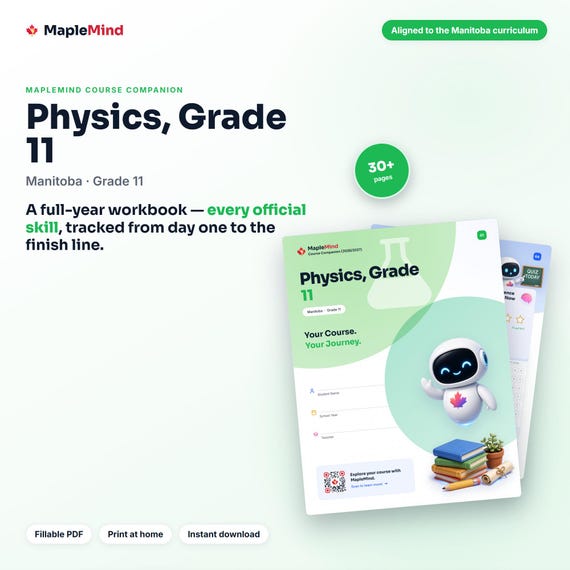
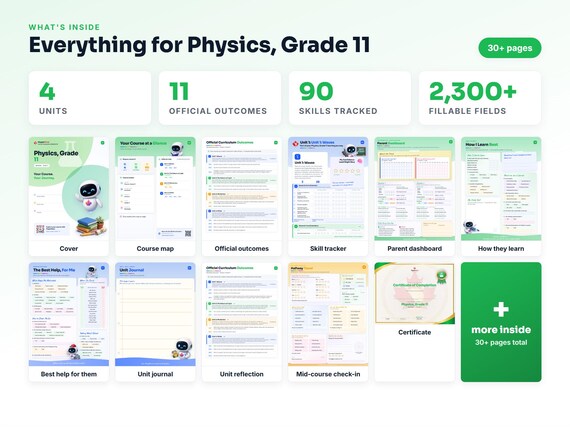


Printable workbook · A keepsake of the year
A Physics, Grade 11 workbook worth keeping
Built from the same official curriculum as this page. Before and after each skill above, your student colours in how sure they feel — so the two of you can see, on one page, what's clicking and what needs another look. It's a quiet way to follow how the year is really going.
By June it's full of their own handwriting: units worked through, confidence grown, a mid-year check-in, notes from parent-teacher night, and a certificate at the end. Less a worksheet, more a record of the year worth keeping on the shelf.
Instant download · see every page, reviews and the full description · five or more workbooks are $2.99 each
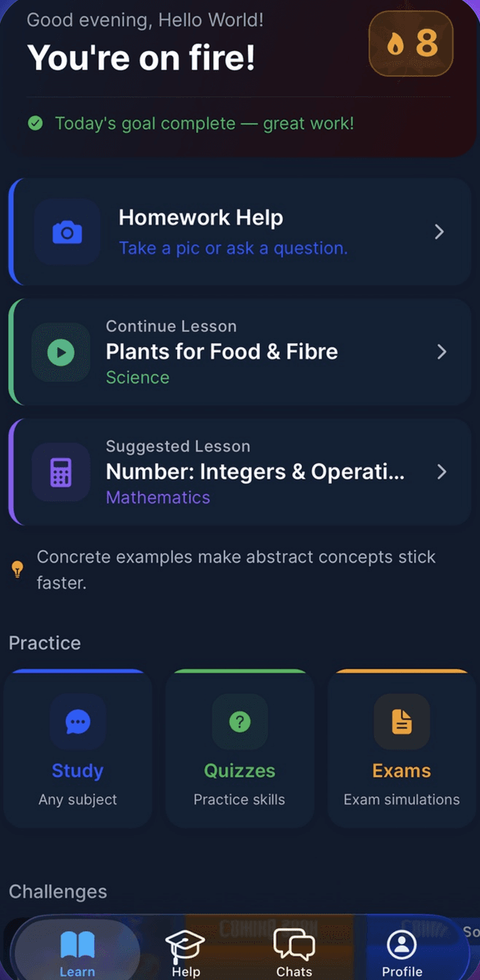
What it looks like in the app

Common questions
Can MapleMind help me with Physics, Grade 11?
Yes. MapleMind's AI tutor covers all 90 skills in Manitoba's Physics, Grade 11 — you pick the exact skill, and the tutor teaches it step by step: a short lesson, a worked example, solving together, then a skill check to show it stuck.
Is MapleMind aligned to Manitoba's official curriculum?
Yes. Every skill in this course maps to an official outcome code from Manitoba's Grade 11 Science curriculum, and the ministry's own wording is quoted under each unit on this page — with the official government source linked so you can check it yourself.
What does MapleMind cost?
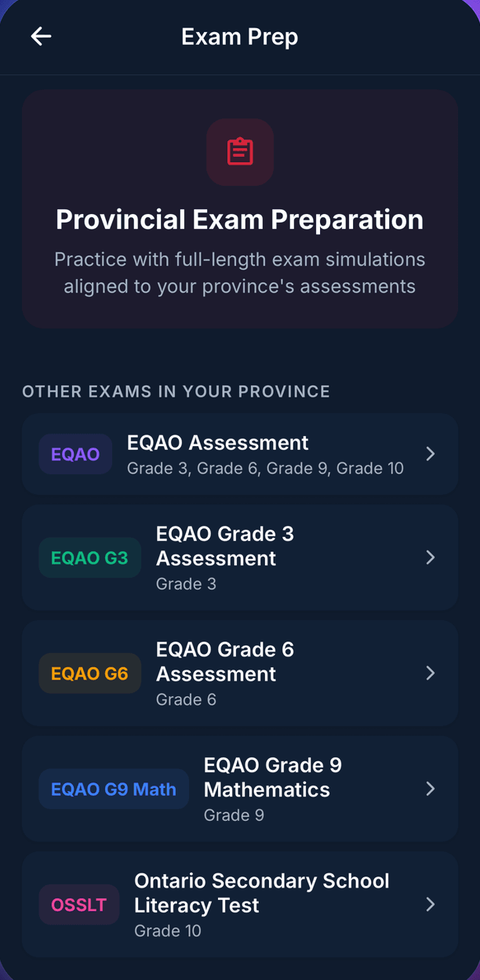
It's free to start — 5 tutoring chats and a practice quiz every day, no credit card. A Pro subscription ($9.99/month or $49.99/year CAD, 7-day free trial) unlocks unlimited tutoring, practice, and exam simulations.
What if I'm stuck on just one topic?
That's the point of skill-level tutoring: open Physics, Grade 11 in the app, tap the exact skill from the list on this page, and the tutor teaches just that — no wading through lessons you don't need.
Does MapleMind work in French or other languages?
Yes — 14 languages, including French. Both the app and the tutor's explanations switch to the language you choose.
Where can I see the official Manitoba curriculum for Physics, Grade 11?
The official source is linked on this page — Manitoba's official curriculum. The outline here follows it: every MapleMind skill carries its official outcome code, and the ministry's own wording is quoted under each unit.
Keep exploring
Ready when you are
Pick a skill from this page and see it taught properly — free, in the browser, in under a minute.