Get help with First Nations, Métis, and Inuit Studies, Grade 12
Most tutoring makes you sit through material you already know. MapleMind flips that: pick the exact skill that's causing trouble — any of the 28 below — and the tutor teaches just that one, step by step, as many times as it takes. Ask questions in plain words, any time of day, in English, French, or 12 other languages.
The official Manitoba First Nations, Métis, and Inuit Studies, Grade 12 curriculum
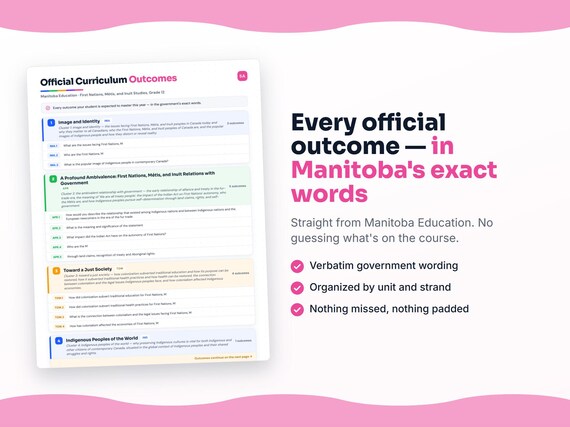
Manitoba defines First Nations, Métis, and Inuit Studies, Grade 12 by strands and outcomes. MapleMind teaches the same curriculum reorganized for one-skill-at-a-time tutoring — the table shows exactly where every official strand lands, and the ministry's own wording is quoted under each unit below.
Official source Manitoba's official curriculumRead it on the government site — edu.gov.mb.ca ↗| Official strand | Outcomes | Where MapleMind teaches it |
|---|---|---|
| Strand 1 | 3 | Image and Identity |
| Strand 2 | 5 | A Profound Ambivalence: First Nations, Métis, and Inuit Relations with Government |
| Strand 3 | 4 | Toward a Just Society |
| Strand 4 | 1 | Indigenous Peoples of the World |
| Strand 5 | 1 | A Festival of Learning |
Every skill below, taught one on one.
 Try the first session free
How MapleMind teaches First Nations, Métis, and Inuit Studies, Grade 12 — every unit, lesson, and skill
Every skill below runs as a short session: a plain-words lesson, a worked example, solving it together, then a five-question skill check that earns up to three stars. Guided Mode keeps it teaching instead of answer-handing — turning it off needs a parent's password.
Unit 1Image and IdentityOfficial strand · Strand 1
Cluster 1: image and identity — the issues facing First Nations, Métis, and Inuit peoples in Canada today and why they matter to all Canadians, who the First Nations, Métis, and Inuit peoples of Canada are, and the popular images of Indigenous people and how they distort or reveal reality.
What issues face First Nations, Métis, and Inuit peoples today, and why should they matter?
- Contemporary issues facing Indigenous peoplesLE-1.1 — Identify the issues facing First Nations, Métis, and Inuit peoples in Canada today.
- Why these issues matter to all CanadiansLE-1.1 — Explain why the issues facing Indigenous peoples matter to all Canadians.
Who are the First Nations, Métis, and Inuit peoples of Canada?
- Three distinct peoplesLE-1.2 — Distinguish First Nations, Métis, and Inuit as three distinct peoples of Canada.
- Diversity within each peopleLE-1.2 — Describe the diversity of nations, languages, and cultures within First Nations, Métis, and Inuit peoples.
What is the popular image of Indigenous people in contemporary Canada?
- Stereotypes and media imagesLE-1.3 — Identify popular images and stereotypes of Indigenous people in Canadian media and culture.
- Image versus reality and its harmLE-1.3 — Analyse the harm of stereotyped images and contrast them with the realities of Indigenous peoples today.
The official wording — 3 outcomes in this unit
- LE-1.1
What are the issues facing First Nations, M
- LE-1.2
Who are the First Nations, M
- LE-1.3
What is the popular image of Indigenous people in contemporary Canada?
Unit 2A Profound Ambivalence: First Nations, Métis, and Inuit Relations with GovernmentOfficial strand · Strand 2
Cluster 2: the ambivalent relationship with government — the early relationship of alliance and treaty in the fur-trade era, the meaning of 'We are all treaty people', the impact of the Indian Act on First Nations' autonomy, who the Métis are, and how Indigenous peoples pursue self-determination through land claims, rights, and self-government.
How would you describe the relationship in the era of the fur trade and pre-Confederation treaties?
- Alliance and the fur-trade relationshipLE-2.1 — Describe the relationship of alliance and interdependence among Indigenous nations and with European newcomers in the fur-trade era.
- Pre-Confederation treatiesLE-2.1 — Describe the pre-Confederation treaties as agreements shaping the relationship between Indigenous nations and newcomers.
What is the meaning and significance of 'We are all treaty people'?
- The treaties and differing understandingsLE-2.2 — Explain the numbered treaties and the differing understandings held by First Nations and the Crown.
- We Are All Treaty PeopleLE-2.2 — Explain the meaning and significance of the statement 'We are all treaty people' for Canadians today.
What impact did the Indian Act have on the autonomy of First Nations?
- How the Indian Act controlled First NationsLE-2.3 — Explain how the Indian Act imposed government control over the lives, land, and governance of First Nations.
- The loss of autonomy and its legacyLE-2.3 — Explain how the Indian Act undermined First Nations' autonomy and its lasting effects.
Who are the Métis?
- Origins of the Métis nationLE-2.4 — Explain the origins of the Métis as a distinct Indigenous nation.
- Métis culture and identityLE-2.4 — Describe the distinct culture, language, and identity of the Métis nation.
How have Indigenous peoples attempted to regain self-determination?
- Land claims and Aboriginal and treaty rightsLE-2.5 — Explain how Indigenous peoples pursue self-determination through land claims and the recognition of treaty and Aboriginal rights.
- Self-government and self-determinationLE-2.5 — Explain how Indigenous peoples pursue self-government as a path to self-determination.
The official wording — 5 outcomes in this unit
- LE-2.1
How would you describe the relationship that existed among Indigenous nations and between Indigenous nations and the European newcomers in the era of the fur trade
- LE-2.2
What is the meaning and significance of the statement
- LE-2.3
What impact did the Indian Act have on the autonomy of First Nations?
- LE-2.4
Who are the M
- LE-2.5
through land claims, recognition of treaty and Aboriginal rights
Unit 3Toward a Just SocietyOfficial strand · Strand 3
Cluster 3: toward a just society — how colonization subverted traditional education and how its purpose can be restored, how it subverted traditional health practices and how health can be restored, the connection between colonialism and the legal issues Indigenous peoples face, and how colonialism affected Indigenous economies.
How did colonization subvert traditional education, and how can its purpose be restored?
- Colonization and residential schoolsLE-3.1 — Explain how colonization, especially residential schools, subverted traditional education for Indigenous peoples.
- Restoring the purpose of educationLE-3.1 — Explain how the original purpose of education can be restored for Indigenous learners today.
How did colonization subvert traditional health practices, and how can health be restored?
- Colonization and healthLE-3.2 — Explain how colonization subverted traditional health practices and harmed Indigenous well-being.
- Restoring health and wellnessLE-3.2 — Explain how Indigenous health and community wellness can be restored today.
What is the connection between colonialism and the legal issues facing Indigenous peoples?
- Colonialism and the justice systemLE-3.3 — Explain how colonialism connects to the overrepresentation of Indigenous peoples in the justice system.
- Responses and Indigenous justiceLE-3.3 — Explain how the legal system is responding through restorative and Indigenous-led justice approaches.
How has colonialism affected the economies of Indigenous peoples?
- Colonial disruption of economiesLE-3.4 — Explain how colonialism disrupted the traditional and self-sufficient economies of Indigenous peoples.
- Rebuilding Indigenous economiesLE-3.4 — Explain how Indigenous peoples are rebuilding their economies today.
The official wording — 4 outcomes in this unit
- LE-3.1
How did colonization subvert traditional education for First Nations, M
- LE-3.2
How did colonization subvert traditional health practices for First Nations, M
- LE-3.3
What is the connection between colonialism and the legal issues facing First Nations, M
- LE-3.4
How has colonialism affected the economies of First Nations, M
Unit 4Indigenous Peoples of the WorldOfficial strand · Strand 4
Cluster 4: Indigenous peoples of the world — why preserving Indigenous cultures is vital for both Indigenous and other citizens of contemporary Canada, situated in the global context of Indigenous peoples and their shared struggles and rights.
Why is preserving Indigenous cultures vital for all citizens?
- Why preservation matters for Indigenous peoplesLE-4.1 — Explain why preserving Indigenous cultures is vital for Indigenous peoples' identity and continuity.
- Why it matters for all citizens and the worldLE-4.1 — Explain why preserving Indigenous cultures is vital for all citizens, in Canada and globally.
The official wording — 1 outcome in this unit
- LE-4.1
Why is the preservation of Indigenous cultures vital for both Indigenous
Unit 5A Festival of LearningOfficial strand · Strand 5
Cluster 5: a festival of learning — how First Nations, Métis, and Inuit cultures combine tradition and adaptation to meet today's challenges and ensure a better tomorrow, celebrating living, contemporary Indigenous cultures.
How do Indigenous cultures combine tradition and adaptation for today and tomorrow?
- Living traditionLE-5.1 — Explain how tradition remains a living, continuing force in Indigenous cultures today.
- Adaptation for a better tomorrowLE-5.1 — Explain how Indigenous cultures adapt creatively to meet today's challenges and build a better tomorrow.
The official wording — 1 outcome in this unit
- LE-5.1
How do First Nations, M
Printable workbook · A keepsake of the year
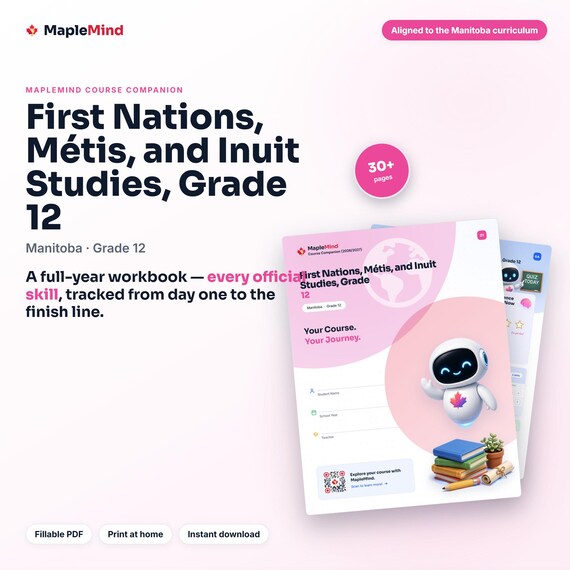
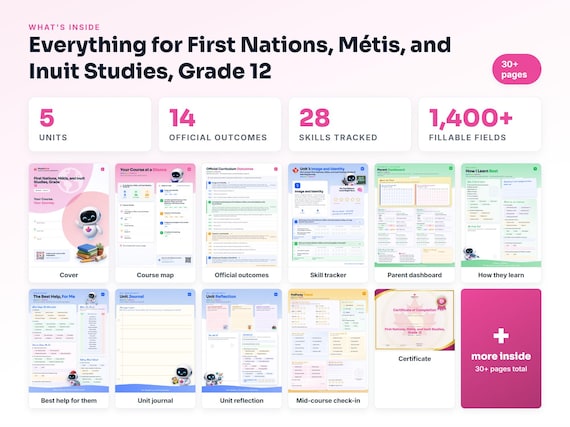
A First Nations, Métis, and Inuit Studies, Grade 12 workbook worth keeping
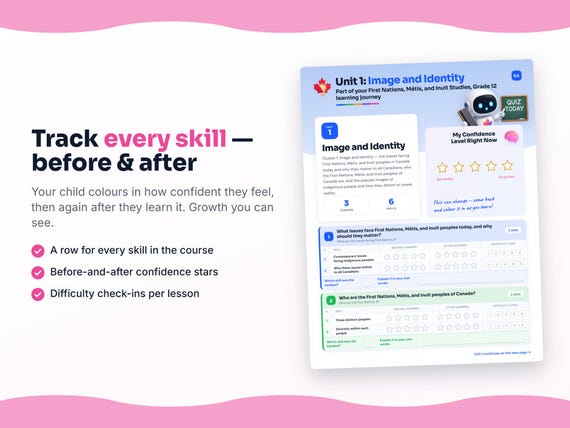
Built from the same official curriculum as this page. Before and after each skill above, your student colours in how sure they feel — so the two of you can see, on one page, what's clicking and what needs another look. It's a quiet way to follow how the year is really going.
By June it's full of their own handwriting: units worked through, confidence grown, a mid-year check-in, notes from parent-teacher night, and a certificate at the end. Less a worksheet, more a record of the year worth keeping on the shelf.
Instant download · see every page, reviews and the full description · five or more workbooks are $2.99 each
What it looks like in the app



Common questions
Can MapleMind help me with First Nations, Métis, and Inuit Studies, Grade 12?
Yes. MapleMind's AI tutor covers all 28 skills in Manitoba's First Nations, Métis, and Inuit Studies, Grade 12 — you pick the exact skill, and the tutor teaches it step by step: a short lesson, a worked example, solving together, then a skill check to show it stuck.
Is MapleMind aligned to Manitoba's official curriculum?
Yes. Every skill in this course maps to an official outcome code from Manitoba's Grade 12 Social Studies curriculum, and the ministry's own wording is quoted under each unit on this page — with the official government source linked so you can check it yourself.
What does MapleMind cost?
It's free to start — 5 tutoring chats and a practice quiz every day, no credit card. A Pro subscription ($9.99/month or $49.99/year CAD, 7-day free trial) unlocks unlimited tutoring, practice, and exam simulations.
What if I'm stuck on just one topic?
That's the point of skill-level tutoring: open First Nations, Métis, and Inuit Studies, Grade 12 in the app, tap the exact skill from the list on this page, and the tutor teaches just that — no wading through lessons you don't need.
Does MapleMind work in French or other languages?
Yes — 14 languages, including French. Both the app and the tutor's explanations switch to the language you choose.
Where can I see the official Manitoba curriculum for First Nations, Métis, and Inuit Studies, Grade 12?
The official source is linked on this page — Manitoba's official curriculum. The outline here follows it: every MapleMind skill carries its official outcome code, and the ministry's own wording is quoted under each unit.
Keep exploring
Ready when you are
Pick a skill from this page and see it taught properly — free, in the browser, in under a minute.