Get help with History of Canada, Grade 11
Most tutoring makes you sit through material you already know. MapleMind flips that: pick the exact skill that's causing trouble — any of the 38 below — and the tutor teaches just that one, step by step, as many times as it takes. Ask questions in plain words, any time of day, in English, French, or 12 other languages.
The official Manitoba History of Canada, Grade 11 curriculum
Manitoba defines History of Canada, Grade 11 by strands and outcomes. MapleMind teaches the same curriculum reorganized for one-skill-at-a-time tutoring — the table shows exactly where every official strand lands, and the ministry's own wording is quoted under each unit below.
Official source Manitoba's official curriculumRead it on the government site — edu.gov.mb.ca ↗| Official strand | Outcomes | Where MapleMind teaches it |
|---|---|---|
| Strand 1 | 4 | First Peoples and Nouvelle-France (to 1763) |
| Strand 2 | 3 | British North America (1763-1867) |
| Strand 3 | 4 | Becoming a Sovereign Nation (1867-1931) |
| Strand 4 | 4 | Achievements and Challenges (1931-1982) |
| Strand 5 | 4 | Defining Contemporary Canada (1982-present) |
Every skill below, taught one on one.
 Try the first session free
How MapleMind teaches History of Canada, Grade 11 — every unit, lesson, and skill
Every skill below runs as a short session: a plain-words lesson, a worked example, solving it together, then a five-question skill check that earns up to three stars. Guided Mode keeps it teaching instead of answer-handing — turning it off needs a parent's password.
Unit 1First Peoples and Nouvelle-France (to 1763)Official strand · Strand 1
Cluster 1: the First Peoples and the founding of Nouvelle-France to 1763 — what history is and why we study it, the First Peoples and how they structured their world, French and other European arrival and interaction with First Peoples, and the meeting of peoples in the Northwest.
What is history, and why do we study it?
- What history is and thinking historicallyEQ-11.1.0 — Explore what history is and what it means to think historically about the past.
- Why we study historyEQ-11.1.0 — Consider why we study history and what studying the history of Canada offers citizens.
Who were the First Peoples, and how did they structure their world?
- Diverse First Peoples societiesEQ-11.1.1 — Describe the diversity of First Peoples and the societies they built across the land before contact.
- How First Peoples structured their worldEQ-11.1.1 — Explain how First Peoples organized their societies through governance, worldviews, economies, and relationships with the land.
Why did the French and other Europeans come, and how did they interact with First Peoples?
- Why the French and Europeans cameEQ-11.1.2 — Explain why the French and other Europeans came to North America.
- Interaction, alliance, and Nouvelle-FranceEQ-11.1.2 — Describe how the French interacted with First Peoples through trade, alliance, and mission as Nouvelle-France was built.
How did First Peoples and Europeans interact in the Northwest, and what were the results?
- Interaction in the NorthwestEQ-11.1.3 — Describe how First Peoples and Europeans interacted in the Northwest through the fur trade and exchange.
- Results, including the emergence of the MétisEQ-11.1.3 — Explain the results of Northwest interaction, including the emergence of Métis communities and lasting social change.
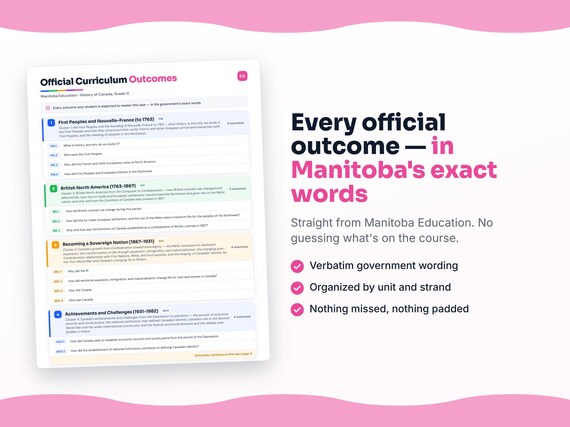
The official wording — 4 outcomes in this unit
- EQ-11.1.0
What is history, and why do we study it?
- EQ-11.1.1
Who were the First Peoples
- EQ-11.1.2
Why did the French and other Europeans come to North America
- EQ-11.1.3
How did First Peoples and Europeans interact in the Northwest
Unit 2British North America (1763-1867)Official strand · Strand 2
Cluster 2: British North America from the Conquest to Confederation — how British colonial rule changed and affected life, how the fur trade and European settlement transformed the Northwest and gave rise to the Métis nation, and why and how the Dominion of Canada was created in 1867.
How did British colonial rule change, and what was its impact on life in North America?
- Changing British colonial ruleEQ-11.2.1 — Describe how British colonial rule changed after 1763, including the Royal Proclamation and the Quebec Act.
- Impact of British rule on lifeEQ-11.2.1 — Explain the impact of British colonial rule on the lives of French Canadians, First Peoples, and new settlers.
How did the fur trade, settlement, and the rise of the Métis nation transform the Northwest?
- Fur trade and settlement transform the NorthwestEQ-11.2.2 — Explain how the fur trade and European settlement transformed life in the Northwest.
- The rise of the Métis nationEQ-11.2.2 — Explain the rise of the Métis nation as a distinct people with its own identity, economy, and sense of rights in the Northwest.
Why and how was the Dominion of Canada established in 1867?
- Why Confederation happenedEQ-11.2.3 — Explain the reasons the British North American colonies formed a confederation in 1867.
- How Confederation was achievedEQ-11.2.3 — Describe how Confederation was achieved through conferences, negotiation, and the British North America Act, and who was left out.
The official wording — 3 outcomes in this unit
- EQ-11.2.1
How did British colonial rule change during this period
- EQ-11.2.2
How did the fur trade, European settlement, and the rise of the Métis nation transform life for the peoples of the Northwest?
- EQ-11.2.3
Why and how was the Dominion of Canada established as a confederation of British colonies in 1867?
Unit 3Becoming a Sovereign Nation (1867-1931)Official strand · Strand 3
Cluster 3: Canada's growth from Confederation toward sovereignty — the Métis resistance to westward expansion, the transformation of life through expansion, immigration, and industrialization, the changing post-Confederation relationship with First Nations, Métis, and Inuit peoples, and the shaping of Canadian identity by the First World War and Canada's changing tie to Britain.
Why did the Métis resist westward expansion, and what were the consequences?
- Why the Métis resistedEQ-11.3.1 — Explain why the Métis resisted the westward expansion of Canada into the Northwest.
- Consequences of the resistanceEQ-11.3.1 — Explain the consequences of the Métis resistance, including Manitoba's creation, the 1885 Northwest Resistance, and Métis dispossession.
How did expansion, immigration, and industrialization change life for men and women?
- Expansion and immigrationEQ-11.3.2 — Explain how territorial expansion and immigration changed Canada and the peoples who lived there.
- Industrialization and the lives of men and womenEQ-11.3.2 — Explain how industrialization changed the daily lives of men and women in Canada.
How did Canada's relationship with First Nations, Métis, and Inuit peoples change after Confederation?
- The numbered treatiesEQ-11.3.3 — Explain how the numbered treaties reshaped the relationship between Canada and First Nations.
- The Indian Act and residential schoolsEQ-11.3.3 — Explain how the Indian Act and residential schools sought to control and assimilate First Nations, Métis, and Inuit peoples, and the harm they caused.
How was Canada's identity shaped by the First World War and its changing tie to Britain?
- Canada and the First World WarEQ-11.3.4 — Explain Canada's experience of the First World War at the front and at home, including conscription and division.
- War, identity, and the tie to BritainEQ-11.3.4 — Explain how the war and Canada's changing relationship with Britain shaped its identity as a nation.
The official wording — 4 outcomes in this unit
- EQ-11.3.1
Why did the M
- EQ-11.3.2
How did territorial expansion, immigration, and industrialization change life for men and women in Canada?
- EQ-11.3.3
How did Canada
- EQ-11.3.4
How was Canada
Unit 4Achievements and Challenges (1931-1982)Official strand · Strand 4
Cluster 4: Canada's achievements and challenges from the Depression to patriation — the pursuit of economic security and social justice, the national institutions that defined Canadian identity, Canada's role in the Second World War and the wider international community, and the federal-provincial tensions and the debate over Québec's status.
How did Canada seek economic security and social justice from the Depression to patriation?
- The Depression and its responseEQ-11.4.1 — Explain the impact of the Great Depression and how governments responded to economic crisis.
How did national institutions define Canadian identity?
- National institutions and identityEQ-11.4.2 — Explain how the establishment of national institutions helped define a shared Canadian identity.
How was Canada's presence on the world stage shaped by WWII and international participation?
- Canada in the Second World WarEQ-11.4.3 — Explain Canada's role and experience in the Second World War, at the front and at home.
- Canada in the postwar international communityEQ-11.4.3 — Explain how Canada's growing participation in international bodies shaped its presence on the world stage.
How was Canadian federalism challenged by federal-provincial tensions and the status of Québec?
- The Quiet Revolution and QuébecEQ-11.4.4 — Explain how the Quiet Revolution transformed Québec and fuelled debate over its status in Canada.
- Federal-provincial tensionsEQ-11.4.4 — Explain how federal-provincial tensions over powers and resources challenged Canadian federalism.
The official wording — 4 outcomes in this unit
- EQ-11.4.1
How did Canada seek to establish economic security and social justice from the period of the Depression
- EQ-11.4.2
How did the establishment of national institutions contribute to defining Canadian identity?
- EQ-11.4.3
How was Canada
- EQ-11.4.4
the debate over the status of Qu
Unit 5Defining Contemporary Canada (1982-present)Official strand · Strand 5
Cluster 5: contemporary Canada since patriation — how the Charter, diversity, and demographic and technological change have shaped Canada, how national unity has influenced federalism and constitutional debate, how First Nations, Métis, and Inuit peoples pursue self-determination, and how Canada's international relations and global commitments have evolved.
How has Canada been shaped by the Charter, cultural diversity, and demographic and technological change?
- The Charter of Rights and FreedomsEQ-11.5.1 — Explain how the Canadian Charter of Rights and Freedoms has shaped rights and life in Canada.
- Cultural diversity and multiculturalismEQ-11.5.1 — Explain how cultural diversity and multiculturalism have shaped contemporary Canada.
- Demographic and technological changeEQ-11.5.1 — Explain how demographic and technological change have transformed contemporary Canada.
How has national unity influenced federalism, constitutional debate, and political change?
- Québec referendums and sovereigntyEQ-11.5.2 — Explain how the Québec sovereignty movement and its referendums challenged national unity.
- Constitutional debate and political changeEQ-11.5.2 — Explain how the unity question drove constitutional debate and political change, including the failed accords.
How are First Nations, Métis, and Inuit peoples seeking self-determination?
- Land claims and self-governmentEQ-11.5.3 — Explain how First Nations, Métis, and Inuit peoples pursue political and economic self-determination through land claims and self-government.
- Cultural revitalization and reconciliationEQ-11.5.3 — Explain how First Nations, Métis, and Inuit peoples pursue cultural self-determination and reconciliation.
How have Canada's international relations changed since 1982, and what should its commitments be?
- Canada's changing international relationsEQ-11.5.4 — Explain how Canada's international relations have changed since 1982 through trade, globalization, and shifting roles.
- Canada's future global commitmentsEQ-11.5.4 — Reason about what Canada's global commitments should be, weighing values, interests, and responsibilities.
The official wording — 4 outcomes in this unit
- EQ-11.5.1
How has Canada been shaped by the Canadian Charter of Rights and Freedoms
- EQ-11.5.2
How has the question of national unity
- EQ-11.5.3
How are the First Nations, M
- EQ-11.5.4
How have Canada
Printable workbook · A keepsake of the year
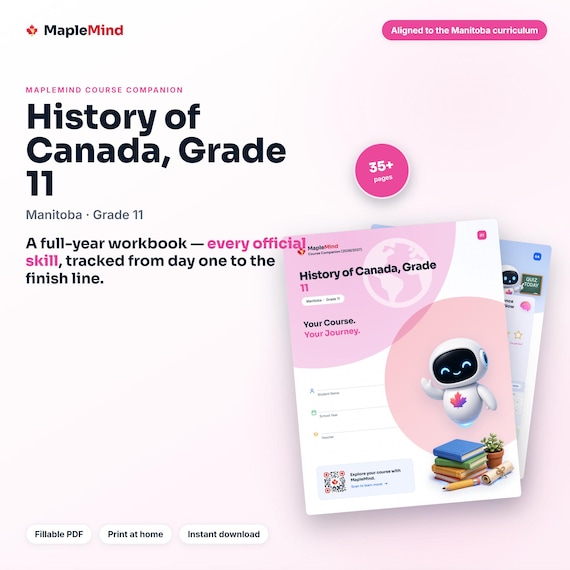
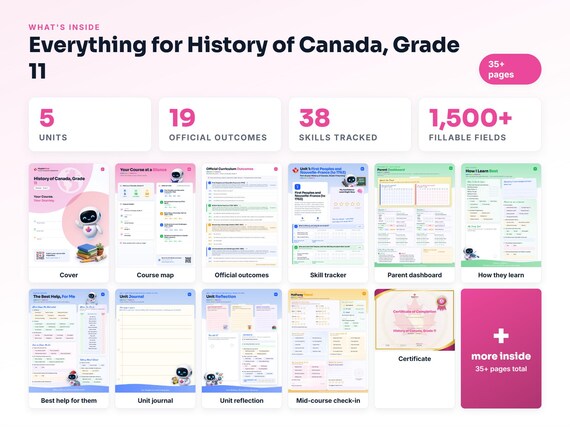
A History of Canada, Grade 11 workbook worth keeping
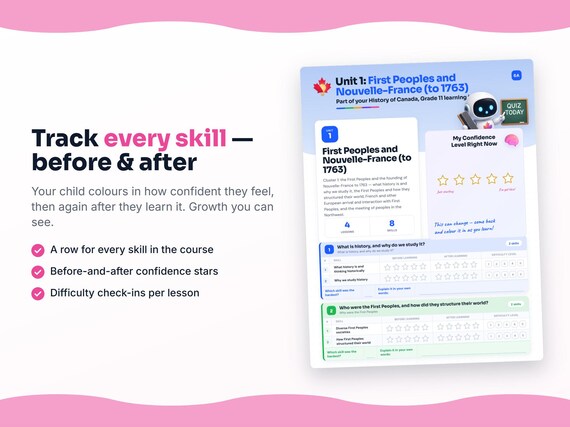
Built from the same official curriculum as this page. Before and after each skill above, your student colours in how sure they feel — so the two of you can see, on one page, what's clicking and what needs another look. It's a quiet way to follow how the year is really going.
By June it's full of their own handwriting: units worked through, confidence grown, a mid-year check-in, notes from parent-teacher night, and a certificate at the end. Less a worksheet, more a record of the year worth keeping on the shelf.
Instant download · see every page, reviews and the full description · five or more workbooks are $2.99 each
What it looks like in the app



Common questions
Can MapleMind help me with History of Canada, Grade 11?
Yes. MapleMind's AI tutor covers all 38 skills in Manitoba's History of Canada, Grade 11 — you pick the exact skill, and the tutor teaches it step by step: a short lesson, a worked example, solving together, then a skill check to show it stuck.
Is MapleMind aligned to Manitoba's official curriculum?
Yes. Every skill in this course maps to an official outcome code from Manitoba's Grade 11 Social Studies curriculum, and the ministry's own wording is quoted under each unit on this page — with the official government source linked so you can check it yourself.
What does MapleMind cost?
It's free to start — 5 tutoring chats and a practice quiz every day, no credit card. A Pro subscription ($9.99/month or $49.99/year CAD, 7-day free trial) unlocks unlimited tutoring, practice, and exam simulations.
What if I'm stuck on just one topic?
That's the point of skill-level tutoring: open History of Canada, Grade 11 in the app, tap the exact skill from the list on this page, and the tutor teaches just that — no wading through lessons you don't need.
Does MapleMind work in French or other languages?
Yes — 14 languages, including French. Both the app and the tutor's explanations switch to the language you choose.
Where can I see the official Manitoba curriculum for History of Canada, Grade 11?
The official source is linked on this page — Manitoba's official curriculum. The outline here follows it: every MapleMind skill carries its official outcome code, and the ministry's own wording is quoted under each unit.
Keep exploring
Ready when you are
Pick a skill from this page and see it taught properly — free, in the browser, in under a minute.