Get help with Law, Grade 12
Most tutoring makes you sit through material you already know. MapleMind flips that: pick the exact skill that's causing trouble — any of the 85 below — and the tutor teaches just that one, step by step, as many times as it takes. Ask questions in plain words, any time of day, in English, French, or 12 other languages.
The official Manitoba Law, Grade 12 curriculum
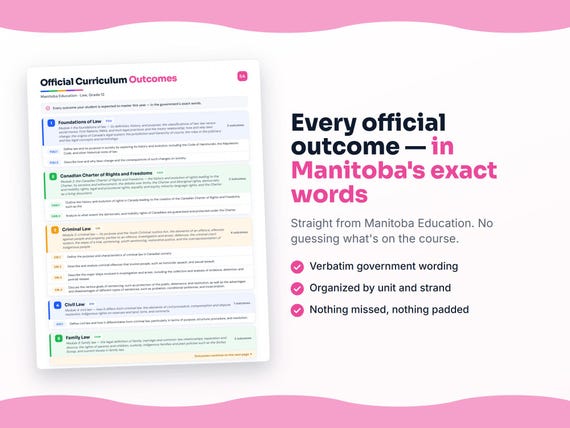
Manitoba defines Law, Grade 12 by strands and outcomes. MapleMind teaches the same curriculum reorganized for one-skill-at-a-time tutoring — the table shows exactly where every official strand lands, and the ministry's own wording is quoted under each unit below.
Official source Manitoba's official curriculumRead it on the government site — edu.gov.mb.ca ↗| Official strand | Outcomes | Where MapleMind teaches it |
|---|---|---|
| Strand M1 | 9 | Foundations of Law |
| Strand M2 | 9 | Canadian Charter of Rights and Freedoms |
| Strand M3 | 13 | Criminal Law |
| Strand M4 | 6 | Civil Law |
| Strand M5 | 7 | Family Law |
| M6A | 7 | International Law |
| M6B | 9 | Human Rights Law |
| M6C | 9 | Youth and the Law |
| M6D | 8 | Labour Law |
| M6E | 6 | Environmental Law |
Every skill below, taught one on one.
 Try the first session free
How MapleMind teaches Law, Grade 12 — every unit, lesson, and skill
Every skill below runs as a short session: a plain-words lesson, a worked example, solving it together, then a five-question skill check that earns up to three stars. Guided Mode keeps it teaching instead of answer-handing — turning it off needs a parent's password.
Unit 1Foundations of LawOfficial strand · Strand M1
Module 1: the foundations of law — its definition, history, and purpose; the classifications of law; law versus social mores; First Nations, Métis, and Inuit legal practices and the treaty relationship; how and why laws change; the origins of Canada's legal system; the jurisdiction and hierarchy of courts; the roles in the judiciary; and key legal concepts and terminology.
The nature and classification of law
- Defining law and its history1.1 — Define law and its purpose in society by exploring its history and evolution, including the Code of Hammurabi and the Napoleonic Code.
- Classifications of law1.2 — Differentiate and understand the various classifications of law.
- Law, mores, and inherent rights1.3 — Distinguish between law and social mores and explore inherent versus conferred rights and the Doctrine of Discovery / terra nullius.
- First Nations, Métis, and Inuit legal practices1.4 — Explore First Nations, Métis, and Inuit legal practices and the evolving legal relationship with non-Indigenous Canadians, including the treaty relationship.
The Canadian legal system
- How and why laws change1.5 — Describe how and why laws change and the consequences of such changes on society.
- Origins of Canada's legal system1.6 — Understand how Canada's legal system was created, including British Common Law and the French Civil Code.
- Jurisdiction and the court hierarchy1.7 — Understand the jurisdiction and powers of each level of government over law and the hierarchy of the courts.
- Roles in the judiciary1.8 — Explore and compare the roles and responsibilities of key individuals in the judicial system, such as judges, lawyers, and clerks.
- Key legal concepts and terminology1.9 — Build knowledge of key law concepts and terminology, such as case law, habeas corpus, and Rule of Law.
The official wording — 9 outcomes in this unit
- 1.1
Define law and its purpose in society by exploring its history and evolution, including the Code of Hammurabi, the Napoleonic Code, and other historical roots of law.
- 1.2
Differentiate and develop an understanding of the various classifications of law.
- 1.3
Distinguish between law and social mores, and explore questions regarding issues such as inherent versus conferred rights and the Doctrine of Discovery/terra nullius.
- 1.4
Explore First Nations, M
- 1.5
Describe how and why laws change and the consequences of such changes on society.
- 1.6
Demonstrate an understanding of how Canada
- 1.7
Demonstrate an understanding of the jurisdiction and powers of each level of government pertaining to law, as well as the hierarchy of the courts.
- 1.8
Explore and compare the roles and responsibilities of key individuals in the judiciary system, such as judges, lawyers, and clerks.
- 1.9
Build knowledge and understanding of key law concepts and terminology, such as case law, habeas corpus, and Rule of Law.
Unit 2Canadian Charter of Rights and FreedomsOfficial strand · Strand M2
Module 2: the Canadian Charter of Rights and Freedoms — the history and evolution of rights leading to the Charter, its sections and enforcement, the debate over limits, the Charter and Aboriginal rights, democratic and mobility rights, legal and procedural rights, equality and equity, minority language rights, and the Charter as a living document.
The Charter's foundations and reach
- History and evolution of rights2.1 — Outline the history and evolution of rights leading to the Charter, such as the Persons Case and the Canadian Bill of Rights.
- Charter sections and their impact2.2 — Describe and assess each section of the Charter, its jurisdiction and enforcement, and its impact on Canadian society.
- Limits, the notwithstanding clause, and the Supreme Court2.3 — Examine the debate over limits to rights, the reasonable limits and notwithstanding clauses, and the Supreme Court as guardian of the Constitution.
- The Charter and Aboriginal rights2.4 — Explore the impact of the Charter and documents such as the Royal Proclamation, land claims, treaties, and the Indian Act on Aboriginal rights.
Charter rights in action
- Democratic and mobility rights2.5 — Analyze the extent to which democratic and mobility rights are guaranteed and protected under the Charter.
- Legal and procedural rights2.6 — Outline how the Charter protects legal and procedural rights and limits police and the Crown.
- Equality and equity under Section 152.7 — Compare and contrast equality and equity in relation to Section 15 of the Charter.
- Minority language rights2.8 — Describe how minority language rights are protected in the Charter.
- The Charter as a living document2.9 — Examine how current issues, such as gender identity and medically assisted death, affect interpretations of the Charter.
The official wording — 9 outcomes in this unit
- 2.1
Outline the history and evolution of rights in Canada leading to the creation of the Canadian Charter of Rights and Freedoms, such as the
- 2.2
Describe and assess each section of the Charter, its jurisdiction and enforcement, as well as its general impact on Canadian society.
- 2.3
Examine the ongoing debate around limitations to our rights and freedoms, as outlined in the reasonable limits clause and the notwithstanding clause, as well as the role of the Supreme Court
- 2.4
Explore the impact of the Charter and other documents, such as the Royal Proclamation of 1763, land claim agreements, treaties, and the Indian Act, on Aboriginal rights.
- 2.5
Analyze to what extent the democratic and mobility rights of Canadians are guaranteed and protected under the Charter.
- 2.6
Outline how the Charter protects your legal and procedural rights and establishes limits on representatives of the criminal justice system, such as the police and the Crown.
- 2.7
Compare and contrast the concepts of equality and equity in relation to Section 15 of the Charter.
- 2.8
Describe how minority language rights are protected in the Charter.
- 2.9
Examine how issues such as women
Unit 3Criminal LawOfficial strand · Strand M3
Module 3: criminal law — its purpose and the Youth Criminal Justice Act, the elements of an offence, offences against people and property, parties to an offence, investigation and arrest, defences, the criminal court system, the steps of a trial, sentencing, youth sentencing, restorative justice, and the overrepresentation of Indigenous people.
Foundations of criminal law
- Purpose and characteristics of criminal law3.1 — Define the purpose and characteristics of criminal law in Canadian society.
- The Youth Criminal Justice Act3.1 — Explain how the Youth Criminal Justice Act shapes criminal law for young persons.
- Retribution versus rehabilitation3.1 — Explore the challenge of balancing retribution and rehabilitation while respecting the rights of offender and victim.
- Elements of a criminal offence3.2 — Understand the elements of a criminal offence, such as actus reus, mens rea, and absolute liability.
Offences and parties to a crime
- Offences against people3.3 — Describe and analyze criminal offences against people, such as homicide, assault, and sexual assault.
- Offences against property and other crimes3.4 — Describe and analyze criminal offences involving property and other offences, such as fraud and drug offences.
- Parties to an offence3.5 — Understand how persons other than the principal offender can be charged, such as by conspiracy, attempt, or aiding and abetting.
Investigation, defences, and trial
- Investigation and arrest3.6 — Describe the major steps of investigation and arrest, including evidence, detention, and pretrial release.
- Defences for the accused3.7 — Identify and describe defences for the accused, such as mental state, self-defence, and duress.
- The criminal court system3.8 — Describe the structure of the criminal court system and the roles of its participants.
- Steps of a criminal trial3.9 — Describe the steps of a criminal trial, including plea negotiations, examination, verdict, and appeal.
Sentencing and restorative justice
- Goals and types of sentencing3.10 — Discuss the goals of sentencing and the advantages and disadvantages of different sentences.
- Youth sentencing3.11 — Distinguish adult sentencing from procedures for sentencing young offenders under the Youth Criminal Justice Act.
- Restorative justice3.12 — Explore restorative justice through alternative measures such as sentencing circles, as recommended by the Aboriginal Justice Inquiry and the Gladue ruling.
- Indigenous overrepresentation in the justice system3.13 — Analyze the overrepresentation of Indigenous people in incarceration and how the system is responding, including the AJI and the TRC Calls to Action.
The official wording — 13 outcomes in this unit
- 3.1
Define the purpose and characteristics of criminal law in Canadian society
- 3.2
Demonstrate an understanding of the elements of a criminal offence, such as actus reus, mens rea, and absolute liability.
- 3.3
Describe and analyze criminal offences that involve people, such as homicide, assault, and sexual assault.
- 3.4
Describe and analyze criminal offences that involve property, such as theft, robbery, and breaking and entering, as well as other criminal offences, such as drug trafficking and possession, identity theft, and fraud.
- 3.5
Develop an understanding of how persons other than a principal offender can be charged and convicted of a criminal act, such as with charges of conspiracy, attempt, or aiding and abetting.
- 3.6
Describe the major steps involved in investigation and arrest, including the collection and analysis of evidence, detention, and pretrial release.
- 3.7
Identify and describe defences for the accused, such as mental state, self-defense, and duress.
- 3.8
Describe the structure of the Canadian criminal court system and the roles of participants, such as the judge, witnesses, jury, Crown counsel, defence counsel, and other court personnel.
- 3.9
Describe the steps of a criminal trial, including preliminary inquiry, plea negotiations, opening statement, examination, verdict, and appeal.
- 3.10
Discuss the various goals of sentencing, such as protection of the public, deterrence, and restitution, as well as the advantages and disadvantages of different types of sentences, such as probation, conditional sentences, and incarceration.
- 3.11
Distinguish between adult sentencing and the procedures for sentencing young offenders, as outlined in the Youth Criminal Justice Act.
- 3.12
Explore the concept of restorative justice through alternative measures, such as sentencing circles and family group conferencing, as recommended by the Aboriginal Justice Inquiry (1991) and the Gladue ruling (1999).
- 3.13
Analyze the overrepresentation of Indigenous people incarcerated in Manitoba and in Canada, and how the judicial system is responding to this issue, particularly in light of the recommendations made by the Aboriginal Justice Inquiry (1991) and in the Truth and Reconciliation Commission of Canada: Calls to Action document (2015).
Unit 4Civil LawOfficial strand · Strand M4
Module 4: civil law — how it differs from criminal law, the elements of civil procedure, compensation and dispute resolution, Indigenous rights on reserves and land, torts, and contracts.
Civil law and procedure
- Civil versus criminal law4.1 — Define civil law and how it differs from criminal law in purpose, structure, procedure, and resolution.
- Elements of civil procedure4.2 — Assess the elements of civil procedure, including parties, stages, class actions, and civil courts.
- Compensation and dispute resolution4.3 — Describe types of compensation, such as damages and injunctions, and alternative dispute resolution methods.
- Indigenous rights, land, and civil actions4.4 — Examine Indigenous practices and case law on rights on reserves, land titles, treaty lands, and civil actions such as residential school compensation.
- Torts4.5 — Analyze the elements, examples, and defences of intentional and non-intentional torts, such as negligence and defamation.
- Contracts4.6 — Explain the elements of contracts, factors that invalidate them, and the types of contracts people use.
The official wording — 6 outcomes in this unit
- 4.1
Define civil law and how it differentiates from criminal law, particularly in terms of purpose, structure, procedure, and resolution.
- 4.2
Assess the various elements involved in civil procedures, including parties involved in civil actions, stages in a civil action, class action lawsuits, and civil courts.
- 4.3
Describe various types of compensation, such as damages and injunctions, as well as alternative dispute resolution methods, such as negotiation, mediation, and arbitration.
- 4.4
Examine Indigenous practices and case law regarding rights on reserves, land titles, and treaty lands, as well as property rights on reserves and civil actions against government, such as residential school compensation and treaty and land rights.
- 4.5
Analyze elements, examples, and defences of intentional and non-intentional torts, such as negligence, invasion of privacy, and defamation of character.
- 4.6
Explain the main elements of contracts, including the factors that can invalidate them, and the different types of contracts available, such as cell phone contracts, parking agreements, purchases, rent, warranties, and mortgages.
Unit 5Family LawOfficial strand · Strand M5
Module 5: family law — the legal definition of family, marriage and common-law relationships, separation and divorce, the rights of parents and children, custody, Indigenous families and past policies such as the Sixties Scoop, and current issues in family law.
Family, marriage, and its ending
- The legal definition of family5.1 — Explore the legal definition of a family and what constitutes family law, including marriage, child protection, and family assets.
- Marriage and common-law relationships5.2 — Describe the legal requirements of marriage and common-law relationships, including same-sex partnerships and limitations.
- Separation and divorce5.3 — Examine the legal requirements and procedures of separation and divorce, including support, property division, and protection from abuse.
Children, Indigenous families, and current issues
- Rights of parents and children5.4 — Describe the rights and responsibilities of parents and guardians and how family law protects children.
- Custody and child support5.5 — Explore issues of custody, access for non-custodial parents, and child support.
- Indigenous families and past policies5.6 — Examine past and present policies on Indigenous families, including the Sixties Scoop, residential schools, and Child and Family Services.
- Current issues in family law5.7 — Analyze issues related to family law, such as cultural expectations, economics, and reproductive technology.
The official wording — 7 outcomes in this unit
- 5.1
Explore the definition of a family in legal terms in Canada, and describe what constitutes family law, including marriage, child protection, and family assets.
- 5.2
Describe and understand the legal requirements of marriage and common law relationships, including same-sex partnerships, and limitations, such as age, polygamy, and consent.
- 5.3
Examine the legal requirements and procedures of separation and divorce, including mediation, spousal support, and division of property, as well as protection for individuals in abusive relationships.
- 5.4
Describe the rights and responsibilities of parents and guardians and how family law protects the rights of children, including topics such as safety, custody and support, adoption, and the role of Child and Family Services.
- 5.5
Explore issues related to custody of children, such as types of custody, access for non-custodial parents, and child support.
- 5.6
Examine past and present policies related to customary Indigenous practices and interventions into Indigenous families by governmental agencies, such as adoption of Indigenous children, the Sixties Scoop, residential schools, and interactions with Child and Family Services.
- 5.7
Analyze issues related to family law, such as cultural expectations, economic factors, and the effects of reproductive technology on families
Unit 6International LawOfficial strand · M6A
Module 6, Theme 6A: international law — its nature and principles, relevant issues, concepts such as diplomatic immunity and extradition, international judicial bodies, implementing international law domestically, violations of international law, and UNDRIP's impact on Canadian law.
The nature and reach of international law
- Nature and principles of international law6A.1 — Explain the nature and general principles of international law.
- Issues in international law6A.2 — Identify issues relevant to international law, such as refugees, terrorism, and the law of the sea.
- Diplomatic immunity and extradition6A.3 — Explain concepts such as diplomatic immunity and extradition.
Bodies, enforcement, and violations
- International judicial bodies6A.4 — Describe the role and jurisdiction of international judicial bodies such as the International Court of Justice and the UNHCR.
- Implementing international law6A.5 — Examine issues in implementing international law domestically and resolving international conflicts.
- Violations of international law6A.6 — Analyze violations of international law, such as segregation in the United States and the Nuremberg laws in Germany.
- UNDRIP and Canadian law6A.7 — Evaluate the impact of the United Nations Declaration on the Rights of Indigenous Peoples on Canadian law.
The official wording — 7 outcomes in this unit
- 6A.1
Explain the nature and the general principles of international law.
- 6A.2
Identify issues that are relevant to international law, such as disarmament, international crime, refugees, problems of nationality, the conduct of war, terrorism, and the law of the sea.
- 6A.3
Explain concepts such as diplomatic immunity and extradition.
- 6A.4
Describe the role, function, and jurisdiction of international judicial bodies such as the International Court of Justice and the United Nations High Commissioner for Refugees.
- 6A.5
Examine issues in implementing international law into the domestic realm and resolving international conflicts.
- 6A.6
Analyze violations of international law and explore how the acts and laws of different countries, both past and present, have violated the principles of international law, such as segregation in the United States and the Nuremberg laws in Germany.
- 6A.7
Evaluate the impact of the United Nations Declaration on the Rights of Indigenous Peoples on Canadian law.
Unit 7Human Rights LawOfficial strand · M6B
Module 6, Theme 6B: human rights law — the Universal Declaration of Human Rights, comparing the Charter with the UDHR, exercising rights and the role of human rights bodies, the limits and responsibilities of rights, conflicts of rights, unrespected rights including Indigenous and minority rights, the impact of the Indian Act and unfulfilled treaties, key human-rights figures, and collective action.
Human rights frameworks
- The Universal Declaration of Human Rights6B.1 — Explain the reasons for the Universal Declaration of Human Rights and its key concepts.
- Comparing the Charter and the UDHR6B.2 — Identify freedoms and safeguards in the Charter and compare them with the Universal Declaration of Human Rights.
- Exercising rights and human-rights bodies6B.3 — Explain how a person can exercise Charter rights and the role of bodies such as the Ombudsman and the Human Rights Commission.
- Limits and responsibilities of rights6B.4 — Explain how rights may be limited and the obligations and responsibilities that accompany them.
Rights in conflict and rights denied
- When rights conflict6B.5 — Analyze situations where rights and freedoms conflict, such as freedom of expression and hate literature.
- Rights that have not been respected6B.6 — Examine the rights of groups in Canada that have not been respected, including Indigenous, minority, and language rights.
- The Indian Act and treaty obligations6B.7 — Assess the impact of the Indian Act and unfulfilled treaty obligations on the human rights of Indigenous peoples.
- Key people and organizations6B.8 — Assess the contribution of key people and organizations in promoting human rights nationally and internationally.
- Collective action and legal change6B.9 — Measure the effects of collective action, such as petitions and interest groups, on the evolution of law in democracies.
The official wording — 9 outcomes in this unit
- 6B.1
Explain the reasons for the creation of the Universal Declaration of Human Rights and key concepts associated with the declaration.
- 6B.2
Identify the fundamental freedoms and legal safeguards entrenched in the Canadian Charter of Rights and Freedoms and compare them with those contained in the Universal Declaration of Human Rights.
- 6B.3
Explain what means a person can use to exercise his or her rights under the Charter, such as challenging a provincial or federal law, and describe the role of agencies such as the Ombudsman and the Human Rights Commission.
- 6B.4
Explain how rights and freedoms may be limited and how they are accompanied by specific obligations and responsibilities.
- 6B.5
Analyze situations in which rights and freedoms may conflict, such as those involving freedom of expression, hate literature, traditions, and defamation.
- 6B.6
Examine the rights of groups or individuals in Canada that have not been respected, such as Indigenous rights, minority rights, gender politics, the status of women, and linguistic rights.
- 6B.7
Assess the impact of the Indian Act and other legislation, as well as unfulfilled treaty obligations, on the human rights of Indigenous peoples in Canada.
- 6B.8
Assess the contribution of key people and organizations in the promotion of human rights both nationally and internationally.
- 6B.9
Measure the effects of collective action, such as petitions and special interest groups, on the evolution of law in democracies.
Unit 8Youth and the LawOfficial strand · M6C
Module 6, Theme 6C: youth and the law — children's rights and the Youth Criminal Justice Act, the effectiveness of children's-rights laws, educational inequities on First Nations reserves, why youth are treated differently, the evolution of youth law, elements of the YCJA, criminal law affecting minors, resources for young victims, and comparing adult and youth treatment.
Children's rights and youth law
- Children's rights and YCJA principles6C.1 — Analyze the rights in the Declaration of the Rights of the Child and the guiding principles of the Youth Criminal Justice Act.
- Effectiveness of children's-rights laws6C.2 — Assess the effectiveness of international laws protecting children's rights.
- Educational inequities on reserves6C.3 — Analyze educational inequities on First Nations reserves and the changes improving access to education.
- Why youth are treated differently6C.4 — Debate the rationale for treating youth differently from adults in issues such as voting, consent, and criminality.
The youth justice system
- Evolution of youth law6C.5 — Describe the evolution of youth law from the Juvenile Delinquents Act to the Youth Criminal Justice Act.
- Elements of the YCJA and the debate6C.6 — Assess elements of the Youth Criminal Justice Act, including the 2012 amendments, and arguments for and against them.
- Criminal law affecting minors beyond the YCJA6C.7 — Analyze aspects of criminal law that concern minors but are not defined in the YCJA, such as drug offences and child protection.
- Resources for young victims6C.8 — Identify resources available for young victims.
- Comparing adult and minor treatment6C.9 — Compare the treatment of adults and minors in arrest, detention, trial, and sentencing.
The official wording — 9 outcomes in this unit
- 6C.1
Analyze the fundamental rights described in the Declaration of the Rights of the Child (1959), as well as the guiding principles of the Youth Criminal Justice Act (2003).
- 6C.2
Assess the effectiveness of international laws concerning the respect of children
- 6C.3
Analyze the impact of educational inequities on First Nations reserves and the changes that are being made to improve access to education.
- 6C.4
Debate the rationale for treating youth differently from adults in issues such as voting, driving, consent, school attendance, and criminality.
- 6C.5
Describe the evolution of youth law from the Juvenile Delinquents Act (1908) to the Youth Criminal Justice Act (2003), including amendments to the act adopted in 2012.
- 6C.6
Assess some of the elements of the Youth Criminal Justice Act (2003), including amendments adopted in 2012, and explain the arguments for and against these items.
- 6C.7
Analyze certain aspects of criminal law that may apply to minors or concern minors but are not defined in the Youth Criminal Justice Act, such as possession and drug trafficking, child protection, sexual assault, and harassment.
- 6C.8
Identify resources available for young victims.
- 6C.9
Compare the treatment provided to adults and minors regarding arrest, detention, trial, and sentencing.
Unit 9Labour LawOfficial strand · M6D
Module 6, Theme 6D: labour law — why it is needed, federal and provincial roles, worker protections, workers' rights and collective bargaining, legal recourses, the effects of globalization and technology, employment equity, and migrant workers.
Foundations of labour law
- Why labour law is required6D.1 — Explain why labour law is required to address safety, hygiene, and basic workers' rights.
- Federal and provincial roles6D.2 — Compare the roles of federal and provincial governments in developing labour and workplace laws.
- Worker protections and legislation6D.3 — Describe the protections granted to workers by legislation such as the Canada Labour Code and the Employment Standards Code.
Workers' rights and workplace issues
- Workers' rights and collective bargaining6D.4 — Explore issues related to workers' rights, such as organized labour, collective bargaining, and back-to-work legislation.
- Legal recourses for workers6D.5 — Describe the legal recourses available if workers' rights are not respected, such as grievances and mediation.
- Globalization and the future of work6D.6 — Analyze the effects of trade liberalization, globalization, and technology on collective bargaining and workplace rules.
- Employment equity6D.7 — Analyze the rationale and impact of employment equity policies on groups such as Indigenous peoples, women, and people with disabilities.
- Migrant workers6D.8 — Explore issues related to migrant workers, such as temporary foreign workers and human trafficking.
The official wording — 8 outcomes in this unit
- 6D.1
Explain why labour law is required to address such issues as safety, hygiene, and basic workers
- 6D.2
Compare the role of the federal and provincial governments in the development of laws relating to labour and the workplace.
- 6D.3
Describe the key elements and protection granted to workers by provincial and federal legislation, such as the Workers Compensation Board of Manitoba, the Canada Labour Code, the Trade Unions Act, the Labour Relations Act, and the Employment Standards Code.
- 6D.4
Explore issues related to workers
- 6D.5
Describe the legal recourses available if workers
- 6D.6
Analyze the effects of the liberalization of trade exchanges, globalization of the economy, and technological change on the future of collective bargaining and workplace regulations.
- 6D.7
Analyze the rationale and impact of employment equity policies on groups such as Indigenous peoples, women, visible minorities, and people with disabilities.
- 6D.8
Explore issues related to migrant workers, such as temporary foreign workers, skilled workers entering into Canada, and human trafficking.
Unit 10Environmental LawOfficial strand · M6E
Module 6, Theme 6E: environmental law — the need for it, the division of powers over the environment, the impact of international agreements, the roles of individuals and NGOs, First Nations, Métis, and Inuit environmental leadership, and cases related to environmental law.
Environmental law and stewardship
- The need for environmental law6E.1 — Identify the need and rationale for laws to protect the environment.
- Division of environmental powers6E.2 — Distinguish the division of environmental powers among federal, provincial, and municipal governments.
- International environmental agreements6E.3 — Assess the effects of international agreements such as the Kyoto Protocol and the Paris Agreement on protecting the environment.
- Individuals and NGOs in environmental protection6E.4 — Evaluate the roles of individuals and non-governmental organizations in environmental protection.
- First Nations, Métis, and Inuit environmental leadership6E.5 — Describe the environmental leadership of First Nations, Métis, and Inuit communities and their traditional land-use practices.
- Environmental law cases6E.6 — Analyze criminal or civil cases related to environmental laws, such as oil spills or poaching.
The official wording — 6 outcomes in this unit
- 6E.1
Identify the need and rationale for laws to protect the environment.
- 6E.2
Distinguish the separation of powers regarding environmental protection among the federal, provincial, and municipal governments as it relates to such areas as forestry, fisheries, endangered species, waste management, and hazardous materials.
- 6E.3
Assess the effects that international agreements such as the Kyoto Protocol (1997) and the Paris Agreement (2016) have had on protecting the environment, reducing greenhouse gas emissions, and promoting sustainable development.
- 6E.4
Evaluate the roles of individuals and non-governmental organizations with regard to environmental protection.
- 6E.5
Describe the leadership of First Nations, M
- 6E.6
Analyze specific criminal or civil cases related to environmental laws, such as nuclear incidents, oil spills, or poaching.
Printable workbook · A keepsake of the year
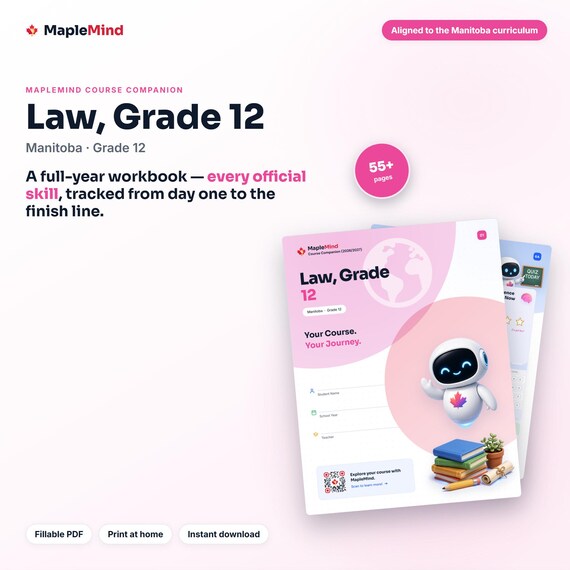
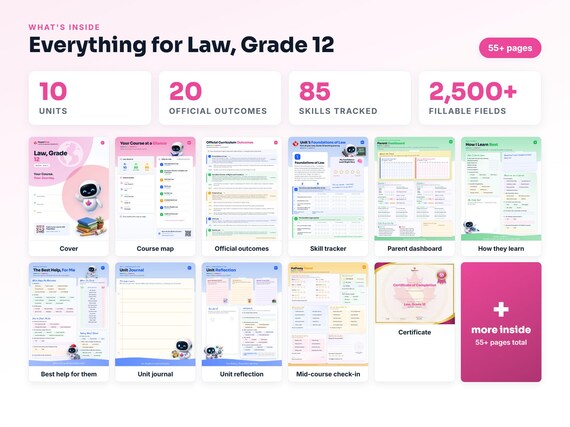
A Law, Grade 12 workbook worth keeping
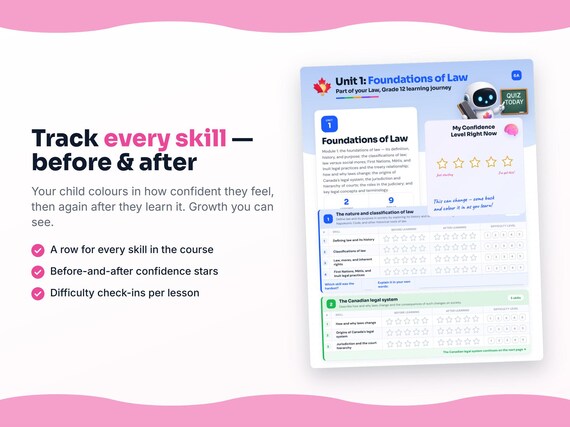
Built from the same official curriculum as this page. Before and after each skill above, your student colours in how sure they feel — so the two of you can see, on one page, what's clicking and what needs another look. It's a quiet way to follow how the year is really going.
By June it's full of their own handwriting: units worked through, confidence grown, a mid-year check-in, notes from parent-teacher night, and a certificate at the end. Less a worksheet, more a record of the year worth keeping on the shelf.
Instant download · see every page, reviews and the full description · five or more workbooks are $2.99 each
What it looks like in the app



Common questions
Can MapleMind help me with Law, Grade 12?
Yes. MapleMind's AI tutor covers all 85 skills in Manitoba's Law, Grade 12 — you pick the exact skill, and the tutor teaches it step by step: a short lesson, a worked example, solving together, then a skill check to show it stuck.
Is MapleMind aligned to Manitoba's official curriculum?
Yes. Every skill in this course maps to an official outcome code from Manitoba's Grade 12 Social Studies curriculum, and the ministry's own wording is quoted under each unit on this page — with the official government source linked so you can check it yourself.
What does MapleMind cost?
It's free to start — 5 tutoring chats and a practice quiz every day, no credit card. A Pro subscription ($9.99/month or $49.99/year CAD, 7-day free trial) unlocks unlimited tutoring, practice, and exam simulations.
What if I'm stuck on just one topic?
That's the point of skill-level tutoring: open Law, Grade 12 in the app, tap the exact skill from the list on this page, and the tutor teaches just that — no wading through lessons you don't need.
Does MapleMind work in French or other languages?
Yes — 14 languages, including French. Both the app and the tutor's explanations switch to the language you choose.
Where can I see the official Manitoba curriculum for Law, Grade 12?
The official source is linked on this page — Manitoba's official curriculum. The outline here follows it: every MapleMind skill carries its official outcome code, and the ministry's own wording is quoted under each unit.
Keep exploring
Ready when you are
Pick a skill from this page and see it taught properly — free, in the browser, in under a minute.