Get help with Global Issues: Citizenship and Sustainability, Grade 12
Most tutoring makes you sit through material you already know. MapleMind flips that: pick the exact skill that's causing trouble — any of the 20 below — and the tutor teaches just that one, step by step, as many times as it takes. Ask questions in plain words, any time of day, in English, French, or 12 other languages.
The official Manitoba Global Issues: Citizenship and Sustainability, Grade 12 curriculum
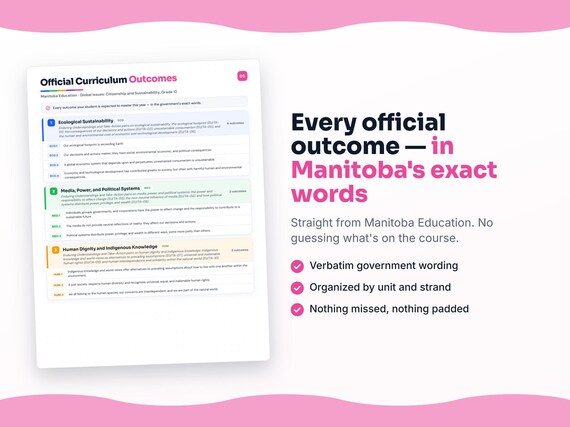
Manitoba defines Global Issues: Citizenship and Sustainability, Grade 12 by strands and outcomes. MapleMind teaches the same curriculum reorganized for one-skill-at-a-time tutoring — the table shows exactly where every official strand lands, and the ministry's own wording is quoted under each unit below.
Official source Manitoba's official curriculumRead it on the government site — edu.gov.mb.ca ↗| Official strand | Outcomes | Where MapleMind teaches it |
|---|---|---|
| Strand A | 8 | Ecological Sustainability |
| Strand B | 6 | Media, Power, and Political Systems |
| Strand C | 6 | Human Dignity and Indigenous Knowledge |
Every skill below, taught one on one.
 Try the first session free
How MapleMind teaches Global Issues: Citizenship and Sustainability, Grade 12 — every unit, lesson, and skill
Every skill below runs as a short session: a plain-words lesson, a worked example, solving it together, then a five-question skill check that earns up to three stars. Guided Mode keeps it teaching instead of answer-handing — turning it off needs a parent's password.
Unit 1Ecological SustainabilityOfficial strand · Strand A
Enduring Understandings and Take-Action pairs on ecological sustainability: the ecological footprint (EU/TA-01), the consequences of our decisions and actions (EU/TA-02), unsustainable consumerism (EU/TA-05), and the human and environmental cost of economic and technological development (EU/TA-06).
Ecological footprint
- The ecological footprintEU-01 — Explain how the human ecological footprint exceeds Earth's capacity to sustain biodiversity and human life.
- Living more responsiblyTA-01 — Plan and take action to minimize one's ecological footprint and live more responsibly.
Decisions and consequences
- Decisions and their consequencesEU-02 — Explain how our decisions and actions have social, environmental, economic, and political consequences.
- Acting for a sustainable, just futureTA-02 — Recognize the consequences of one's decisions and take action as a citizen for a sustainable and just future.
Consumerism and sustainability
- Why consumerism is unsustainableEU-05 — Explain why a global economy dependent on unrestrained consumerism is unsustainable.
- Ethical consumption choicesTA-05 — Make consumption decisions that follow ecological and ethical principles.
Development and its costs
- Development, benefits, and harmsEU-06 — Explain how economic and technological development brings both benefits and harmful human and environmental consequences.
- Assessing sustainability of developmentTA-06 — Assess the relative value and sustainability of economic and technological developments to make informed decisions.
The official wording — 8 outcomes in this unit
- EU-01
Our ecological footprint is exceeding Earth
- TA-01
Minimize your ecological footprint, and live more responsibly
- EU-02
Our decisions and actions matter; they have social, environmental, economic, and political consequences.
- TA-02
take action as a citizen for a sustainable and just future for all.
- EU-05
A global economic system that depends upon and perpetuates unrestrained consumerism is unsustainable.
- TA-05
Make consumption decisions that follow ecological and ethical principles
- EU-06
Economic and technological development has contributed greatly to society, but often with harmful human and environmental consequences.
- TA-06
Assess the relative value and sustainability of economic and technological developments in order to make informed decisions.
Unit 2Media, Power, and Political SystemsOfficial strand · Strand B
Enduring Understandings and Take-Action pairs on media, power, and political systems: the power and responsibility to effect change (EU/TA-03), the non-neutral influence of media (EU/TA-04), and how political systems distribute power, privilege, and wealth (EU/TA-08).
Power and responsibility to effect change
- Power and responsibility to effect changeEU-03 — Explain how individuals, groups, governments, and corporations have the power and responsibility to shape a sustainable future.
- Being an ethical decision-makerTA-03 — Act as an ethical decision-maker who takes a stand for quality of life and challenges the unsustainable.
Media and reality
- Media are not neutralEU-04 — Explain how the media do not provide neutral reflections of reality and how they affect our decisions and actions.
- Critically questioning mediaTA-04 — Evaluate the purposes of media and critically question information sources and our responses.
Political systems and power
- How systems distribute powerEU-08 — Explain how political systems distribute power, privilege, and wealth in different ways, some more justly than others.
- Vigilant democratic citizenshipTA-08 — Support democratic citizenship and stay vigilant about political decisions affecting social, economic, and environmental conditions.
The official wording — 6 outcomes in this unit
- EU-03
Individuals, groups, governments, and corporations have the power to effect change and the responsibility to contribute to a sustainable future.
- TA-03
Be an ethical decision-maker, take a stand to support quality of life for all, and challenge the unethical and the unsustainable.
- EU-04
The media do not provide neutral reflections of reality; they affect our decisions and actions.
- TA-04
Evaluate the purposes of media, critically question information sources and our responses to media, and make decisions accordingly.
- EU-08
Political systems distribute power, privilege, and wealth in different ways, some more justly than others.
- TA-08
Support democratic citizenship and be vigilant about political decisions that affect social, economic, and environmental conditions.
Unit 3Human Dignity and Indigenous KnowledgeOfficial strand · Strand C
Enduring Understandings and Take-Action pairs on human dignity and Indigenous knowledge: Indigenous knowledge and world views as alternatives to prevailing assumptions (EU/TA-07), universal and inalienable human rights (EU/TA-09), and human interdependence and solidarity within the natural world (EU/TA-10).
Indigenous knowledge and world views
- Indigenous knowledge as an alternativeEU-07 — Explain how Indigenous knowledge and world views offer alternatives to prevailing assumptions about living with one another and the environment.
- Exploring Indigenous perspectivesTA-07 — Explore Indigenous perspectives to extend the familiar and challenge assumptions and practices.
Human rights and diversity
- A just society and human rightsEU-09 — Explain how a just society respects human diversity and recognizes universal, equal, and inalienable human rights.
- Committing to universal human rightsTA-09 — Be committed to universal human rights for all people regardless of identity or status.
Human interdependence and solidarity
- One interdependent human familyEU-10 — Explain how all people belong to one interdependent human species within the natural world.
- Building community and solidarityTA-10 — Uphold the value of every person and act in ways that acknowledge human solidarity and the interrelatedness of all life.
The official wording — 6 outcomes in this unit
- EU-07
Indigenous knowledge and world views offer alternatives to prevailing assumptions about how to live with one another within the environment.
- TA-07
Explore indigenous perspectives to extend the boundaries of the familiar and to challenge assumptions and practices.
- EU-09
A just society respects human diversity and recognizes universal, equal, and inalienable human rights.
- TA-09
Be committed to universal human rights, regardless of gender, age, physical ability, sexual orientation, language, culture, religion, political beliefs, ethnicity, national or social origin, or status
- EU-10
we all belong to the human species, our concerns are interdependent, and we are part of the natural world.
- TA-10
Uphold the value of every person and strive to build community; act in ways that acknowledge human solidarity and the complexity and interrelatedness of all life.
Printable workbook · A keepsake of the year
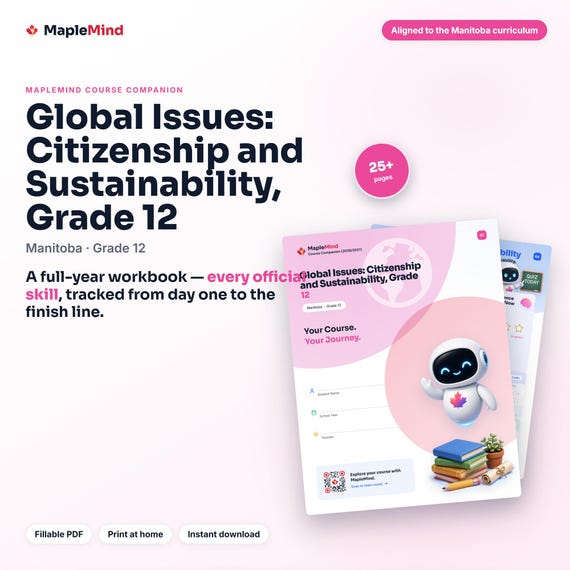
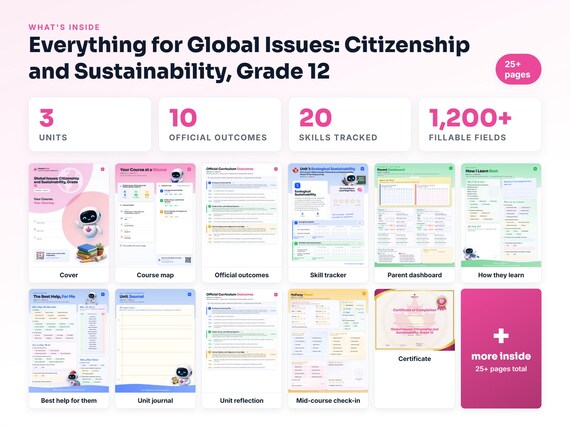
A Global Issues: Citizenship and Sustainability, Grade 12 workbook worth keeping
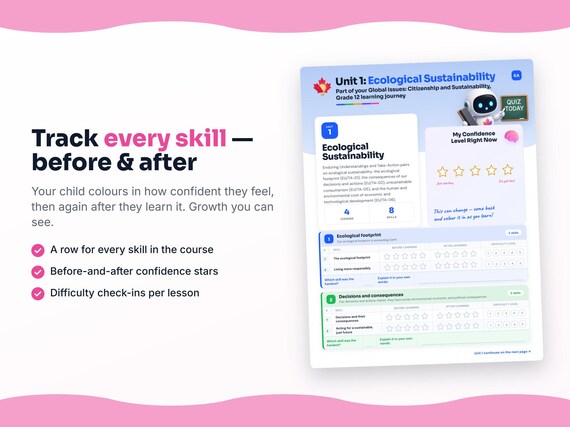
Built from the same official curriculum as this page. Before and after each skill above, your student colours in how sure they feel — so the two of you can see, on one page, what's clicking and what needs another look. It's a quiet way to follow how the year is really going.
By June it's full of their own handwriting: units worked through, confidence grown, a mid-year check-in, notes from parent-teacher night, and a certificate at the end. Less a worksheet, more a record of the year worth keeping on the shelf.
Instant download · see every page, reviews and the full description · five or more workbooks are $2.99 each
What it looks like in the app



Common questions
Can MapleMind help me with Global Issues: Citizenship and Sustainability, Grade 12?
Yes. MapleMind's AI tutor covers all 20 skills in Manitoba's Global Issues: Citizenship and Sustainability, Grade 12 — you pick the exact skill, and the tutor teaches it step by step: a short lesson, a worked example, solving together, then a skill check to show it stuck.
Is MapleMind aligned to Manitoba's official curriculum?
Yes. Every skill in this course maps to an official outcome code from Manitoba's Grade 12 Social Studies curriculum, and the ministry's own wording is quoted under each unit on this page — with the official government source linked so you can check it yourself.
What does MapleMind cost?
It's free to start — 5 tutoring chats and a practice quiz every day, no credit card. A Pro subscription ($9.99/month or $49.99/year CAD, 7-day free trial) unlocks unlimited tutoring, practice, and exam simulations.
What if I'm stuck on just one topic?
That's the point of skill-level tutoring: open Global Issues: Citizenship and Sustainability, Grade 12 in the app, tap the exact skill from the list on this page, and the tutor teaches just that — no wading through lessons you don't need.
Does MapleMind work in French or other languages?
Yes — 14 languages, including French. Both the app and the tutor's explanations switch to the language you choose.
Where can I see the official Manitoba curriculum for Global Issues: Citizenship and Sustainability, Grade 12?
The official source is linked on this page — Manitoba's official curriculum. The outline here follows it: every MapleMind skill carries its official outcome code, and the ministry's own wording is quoted under each unit.
Keep exploring
Ready when you are
Pick a skill from this page and see it taught properly — free, in the browser, in under a minute.