Get help with Core French, Grade 12
Most tutoring makes you sit through material you already know. MapleMind flips that: pick the exact skill that's causing trouble — any of the 26 below — and the tutor teaches just that one, step by step, as many times as it takes. Ask questions in plain words, any time of day, in English, French, or 12 other languages.
The official Manitoba Core French, Grade 12 curriculum
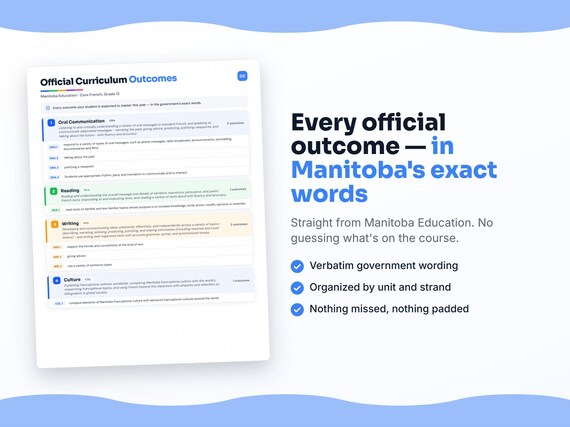
Manitoba defines Core French, Grade 12 by strands and outcomes. MapleMind teaches the same curriculum reorganized for one-skill-at-a-time tutoring — the table shows exactly where every official strand lands, and the ministry's own wording is quoted under each unit below.
Official source Manitoba's official curriculumRead it on the government site — edu.gov.mb.ca ↗| Official strand | Outcomes | Where MapleMind teaches it |
|---|---|---|
| Strand B | 8 | Oral Communication |
| Strand C | 5 | Reading |
| Strand D | 8 | Writing |
| Strand E | 5 | Culture |
Every skill below, taught one on one.
 Try the first session free
How MapleMind teaches Core French, Grade 12 — every unit, lesson, and skill
Every skill below runs as a short session: a plain-words lesson, a worked example, solving it together, then a five-question skill check that earns up to three stars. Guided Mode keeps it teaching instead of answer-handing — turning it off needs a parent's password.
Unit 1Oral CommunicationOfficial strand · Strand B
Listening to and critically understanding a variety of oral messages in standard French, and speaking to communicate elaborated messages - narrating the past, giving advice, predicting, justifying viewpoints, and talking about the future - with fluency and accuracy.
Listening for Meaning
- Understanding and interpreting oral messagesFR.B.GRADES11-12.1 — Listen to standard French and demonstrate comprehension - responding critically to a variety of messages by recognizing point of view, bias, and language register, and retelling the gist.
- Listening strategiesFR.B.GRADES11-12.2 — Use appropriate strategies to understand a message - deliberately combining careful listening, requests for explanation, and prediction/verification for complex messages.
Message: Narrating and Advising
- Talking about the pastFR.B.GRADES11-12.3 — Communicate elaborated ideas orally - talking about the past with the passe compose, imperfect, and past conditional for nuanced, reflective narration.
- Giving advice and making predictionsFR.B.GRADES11-12.4 — Communicate elaborated ideas orally - giving advice with the subjunctive and making predictions with the past conditional.
Message: Justifying and Future
- Justifying a viewpointFR.B.GRADES11-12.5 — Communicate elaborated ideas orally - justifying a viewpoint persuasively with nuanced, well-structured reasoning.
- Talking about the futureFR.B.GRADES11-12.6 — Communicate elaborated ideas orally - talking about the future with the simple future and conditional across ambitious, conditional plans.
Fluency and Accuracy
- FluencyFR.B.GRADES11-12.7 — Use appropriate vocabulary and expressions to communicate with spontaneity across any topic and interaction, with appropriate rhythm, pace, and intonation.
- AccuracyFR.B.GRADES11-12.8 — Correctly use the vocabulary and syntax of French - complex sentences and the complete range of tenses (including subjunctive) accurately across any communicative intent.
The official wording — 8 outcomes in this unit
- FR.B.GRADES11-12.1
respond to a variety of types of oral messages, such as phone messages, radio broadcasts, announcements, storytelling, documentaries and films
- FR.B.GRADES11-12.2
use appropriate strategies to understand the message ex., ask for repetition and explanation
- FR.B.GRADES11-12.3
talking about the past
- FR.B.GRADES11-12.4
giving advice
- FR.B.GRADES11-12.5
justifying a viewpoint
- FR.B.GRADES11-12.6
talking about the future
- FR.B.GRADES11-12.7
Students use appropriate rhythm, pace, and intonation to communicate and to interact.
- FR.B.GRADES11-12.8
Students use the present, imperative, past, imperfect, future tenses and conditional tenses, among others, as needed, for communicative purposes related to the topic.
Unit 2ReadingOfficial strand · Strand C
Reading and understanding the overall message and details of narrative, expository, persuasive, and poetic French texts, responding to and evaluating texts, and reading a variety of texts aloud with fluency and accuracy.
Message: Understanding Text
- Reading for purpose across text typesFR.C.GRADES11-12.1 — Read and understand the overall message and details of texts according to your purpose - reading texts on familiar and less familiar topics that inform, incite action, modify opinions, or entertain.
- Summarizing and analyzing relationshipsFR.C.GRADES11-12.2 — Demonstrate understanding of texts of differing lengths - summarizing, identifying details, and describing and comparing character relationships from beginning to end.
- Responding to and connecting with textFR.C.GRADES11-12.3 — Respond to texts orally or in writing - giving justified opinions, making personal connections, classifying ideas and differentiating fact from argument, and explaining the author's message.
- Inferring and evaluating textFR.C.GRADES11-12.4 — Respond to texts - making inferences, asking probing questions, and critically evaluating the effectiveness of the text and its evidence.
- Reading aloud with fluency and accuracyFR.C.GRADES11-12.5 — Read a variety of texts aloud - adapting expression, tone, emphasis, and pace to the genre, and pronouncing words and liaisons accurately.
The official wording — 5 outcomes in this unit
- FR.C.GRADES11-12.1
read texts on familiar and less familiar topics whose purpose is to increase knowledge, incite action, modify opinions or entertain
- FR.C.GRADES11-12.2
describing the relationships between characters
- FR.C.GRADES11-12.3
making personal connections
- FR.C.GRADES11-12.4
evaluating the effectiveness of the text based on its communicative intent
- FR.C.GRADES11-12.5
read with expression to convey the message
Unit 3WritingOfficial strand · Strand D
Developing and communicating ideas coherently, effectively, and independently across a variety of topics - describing, narrating, advising, predicting, justifying, and sharing information (including resumes and cover letters) - and writing well-organized texts with accurate grammar, syntax, and synchronized tenses.
Message: Purpose and Describing
- Purpose, conventions, and describingFR.D.GRADES11-12.1 — Develop and communicate ideas coherently, effectively, and independently - explaining intent, respecting full conventions including citing sources, and describing in depth.
- Writing about the pastFR.D.GRADES11-12.2 — Develop and communicate ideas independently - writing about the past with the passe compose, imperfect, and past conditional for nuanced, reflective narration.
Message: Advising and Justifying
- Writing advice and predictionsFR.D.GRADES11-12.3 — Develop and communicate ideas independently - writing advice and making complex predictions with the past conditional.
- Justifying a viewpoint in writingFR.D.GRADES11-12.4 — Develop and communicate ideas independently - justifying a viewpoint persuasively in writing with nuanced, well-structured reasoning.
- Sharing information: reports, resumes, cover lettersFR.D.GRADES11-12.5 — Develop and communicate ideas independently - sharing information by writing reports, summaries, and professional documents (a resume and cover letter).
Fluency and Accuracy
- Organizing varied, coherent textsFR.D.GRADES11-12.6 — Write a variety of coherent, organized texts - planning and editing for flow and using a full variety of sentence types for rhetorical effect.
- Writing devices and synchronizing tensesFR.D.GRADES11-12.7 — Write coherent texts - using sophisticated writing devices and synchronizing verb tenses and modes across a full range including the subjunctive.
- Accuracy: grammar and syntaxFR.D.GRADES11-12.8 — Manage your writing with the rules and syntax of French - agreement, correct conjugations across the full range (including past infinitive), and complex structures with precision.
The official wording — 8 outcomes in this unit
- FR.D.GRADES11-12.1
respect the format and conventions of the kind of text
- FR.D.GRADES11-12.2
writing about the past ex., describe an event or personal experience from the past
- FR.D.GRADES11-12.3
giving advice
- FR.D.GRADES11-12.4
justifying a viewpoint
- FR.D.GRADES11-12.5
sharing information ex., write a resume and cover letter
- FR.D.GRADES11-12.6
use a variety of sentence types
- FR.D.GRADES11-12.7
synchronise verb tenses and modes
- FR.D.GRADES11-12.8
conjugate verbs correctly (present, imperative, compound past, imperfect, future, conditional, past perfect, subjunctive, based on the intention of the communication)
Unit 4CultureOfficial strand · Strand E
Explaining francophone cultures worldwide, comparing Manitoba francophone culture with the world's, researching francophone topics, and using French beyond the classroom with empathy and reflection on bilingualism in global society.
Francophone Cultures and Research
- Explaining and researching francophone culturesFR.E.GRADES11-12.1 — Explain elements of francophone cultures - researching cultural, political, or historical topics and naming francophone events and institutions and explaining their roles nationally and globally.
- Connecting to francophone youthFR.E.GRADES11-12.2 — Make links to your personal life - comparing your cultural influences and your hopes, dreams, and future plans with those of francophone youth.
- Formal register and language comparisonFR.E.GRADES11-12.3 — Use appropriate vocabulary - deliberate formal register and detailed analysis of commonalities and differences between French and English, including connotation and folk wisdom.
- Personal reasons and benefits of FrenchFR.E.GRADES11-12.4 — Identify the reasons and advantages of learning French - articulating a compelling, personal case tied to future study, work, and travel.
- French beyond the classroom and empathyFR.E.GRADES11-12.5 — Identify yourself as a French language learner - engaging French beyond the classroom, reflecting and analysing the experience, showing empathy, and identifying bilingualism in global society.
The official wording — 5 outcomes in this unit
- FR.E.GRADES11-12.1
compare elements of Manitoba francophone culture with elements francophone cultures around the world.
- FR.E.GRADES11-12.2
compare their own cultural influences with those of francophone youth in other parts of the world.
- FR.E.GRADES11-12.3
explain commonalities/differences between the French and English languages.
- FR.E.GRADES11-12.4
explain personal reasons and benefits for learning French.
- FR.E.GRADES11-12.5
show empathy toward people of differing cultures.
Printable workbook · A keepsake of the year
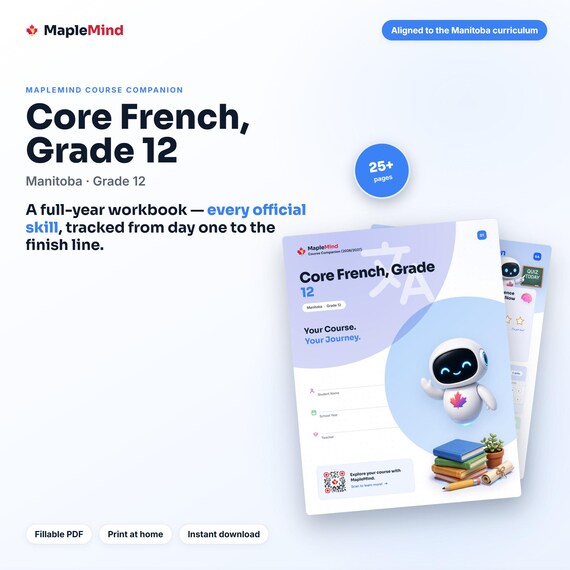
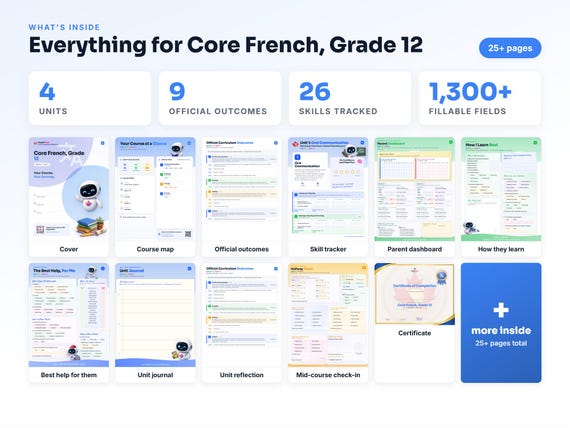
A Core French, Grade 12 workbook worth keeping
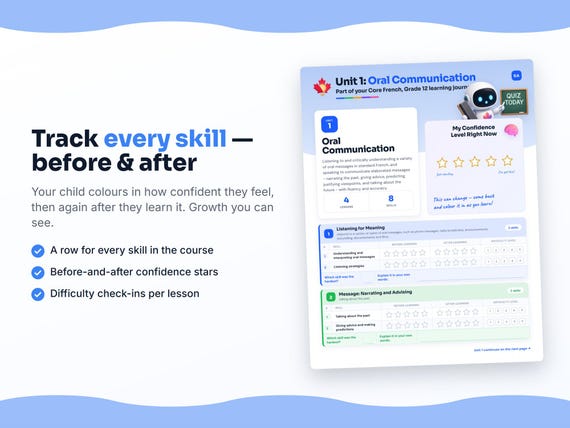
Built from the same official curriculum as this page. Before and after each skill above, your student colours in how sure they feel — so the two of you can see, on one page, what's clicking and what needs another look. It's a quiet way to follow how the year is really going.
By June it's full of their own handwriting: units worked through, confidence grown, a mid-year check-in, notes from parent-teacher night, and a certificate at the end. Less a worksheet, more a record of the year worth keeping on the shelf.
Instant download · see every page, reviews and the full description · five or more workbooks are $2.99 each
What it looks like in the app



Common questions
Can MapleMind help me with Core French, Grade 12?
Yes. MapleMind's AI tutor covers all 26 skills in Manitoba's Core French, Grade 12 — you pick the exact skill, and the tutor teaches it step by step: a short lesson, a worked example, solving together, then a skill check to show it stuck.
Is MapleMind aligned to Manitoba's official curriculum?
Yes. Every skill in this course maps to an official outcome code from Manitoba's Grade 12 French curriculum, and the ministry's own wording is quoted under each unit on this page — with the official government source linked so you can check it yourself.
What does MapleMind cost?
It's free to start — 5 tutoring chats and a practice quiz every day, no credit card. A Pro subscription ($9.99/month or $49.99/year CAD, 7-day free trial) unlocks unlimited tutoring, practice, and exam simulations.
What if I'm stuck on just one topic?
That's the point of skill-level tutoring: open Core French, Grade 12 in the app, tap the exact skill from the list on this page, and the tutor teaches just that — no wading through lessons you don't need.
Does MapleMind work in French or other languages?
Yes — 14 languages, including French. Both the app and the tutor's explanations switch to the language you choose.
Where can I see the official Manitoba curriculum for Core French, Grade 12?
The official source is linked on this page — Manitoba's official curriculum. The outline here follows it: every MapleMind skill carries its official outcome code, and the ministry's own wording is quoted under each unit.
Keep exploring
Ready when you are
Pick a skill from this page and see it taught properly — free, in the browser, in under a minute.