Manitoba · For parents

What your child learns in Grade 7 in Manitoba

Every subject, unit by unit, from Manitoba’s curriculum: 220 skills in plain words.

Subjects
5
Skills
220
Provincial exams
None
Official curriculum
edu.gov.mb.ca

Math in Grade 7

Mathematics, Grade 7

4 units · 29 skills

  1. Unit 1

    Number

    Each divisibility rule tests a number without dividing, like 'even' for 2.

    • Divisibility rules
    • Four operations with decimals
    • Percent problems
    5 more skills
    • Repeating and terminating decimals
    • Adding and subtracting fractions
    • Adding and subtracting integers
    • Ordering with benchmarks and place value
    • Ordering with equivalent fractions and decimals
  2. Unit 2

    Patterns and Relations

    A relation is a rule that links each term to its position.

    • Patterns and their relations
    • Tables, graphs, and conclusions
    • Preservation of equality
    4 more skills
    • Expressions versus equations
    • Evaluating expressions
    • One-step equations x + a = b
    • Linear equations ax + b = c
  3. Unit 3

    Shape and Space

    The diameter is twice the radius.

    • Radius, diameter, and pi
    • Central angles and circle problems
    • Area of triangles and parallelograms
    5 more skills
    • Area of circles
    • Perpendicular and parallel line segments
    • Perpendicular and angle bisectors
    • Plotting in four quadrants
    • Transformations across quadrants
  4. Unit 4

    Statistics and Probability

    Mean, median, and mode each summarize a data set differently.

    • Central tendency and range
    • The effect of outliers
    • Circle graphs
    3 more skills
    • Expressing probabilities
    • Sample space of two events
    • Probability of two independent events
Science in Grade 7

Science, Grade 7

5 units · 69 skills

  1. Unit 1

    Scientific Skills and Inquiry

    A prototype is a working model built to test a design idea before anything final is made.

    • Construct a prototype
    • Construct graphs to display data, and interpret and evaluate these and other graphs
    • Select and use tools to observe, measure, and construct.
    1 more skill
    • Estimate and measure accurately using SI and other standard units
  2. Unit 2

    Interactions Within Ecosystems

    An ecosystem is a place where living things interact with each other and with non-living things; the biosphere is all of Earth's ecosystems together.

    • Use appropriate vocabulary related to their investigations of interactions within ecosystems
    • Define ecosystem, and describe various examples that range from the microscopic to the entire biosphere
    • Identify abiotic and biotic components of ecosystems that allow particular organisms to survive
    12 more skills
    • Describe ecological succession and identify signs of succession in a variety of ecosystems
    • Identify and describe positive and negative examples of human interventions that have an impact on ecological succession or the makeup of ecosystems
    • Identify environmental, social, and economic factors that should be considered in the management and preservation of ecosystems
    • Propose a course of action to protect the habitat of a particular organism within an ecosystem
    • Compare photosynthesis to cellular respiration, and explain how both are part of the cycling of matter and the transfer of energy in ecosystems
    • Analyze food webs, using ecological pyramids, to show energy gained or lost at various consumer levels
    • Analyze, using ecological pyramids, the implications of the loss of producers and consumers to the transfer of energy within an ecosystem
    • Explain, using ecological pyramids, the potential for bioaccumulation within an ecosystem
    • Provide examples of scavengers and decomposers
    • Demonstrate proper use and care of the microscope to observe micro-organisms
    • Identify beneficial and harmful roles played by micro-organisms
    • Research and describe human food production or preservation techniques
  3. Unit 3

    Particle Theory of Matter

    Temperature measures how fast a substance's particles move on average; heat is energy transferred from a warmer object to a cooler one, by conduction, convection or radiation.

    • Use appropriate vocabulary related to their investigations of the particle theory of matter
    • Evaluate different types of thermometers using the design process
    • Demonstrate the effects of heating and cooling on the volume of solids, liquids, and gases
    20 more skills
    • Compare the boiling and melting points of a variety of substances and recognize that boiling and melting points are properties of pure substances
    • Explain what scientific theories are, and provide some examples.
    • Describe the particle theory of matter and use it to explain changes of state
    • Differentiate between the concept of temperature and the concept of heat
    • Demonstrate how heat can be transmitted through solids, liquids, and gases
    • Plan an experiment to identify materials that are good heat insulators and good heat conductors, and describe some uses of these materials
    • Use the design process to construct a prototype that controls the transfer of heat energy
    • Recognize that heat energy is the most common by-product of energy transformations, and describe some examples
    • Identify different forms of energy that can be transformed into heat energy
    • Differentiate between pure substances and mixtures by using the particle theory of matter
    • Differentiate between the two types of mixtures, solutions and mechanical mixtures
    • Classify a variety of substances used in daily life as pure substances, solutions, or mechanical mixtures
    • Demonstrate the difference between saturated and unsaturated solutions
    • Discuss the potential harmful effects of some substances on the environment
    • Identify solutes and solvents in common solid, liquid, and gaseous solutions
    • Describe solutions by using the particle theory of matter.
    • Demonstrate different methods of separating the components of both solutions and mechanical mixtures
    • Identify a separation technique used in industry, and explain why it is appropriate
    • Experiment to determine factors that affect solubility
    • Describe the concentration of a solution in qualitative and quantitative terms
  4. Unit 4

    Forces and Structures

    Structures are frame structures (a skeleton of parts, like a tower), shell structures (a thin outer layer, like an egg or a dome) or solid structures (filled throughout, like a dam).

    • Use appropriate vocabulary related to their investigations of forces and structures
    • Classify natural and human-built structures found locally and around the world
    • Identify the centre of gravity in a model structure, and demonstrate that changes in the location of a structure’s centre of gravity affect its stability
    9 more skills
    • Identify internal forces acting on a structure, and describe them using diagrams
    • Identify external forces acting on a structure, and describe them using diagrams
    • Recognize that internal and external forces apply stress to structures
    • Investigate to determine that the effect of a force on a structure depends on its magnitude, direction, and point and plane of application
    • Describe, using diagrams, how common structural shapes and components can increase the strength and stability of a structure
    • Describe and demonstrate methods to increase the strength of materials
    • Determine the efficiency of a structure by comparing its mass with the mass of the load it supports
    • Evaluate a structure to determine the appropriateness of its design, using the design process
    • Use the design process to construct a structure that will withstand the application of an external force
  5. Unit 5

    Earth’s Crust

    Earth's layers, from the outside in, are the crust, the mantle, the outer core and the inner core.

    • Use appropriate vocabulary related to their investigations of the Earth’s crust
    • Describe the Earth’s structure
    • Describe the geological processes involved in rock and mineral formation, and classify rocks and minerals by their method of formation
    12 more skills
    • Investigate and describe the processes of weathering and erosion, and recognize that they cause changes in the landscape over time
    • Explain how rocks on the Earth constantly undergo a slow process of change through the rock cycle
    • Identify geological resources that are used by humans as sources of energy, and describe their method of formation
    • Identify geological resources that are present in Manitoba and Canada
    • Identify environmental impacts of geological resource extraction, and describe techniques used to address these
    • Recognize that soil is a natural resource, and explain how the characteristics of soil determine its use
    • Describe methods used to control soil erosion, and recognize the importance of soil conservation
    • Identify environmental, social, and economic factors that should be considered in making informed decisions about land use
    • Describe evidence used to support the continental drift theory, and explain why this theory was not generally accepted by scientists
    • Describe evidence used to support the theory of plate tectonics, the role technology has played in the development of this theory, and reasons why it is generally accepted by scientists
    • Explain geological processes and events using the theory of plate tectonics
    • Identify specialized careers involving the study of the Earth’s crust or the utilization of geological resources, and give examples of technologies used in each

English in Grade 7

English Language Arts, Grade 7

4 units · 47 skills

  1. Unit 1

    Explore and Discover Language and Literacy

    • Listening critically to the ideas of others
    • Using non-verbal cues and conventions when listening
    • Interacting to exchange and consider ideas
    6 more skills
    • Asking questions to explore and critique ideas
    • Using the rules and structures of oral language
    • Adapting spoken language to audience and purpose
    • Applying morphology to understand and spell words
    • Building and using precise vocabulary
    • Applying fluency to comprehend text
  2. Unit 2

    Comprehend and Respond to Multimodal Texts

    • Activating prior knowledge to understand new text
    • Generating questions to drive inquiry
    • Engaging with a variety of multimodal texts
    12 more skills
    • Reviewing information and filling gaps
    • Understanding how text form and structure carry meaning
    • Using text features and cues to comprehend
    • Making and confirming predictions
    • Making connections to deepen meaning
    • Using strategies to monitor understanding
    • Summarizing key ideas and drawing conclusions
    • Consolidating and communicating new knowledge
    • Analyzing how texts present diversity and equity
    • Identifying stereotyping, bias and reliable sources
    • Identifying point of view and judging viewpoints
    • Responding personally to bias and prejudice
  3. Unit 3

    Compose and Create Multimodal Texts

    • Generating ideas and focusing a topic
    • Gathering and assessing information from sources
    • Planning text creation with strategies and tools
    12 more skills
    • Choosing text forms for purpose and audience
    • Creating multimodal texts
    • Organizing ideas with structure and paragraphs
    • Crafting varied, correct sentences
    • Choosing precise, impactful words
    • Developing personal voice and tone
    • Revising for clarity, logic and coherence
    • Producing legible, well-formatted text
    • Applying spelling strategies and word structure
    • Applying capitalization conventions
    • Applying punctuation for clarity
    • Publishing a final multimodal text
  4. Unit 4

    Communicate Ideas and Build New Understandings

    • Adjusting tone, volume and expression for delivery
    • Using visuals and media to enhance communication
    • Organizing and presenting ideas for an audience
    5 more skills
    • Reflecting on effective learning strategies
    • Using criteria and tools to self-assess
    • Using feedback to refine strategies
    • Setting learning goals and planning steps
    • Monitoring progress toward goals

French in Grade 7

Core French, Grade 7

4 units · 20 skills

  1. Unit 1

    Oral Communication

    Listen for specific information: name key ideas, the MAIN IDEA and supporting details of short, familiar messages.

    • Understanding messages and following multi-step directions
    • Listening strategies and note-taking
    • Introducing yourself and describing with detail
    4 more skills
    • Describing places, things, and activities
    • Needs, inversion questions, and directions
    • Fluency
    • Accuracy
  2. Unit 2

    Reading

    Anticipate the global meaning: read the title, subtitles, and table of contents; scan pictures; find cognates; ask questions; and think about prior knowledge.

    • Understanding multi-paragraph texts
    • Responding to and organizing text
    • Summarizing and comparing text to life
    1 more skill
    • Reading aloud with fluency and accuracy
  3. Unit 3

    Writing

    Establish the communicative purpose - identify the TARGET AUDIENCE.

    • Purpose, structure, and introducing yourself in writing
    • Describing places, things, and asking in writing
    • Fluency: varied sentences with autonomy
    1 more skill
    • Accuracy: grammar, tenses, and conventions
  4. Unit 4

    Culture

    Describe elements of your OWN cultural background (traditions, songs, food, celebrations).

    • Francophone communities around the world
    • Connecting to world francophone cultures
    • Forms of address and false cognates
    2 more skills
    • Reasons and benefits of learning French
    • Bilingualism and French in daily life

Social studies in Grade 7

Social Studies, Grade 7

4 units · 55 skills

  1. Unit 1

    World Geography

    Latitude and longitude form a grid of parallels and meridians on a map or globe.

    • Latitude, longitude, parallels, and meridians
    • Continents, landforms, and bodies of water
    • Climate and vegetation zones
    6 more skills
    • Population clusters and the environment
    • Major francophone countries
    • Why people move around the world
    • Time zones and their purpose
    • Standards related to time zones
    • Map projections and our view of the world
  2. Unit 2

    Global Quality of Life

    Citizenship rights are affected by laws, history, government type, and discrimination.

    • Factors affecting citizenship rights
    • Factors affecting quality of life
    • Democracy and quality of life
    7 more skills
    • How my actions affect others in the world
    • Remembrance Day
    • Diverse perspectives on quality of life
    • Discrimination and quality of life
    • Factors that shape personal identity
    • What all societies share
    • Universal human rights
  3. Unit 3

    Ways of Life in Asia, Africa, or Australasia

    Each society has its own major cities, landforms, and bodies of water.

    • Cities, landforms, and water of the society
    • The environment and ways of life
    • Cultural factors shaping the society
    10 more skills
    • Artistic expression of culture
    • The influence of westernization
    • Factors affecting health
    • Indigenous ways of life
    • History that still affects the society
    • Major economic activities
    • Urbanization and indigenous peoples
    • Changing technologies
    • Work and trade issues
    • Government and the justice system
  4. Unit 4

    Human Impact in Europe or the Americas

    Urbanization means more people moving to cities, often for jobs and services.

    • Cities, landforms, and water of the society
    • Reasons for increased urbanization
    • Approaches to land and resource use
    20 more skills
    • Human impact on the environment
    • History that still affects the society
    • Major economic activities
    • Human activities and climate change
    • Consequences of climate change
    • Government and the environment
    • Food production and distribution
    • Sustainable development issues
    • The impact of consumerism
    • Challenges of large urban centres
    • More and less developed nations
    • Uneven distribution of wealth
    • Types of power and authority
    • Power, wealth, and resources
    • Government decisions and quality of life
    • Individuals who influence world affairs
    • Enhancing understanding among peoples
    • Reasons people emigrate
    • Global cooperation for conflicts and disasters
    • International organizations and quality of life

MapleMind

See Grade 7 in MapleMind

Real screens from the app your child would use.

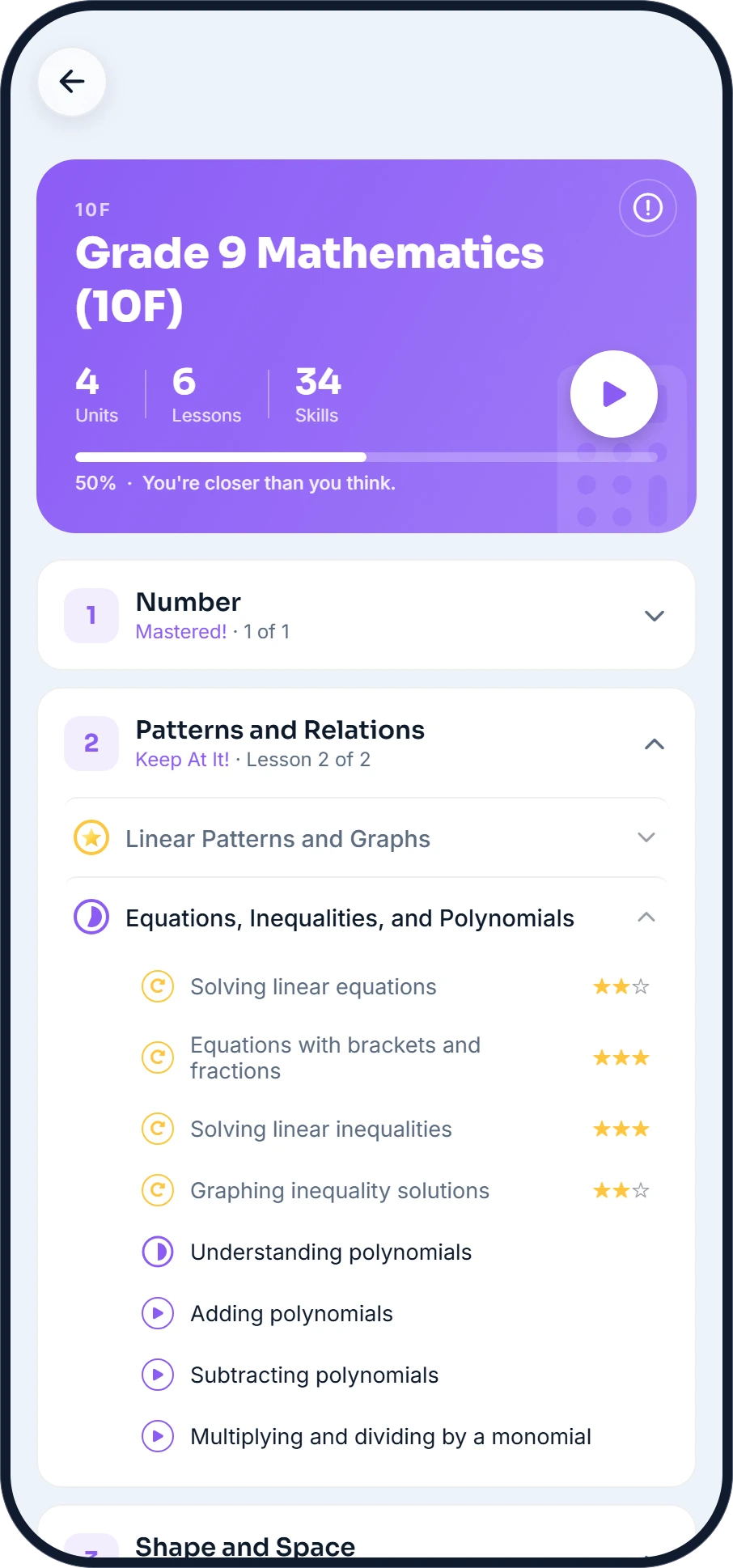
Grade 9 Mathematics (10F) in MapleMind on a tablet: its units and lessons in order, a student partway through.Grade 9 Mathematics (10F) in MapleMind on a phone: its units and lessons in order, a student partway through.
Their course, unit by unit, the way Manitoba teaches it.Shown: Grade 9 Mathematics (10F)
Homework Help on a tablet: a photo of a worksheet, the tutor’s worked example of a two-step equation, and a question back to the student.Homework Help on a phone: a photo of a worksheet, the tutor’s worked example of a two-step equation, and a question back to the student.
Homework Help: they take a photo of the question, and the tutor works through it with them.
The Parent Dashboard on a tablet: a student’s days studied, streak, lessons, quiz average and recent activity.The Parent Dashboard on a phone: a student’s days studied, streak, lessons, quiz average and recent activity.
The Parent Dashboard: how each child’s week went, in lessons, quizzes and days studied.
A Grade 9 provincial mathematics exam on a tablet: a readiness score, the exam’s time and its next sitting.A Grade 9 provincial mathematics exam on a phone: a readiness score, the exam’s time and its next sitting.
A provincial exam: a practice sitting under the real time, and how ready they are.
The Learn tab on a tablet: a four-day streak, the week’s days, Homework Help, the next lesson and a review.The Learn tab on a phone: a four-day streak, the week’s days, Homework Help, the next lesson and a review.
The Learn tab: their week so far, and the next thing to do.

Help at home

Questions parents ask

What will my child learn in Grade 7 in Manitoba?

Math: Mathematics, Grade 7. Science: Science, Grade 7. English: English Language Arts, Grade 7. French: Core French, Grade 7. Social studies: Social Studies, Grade 7. That’s 220 skills in all, from Manitoba’s curriculum.

Does my child write a provincial exam in Grade 7?

No. Manitoba has no provincial exam in Grade 7.

Where does this list come from?

From Manitoba’s official curriculum, the documents its education ministry publishes for each course. Each skill here is one of their expectations, written in plain words.

Can MapleMind help my child in Grade 7?

Yes. Every course on this page is in MapleMind, with lessons, practice and a tutor that works through each step with them. A free account gets 30 messages and 4 activities a day.

Help with Grade 7, one skill at a time.

Every course on this page is in MapleMind, free with daily limits.