Manitoba · For parents

What your child learns in Grade 8 in Manitoba

Every subject, unit by unit, from Manitoba’s curriculum: 218 skills in plain words.

Subjects
5
Skills
218
Provincial exams
None
Official curriculum
edu.gov.mb.ca

Math in Grade 8

Mathematics, Grade 8

4 units · 20 skills

  1. Unit 1

    Number

    A perfect square can be arranged as a square region, like 16 = 4 x 4.

    • Perfect squares and square roots
    • Approximate square roots
    • Percents beyond 100% and below 1%
    5 more skills
    • Ratio and rate
    • Proportional reasoning
    • Multiplying and dividing fractions
    • Multiplying and dividing integers
    • Positive rational number problems
  2. Unit 2

    Patterns and Relations

    A two-variable linear relation pairs each x with a y by a rule.

    • Graphing two-variable linear relations
    • Solving linear equations
    • Equations with the distributive property
  3. Unit 3

    Shape and Space

    In a right triangle, the squares of the two legs add to the square of the hypotenuse.

    • The Pythagorean theorem
    • Nets for 3-D objects
    • Surface area of prisms and cylinders
    4 more skills
    • Volume of prisms and cylinders
    • Top, front, and side views
    • What tessellates and why
    • Creating and finding tessellations
  4. Unit 4

    Statistics and Probability

    Different graphs suit different data and have strengths and limitations.

    • Critiquing data displays
    • Probability of independent events

Science in Grade 8

Science, Grade 8

5 units · 70 skills

  1. Unit 1

    Scientific Skills and Inquiry

    A prototype is a working model that tests whether a design idea solves a practical problem.

    • Construct a prototype
    • Construct graphs to display data, and interpret and evaluate these and other graphs
    • Select and use tools to observe, measure, and construct.
    1 more skill
    • Estimate and measure accurately using SI and other standard units
  2. Unit 2

    Cells and Systems

    The cell theory explains that all living things are made of cells; unicellular organisms are a single cell and multicellular organisms are made of many.

    • Use appropriate vocabulary related to their investigations of cells and systems
    • Identify characteristics of living things, and describe how different living things exhibit these characteristics
    • Describe cell theory
    16 more skills
    • Identify major events and technological innovations that have enabled scientists to increase our understanding of cell biology
    • Identify and compare major structures in plants and animal cells, and explain their function
    • Demonstrate proper use and care of the microscope to observe the general structure of plant and animal cells
    • Describe the movement of nutrients and wastes across cell membranes and explain its importance
    • Differentiate between unicellular and multicellular organisms
    • Describe why cells and tissues are specialized in multicellular organisms, and observe examples
    • Describe structural and functional relationships among cells, tissues, organs, and systems
    • Describe the structure and function of the heart and the path of blood to and from the heart
    • Compare and contrast the structure and function of arteries, veins, and capillaries
    • Identify components of blood and describe the function of each
    • Describe, using examples, how individual systems in the human body function interdependently
    • Compare heart rate and respiratory rate before, during, and after various physical activities; explain the observed variations; and discuss implications for overall health
    • Identify components of the primary and secondary defence systems of the human body, and describe their roles
    • Identify medical advances that enhance the human body’s defence mechanisms and describe their effects on society
    • Research and describe disorders/diseases that affect body systems
    • Describe functional similarities and differences of comparable structures and systems in different groups of living things
  3. Unit 3

    Optics

    The visible spectrum is the band of colours in white light, from red, with the longest wavelength, to violet, with the shortest.

    • Use appropriate vocabulary related to their investigations of optics.
    • Differentiate between incandescent and luminescent sources of light
    • Demonstrate that light is a form of energy, that light travels in a straight line, and can be separated into the visible light spectrum
    11 more skills
    • Explain, using the additive theory, how colours are produced, and identify applications of this theory in daily life
    • Explain how the human eye detects colour, and how the ability to perceive colour may vary from person to person
    • Demonstrate, using the subtractive theory, how colours are produced, and identify applications of this theory in daily life
    • Compare and contrast various types of electromagnetic radiation, with respect to relative energy, frequency, wavelength, and human perception
    • Provide examples of technologies that use electromagnetic radiation
    • Conduct experiments to determine the law of reflection
    • Conduct experiments to compare the refraction of light through substances of different densities
    • Explain how reflection and refraction produce natural phenomena
    • Investigate to determine how light interacts with concave and convex mirrors and lenses
    • Demonstrate the formation of images using a double convex lens, and predict the effects of changes in lens position on the size and location of the image
    • Compare the functional operation of the human eye to that of a camera in focussing an image
  4. Unit 4

    Fluids

    A fluid is any substance that can flow, which includes all liquids and gases; viscosity is a fluid's resistance to flow.

    • Use appropriate vocabulary related to their investigations of fluids.
    • Distinguish between fluids and non-fluids
    • Explore and compare the viscosity of various liquids
    11 more skills
    • Identify products in which viscosity is an important property, and evaluate different brands of the same product, using the design process
    • Plan and conduct experiments to determine factors that affect flow within a given system
    • Measure, calculate, and compare densities of solids, liquids, and gases
    • Illustrate, using the particle theory of matter, the effects of temperature change on the density of solids, liquids, and gases
    • Compare fluids of different densities to determine how they alter the buoyant force on an object
    • Recognize that pressure is the relationship between force and area
    • Explain, using the particle theory of matter, the relationships among pressure, volume, and temperature of liquid and gaseous fluids
    • Compare the relative compressibility of water and air
    • Identify a variety of natural and constructed hydraulic and pneumatic systems and describe how they function
    • Compare hydraulic and pneumatic systems, and identify advantages and disadvantages of each
    • Use the design process to construct a prototype that uses a pneumatic or hydraulic system
  5. Unit 5

    Water Systems

    Heat capacity is the amount of heat needed to warm a substance; water's is high, so water warms and cools slowly.

    • Use appropriate vocabulary related to their investigations of water systems
    • Demonstrate that water, as compared to other substances, has a high heat capacity and is able to dissolve a wide variety of solutes
    • Compare and contrast characteristics and properties of fresh water and salt water
    16 more skills
    • Identify factors that can work individually or in combination to affect ocean currents
    • Describe how the heat capacity of large bodies of water and the movement of ocean currents influence regional climates
    • Describe the components of the global water cycle and explain how it works
    • Describe features of the North American drainage system
    • Describe how erosion and deposition are influenced by the flow rate of a stream or river
    • Describe how wave action and ice movement in large bodies of water cause erosion and deposition
    • Explain how tides are caused and describe their effects on shorelines
    • Describe examples of human interventions to prevent riverbank or coastal erosion
    • Identify factors that can cause flooding either individually or in combination
    • Provide examples of the way in which technology is used to contain or prevent damage due to flooding, and discuss related positive and negative impacts
    • Identify sources of drinking water and describe methods for obtaining water in areas where supply is limited
    • Explain how and why water may need to be treated for use by humans
    • Compare the waste-water disposal system within their communities to one used elsewhere
    • Identify substances that may pollute water
    • Identify environmental, social, and economic factors that should be considered in the management of water resources
    • Use the design process to develop a system to solve a water-related problem

English in Grade 8

English Language Arts, Grade 8

4 units · 47 skills

  1. Unit 1

    Explore and Discover Language and Literacy

    • Listening critically to the ideas of others
    • Using non-verbal cues and conventions when listening
    • Interacting to exchange and consider ideas
    6 more skills
    • Asking questions to explore and critique ideas
    • Using the rules and structures of oral language
    • Adapting spoken language to audience and purpose
    • Applying morphology to understand and spell words
    • Building and using precise vocabulary
    • Applying fluency to comprehend text
  2. Unit 2

    Comprehend and Respond to Multimodal Texts

    • Activating prior knowledge to understand new text
    • Generating questions to drive inquiry
    • Engaging with a variety of multimodal texts
    12 more skills
    • Reviewing information and filling gaps
    • Understanding how text form and structure carry meaning
    • Using text features and cues to comprehend
    • Making and confirming predictions
    • Making connections to deepen meaning
    • Using strategies to monitor understanding
    • Summarizing key ideas and drawing conclusions
    • Consolidating and communicating new knowledge
    • Analyzing how texts present diversity and equity
    • Identifying stereotyping, bias and reliable sources
    • Identifying point of view and judging viewpoints
    • Responding personally to bias and prejudice
  3. Unit 3

    Compose and Create Multimodal Texts

    • Generating ideas and focusing a topic
    • Gathering and assessing information from sources
    • Planning text creation with strategies and tools
    12 more skills
    • Choosing text forms for purpose and audience
    • Creating multimodal texts
    • Organizing ideas with structure and paragraphs
    • Crafting varied, correct sentences
    • Choosing precise, impactful words
    • Developing personal voice and tone
    • Revising for clarity, logic and coherence
    • Producing legible, well-formatted text
    • Applying spelling strategies and word structure
    • Applying capitalization conventions
    • Applying punctuation for clarity
    • Publishing a final multimodal text
  4. Unit 4

    Communicate Ideas and Build New Understandings

    • Adjusting tone, volume and expression for delivery
    • Using visuals and media to enhance communication
    • Organizing and presenting ideas for an audience
    5 more skills
    • Reflecting on effective learning strategies
    • Using criteria and tools to self-assess
    • Using feedback to refine strategies
    • Setting learning goals and planning steps
    • Monitoring progress toward goals

French in Grade 8

Core French, Grade 8

4 units · 20 skills

  1. Unit 1

    Oral Communication

    Building on Grade 7, respond to a wider variety of messages - retell important information in the sequence of events and give a reasoned opinion.

    • Understanding messages and following multi-step directions
    • Listening strategies and note-taking
    • Introducing yourself and describing with detail
    4 more skills
    • Describing places, things, and activities
    • Needs, inversion questions, and directions
    • Fluency
    • Accuracy
  2. Unit 2

    Reading

    Building on Grade 7, describe the main character with EVIDENCE from the text: 'Le personnage principal est sportif et amusant. En plus, il adore jouer au football.'.

    • Understanding multi-paragraph texts
    • Responding to and organizing text
    • Summarizing and comparing text to life
    1 more skill
    • Reading aloud with fluency and accuracy
  3. Unit 3

    Writing

    Building on Grade 7, write with a clear purpose for a specific audience across paragraph texts.

    • Purpose, structure, and introducing yourself in writing
    • Describing places, things, and asking in writing
    • Fluency: varied sentences with autonomy
    1 more skill
    • Accuracy: grammar, tenses, and conventions
  4. Unit 4

    Culture

    Building on Grade 7, connect world communities to specific CULTURAL ELEMENTS (food, festivals, interesting facts) and give justified opinions.

    • Francophone communities around the world
    • Connecting to world francophone cultures
    • Forms of address and false cognates
    2 more skills
    • Reasons and benefits of learning French
    • Bilingualism and French in daily life

Social studies in Grade 8

Social Studies, Grade 8

5 units · 61 skills

  1. Unit 1

    Understanding Societies Past and Present

    A world view is the set of beliefs and assumptions through which a society sees the world.

    • The concept of world view
    • What creates differences in world views
    • Society and civilization
    8 more skills
    • Why societies stay the same or change
    • How societies organize and continue
    • Sources of historical evidence
    • Why knowing the past matters
    • Stories and theories of human origins
    • The hunter-gatherer way of life
    • The rise of agrarian societies
    • The environment and the growth of societies
  2. Unit 2

    Early Societies of Mesopotamia, Egypt, or the Indus Valley

    Early societies grew along rivers like the Tigris, Euphrates, Nile, or Indus.

    • Landforms, water, and population of the early society
    • The environment and ways of life
    • Life for various groups in the early society
    6 more skills
    • Art, architecture, and science
    • People, events, and ideas of the early society
    • The development of writing
    • Governance in the early society
    • Technologies and tools
    • Defining characteristics of early civilizations
  3. Unit 3

    Ancient Societies of Greece and Rome

    Ancient Greek society had citizens, non-citizens, women, and enslaved people.

    • Social organization of ancient Greece
    • The rise of democracy in ancient Greece
    • Citizenship: ancient Greece and Canada
    12 more skills
    • Sparta and Athens
    • Myths in ancient Greek culture
    • The origins of the rule of law
    • The expansion of the Roman Empire
    • Structures of governance in ancient Rome
    • War and territorial expansion in Rome
    • The rise and decline of Greece and Rome
    • People, events, and ideas of Greece and Rome
    • How Greece and Rome shaped today's world
    • Technologies and achievements of Greece and Rome
    • Trade and the exchange of ideas in Rome
    • Ancient civilizations, 500 BCE to 500 CE
  4. Unit 4

    Transition to the Modern World (Circa 500 to 1400)

    When the Western Roman Empire fell, Europe broke into smaller kingdoms.

    • The fall of the Western Roman Empire
    • Characteristics of medieval Europe
    • The Catholic Church in medieval Europe
    12 more skills
    • Work and education in medieval Europe
    • Motivations and consequences of the Crusades
    • The Arab conquests
    • Islamic achievements, 7th to 15th centuries
    • The Viking invasions
    • The Mongol Empire
    • China as an advanced civilization
    • Major events, 5th to 15th centuries
    • The spread of ideas and technologies
    • Achievements in diverse societies
    • The Ottoman Empire
    • Technological developments, 5th to 15th centuries
  5. Unit 5

    Shaping the Modern World (Circa 1400 to 1850)

    The Renaissance was a rebirth of art, learning, and ideas in Europe from the 1300s to 1500s.

    • The Renaissance
    • Individuals and significance of the Renaissance
    • The Protestant Reformation
    8 more skills
    • Major events, 15th to 18th centuries
    • Voyages of European explorers
    • Motivations and impact of global exploration
    • Europeans and indigenous peoples
    • Science and technology, 15th to 19th centuries
    • The Industrial Revolution
    • World religions of antiquity
    • The continuing influence of past societies

MapleMind

See Grade 8 in MapleMind

Real screens from the app your child would use.

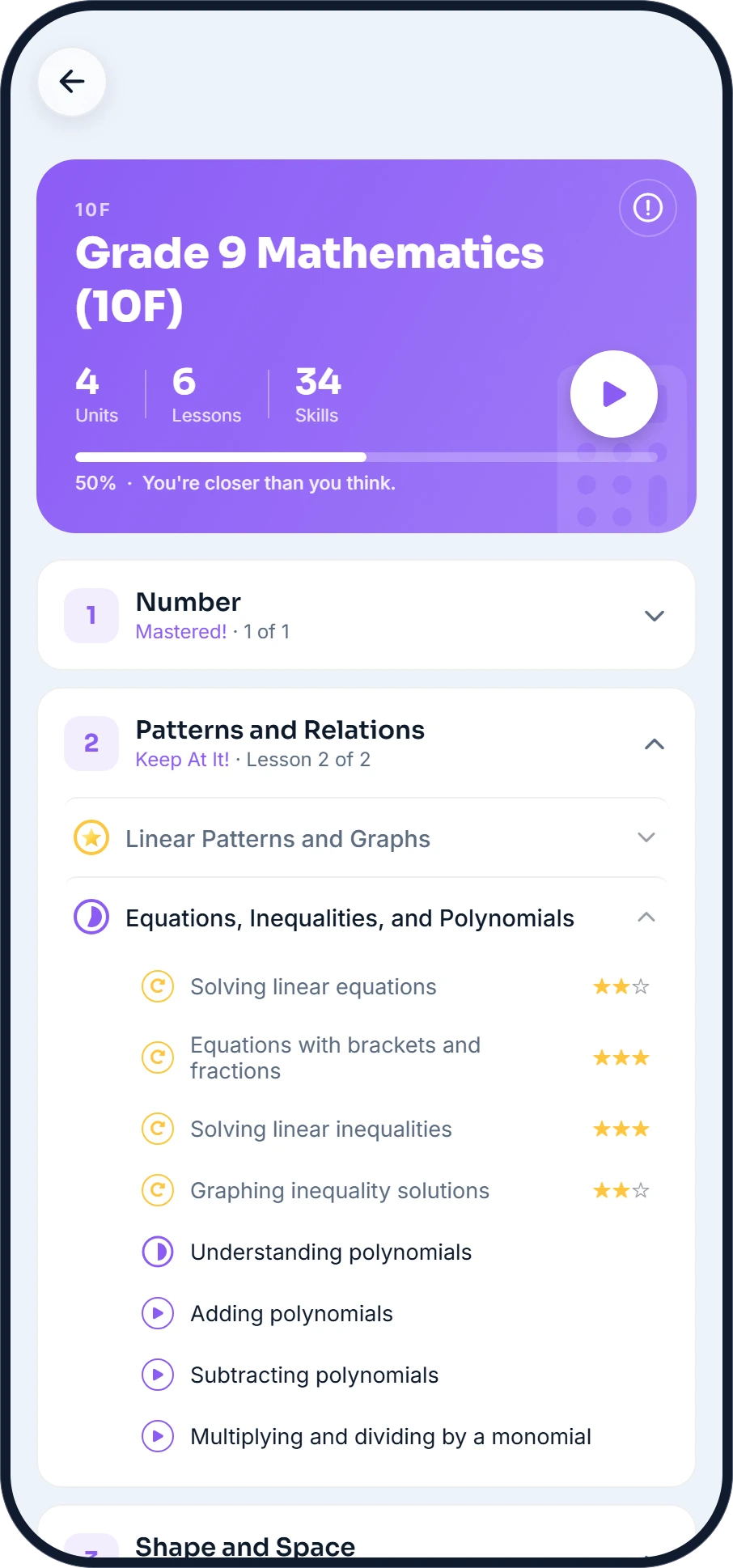
Grade 9 Mathematics (10F) in MapleMind on a tablet: its units and lessons in order, a student partway through.Grade 9 Mathematics (10F) in MapleMind on a phone: its units and lessons in order, a student partway through.
Their course, unit by unit, the way Manitoba teaches it.Shown: Grade 9 Mathematics (10F)
Homework Help on a tablet: a photo of a worksheet, the tutor’s worked example of a two-step equation, and a question back to the student.Homework Help on a phone: a photo of a worksheet, the tutor’s worked example of a two-step equation, and a question back to the student.
Homework Help: they take a photo of the question, and the tutor works through it with them.
The Parent Dashboard on a tablet: a student’s days studied, streak, lessons, quiz average and recent activity.The Parent Dashboard on a phone: a student’s days studied, streak, lessons, quiz average and recent activity.
The Parent Dashboard: how each child’s week went, in lessons, quizzes and days studied.
A Grade 9 provincial mathematics exam on a tablet: a readiness score, the exam’s time and its next sitting.A Grade 9 provincial mathematics exam on a phone: a readiness score, the exam’s time and its next sitting.
A provincial exam: a practice sitting under the real time, and how ready they are.
The Learn tab on a tablet: a four-day streak, the week’s days, Homework Help, the next lesson and a review.The Learn tab on a phone: a four-day streak, the week’s days, Homework Help, the next lesson and a review.
The Learn tab: their week so far, and the next thing to do.

Help at home

Questions parents ask

What will my child learn in Grade 8 in Manitoba?

Math: Mathematics, Grade 8. Science: Science, Grade 8. English: English Language Arts, Grade 8. French: Core French, Grade 8. Social studies: Social Studies, Grade 8. That’s 218 skills in all, from Manitoba’s curriculum.

Does my child write a provincial exam in Grade 8?

No. Manitoba has no provincial exam in Grade 8.

Where does this list come from?

From Manitoba’s official curriculum, the documents its education ministry publishes for each course. Each skill here is one of their expectations, written in plain words.

Can MapleMind help my child in Grade 8?

Yes. Every course on this page is in MapleMind, with lessons, practice and a tutor that works through each step with them. A free account gets 30 messages and 4 activities a day.

Help with Grade 8, one skill at a time.

Every course on this page is in MapleMind, free with daily limits.