Get help with Social Studies, Grade 8
Most tutoring makes you sit through material you already know. MapleMind flips that: pick the exact skill that's causing trouble — any of the 61 below — and the tutor teaches just that one, step by step, as many times as it takes. Ask questions in plain words, any time of day, in English, French, or 12 other languages.
The official Manitoba Social Studies, Grade 8 curriculum
Manitoba defines Social Studies, Grade 8 by strands and outcomes. MapleMind teaches the same curriculum reorganized for one-skill-at-a-time tutoring — the table shows exactly where every official strand lands, and the ministry's own wording is quoted under each unit below.
Official source Manitoba's official curriculumRead it on the government site — edu.gov.mb.ca ↗| Official strand | Outcomes | Where MapleMind teaches it |
|---|---|---|
| Strand I0 | 11 | Understanding Societies Past and Present |
| Strand G1 | 9 | Early Societies of Mesopotamia, Egypt, or the Indus Valley |
| Strand C1 | 15 | Ancient Societies of Greece and Rome |
| Strand H4 | 15 | Transition to the Modern World (Circa 500 to 1400) |
| Strand G5 | 11 | Shaping the Modern World (Circa 1400 to 1850) |
Every skill below, taught one on one.
 Try the first session free
How MapleMind teaches Social Studies, Grade 8 — every unit, lesson, and skill
Every skill below runs as a short session: a plain-words lesson, a worked example, solving it together, then a five-question skill check that earns up to three stars. Guided Mode keeps it teaching instead of answer-handing — turning it off needs a parent's password.
Unit 1Understanding Societies Past and PresentOfficial strand · Strand I0
Cluster 1: how to study societies — world views, society and civilization, why societies change, historical evidence, human origins, hunter-gatherers, agrarian societies, and the environment.
World Views and Societies
- The concept of world viewKI-005 — Explain the concept of world view.
- What creates differences in world viewsKI-006 — Describe influences that create differences in world views.
- Society and civilizationKI-007 — Compare and contrast the concepts of society and civilization.
- Why societies stay the same or changeKI-008 — Give reasons why societies may stay the same or change over time.
- How societies organize and continueKI-009 — Describe ways in which societies organize, maintain, and perpetuate themselves.
- Sources of historical evidenceKH-027 — Identify sources of historical evidence and explain how each enhances understanding of the past.
- Why knowing the past mattersKH-028 — Explain the importance of knowing the past and understanding history.
- Stories and theories of human originsKI-010 — Relate various stories and theories of the origin and development of human life.
- The hunter-gatherer way of lifeKI-011 — Identify the characteristics, advantages, and disadvantages of a hunter-gatherer way of life.
- The rise of agrarian societiesKI-012 — Describe the development of agrarian societies and how they differed from hunter-gatherers.
- The environment and the growth of societiesKL-022 — Give examples of the influence of the natural environment on the development of societies.
The official wording — 11 outcomes in this unit
- KI-005
Explain the concept of world view.
- KI-006
Describe influences that create differences in world views.
- KI-007
Compare and contrast the concepts of society and civilization.
- KI-008
Give reasons why societies may stay the same or change over time.
- KI-009
Describe ways in which societies organize, maintain, and perpetuate themselves.
- KH-027
Identify various sources of historical evidence and information and explain how each enhances understanding of the past.
- KH-028
Explain the importance of knowing the past and understanding history.
- KI-010
Relate various stories and theories of the origin and development of human life.
- KI-011
Identify the characteristics, advantages, and disadvantages of a hunter-gatherer way of life.
- KI-012
Describe the development of agrarian societies and explain how they differed from hunter-gatherer societies.
- KL-022
Give examples of the influence of the natural environment on the development of societies.
Unit 2Early Societies of Mesopotamia, Egypt, or the Indus ValleyOfficial strand · Strand G1
Cluster 2: an in-depth study of one early river-valley society — its geography, groups, art and science, people and writing, governance, tools, and defining characteristics.
Early Societies of the River Valleys
- Landforms, water, and population of the early societyKL-023 — Locate on a map the major landforms, bodies of water, and population clusters of a society of Mesopotamia, Egypt, or the Indus Valley.
- The environment and ways of lifeKL-024 — Give examples of the influence of the natural environment on ways of life in the early society.
- Life for various groups in the early societyKI-013 — Describe life for various groups in an early society of Mesopotamia, Egypt, or the Indus Valley.
- Art, architecture, and scienceKI-014 — Describe the art, architecture, and science of an early society of Mesopotamia, Egypt, or the Indus Valley.
- People, events, and ideas of the early societyKH-029 — Identify people, events, and ideas in an early society of Mesopotamia, Egypt, or the Indus Valley.
- The development of writingKH-030 — Describe the impact and significance of the development of writing in the early society.
- Governance in the early societyKP-045 — Describe governance in an early society of Mesopotamia, Egypt, or the Indus Valley.
- Technologies and toolsKE-054 — Describe technologies and tools in an early society of Mesopotamia, Egypt, or the Indus Valley.
- Defining characteristics of early civilizationsKG-038 — Identify defining characteristics of societies in Mesopotamia, Egypt, the Indus Valley, and China, from 3500 to 500 BCE.
The official wording — 9 outcomes in this unit
- KL-023
Locate on a map the major landforms, bodies of water, and population clusters of a society of Mesopotamia, Egypt, or the Indus Valley.
- KL-024
Give examples of the influence of the natural environment on ways of life in an early society of Mesopotamia, Egypt, or the Indus Valley.
- KI-013
Describe life for various groups in an early society of Mesopotamia, Egypt, or the Indus Valley.
- KI-014
Describe the art, architecture, and science of an early society of Mesopotamia, Egypt, or the Indus Valley.
- KH-029
Identify people, events, and ideas in an early society of Mesopotamia, Egypt, or the Indus Valley.
- KH-030
Describe the impact and significance of the development of writing in an early society of Mesopotamia, Egypt, or the Indus Valley.
- KP-045
Describe governance in an early society of Mesopotamia, Egypt, or the Indus Valley.
- KE-054
Describe technologies and tools in an early society of Mesopotamia, Egypt, or the Indus Valley.
- KG-038
Identify defining characteristics of societies in Mesopotamia, Egypt, the Indus Valley, and China, from 3500 to 500 BCE.
Unit 3Ancient Societies of Greece and RomeOfficial strand · Strand C1
Cluster 3: ancient Greece and Rome — citizenship and democracy, Sparta and Athens, myths, the rule of law, Roman governance and expansion, their lasting influence, and ancient civilizations.
Ancient Greece
- The rise of democracy in ancient GreeceKC-002 — Describe the rise of democracy in ancient Greece.
- Citizenship: ancient Greece and CanadaKC-003 — Compare criteria for citizenship and participation in government in ancient Greece and contemporary Canada.
- Sparta and AthensKI-015 — Compare and contrast life in Sparta and Athens.
- Myths in ancient Greek cultureKI-016 — Describe the importance of myths in ancient Greek culture.
- The origins of the rule of lawKC-004 — Identify the origins and significance of the rule of law.
Ancient Rome
- The expansion of the Roman EmpireKL-025 — Illustrate on a map the expansion of the Roman Empire.
- Structures of governance in ancient RomeKP-047 — Describe structures of governance in ancient Rome.
- War and territorial expansion in RomeKP-048 — Describe the nature of war and territorial expansion in the Roman Empire.
- The rise and decline of Greece and RomeKP-046 — Identify factors that influenced the rise and decline of ancient Greece and Rome.
- People, events, and ideas of Greece and RomeKH-031 — Identify significant people, events, and ideas in ancient Greece and Rome.
- How Greece and Rome shaped today's worldKH-032 — Identify ways in which today's world has been influenced by the ideas of ancient Greece and Rome.
- Technologies and achievements of Greece and RomeKE-056 — Describe technologies and achievements in ancient Greece and Rome.
- Trade and the exchange of ideas in RomeKE-055 — Describe the influence of trade on the exchange of ideas within the Roman Empire and beyond.
- Ancient civilizations, 500 BCE to 500 CEKG-039 — Identify defining characteristics of the ancient civilizations of China, Greece, Rome, Persia, and the Mayans from 500 BCE to 500 CE.
The official wording — 15 outcomes in this unit
- KC-001
Describe the social organization of ancient Greece.
- KC-002
Describe the rise of democracy in ancient Greece.
- KC-003
Compare criteria for citizenship and participation in government in ancient Greece and in contemporary Canada.
- KI-015
Compare and contrast life in Sparta and Athens.
- KI-016
Describe the importance of myths in ancient Greek culture.
- KC-004
Identify the origins and significance of the rule of law.
- KL-025
Illustrate on a map the expansion of the Roman Empire.
- KP-047
Describe structures of governance in ancient Rome.
- KP-048
Describe the nature of war and territorial expansion in the Roman Empire.
- KP-046
Identify factors that influenced the rise and decline of ancient Greece and Rome.
- KH-031
Identify significant people, events, and ideas in ancient Greece and Rome.
- KH-032
Identify ways in which today’s world has been influenced by the ideas of ancient Greece and Rome.
- KE-056
Describe technologies and achievements in ancient Greece and Rome.
- KE-055
Describe the influence of trade on the exchange of ideas within the Roman Empire and between Rome and other places in the world.
- KG-039
Identify defining characteristics of the ancient civilizations of China, Greece, Rome, Persia, and the Mayans from 500 BCE to 500 CE.
Unit 4Transition to the Modern World (Circa 500 to 1400)Official strand · Strand H4
Cluster 4: the medieval world — the fall of Rome, medieval Europe and the Church, the Crusades, the Arab conquests and Islamic achievements, the Vikings, the Mongols, China, and global exchange.
Transition to the Modern World (Circa 500 to 1400)
- The fall of the Western Roman EmpireKH-033 — Identify the consequences of the fall of the Western Roman Empire.
- Characteristics of medieval EuropeKH-035 — Describe characteristics of medieval Europe.
- The Catholic Church in medieval EuropeKP-052 — Describe the influence of the Catholic Church in medieval Europe.
- Work and education in medieval EuropeKE-057 — Identify how work and education were organized in medieval Europe.
- Motivations and consequences of the CrusadesKH-034 — Identify motivations for and consequences of the Crusades.
- The Arab conquestsKP-049 — Locate and describe the Arab conquests in the Middle East, North Africa, India, and southern Europe.
- Islamic achievements, 7th to 15th centuriesKI-018 — Identify Islamic achievements from the seventh to fifteenth centuries and how they influenced other societies.
- The Viking invasionsKP-050 — Locate and describe the impact of the Viking invasions on Europe from the ninth to twelfth centuries.
- The Mongol EmpireKP-051 — Locate and describe the expansion of the Mongol Empire into China, Europe, and the Middle East.
- China as an advanced civilizationKI-019 — Explain why China may be regarded as one of the most advanced civilizations of the fifth to fifteenth centuries.
- Major events, 5th to 15th centuriesKG-040 — Identify major events in Europe, the Middle East, Africa, Asia, and the Americas from the fifth to fifteenth centuries.
- The spread of ideas and technologiesKG-041 — Describe the significance of the spread of ideas and technologies between societies from the fifth to fifteenth centuries.
- Achievements in diverse societiesKG-042 — Give examples of achievements in art, architecture, literature, and science in diverse societies from the fifth to fifteenth centuries.
- The Ottoman EmpireKP-053 — Locate and describe the nature of the Ottoman Empire and its expansion into the Middle East, North Africa, India, and Europe.
- Technological developments, 5th to 15th centuriesKE-058 — Describe the impact of technological developments from the fifth to fifteenth centuries.
The official wording — 15 outcomes in this unit
- KH-033
Identify the consequences of the fall of the Western Roman Empire.
- KH-035
Describe characteristics of medieval Europe.
- KP-052
Describe the influence of the Catholic Church in medieval Europe.
- KE-057
Identify how work and education were organized in medieval Europe.
- KH-034
Identify motivations for and consequences of the Crusades.
- KP-049
Locate on a map and describe the Arab conquests in the Middle East, North Africa, India, and southern Europe in the seventh and eighth centuries.
- KI-018
Identify Islamic achievements from the seventh to fifteenth centuries and describe how they influenced other societies.
- KP-050
Locate on a map and describe the impact of the Viking invasions on Europe from the ninth to twelfth centuries.
- KP-051
Locate on a map and describe the expansion of the Mongol Empire into China, Europe, and the Middle East in the thirteenth century.
- KI-019
Explain why China may be regarded as one of the most advanced civilizations of the fifth to fifteenth centuries.
- KG-040
Identify major events in Europe, the Middle East, Africa, Asia, and the Americas from the fifth to fifteenth centuries.
- KG-041
Describe the significance of the spread of ideas and technologies between societies from the fifth to fifteenth centuries.
- KG-042
Give examples of achievements in art, architecture, literature, and science in diverse societies from the fifth to fifteenth centuries.
- KP-053
Locate on a map and describe the nature of the Ottoman Empire and its expansion into the Middle East, North Africa, India, and Europe from the fourteenth to sixteenth centuries.
- KE-058
Describe the impact of technological developments from the fifth to fifteenth centuries.
Unit 5Shaping the Modern World (Circa 1400 to 1850)Official strand · Strand G5
Cluster 5: the making of the modern world — the Renaissance, the Reformation, global exploration and its impact on indigenous peoples, science and technology, the Industrial Revolution, and world religions.
Shaping the Modern World (Circa 1400 to 1850)
- The RenaissanceKI-020 — Give examples of the expression of the Renaissance in art, architecture, philosophy, literature, science, or technology.
- Individuals and significance of the RenaissanceKH-036 — Identify individuals and ideas of the Renaissance and describe the historical significance of this period.
- The Protestant ReformationKH-037 — Identify individuals and ideas of the Protestant Reformation and describe the historical significance of this movement.
- Major events, 15th to 18th centuriesKG-043 — Identify major events in Europe, Africa, Asia, Australasia, and the Americas during the fifteenth to eighteenth centuries.
- Voyages of European explorersKL-026 — Illustrate on a world map the voyages of European explorers during the fifteenth to eighteenth centuries.
- Motivations and impact of global explorationKG-044 — Explain the motivations for and the impact of global exploration and territorial expansion from the fifteenth to eighteenth centuries.
- Europeans and indigenous peoplesKI-021 — Give examples of the impact of interactions between Europeans and indigenous peoples of Africa, Asia, Australasia, and the Americas.
- Science and technology, 15th to 19th centuriesKE-059 — Describe the impact of advances in science and technology on societies from the fifteenth to nineteenth centuries.
- The Industrial RevolutionKE-060 — Describe the impact of the Industrial Revolution on individuals and societies.
- World religions of antiquityKI-017 — Identify defining characteristics of world religions that emerged in antiquity.
- The continuing influence of past societiesKE-061 — Give examples of the continuing influence of ideas and technologies of past societies.
The official wording — 11 outcomes in this unit
- KI-020
Give examples of the expression of the Renaissance in its art, architecture, philosophy, literature, science, or technology from the fourteenth to sixteenth centuries.
- KH-036
Identify individuals and ideas of the Renaissance and describe the historical significance of this period.
- KH-037
Identify individuals and ideas of the Protestant Reformation during the sixteenth century and describe the historical significance of this movement.
- KG-043
Identify major events in Europe, Africa, Asia, Australasia, and the Americas during the fifteenth to eighteenth centuries.
- KL-026
Illustrate on a world map the voyages of European explorers during the fifteenth to eighteenth centuries.
- KG-044
Explain the motivations for and the impact of global exploration and territorial expansion from the fifteenth to eighteenth centuries.
- KI-021
Give examples of the impact of interactions between Europeans and indigenous peoples of Africa, Asia, Australasia, and the Americas from the fifteenth to nineteenth centuries.
- KE-059
Describe the impact of advances in science and technology on societies from the fifteenth to nineteenth centuries.
- KE-060
Describe the impact of the Industrial Revolution on individuals and societies.
- KI-017
Identify defining characteristics of world religions that emerged in antiquity.
- KE-061
Give examples of the continuing influence of ideas and technologies of past societies.
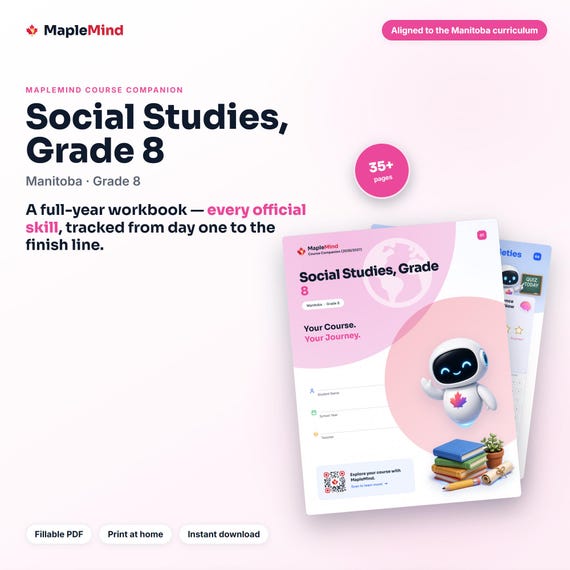



Printable workbook · A keepsake of the year
A Social Studies, Grade 8 workbook worth keeping
Built from the same official curriculum as this page. Before and after each skill above, your student colours in how sure they feel — so the two of you can see, on one page, what's clicking and what needs another look. It's a quiet way to follow how the year is really going.
By June it's full of their own handwriting: units worked through, confidence grown, a mid-year check-in, notes from parent-teacher night, and a certificate at the end. Less a worksheet, more a record of the year worth keeping on the shelf.
Instant download · see every page, reviews and the full description · five or more workbooks are $2.99 each
What it looks like in the app



Common questions
Can MapleMind help me with Social Studies, Grade 8?
Yes. MapleMind's AI tutor covers all 61 skills in Manitoba's Social Studies, Grade 8 — you pick the exact skill, and the tutor teaches it step by step: a short lesson, a worked example, solving together, then a skill check to show it stuck.
Is MapleMind aligned to Manitoba's official curriculum?
Yes. Every skill in this course maps to an official outcome code from Manitoba's Grade 8 Social Studies curriculum, and the ministry's own wording is quoted under each unit on this page — with the official government source linked so you can check it yourself.
What does MapleMind cost?
It's free to start — 5 tutoring chats and a practice quiz every day, no credit card. A Pro subscription ($9.99/month or $49.99/year CAD, 7-day free trial) unlocks unlimited tutoring, practice, and exam simulations.
What if I'm stuck on just one topic?
That's the point of skill-level tutoring: open Social Studies, Grade 8 in the app, tap the exact skill from the list on this page, and the tutor teaches just that — no wading through lessons you don't need.
Does MapleMind work in French or other languages?
Yes — 14 languages, including French. Both the app and the tutor's explanations switch to the language you choose.
Where can I see the official Manitoba curriculum for Social Studies, Grade 8?
The official source is linked on this page — Manitoba's official curriculum. The outline here follows it: every MapleMind skill carries its official outcome code, and the ministry's own wording is quoted under each unit.
Keep exploring
Ready when you are
Pick a skill from this page and see it taught properly — free, in the browser, in under a minute.