Get help with Social Studies, Grade 9 (Canada in the Contemporary World)
Most tutoring makes you sit through material you already know. MapleMind flips that: pick the exact skill that's causing trouble — any of the 60 below — and the tutor teaches just that one, step by step, as many times as it takes. Ask questions in plain words, any time of day, in English, French, or 12 other languages.
The official Manitoba Social Studies, Grade 9 (Canada in the Contemporary World) curriculum
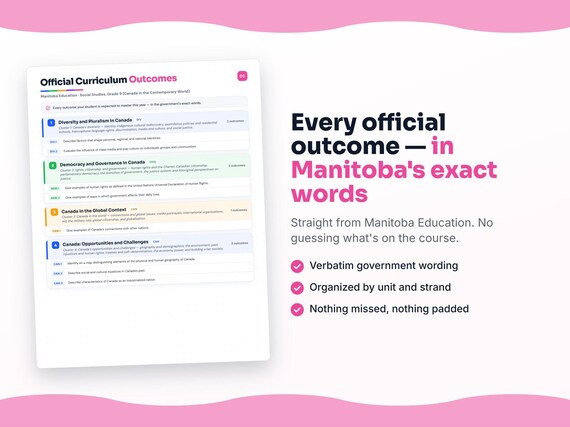
Manitoba defines Social Studies, Grade 9 (Canada in the Contemporary World) by strands and outcomes. MapleMind teaches the same curriculum reorganized for one-skill-at-a-time tutoring — the table shows exactly where every official strand lands, and the ministry's own wording is quoted under each unit below.
Official source Manitoba's official curriculumRead it on the government site — edu.gov.mb.ca ↗| Official strand | Outcomes | Where MapleMind teaches it |
|---|---|---|
| Strand I1 | 12 | Diversity and Pluralism in Canada |
| Strand C1 | 19 | Democracy and Governance in Canada |
| Strand G1 | 11 | Canada in the Global Context |
| Strand L1 | 18 | Canada: Opportunities and Challenges |
Every skill below, taught one on one.
 Try the first session free
How MapleMind teaches Social Studies, Grade 9 (Canada in the Contemporary World) — every unit, lesson, and skill
Every skill below runs as a short session: a plain-words lesson, a worked example, solving it together, then a five-question skill check that earns up to three stars. Guided Mode keeps it teaching instead of answer-handing — turning it off needs a parent's password.
Unit 1Diversity and Pluralism in CanadaOfficial strand · Strand I1
Cluster 1: Canada's diversity — identity, Indigenous cultural rediscovery, assimilative policies and residential schools, francophone language rights, discrimination, media and culture, and social justice.
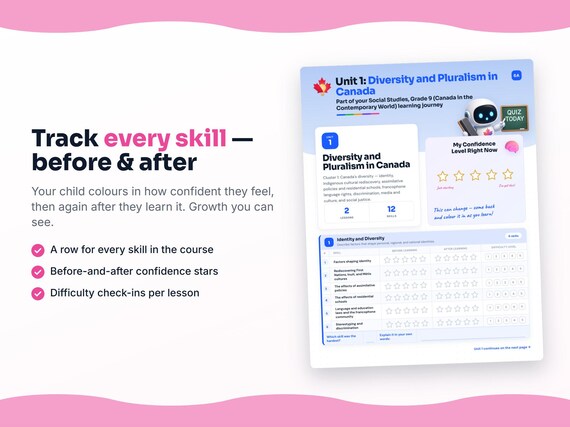
Identity and Diversity
- Factors shaping identityKI-016 — Describe factors that shape personal, regional, and national identities.
- Rediscovering First Nations, Inuit, and Métis culturesKI-017 — Give examples of ways in which First Nations, Inuit, and Métis peoples are rediscovering their cultures.
- The effects of assimilative policiesKI-018 — Evaluate effects of assimilative policies on cultural and linguistic groups in Canada.
- The effects of residential schoolsKI-018A — Evaluate effects of residential schools on their own and other Aboriginal communities.
- Language and education laws and the francophone communityKI-018F — Evaluate effects of language and education laws on their francophone community.
- Stereotyping and discriminationKI-019 — Describe effects of stereotyping and discrimination on individuals, communities, and regions.
Media, Culture, and Protecting Identity
- Mass media and pop cultureKI-020 — Evaluate the influence of mass media and pop culture on individuals, groups, and communities.
- Media and Aboriginal identitiesKI-020A — Evaluate the influence of mass media and pop culture on Aboriginal identities and cultures.
- Media and francophone identitiesKI-020F — Evaluate the influence of mass media and pop culture on francophone identities and cultures.
- Protecting identity, diversity, and cultureKI-021 — Describe ways in which identity, diversity, and culture are protected in Canada.
- Current issues in Canadian culture and identityKI-022 — Analyze current issues surrounding Canadian culture and identity.
The official wording — 12 outcomes in this unit
- KI-016
Describe factors that shape personal, regional, and national identities.
- KI-017
Give examples of ways in which First Nations, Inuit, and Métis peoples are rediscovering their cultures.
- KI-018
Evaluate effects of assimilative policies on cultural and linguistic groups in Canada.
- KI-018A
Evaluate effects of residential schools on their own and other Aboriginal communities.
- KI-018F
Evaluate effects of language and education laws on their francophone community.
- KI-019
Describe effects of stereotyping and discrimination on individuals, communities, and regions.
- KI-020
Evaluate the influence of mass media and pop culture on individuals, groups, and communities.
- KI-020A
Evaluate the influence of mass media and pop culture on Aboriginal identities and cultures.
- KI-020F
Evaluate the influence of mass media and pop culture on francophone identities and cultures.
- KI-021
Describe ways in which identity, diversity, and culture are protected in Canada.
- KI-022
Analyze current issues surrounding Canadian culture and identity.
- KI-023
Identify possible ways of addressing social injustices in Canada.
Unit 2Democracy and Governance in CanadaOfficial strand · Strand C1
Cluster 2: rights, citizenship, and government — human rights and the Charter, Canadian citizenship, parliamentary democracy, the branches of government, the justice system, and Aboriginal perspectives on justice.
Rights and Citizenship
- The UN Universal Declaration of Human RightsKC-001 — Give examples of human rights as defined in the UN Universal Declaration of Human Rights.
- Effects of the Canadian CharterKC-002 — Give examples of the effects of the Canadian Charter of Rights and Freedoms on individuals and groups.
- Article 23 and linguistic minoritiesKC-002F — Describe effects of Article 23 of the Charter on linguistic minorities.
- Becoming a Canadian citizenKC-003 — Describe the criteria for becoming a Canadian citizen.
- Canadians who promoted human rightsKC-004 — Describe contributions of Canadians whose social and political actions have promoted human rights.
- Rights and responsibilities of citizensKC-013 — Describe their responsibilities and rights as citizens of Canada and the world.
- Rights and responsibilities as Aboriginal citizensKC-013A — Describe their responsibilities and rights as Aboriginal citizens in Canada and the world.
- Rights and responsibilities as francophone citizensKC-013F — Describe their responsibilities and rights as francophone citizens of Canada and the world.
- Charter challenges and opportunitiesKC-015 — Give examples of evolving challenges and opportunities in Canadian society as a result of the Charter.
Government and Justice
- How government affects daily lifeKC-005 — Give examples of ways in which government affects their daily lives.
- Canadian parliamentary democracyKC-006 — Describe Canadian parliamentary democracy.
- The branches of the federal governmentKC-007 — Describe the responsibilities and processes of the legislative, executive, and judicial branches.
- Electoral processes and political partiesKC-008 — Describe electoral processes and roles of political parties.
- Contemporary political leadersKC-009 — Identify contemporary political leaders in Canada.
- The justice system in ManitobaKC-010 — Describe responsibilities and processes of the justice system in Manitoba.
- Aboriginal perspectives on justice and lawKC-010A — Describe Aboriginal perspectives on justice and law.
- How democratic ideals shape societyKC-011 — Identify ways in which democratic ideals have shaped contemporary Canadian society.
- Advantages and disadvantages of democratic processesKC-012 — Assess the advantages and disadvantages of democratic processes in Canada.
The official wording — 19 outcomes in this unit
- KC-001
Give examples of human rights as defined in the United Nations Universal Declaration of Human Rights.
- KC-002
Give examples of the effects of the Canadian Charter of Rights and Freedoms on individuals and groups.
- KC-002F
Describe effects of Article 23 of the Canadian Charter of Rights and Freedoms on linguistic minorities.
- KC-003
Describe the criteria for becoming a Canadian citizen.
- KC-004
Describe contributions of Canadians whose social and political actions have promoted human rights.
- KC-013
Describe their responsibilities and rights as citizens of Canada and the world.
- KC-013A
Describe their responsibilities and rights as Aboriginal citizens in Canada and the world.
- KC-013F
Describe their responsibilities and rights as francophone citizens of Canada and the world.
- KC-014
Describe current issues related to citizenship in Canada.
- KC-015
Give examples of evolving challenges and opportunities in Canadian society as a result of the Charter of Rights and Freedoms.
- KC-005
Give examples of ways in which government affects their daily lives.
- KC-006
Describe Canadian parliamentary democracy.
- KC-007
Describe the responsibilities and processes of the legislative, executive, and judicial branches of the federal government.
- KC-008
Describe electoral processes and roles of political parties.
- KC-009
Identify contemporary political leaders in Canada.
- KC-010
Describe responsibilities and processes of the justice system in Manitoba.
- KC-010A
Describe Aboriginal perspectives on justice and law.
- KC-011
Identify ways in which democratic ideals have shaped contemporary Canadian society.
- KC-012
Assess the advantages and disadvantages of democratic processes in Canada.
Unit 3Canada in the Global ContextOfficial strand · Strand G1
Cluster 3: Canada in the world — connections and global issues, media portrayals, international organizations, aid, the military role, global citizenship, and globalization.
Canada and the World
- Canada's connections with other nationsKG-034 — Give examples of Canada's connections with other nations.
- Countries where global events are taking placeKL-025 — Identify on a world map countries in which events of global significance are taking place.
- Canadian perspectives on global issuesKG-035 — Evaluate Canadian perspectives regarding current global issues.
- Decisions of global citizenshipKG-036 — Give examples of decisions that reflect the responsibilities of global citizenship.
- Comparing media portrayals of issuesKG-037 — Compare media portrayals of current issues.
- Canada in international organizationsKG-038 — Give examples of Canada's participation within international organizations.
- Canada's international aid and developmentKG-039 — Evaluate Canada's contributions to international aid and development.
- Canada's military role in conflictsKG-040 — Assess the implications of Canada's military role in contemporary conflicts.
- Canadians contributing to the global communityKG-041 — Give examples of contributions of various Canadians to the global community.
- Canada's leadership on global issuesKG-042 — Describe Canada's responsibilities and potential for leadership regarding current global issues.
- The impact of globalization on CanadaKE-050 — Give examples of the cultural, political, and economic impact of globalization on Canada.
The official wording — 11 outcomes in this unit
- KG-034
Give examples of Canada’s connections with other nations.
- KL-025
Identify on a world map countries in which events of global significance are taking place.
- KG-035
Evaluate Canadian perspectives regarding current global issues.
- KG-036
Give examples of decisions that reflect the responsibilities of global citizenship.
- KG-037
Compare media portrayals of current issues.
- KG-038
Give examples of Canada’s participation within international organizations.
- KG-039
Evaluate Canada’s contributions to international aid and development.
- KG-040
Assess the implications of Canada’s military role in contemporary conflicts.
- KG-041
Give examples of contributions of various Canadians to the global community.
- KG-042
Describe Canada’s responsibilities and potential for leadership regarding current global issues.
- KE-050
Give examples of the cultural, political, and economic impact of globalization on Canada.
Unit 4Canada: Opportunities and ChallengesOfficial strand · Strand L1
Cluster 4: Canada's opportunities and challenges — geography and demographics, the environment, past injustices and human rights, treaties and self-determination, the economy, power, and building a fair society.
Geography, Demographics, and Environment
- Physical and human geography of CanadaKL-024 — Identify on a map distinguishing elements of the physical and human geography of Canada.
- Canadian demographics and future trendsKL-026 — Analyze current Canadian demographics and predict future trends.
- Demographic patterns since the 20th centuryKH-029 — Describe factors affecting demographic patterns in Canada since the beginning of the 20th century.
- Environmental stewardship and sustainabilityKL-028 — Evaluate Canadian concerns and commitments regarding environmental stewardship and sustainability.
History, Rights, and Treaties
- Human rights milestones in CanadaKH-031 — Identify significant events in the development of human rights in Canada.
- The changing status of women in CanadaKH-032 — Describe ways in which the status of women in Canada has changed since the early 20th century.
- Treaties and Aboriginal rightsKL-027 — Give examples of opportunities and challenges related to First Nations treaties and Aboriginal rights.
- Aboriginal self-determinationKP-045 — Describe factors related to Aboriginal self-determination in Canada.
Economy, Power, and a Fair Society
- Canada as an industrialized nationKE-048 — Describe characteristics of Canada as an industrialized nation.
- Living in a consumer-based economyKE-049 — Evaluate implications of living in a consumer-based economy.
- Consequences of consumer choicesKE-051 — Analyze possible consequences of their consumer choices.
- Poverty and a more equitable societyKE-052 — Identify poverty issues in Canada and propose ideas for a more equitable society.
- Division of power among governmentsKP-044 — Describe the division of power and responsibilities of federal, First Nations, provincial, and municipal governments.
- Approaches to conflict resolutionKP-043 — Give examples of diverse approaches to conflict resolution.
- Canadian-American relationsKP-047 — Identify opportunities and challenges regarding Canadian-American relationships.
The official wording — 18 outcomes in this unit
- KL-024
Identify on a map distinguishing elements of the physical and human geography of Canada.
- KL-026
Analyze current Canadian demographics and predict future trends.
- KH-029
Describe factors affecting demographic patterns in Canada since the beginning of the 20th century.
- KL-028
Evaluate Canadian concerns and commitments regarding environmental stewardship and sustainability.
- KH-030
Describe social and cultural injustices in Canada’s past.
- KH-031
Identify significant events in the development of human rights in Canada.
- KH-032
Describe ways in which the status of women in Canada has changed since the early 20th century.
- KL-027
Give examples of opportunities and challenges related to First Nations treaties and Aboriginal rights.
- KP-045
Describe factors related to Aboriginal self-determination in Canada.
- KH-033
Give examples of social and technological changes that continue to influence quality of life in Canada.
- KE-048
Describe characteristics of Canada as an industrialized nation.
- KE-049
Evaluate implications of living in a consumer-based economy.
- KE-051
Analyze possible consequences of their consumer choices.
- KE-052
Identify poverty issues in Canada and propose ideas for a more equitable society.
- KP-044
Describe the division of power and responsibilities of federal, First Nations, provincial, and municipal governments.
- KP-046
Give examples of ways in which people can individually and collectively influence Canada’s political and social systems.
- KP-043
Give examples of diverse approaches to conflict resolution.
- KP-047
Identify opportunities and challenges regarding Canadian-American relationships.
Printable workbook · A keepsake of the year
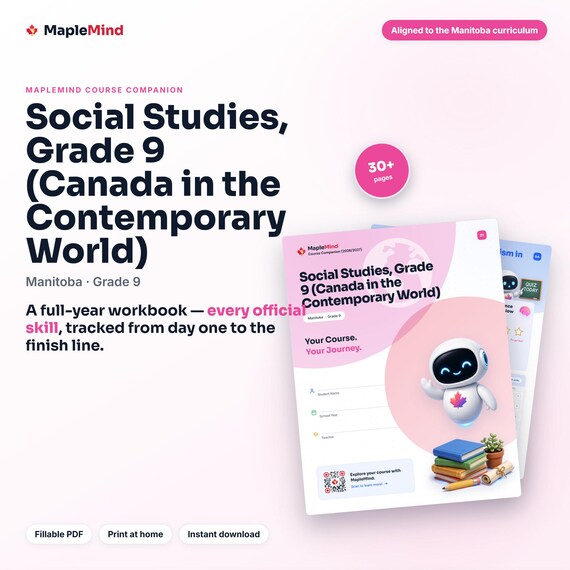
A Social Studies, Grade 9 (Canada in the Contemporary World) workbook worth keeping
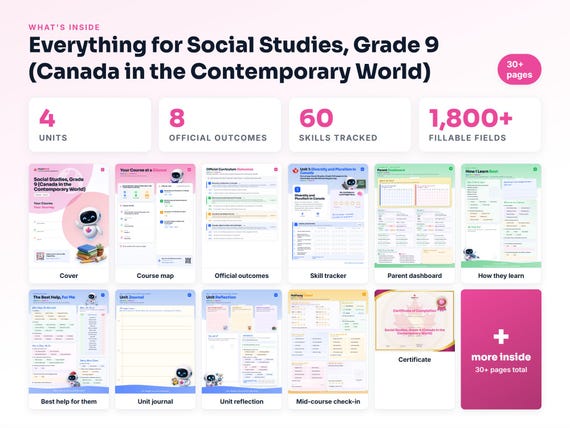
Built from the same official curriculum as this page. Before and after each skill above, your student colours in how sure they feel — so the two of you can see, on one page, what's clicking and what needs another look. It's a quiet way to follow how the year is really going.
By June it's full of their own handwriting: units worked through, confidence grown, a mid-year check-in, notes from parent-teacher night, and a certificate at the end. Less a worksheet, more a record of the year worth keeping on the shelf.
Instant download · see every page, reviews and the full description · five or more workbooks are $2.99 each
What it looks like in the app



Common questions
Can MapleMind help me with Social Studies, Grade 9 (Canada in the Contemporary World)?
Yes. MapleMind's AI tutor covers all 60 skills in Manitoba's Social Studies, Grade 9 (Canada in the Contemporary World) — you pick the exact skill, and the tutor teaches it step by step: a short lesson, a worked example, solving together, then a skill check to show it stuck.
Is MapleMind aligned to Manitoba's official curriculum?
Yes. Every skill in this course maps to an official outcome code from Manitoba's Grade 9 Social Studies curriculum, and the ministry's own wording is quoted under each unit on this page — with the official government source linked so you can check it yourself.
What does MapleMind cost?
It's free to start — 5 tutoring chats and a practice quiz every day, no credit card. A Pro subscription ($9.99/month or $49.99/year CAD, 7-day free trial) unlocks unlimited tutoring, practice, and exam simulations.
What if I'm stuck on just one topic?
That's the point of skill-level tutoring: open Social Studies, Grade 9 (Canada in the Contemporary World) in the app, tap the exact skill from the list on this page, and the tutor teaches just that — no wading through lessons you don't need.
Does MapleMind work in French or other languages?
Yes — 14 languages, including French. Both the app and the tutor's explanations switch to the language you choose.
Where can I see the official Manitoba curriculum for Social Studies, Grade 9 (Canada in the Contemporary World)?
The official source is linked on this page — Manitoba's official curriculum. The outline here follows it: every MapleMind skill carries its official outcome code, and the ministry's own wording is quoted under each unit.
Keep exploring
Ready when you are
Pick a skill from this page and see it taught properly — free, in the browser, in under a minute.