Get help with Core French, Grade 8
Most tutoring makes you sit through material you already know. MapleMind flips that: pick the exact skill that's causing trouble — any of the 20 below — and the tutor teaches just that one, step by step, as many times as it takes. Ask questions in plain words, any time of day, in English, French, or 12 other languages.
The official Manitoba Core French, Grade 8 curriculum
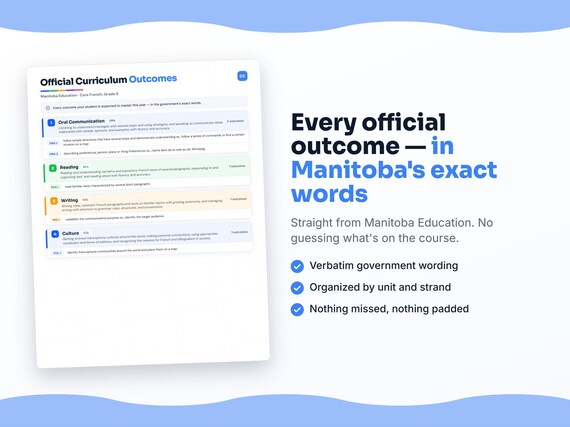
Manitoba defines Core French, Grade 8 by strands and outcomes. MapleMind teaches the same curriculum reorganized for one-skill-at-a-time tutoring — the table shows exactly where every official strand lands, and the ministry's own wording is quoted under each unit below.
Official source Manitoba's official curriculumRead it on the government site — edu.gov.mb.ca ↗| Official strand | Outcomes | Where MapleMind teaches it |
|---|---|---|
| Strand B | 7 | Oral Communication |
| Strand C | 4 | Reading |
| Strand D | 4 | Writing |
| Strand E | 5 | Culture |
Every skill below, taught one on one.
 Try the first session free
How MapleMind teaches Core French, Grade 8 — every unit, lesson, and skill
Every skill below runs as a short session: a plain-words lesson, a worked example, solving it together, then a five-question skill check that earns up to three stars. Guided Mode keeps it teaching instead of answer-handing — turning it off needs a parent's password.
Unit 1Oral CommunicationOfficial strand · Strand B
Listening to understand messages with several steps and using strategies, and speaking to communicate ideas elaborated with details, opinions, and examples, with fluency and accuracy.
Listening for Meaning
- Understanding messages and following multi-step directionsFR.B.GRADES7-8.1 — Listen with visual support and show comprehension - responding to a variety of messages by retelling in sequence and giving opinions, and following directions with several steps.
- Listening strategies and note-takingFR.B.GRADES7-8.2 — Use various strategies to understand a spoken message - deliberately combining attentive listening, contextual clues, questioning, and organized note-taking for longer messages.
Message: Speaking to Communicate
- Introducing yourself and describing with detailFR.B.GRADES7-8.3 — Communicate ideas elaborated with details, opinions, and examples as modeled - introducing yourself and describing preferences and people with justification.
- Describing places, things, and activitiesFR.B.GRADES7-8.4 — Communicate ideas elaborated as modeled - describing places, things, and daily activities across situations and seasons with more detail.
- Needs, inversion questions, and directionsFR.B.GRADES7-8.5 — Communicate ideas elaborated as modeled - communicating needs, asking a range of inversion questions, and giving detailed directions.
- FluencyFR.B.GRADES7-8.6 — Use appropriate vocabulary and expressions to communicate with spontaneity across longer messages and interactions, using appropriate rhythm, pace, and intonation.
- AccuracyFR.B.GRADES7-8.7 — Correctly use the vocabulary and syntax of French as modeled - simple and compound structures and the present, past, future, and imperative tenses across more communicative needs.
The official wording — 7 outcomes in this unit
- FR.B.GRADES7-8.1
follow simple directions that have several steps and demonstrate understanding ex., follow a series of commands to find a certain location on a map
- FR.B.GRADES7-8.2
use various strategies to understand the communicated message ex., take notes using a organizer chart
- FR.B.GRADES7-8.3
describing preferences, person, place or thing Preferences ex., J'aime faire de la voile au lac Winnipeg.
- FR.B.GRADES7-8.4
talking about daily activities, immediate surroundings ex., Daily activities Apres l'ecole, je vais aller chez mon ami.
- FR.B.GRADES7-8.5
asking for information (ask questions using inversion) ex., Ou est la cafeteria? Pouvons-nous manger ensemble?
- FR.B.GRADES7-8.6
Students use appropriate rhythm, pace, and intonation to communicate and to interact as modeled by the teacher.
- FR.B.GRADES7-8.7
Students use the present, past, future and imperative tenses (related to themes).
Unit 2ReadingOfficial strand · Strand C
Reading and understanding narrative and expository French texts of several paragraphs, responding to and organizing text, and reading aloud with fluency and accuracy.
Message: Understanding Text
- Understanding multi-paragraph textsFR.C.GRADES7-8.1 — Read and understand the global meaning of texts - identifying main idea and supporting details, describing the main character, and finding information that answers essential questions.
- Responding to and organizing textFR.C.GRADES7-8.2 — Respond to texts orally or in writing - giving justified opinions, describing structure with story questions, and classifying and organizing details.
- Summarizing and comparing text to lifeFR.C.GRADES7-8.3 — Respond to texts - summarizing chronologically, identifying the author's message or theme, and comparing events and characters with daily life in depth.
- Reading aloud with fluency and accuracyFR.C.GRADES7-8.4 — Read grade-appropriate texts of several paragraphs aloud with ease, precision, and expression - controlling intonation and pronouncing sounds and liaisons accurately.
The official wording — 4 outcomes in this unit
- FR.C.GRADES7-8.1
read familiar texts characterized by several short paragraphs
- FR.C.GRADES7-8.2
classify and organize details ex., Dans le texte, il y a 5 points importants :
- FR.C.GRADES7-8.3
summarize events chronologically ex., Premierement... Deuxiement... Troisiement... Enfin
- FR.C.GRADES7-8.4
read aloud a text of several paragraphs
Unit 3WritingOfficial strand · Strand D
Writing clear, coherent French paragraphs and texts on familiar topics with growing autonomy, and managing writing with attention to grammar rules, structures, and conventions.
Message: Writing to Communicate
- Purpose, structure, and introducing yourself in writingFR.D.GRADES7-8.1 — Communicate ideas clearly in paragraphs following modeled examples - establishing purpose for an audience, respecting structure, and describing preferences with justification.
- Describing places, things, and asking in writingFR.D.GRADES7-8.2 — Communicate ideas in paragraphs as modeled - describing places, things, and activities with elaboration and writing a range of questions using inversion.
- Fluency: varied sentences with autonomyFR.D.GRADES7-8.3 — Write a variety of coherent texts on familiar topics with autonomy - planning and revising for flow, varying sentences, and using rich descriptive and transition language.
- Accuracy: grammar, tenses, and conventionsFR.D.GRADES7-8.4 — Manage your writing with the rules and syntax of French - agreement, correct conjugations across four tenses, correct structures, and consistent conventions across a text.
The official wording — 4 outcomes in this unit
- FR.D.GRADES7-8.1
establish the communicative purpose ex., identify the target audience
- FR.D.GRADES7-8.2
asking for information (ask questions using inversion) ex., write a text A quelle heure est le match de baseball? Vas-tu au match?
- FR.D.GRADES7-8.3
write a range of compound sentences in the affirmative, negative and interrogative forms (in paragraphs).
- FR.D.GRADES7-8.4
correctly use verb conjugations (the present, past, future and imperative tenses)
Unit 4CultureOfficial strand · Strand E
Getting to know francophone cultures around the world, making personal connections, using appropriate vocabulary and forms of address, and recognizing the reasons for French and bilingualism in society.
Francophone Cultures of the World
- Francophone communities around the worldFR.E.GRADES7-8.1 — Identify elements of francophone cultures worldwide - communities and their location, cultural elements with justified opinions, and well-known francophones and their contribution to the world.
- Connecting to world francophone culturesFR.E.GRADES7-8.2 — Make links to your personal life - comparing your own culture and activities to francophone cultures of the world in depth.
- Forms of address and false cognatesFR.E.GRADES7-8.3 — Use appropriate vocabulary for the purpose and context - forms of address, false cognates, extended-family vocabulary, and nationalities, with attention to cultural difference.
- Reasons and benefits of learning FrenchFR.E.GRADES7-8.4 — Identify the reasons and advantages of learning French - explaining several reasons and benefits and connecting them to opportunities.
- Bilingualism and French in daily lifeFR.E.GRADES7-8.5 — Identify yourself as a French language learner - recognizing bilingualism in society, French in daily life, and using a range of idiomatic expressions.
The official wording — 5 outcomes in this unit
- FR.E.GRADES7-8.1
identify francophone communities around the world and place them on a map.
- FR.E.GRADES7-8.2
compare elements of own culture to elements of francophone cultures of the world.
- FR.E.GRADES7-8.3
Identify commonalities/linguistic and cultural differences between the French and English languages. ex., false cognates (faux amis)
- FR.E.GRADES7-8.4
explain reasons and benefits for learning French.
- FR.E.GRADES7-8.5
identify examples of bilingualism in our society.
Printable workbook · A keepsake of the year
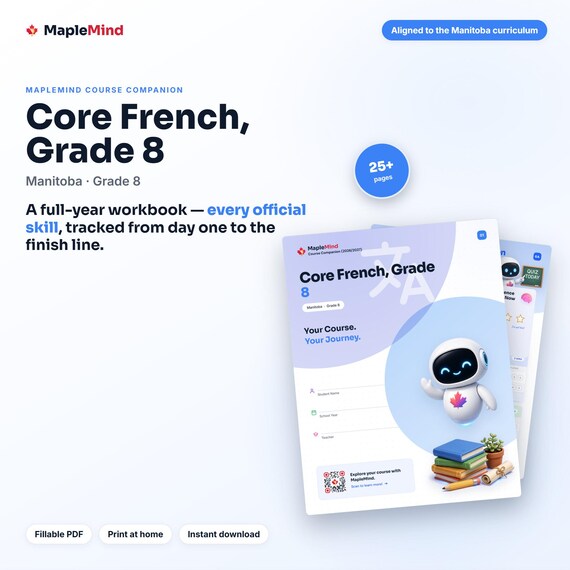
A Core French, Grade 8 workbook worth keeping
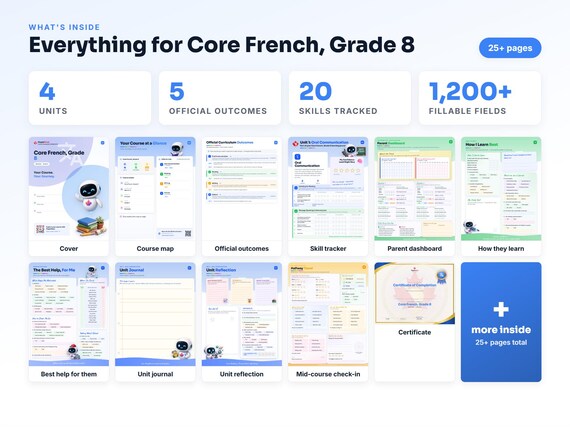
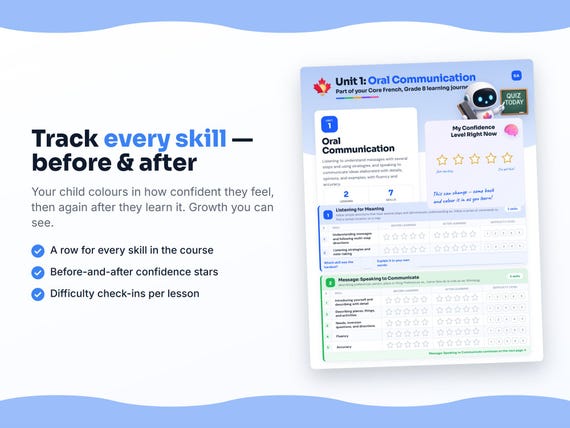
Built from the same official curriculum as this page. Before and after each skill above, your student colours in how sure they feel — so the two of you can see, on one page, what's clicking and what needs another look. It's a quiet way to follow how the year is really going.
By June it's full of their own handwriting: units worked through, confidence grown, a mid-year check-in, notes from parent-teacher night, and a certificate at the end. Less a worksheet, more a record of the year worth keeping on the shelf.
Instant download · see every page, reviews and the full description · five or more workbooks are $2.99 each
What it looks like in the app



Common questions
Can MapleMind help me with Core French, Grade 8?
Yes. MapleMind's AI tutor covers all 20 skills in Manitoba's Core French, Grade 8 — you pick the exact skill, and the tutor teaches it step by step: a short lesson, a worked example, solving together, then a skill check to show it stuck.
Is MapleMind aligned to Manitoba's official curriculum?
Yes. Every skill in this course maps to an official outcome code from Manitoba's Grade 8 French curriculum, and the ministry's own wording is quoted under each unit on this page — with the official government source linked so you can check it yourself.
What does MapleMind cost?
It's free to start — 5 tutoring chats and a practice quiz every day, no credit card. A Pro subscription ($9.99/month or $49.99/year CAD, 7-day free trial) unlocks unlimited tutoring, practice, and exam simulations.
What if I'm stuck on just one topic?
That's the point of skill-level tutoring: open Core French, Grade 8 in the app, tap the exact skill from the list on this page, and the tutor teaches just that — no wading through lessons you don't need.
Does MapleMind work in French or other languages?
Yes — 14 languages, including French. Both the app and the tutor's explanations switch to the language you choose.
Where can I see the official Manitoba curriculum for Core French, Grade 8?
The official source is linked on this page — Manitoba's official curriculum. The outline here follows it: every MapleMind skill carries its official outcome code, and the ministry's own wording is quoted under each unit.
Keep exploring
Ready when you are
Pick a skill from this page and see it taught properly — free, in the browser, in under a minute.