Manitoba · For parents

What your child learns in Grade 9 in Manitoba

Every subject, unit by unit, from Manitoba’s curriculum: 238 skills in plain words.

Subjects
5
Skills
238
Provincial exams
None
Official curriculum
edu.gov.mb.ca

Math in Grade 9

Grade 9 Mathematics (10F)

4 units · 34 skills

  1. Unit 1

    Number

    A power has a base and an exponent: 2^3 means 2 x 2 x 2.

    • Representing powers
    • The zero-exponent rule
    • Evaluating powers
    7 more skills
    • Solving problems with powers
    • Operations on powers
    • Comparing and ordering rational numbers
    • Operations on rational numbers
    • Order of operations with exponents
    • Square roots of perfect squares
    • Approximate square roots
  2. Unit 2

    Patterns and Relations

    A linear pattern grows by a constant amount each step.

    • Generalizing patterns with linear equations
    • Graphing and analyzing linear relations
    • Interpolating and extrapolating
    8 more skills
    • Solving linear equations
    • Equations with brackets and fractions
    • Solving linear inequalities
    • Graphing inequality solutions
    • Understanding polynomials
    • Adding polynomials
    • Subtracting polynomials
    • Multiplying and dividing by a monomial
  3. Unit 3

    Shape and Space

    A perpendicular drawn from the centre to a chord bisects that chord.

    • The perpendicular from the centre to a chord
    • Central and inscribed angles
    • The tangent and the radius
    5 more skills
    • Surface area of composite objects
    • Similarity of polygons
    • Scale diagrams
    • Line symmetry
    • Rotation symmetry
  4. Unit 4

    Statistics and Probability

    Factors like bias, language, ethics, and privacy can distort collected data.

    • Factors affecting data collection
    • Population versus sample
    • Planning a data project
    2 more skills
    • Running and concluding the project
    • The role of probability in society

Science in Grade 9

Science, Grade 9 (Senior 1)

10F · 5 units · 70 skills

  1. Unit 1

    Scientific Skills and Inquiry

    The method depends on the question: a controlled experiment tests a cause and effect, a field study or survey describes what is happening, and research gathers what others have already found.

    • Select and use appropriate methods and tools for collecting data or information
    • Estimate and measure accurately using Système International (SI) and other standard units
    • Record, organize, and display data using an appropriate format.
  2. Unit 2

    Reproduction

    The cell cycle has three main parts: interphase, when the cell grows and copies its chromosomes; mitosis, when the nucleus divides; and cytoplasmic division, when the cytoplasm splits into two cells.

    • Illustrate and explain the process of mitotic cell division
    • Observe and explain the dynamic nature of cell division
    • Describe various types of asexual reproduction that occur in plant and animal species
    15 more skills
    • Investigate and describe agricultural applications of asexual reproduction
    • Illustrate and explain the production of male and female gametes by meiosis
    • Compare and contrast the functions of mitosis to that of meiosis
    • Compare sexual and asexual reproduction in terms of their advantages and disadvantages for plant and animal species
    • Investigate and explain adaptations of plant and animal species which enhance reproductive success
    • Describe the structure and function of the male and female human reproductive systems
    • Outline human development from conception through birth
    • Observe, collect, and analyze class data of single trait inheritance
    • Differentiate between dominant and recessive genes
    • Describe the relationship among DNA, chromosomes, genes, and the expression of traits
    • Explain the inheritance of sex-linked traits in humans and use a pedigree to track the inheritance of a single trait
    • Investigate and describe environmental factors and personal choices that may lead to a genetic mutation or changes in an organism's development
    • Investigate Canadian and international contributions to research and technological development in the field of genetics and reproduction
    • Discuss current and potential applications and implications of biotechnologies
    • Use the decision-making process to address a current biotechnology issue
  3. Unit 3

    Atoms and Elements

    Greek ideas: Empedocles said everything is made of four elements (earth, air, fire and water); Democritus proposed that matter is made of tiny, uncuttable particles he called atoms, but without experiments the idea was set aside for about 2000 years.

    • Describe how historical ideas and models furthered our understanding of the nature of matter
    • Investigate the historical progression of the atomic model
    • Define element and identify symbols of some common elements.
    11 more skills
    • Explain the atomic structure of an atom in terms of the number of protons, electrons, and neutrons, and explain how those numbers define atomic number and atomic mass
    • Assemble or draw Bohr atomic models for the first 18 elements and group them according to the number of outer shell electrons
    • Investigate the development of the periodic table as a method of organizing elements
    • Investigate the characteristic properties of metals, non-metals, and metalloids
    • Relate the reactivity and stability of different families of elements to their atomic structure
    • Compare elements to compounds
    • Interpret chemical formulas of elements and compounds in terms of the number of atoms of each element
    • Investigate properties of substances and explain the importance of knowing these properties
    • Differentiate between physical and chemical changes
    • Experiment to determine indicators of chemical change
    • Investigate technologies and natural phenomena that demonstrate chemical change
  4. Unit 4

    Nature of Electricity

    Rubbing two materials together can leave both of them charged; charged objects push or pull on each other without touching.

    • Demonstrate evidence for the existence of two types of charge
    • Discuss early models of electricity to support the premise that models in science change
    • Explain how a discrepant event can be used to evaluate the particle model of electricity
    21 more skills
    • Relate the particle model of electricity to atomic structure
    • Investigate and explain electrostatic phenomena using the particle model of electricity
    • Investigate common electrostatic technologies and phenomena and describe measures which reduce dangers associated with electrostatics
    • Construct one or more electrostatic apparatus and explain how they function using the particle model of electricity
    • Demonstrate and explain the like nature of electrostatics and current electricity
    • Define electric current as charge per unit time and solve related problems
    • Define voltage (electric potential difference) as the energy per unit charge between two points along a conductor and solve related problems
    • Identify the five sources of electrical energy and some associated technologies
    • Describe resistance in terms of the particle model of electricity
    • Construct electric circuits using schematic diagrams
    • Use appropriate instruments and units to measure voltage (electric potential difference), current, and resistance
    • Compare and contrast voltage and current in series and parallel circuits
    • Investigate and describe qualitatively the relationship among current, voltage (electric potential difference), and resistance in a simple electric circuit
    • Relate the energy dissipated in a circuit to the resistance, current, and brightness of bulbs
    • Explain the parallel circuits, the components, and the safety aspects of household wiring
    • Explain safety considerations of some common household electrical appliances
    • Define electrical power as energy per unit time, and solve related problems
    • Develop a formula for domestic power consumption costs, and solve related problems
    • Analyze the electrical energy consumption of a household appliance.
    • Recognize and explain the importance of incorporating principles of electrical energy conservation into the decision-making process
    • Use the decision-making process to address an issue associated with the generation and transmission of electricity in Manitoba
  5. Unit 5

    Exploration of the Universe

    Altitude is an object's angle above the horizon, from 0° at the horizon to 90° straight overhead (the zenith).

    • Use a coordinate system to locate visible celestial objects, and construct an astrolabe to determine the position of these objects
    • Observe the motion of visible celestial objects and organize collected data
    • Investigate how various cultures used knowledge of the position and motion of visible celestial objects for navigation
    8 more skills
    • Compare and contrast historical perspectives on the relationship between Earth and space
    • Explain reasons for the apparent motion of the Sun, stars, planets, and the Moon as seen from Earth
    • Differentiate between units of measure used for astronomical distances, and perform simple calculations using these units
    • Compare and contrast scientific and cultural perspectives on the origin and evolution of the universe
    • Differentiate between the major components of the universe
    • Explain how various technologies have extended our ability to explore and understand space
    • Investigate ways in which Canada participates in space research and in international space programs, then use the decision-making process to address a related issue
    • Evaluate the impact of space science and technologies in terms of their benefits and risks to humans

English in Grade 9

English Language Arts, Grade 9

10F · 4 units · 47 skills

  1. Unit 1

    Explore and Discover Language and Literacy

    • Listening critically to oral texts
    • Using non-verbal cues and inclusive conventions when listening
    • Adjusting language to foster inclusive interaction
    6 more skills
    • Asking questions to explore and challenge ideas
    • Using the rules and structures of oral language
    • Adapting spoken language to situation and audience
    • Applying morphology to understand and spell words
    • Building and refining precise vocabulary
    • Applying fluency to comprehend complex text
  2. Unit 2

    Comprehend and Respond to Multimodal Texts

    • Activating prior knowledge to build understanding
    • Creating focused questions to drive inquiry
    • Engaging with a variety of multimodal texts
    12 more skills
    • Analyzing and synthesizing information across sources
    • Analyzing and critiquing text cues
    • Using textual cues and organizational patterns to construct meaning
    • Making and testing predictions with text evidence
    • Making connections to deepen understanding
    • Selecting and integrating comprehension strategies
    • Summarizing and synthesizing complex texts
    • Consolidating and communicating new knowledge
    • Analyzing how texts portray diversity and equity
    • Differentiating facts, opinions and bias
    • Examining point of view and viewpoint credibility
    • Responding critically to bias and prejudice
  3. Unit 3

    Compose and Create Multimodal Texts

    • Selecting and focusing a topic
    • Researching and evaluating sources
    • Planning with strategies and tools
    12 more skills
    • Choosing and blending forms purposefully
    • Drafting complex multimodal texts
    • Organizing ideas with structure and transitions
    • Crafting sentences for meaning and style
    • Choosing precise, discipline-specific words
    • Controlling voice for purpose and audience
    • Revising for clarity, coherence and logic
    • Producing legible, well-formatted text
    • Applying spelling strategies and word structure
    • Applying capitalization conventions
    • Applying punctuation for clarity and effect
    • Publishing a polished multimodal project
  4. Unit 4

    Communicate Ideas and Build New Understandings

    • Using tone, volume and expression for delivery
    • Combining visuals and media for polished messages
    • Structuring a presentation to engage an audience
    5 more skills
    • Reflecting on and reviewing personal growth
    • Using criteria and tools to assess your learning
    • Using feedback to refine strategies
    • Setting learning goals and planning steps
    • Monitoring progress toward goals

French in Grade 9

Core French, Grade 9

10F · 4 units · 27 skills

  1. Unit 1

    Oral Communication

    When the speaker uses standard French at normal speed, find specific information: identify the main idea and key points (who, what, where, when, why, how) on familiar topics.

    • Understanding and retelling oral messages
    • Listening strategies
    • Describing people and things
    6 more skills
    • Talking about the past
    • Expressing feelings and giving advice
    • Predicting and justifying a viewpoint
    • Talking about the future
    • Fluency
    • Accuracy
  2. Unit 2

    Reading

    Establish the PURPOSE for reading: find specific information, learn to play a game, follow a recipe, or follow a storyline.

    • Reading for purpose and main idea
    • Identifying details and describing characters
    • Responding to and connecting with text
    2 more skills
    • Questioning and evaluating text
    • Reading aloud with fluency and accuracy
  3. Unit 3

    Writing

    Explain the communicative PURPOSE: identify the target audience and a targeted action or reaction.

    • Purpose, conventions, and describing
    • Writing about the past
    • Writing feelings, opinions, and advice
    5 more skills
    • Writing predictions and justifying viewpoints
    • Writing about the future and sharing information
    • Organizing varied, coherent texts
    • Writing devices and synchronizing tenses
    • Accuracy: grammar and syntax
  4. Unit 4

    Culture

    Describe elements of your OWN cultural background (traditions, folklore, celebrations).

    • Francophone cultures and cultural events
    • Connecting to francophone teens
    • Language register and comparisons
    2 more skills
    • Reasons for learning French
    • Bilingualism and French beyond the classroom

Social studies in Grade 9

Social Studies, Grade 9 (Canada in the Contemporary World)

10F · 4 units · 60 skills

  1. Unit 1

    Diversity and Pluralism in Canada

    Identity forms at personal, regional, and national levels, shaped by culture, place, and history.

    • Factors shaping identity
    • Rediscovering First Nations, Inuit, and Métis cultures
    • The effects of assimilative policies
    9 more skills
    • The effects of residential schools
    • Language and education laws and the francophone community
    • Stereotyping and discrimination
    • Mass media and pop culture
    • Media and Aboriginal identities
    • Media and francophone identities
    • Protecting identity, diversity, and culture
    • Current issues in Canadian culture and identity
    • Addressing social injustices
  2. Unit 2

    Democracy and Governance in Canada

    The UN Universal Declaration of Human Rights lists rights belonging to every person.

    • The UN Universal Declaration of Human Rights
    • Effects of the Canadian Charter
    • Article 23 and linguistic minorities
    16 more skills
    • Becoming a Canadian citizen
    • Canadians who promoted human rights
    • Rights and responsibilities of citizens
    • Rights and responsibilities as Aboriginal citizens
    • Rights and responsibilities as francophone citizens
    • Current issues related to citizenship
    • Charter challenges and opportunities
    • How government affects daily life
    • Canadian parliamentary democracy
    • The branches of the federal government
    • Electoral processes and political parties
    • Contemporary political leaders
    • The justice system in Manitoba
    • Aboriginal perspectives on justice and law
    • How democratic ideals shape society
    • Advantages and disadvantages of democratic processes
  3. Unit 3

    Canada in the Global Context

    Canada connects to other nations through trade, diplomacy, culture, and migration.

    • Canada's connections with other nations
    • Countries where global events are taking place
    • Canadian perspectives on global issues
    8 more skills
    • Decisions of global citizenship
    • Comparing media portrayals of issues
    • Canada in international organizations
    • Canada's international aid and development
    • Canada's military role in conflicts
    • Canadians contributing to the global community
    • Canada's leadership on global issues
    • The impact of globalization on Canada
  4. Unit 4

    Canada: Opportunities and Challenges

    Physical geography includes landforms and climate; human geography includes cities and regions.

    • Physical and human geography of Canada
    • Canadian demographics and future trends
    • Demographic patterns since the 20th century
    15 more skills
    • Environmental stewardship and sustainability
    • Social and cultural injustices in Canada's past
    • Human rights milestones in Canada
    • The changing status of women in Canada
    • Treaties and Aboriginal rights
    • Aboriginal self-determination
    • Social and technological changes and quality of life
    • Canada as an industrialized nation
    • Living in a consumer-based economy
    • Consequences of consumer choices
    • Poverty and a more equitable society
    • Division of power among governments
    • Influencing Canada's political and social systems
    • Approaches to conflict resolution
    • Canadian-American relations

MapleMind

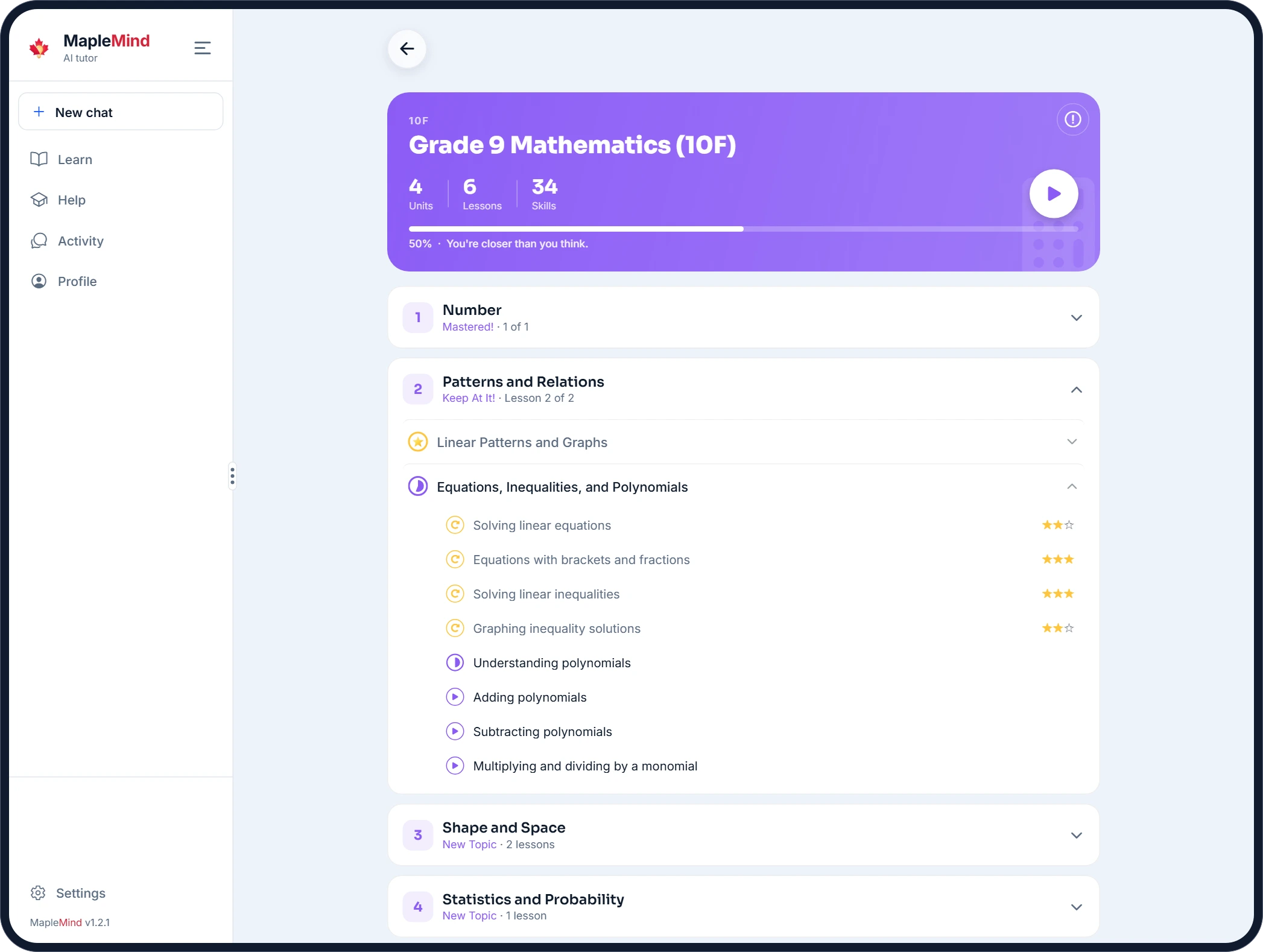
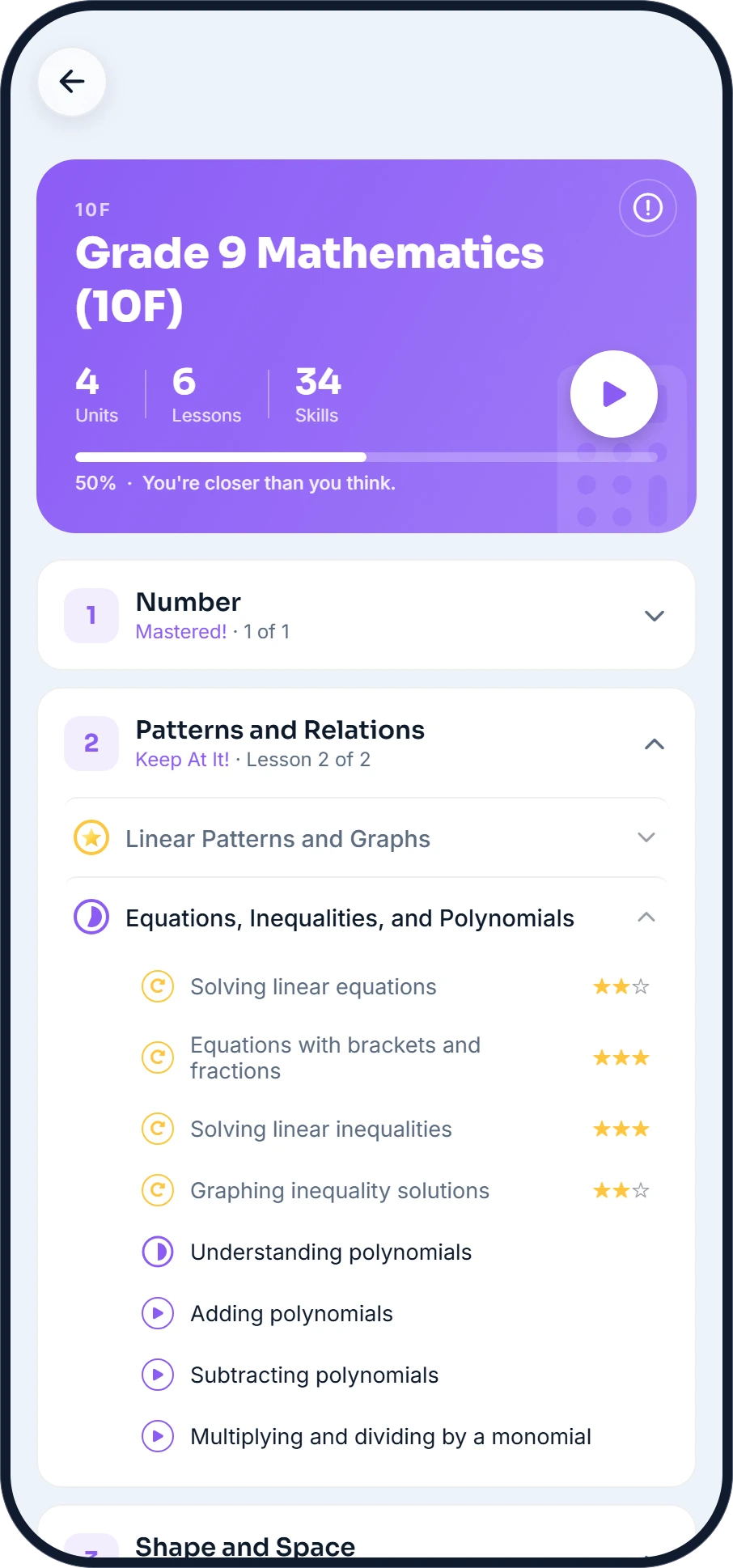
See Grade 9 in MapleMind

Real screens from the app your child would use.

Grade 9 Mathematics (10F) in MapleMind on a tablet: its units and lessons in order, a student partway through.Grade 9 Mathematics (10F) in MapleMind on a phone: its units and lessons in order, a student partway through.
Their course, unit by unit, the way Manitoba teaches it.Shown: Grade 9 Mathematics (10F)
Homework Help on a tablet: a photo of a worksheet, the tutor’s worked example of a two-step equation, and a question back to the student.Homework Help on a phone: a photo of a worksheet, the tutor’s worked example of a two-step equation, and a question back to the student.
Homework Help: they take a photo of the question, and the tutor works through it with them.
The Parent Dashboard on a tablet: a student’s days studied, streak, lessons, quiz average and recent activity.The Parent Dashboard on a phone: a student’s days studied, streak, lessons, quiz average and recent activity.
The Parent Dashboard: how each child’s week went, in lessons, quizzes and days studied.
A Grade 9 provincial mathematics exam on a tablet: a readiness score, the exam’s time and its next sitting.A Grade 9 provincial mathematics exam on a phone: a readiness score, the exam’s time and its next sitting.
A provincial exam: a practice sitting under the real time, and how ready they are.
The Learn tab on a tablet: a four-day streak, the week’s days, Homework Help, the next lesson and a review.The Learn tab on a phone: a four-day streak, the week’s days, Homework Help, the next lesson and a review.
The Learn tab: their week so far, and the next thing to do.

Help at home

Questions parents ask

What will my child learn in Grade 9 in Manitoba?

Math: Grade 9 Mathematics (10F). Science: Science, Grade 9 (Senior 1). English: English Language Arts, Grade 9. French: Core French, Grade 9. Social studies: Social Studies, Grade 9 (Canada in the Contemporary World). That’s 238 skills in all, from Manitoba’s curriculum.

Does my child write a provincial exam in Grade 9?

No. Manitoba has no provincial exam in Grade 9.

Where does this list come from?

From Manitoba’s official curriculum, the documents its education ministry publishes for each course. Each skill here is one of their expectations, written in plain words.

Can MapleMind help my child in Grade 9?

Yes. Every course on this page is in MapleMind, with lessons, practice and a tutor that works through each step with them. A free account gets 30 messages and 4 activities a day.

Help with Grade 9, one skill at a time.

Every course on this page is in MapleMind, free with daily limits.