Get help with English Language Arts, Grade 9
Most tutoring makes you sit through material you already know. MapleMind flips that: pick the exact skill that's causing trouble — any of the 47 below — and the tutor teaches just that one, step by step, as many times as it takes. Ask questions in plain words, any time of day, in English, French, or 12 other languages.
The official Manitoba English Language Arts, Grade 9 curriculum
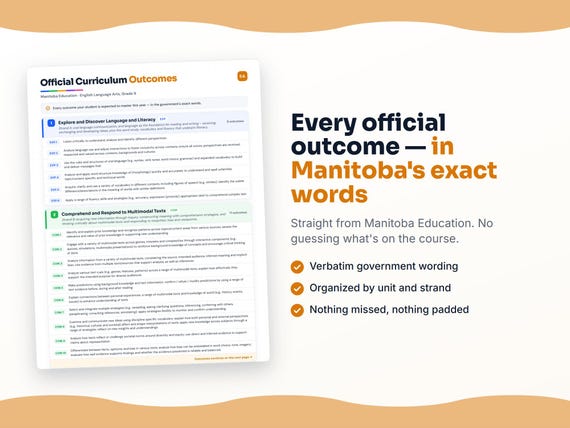
Manitoba defines English Language Arts, Grade 9 by strands and outcomes. MapleMind teaches the same curriculum reorganized for one-skill-at-a-time tutoring — the table shows exactly where every official strand lands, and the ministry's own wording is quoted under each unit below.
Official source Manitoba's official curriculumRead it on the government site — edu.gov.mb.ca ↗| Official strand | Outcomes | Where MapleMind teaches it |
|---|---|---|
| Strand A | 9 | Explore and Discover Language and Literacy |
| Strand B | 15 | Comprehend and Respond to Multimodal Texts |
| Strand C | 15 | Compose and Create Multimodal Texts |
| Strand D | 8 | Communicate Ideas and Build New Understandings |
Every skill below, taught one on one.
 Try the first session free
How MapleMind teaches English Language Arts, Grade 9 — every unit, lesson, and skill
Every skill below runs as a short session: a plain-words lesson, a worked example, solving it together, then a five-question skill check that earns up to three stars. Guided Mode keeps it teaching instead of answer-handing — turning it off needs a parent's password.
Unit 1Explore and Discover Language and LiteracyOfficial strand · Strand A
Strand A: oral language communication, and language as the foundation for reading and writing - receiving, exchanging and developing ideas, plus the word study, vocabulary and fluency that underpin literacy.
Listening (Receptive)
- Listening critically to oral textsELA.9.A1.1 — Listen critically to oral information and ideas, and respond to different perspectives, points of view, values and biases in what you hear.
- Using non-verbal cues and inclusive conventions when listeningELA.9.A1.2 — Use and adjust supportive non-verbal cues and inclusive social conventions when receiving the contributions of others, listening attentively and appreciating multiple perspectives.
Interacting
- Adjusting language to foster inclusive interactionELA.9.A1.3 — Analyze and evaluate language use, and adjust your interactions so that all voices and perspectives are received, respected and valued across contexts, backgrounds and cultures.
- Asking questions to explore and challenge ideasELA.9.A1.4 — Ask multifaceted questions and seek or provide clarification and explanation to explore and critique ideas, and to clarify, verify or challenge ideas and conclusions.
Speaking (Expressive)
- Using the rules and structures of oral languageELA.9.A1.5 — Use the rules and structures of oral language and expanded vocabulary to build and deliver coherent, clear messages appropriate to formal and informal contexts, purposes and audiences, and self-monitor your language.
- Adapting spoken language to situation and audienceELA.9.A1.6 — Use language appropriate to different situations, audiences and purposes, adjusting speaking techniques and self-monitoring your language and tone.
Word Study (Morphology)
- Applying morphology to understand and spell wordsELA.9.A2.4 — Analyze and apply word-structure (morphology) knowledge to understand and spell unfamiliar, topic-specific and technical words.
Vocabulary
- Building and refining precise vocabularyELA.9.A2.5 — Acquire, clarify and use a variety of vocabulary across contexts, including figures of speech, and distinguish subtle differences in the meaning of words with similar definitions.
Reading Fluency
- Applying fluency to comprehend complex textELA.9.A2.6 — Apply a range of fluency skills and strategies - accuracy, expression (prosody), appropriate rate - to comprehend complex text.
The official wording — 9 outcomes in this unit
- ELA.9.A1.1
Listen critically to understand, analyze and identify different perspectives
- ELA.9.A1.2
Understand and adapt use of supportive non-verbal cues and inclusive social conventions when listening to and receiving the contributions of others
- ELA.9.A1.3
Analyze language use and adjust interactions to foster inclusivity across contexts; ensure all voices, perspectives are received, respected and valued across contexts, backgrounds and cultures
- ELA.9.A1.4
Ask multifaceted questions and seek/provide clarification and explanation to further explore and critique ideas, concepts, problems, solutions; clarify, verify or challenge ideas and conclusions
- ELA.9.A1.5
Use the rules and structures of oral language (e.g., syntax, verb tense, word choice, grammar) and expanded vocabulary to build and deliver messages that
- ELA.9.A1.6
Use language appropriate to different situations, audiences, and purposes (e.g., interviews); recognize how speaking techniques change according to different situations
- ELA.9.A2.4
Analyze and apply word structure knowledge of (morphology) quickly and accurately to understand and spell unfamiliar, topic/content specific and technical words
- ELA.9.A2.5
Acquire, clarify and use a variety of vocabulary in different contexts, including figures of speech (e.g., similes); identify the subtle difference/associations in the meaning of words with similar definitions
- ELA.9.A2.6
Apply a range of fluency skills and strategies (e.g., accuracy, expression (prosody), appropriate rate) to comprehend complex text
Unit 2Comprehend and Respond to Multimodal TextsOfficial strand · Strand B
Strand B: acquiring new information through inquiry, constructing meaning with comprehension strategies, and thinking critically about multimodal texts and responding to inequities, bias and viewpoints.
Activate Prior Knowledge and Inquire
- Activating prior knowledge to build understandingELA.9.B1.1 — Identify, apply and analyze prior knowledge, recognizing patterns across topics and assessing the relevance and value of that knowledge in supporting new understanding.
- Creating focused questions to drive inquiryELA.9.B1.2 — Create focused, open-ended or analytical questions to challenge misconceptions, explore multiple perspectives and drive individual or group inquiry.
Engage with a Variety of Texts
- Engaging with a variety of multimodal textsELA.9.B1.3 — Engage with a variety of multimodal texts across genres, interests and complexities to build background knowledge and media literacy and encourage critical thinking.
Review Information
- Analyzing and synthesizing information across sourcesELA.9.B1.4 — Analyze or synthesize information from a variety of multimodal texts - considering source, audience, inferred meaning and implicit bias - and cite evidence from multiple sources to support analysis and inferences.
Identify Text Cues
- Analyzing and critiquing text cuesELA.9.B2.1 — Analyze or critique text cues - genres, features, patterns - across multimodal texts and explain how effectively they support the intended purpose for diverse audiences.
- Using textual cues and organizational patterns to construct meaningELA.9.B2.2 — Use and evaluate textual cues and prominent organizational patterns across multimodal texts to construct, confirm and interpret meaning.
Make Predictions
- Making and testing predictions with text evidenceELA.9.B2.3 — Make predictions using background knowledge and text information, then confirm, refute or modify them using a range of text evidence before, during and after reading.
Make Connections
- Making connections to deepen understandingELA.9.B2.4 — Explain, apply and analyze connections between personal experience, a range of multimodal texts and knowledge of the world to deepen understanding and interpretation of texts.
Monitor Understanding
- Selecting and integrating comprehension strategiesELA.9.B2.5 — Select, justify and integrate multiple comprehension strategies and apply them flexibly to monitor, confirm and extend understanding.
- Summarizing and synthesizing complex textsELA.9.B2.6 — Summarize or synthesize ideas, concepts and themes from complex texts, condensing larger sections and distinguishing key ideas from less important information while maintaining the author's message.
Consolidate New Knowledge
- Consolidating and communicating new knowledgeELA.9.B2.7 — Examine, synthesize and communicate new ideas using discipline-specific vocabulary, explain how perspectives shape interpretation, and apply new knowledge across disciplines while reflecting on new insights.
Analyze Text
- Analyzing how texts portray diversity and equityELA.9.B3.1 — Analyze or critically assess how texts reflect, challenge or omit diversity, inclusion and equity, and support claims about representation and bias with direct and inferred evidence across texts.
Recognize Facts, Bias and Viewpoints
- Differentiating facts, opinions and biasELA.9.B3.2 — Differentiate or critique facts, opinions and bias in texts, analyze how bias is embedded in word choice, tone and content, and evaluate whether evidence is reliable, balanced and credible.
- Examining point of view and viewpoint credibilityELA.9.B3.3 — Examine or investigate a text creator's purpose in selecting a point of view, how point of view influences meaning, and how competing viewpoints interact, judging the credibility of sources.
Respond to Text
- Responding critically to bias and prejudiceELA.9.B3.4 — Compare personal reactions with those of others and society, and explain or analyze how prejudice and bias shape meaning and affect understanding of a text's purpose or credibility.
The official wording — 15 outcomes in this unit
- ELA.9.B1.1
Identify and explain prior knowledge and recognize patterns across topics/content areas from various sources; assess the relevance and value of prior knowledge in supporting new understanding
- ELA.9.B1.2
Create focused, open-ended questions to challenge misconceptions and explore multiple perspectives in reading, listening and viewing information in an individual or group inquiry
- ELA.9.B1.3
Engage with a variety of multimodal texts across genres, interests and complexities through interactive components (e.g., quizzes, simulations, multimedia presentations) to reinforce background knowledge of concepts and encourage critical thinking of texts
- ELA.9.B1.4
Analyze information from a variety of multimodal texts, considering the source, intended audience, inferred meaning and implicit bias; cite evidence from multiple texts/sources that support analysis, as well as inferences
- ELA.9.B2.1
Analyze various text cues (e.g., genres, features, patterns) across a range of multimodal texts; explain how effectively they support the intended purpose for diverse audiences
- ELA.9.B2.2
Use textual cues and prominent organizational patterns of a range of multimodal texts to construct/confirm meaning and interpret texts
- ELA.9.B2.3
Make predictions using background knowledge and text information; confirm / refute / modify predictions by using a range of text evidence before, during and after reading
- ELA.9.B2.4
Explain connections between personal experiences, a range of multimodal texts and knowledge of world (e.g., history, events, issues) to enhance understanding of texts
- ELA.9.B2.5
Select and integrate multiple strategies (e.g., rereading, asking clarifying questions, inferencing, conferring with others, paraphrasing, consulting references, annotating); apply strategies flexibly to monitor and confirm understanding
- ELA.9.B2.6
Summarize ideas/concepts/themes from more complex texts; condense larger sections of text/ideas by grouping related ideas together; distinguish between key ideas and less important information
- ELA.9.B2.7
Examine and communicate new ideas using discipline specific vocabulary; explain how both personal and external perspectives (e.g., historical, cultural, and societal) affect and shape interpretations of texts; apply new knowledge across subjects through a range of strategies; reflect on new insights and understandings
- ELA.9.B3.1
Analyze how texts reflect or challenge societal norms around diversity and equity; use direct and inferred evidence to support claims about representation
- ELA.9.B3.2
Differentiate between facts, opinions, and bias in various texts; analyze how bias can be embedded in word choice, tone, imagery; evaluate how well evidence supports findings and whether the evidence presented is reliable and balanced
- ELA.9.B3.3
Examine text creator
- ELA.9.B3.4
Compare personal reactions with others (different audiences) and societal perspectives; explain how prejudice and bias shape meaning and affect understanding of text, purpose or credibility; recognize bias can be subtle
Unit 3Compose and Create Multimodal TextsOfficial strand · Strand C
Strand C: generating ideas, planning and drafting; enhancing the clarity and artistry of multimodal texts; and editing and publishing.
Generate Ideas
- Selecting and focusing a topicELA.9.C1.1 — Select a topic from ideas generated across experiences, current events, literature and cross-curricular knowledge, and focus it based on purpose, format, perspective and audience.
Research Sources
- Researching and evaluating sourcesELA.9.C1.2 — Select, integrate and evaluate multiple sources, comparing them to assess reliability, look for bias and examine different points of view.
Choose Form and Plan
- Planning with strategies and toolsELA.9.C1.3 — Use strategies and planning tools specific to genre and purpose - mind maps, outlines, research organizers - to collect and record information and outline the steps of creating a text.
- Choosing and blending forms purposefullyELA.9.C1.4 — Choose the form of a text purposely, understanding its conventions, and at senior levels choose, adapt or blend forms flexibly for a specific message, audience and purpose.
Create Draft/Prototype
- Drafting complex multimodal textsELA.9.C1.5 — Create complex multimodal texts using varied thinking strategies and maps to draft ideas effectively and creatively, choosing digital tools based on purpose and audience.
Organize Ideas
- Organizing ideas with structure and transitionsELA.9.C2.1 — Select, evaluate and use appropriate organizational structures, techniques and transitions to achieve a specific purpose for an audience and communicate clearly.
Sentence Structure
- Crafting sentences for meaning and styleELA.9.C2.2 — Reread and use more complex and varied sentences - expanding, combining or reducing them - for meaning, interest and style, applying grammatical correctness.
Word Choice
- Choosing precise, discipline-specific wordsELA.9.C2.3 — Use clear, precise, discipline-specific words for different purposes, genres, forms and audiences to convey and strengthen intended meaning.
Voice/Style
- Controlling voice for purpose and audienceELA.9.C2.4 — Demonstrate control over voice - shifting between formal, persuasive, reflective and narrative registers - and use voice to influence, inform and impact an audience.
Revision
- Revising for clarity, coherence and logicELA.9.C2.5 — Revise texts for coherence, voice and logical progression - correcting logic, repetition and transitions, reviewing mechanics - and reflect critically on feedback and the changes made.
Legibility and Word Processing
- Producing legible, well-formatted textELA.9.C3.1 — Write legibly and fluently, integrating word-processing skills and using formatting tools intentionally to support meaning, improve readability and ensure clarity for the reader.
Spelling
- Applying spelling strategies and word structureELA.9.C3.2 — Analyze words and apply spelling strategies and rules - derivatives, bases, affixes, roots and etymology - to confirm conventional spelling of complex words, using resources to confirm.
Punctuation and Capitalization
- Applying capitalization conventionsELA.9.C3.3 — Apply capitalization rules consistently and with attention to context across genres, including proper nouns and adjectives, titles, and digital or media conventions.
- Applying punctuation for clarity and effectELA.9.C3.4 — Apply punctuation correctly and, at senior levels, use it flexibly and as a stylistic device to shape tone, emphasis, rhythm and complex meaning while ensuring clarity.
Publish Final Text
- Publishing a polished multimodal projectELA.9.C3.5 — Create the final copy of a complex multimodal project, integrating multiple modes effectively - and at senior levels with a critical lens and mastery - for a specific purpose and audience.
The official wording — 15 outcomes in this unit
- ELA.9.C1.1
Select topic based on ideas generated from experiences, current events, literature, and cross-curricular knowledge; focus topic based on purpose, format and audience
- ELA.9.C1.2
Select and review information from multiple sources (e.g., different authors, experts, audio, digital online sources); compare sources to assess reliability, look for bias and examine different points of view
- ELA.9.C1.3
Use strategies and planning tools specific to genre and purpose (e.g., mind maps, outlines, research organizers, interview notes); collect and record information; outline steps-research, design, create text/prototype, share and reflect on plan
- ELA.9.C1.4
Choose form more purposely, understand the conventions of the form (e.g., editorials, memoirs, feature articles, documentaries) for a specific message, audience and purpose
- ELA.9.C1.5
Create more complex multimodal texts (e.g., videos, interactive timelines, digital essays); use varied thinking strategies/maps (e.g., flowchart, storyboards) to draft ideas effectively and creatively connecting purpose to format; choose appropriate digital tools based on purpose/audience
- ELA.9.C2.1
Select and use appropriate organizational structures and transitions (e.g., problem/solution, flashbacks) to achieve a specific purpose for an audience and to communicate clearly
- ELA.9.C2.2
Reread and use more complex sentences; expand, combine or reduce sentences for meaning, interest and style; choose vocabulary purposely to enhance sentence nuance and flow; use more advanced transitions to connect ideas, phrases and sentences; apply grammatical correctness to communicate meaning for others
- ELA.9.C2.3
Use clear, effective, discipline specific words for different purposes, genres, forms and audiences to convey and enhance meaning
- ELA.9.C2.4
Demonstrate greater control over voice for different purposes in text (e.g., informal/formal writing); express ideas with more clarity, confidence and emotion; adjust voice depending on form, genre and audience
- ELA.9.C2.5
Apply understanding of how text organization and clarity of structure affect text meaning; identify the logical progression of ideas/ details; revise for word choice, and tone; revisit the use of transitional words/phrases; revise for sentence errors
- ELA.9.C3.1
Write legibly and neatly; digital documentation and presentation is a greater focus; integrate word processing skills into the text creation process; use formatting tools intentionally (e.g., use of headers, bullets, paragraph alignment) to support meaning, improve readability and ensure text clarity for reader
- ELA.9.C3.2
Analyze words and apply knowledge of a range of strategies and rules; understand derivatives
- ELA.9.C3.3
Apply capitalization rules more consistently and with greater attention to context; differentiate between common and proper nouns; use capitalization in complex dialogue, quoted speech, specific historical events, institutions, and brand names, in subtitles and secondary titles
- ELA.9.C3.4
Apply punctuation correctly (e.g., apostrophes for both singular and plural possessives; quotation marks for nested dialogue, commas after introductory phrases and to set off clauses, colons and semi-colons); use punctuation for effect and clarity to communicate meaning clearly for others
- ELA.9.C3.5
Create final copy of more complex multimodal texts (e.g., podcasts, blogs, short documentaries); effectively integrate multiple modes for a specific purpose and audience
Unit 4Communicate Ideas and Build New UnderstandingsOfficial strand · Strand D
Strand D: sharing ideas and information across multimodal forms, and using metacognition to assess language skills, set goals and monitor progress.
Express Ideas and Engage Audience
- Using tone, volume and expression for deliveryELA.9.D1.1 — Use, experiment with and refine tone, volume and expression based on audience and purpose, adjusting delivery to communicate ideas effectively.
- Combining visuals and media for polished messagesELA.9.D1.2 — Combine visuals and media - and at senior levels evaluate their sources and effectiveness - to create polished, purposeful messages aligned to audience, genre and platform.
- Structuring a presentation to engage an audienceELA.9.D1.3 — Support ideas with evidence and adapt the structure and language of a presentation to communicate a clear message, organizing points for rhetorical effect to keep an audience engaged.
Self-Assess
- Reflecting on and reviewing personal growthELA.9.D2.1 — Reflect on, compare, analyze and review personal growth as a listener, speaker, reader, writer, viewer and representer, using self-questioning to approach new challenges.
- Using criteria and tools to assess your learningELA.9.D2.2 — Contribute to or use course criteria and use tools such as exit tickets, self-quizzes and portfolios to assess your own understanding and learning.
- Using feedback to refine strategiesELA.9.D2.3 — Receive descriptive feedback from others and reflect on how to refine your strategies for listening, speaking, reading, viewing, writing or representing.
Set Goals and Monitor Progress
- Setting learning goals and planning stepsELA.9.D2.4 — Reflect on and set specific learning goals - and at senior levels short- and long-term goals - to continue developing across the language processes, planning steps to achieve them.
- Monitoring progress toward goalsELA.9.D2.5 — Monitor progress by collecting evidence of learning and tracking growth toward goal achievement.
The official wording — 8 outcomes in this unit
- ELA.9.D1.1
Use tone, volume, and expression based on audience and purpose (e.g., to persuade, inform, entertain); reflect on effectiveness of tone and adjust accordingly to effectively communicate ideas
- ELA.9.D1.2
Combine visuals and media to create polished, purposeful messages; align design choices to specific audiences, genres, and platforms
- ELA.9.D1.3
Support ideas with evidence or examples and acknowledges audience needs (e.g., reasons for opinions/point of view); move smoothly and logically from one point to another to keep audience engaged
- ELA.9.D2.1
Reflect and compare with increasing independence, effective strategies used as a listener, speaker, reader, writer, viewer and representer by asking self questions
- ELA.9.D2.2
Contribute to the development of class/course criteria; use tools (e.g., exit tickets/reflection slips, self-quizzes, portfolios) to assess own understanding / learning
- ELA.9.D2.3
Receive descriptive feedback from others; reflect on how to refine strategies for listening, speaking, reading, viewing, writing or representing
- ELA.9.D2.4
Reflect on and set specific learning goals to continue to develop as a listener, speaker, reader, writer, viewer, representer; plan steps to achieve goal(s)
- ELA.9.D2.5
Monitor progress by collecting evidence of learning; track growth towards goal achievement
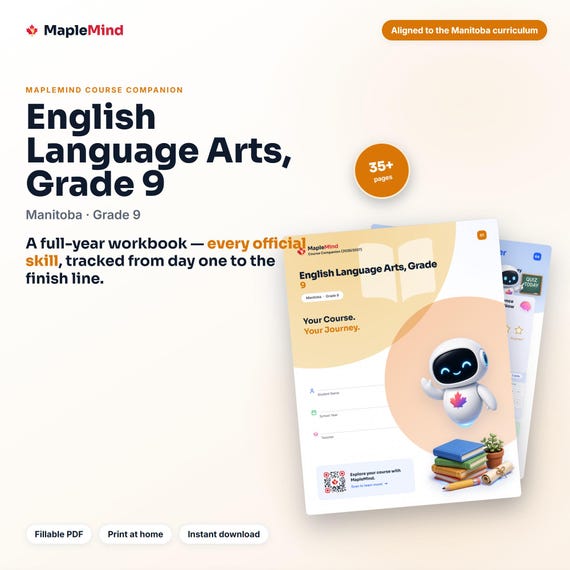
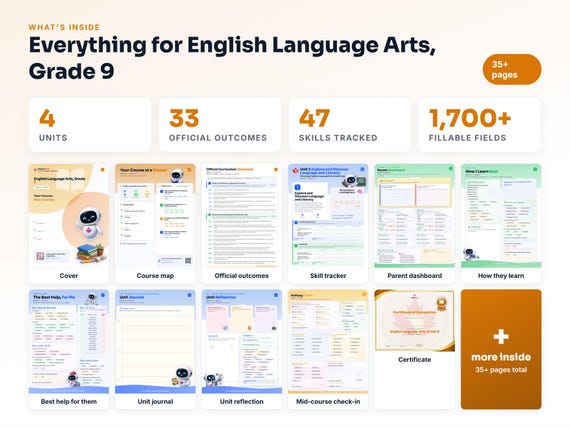
Printable workbook · A keepsake of the year
A English Language Arts, Grade 9 workbook worth keeping
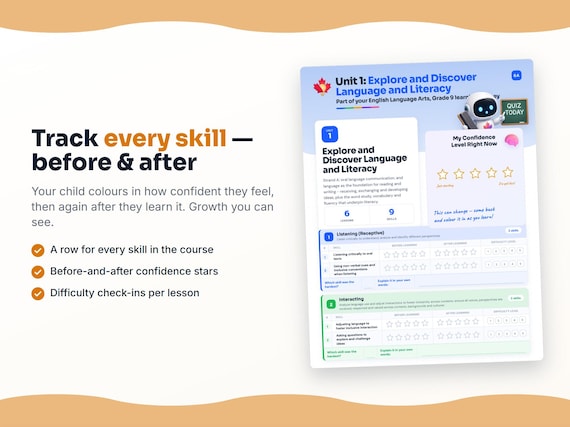
Built from the same official curriculum as this page. Before and after each skill above, your student colours in how sure they feel — so the two of you can see, on one page, what's clicking and what needs another look. It's a quiet way to follow how the year is really going.
By June it's full of their own handwriting: units worked through, confidence grown, a mid-year check-in, notes from parent-teacher night, and a certificate at the end. Less a worksheet, more a record of the year worth keeping on the shelf.
Instant download · see every page, reviews and the full description · five or more workbooks are $2.99 each
What it looks like in the app
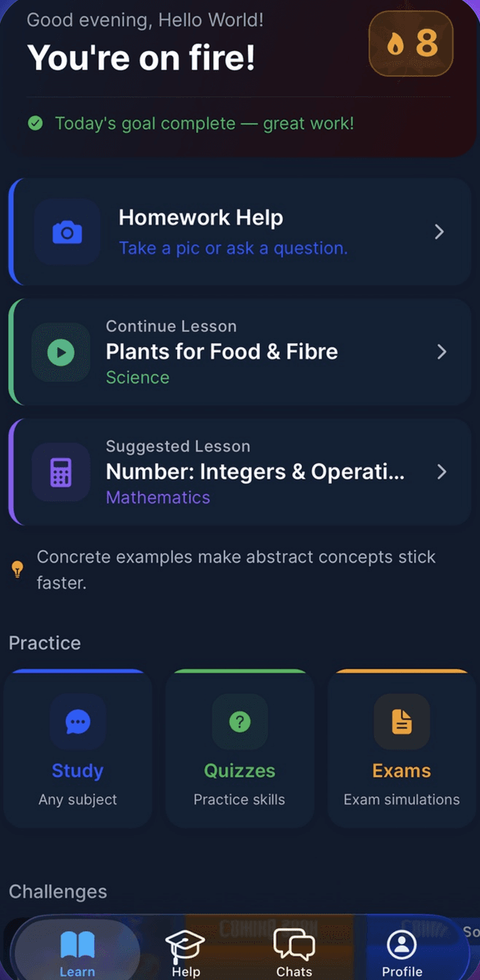
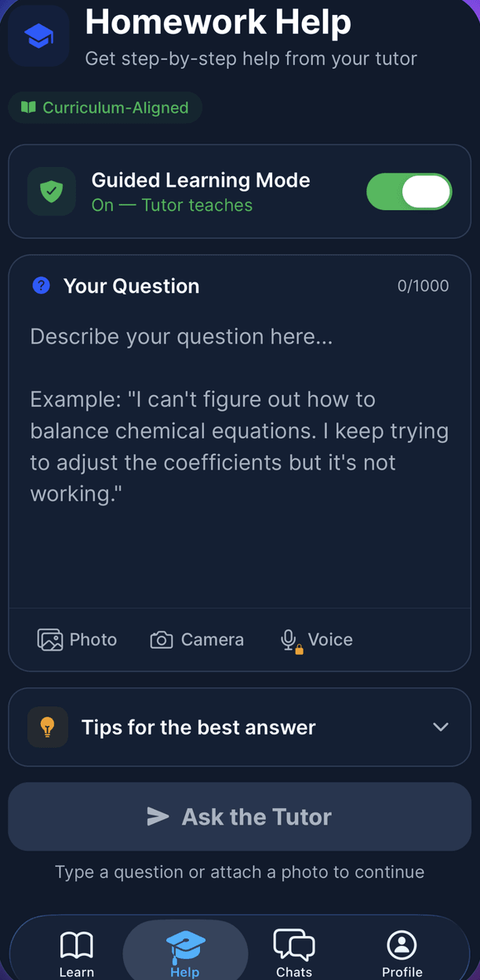
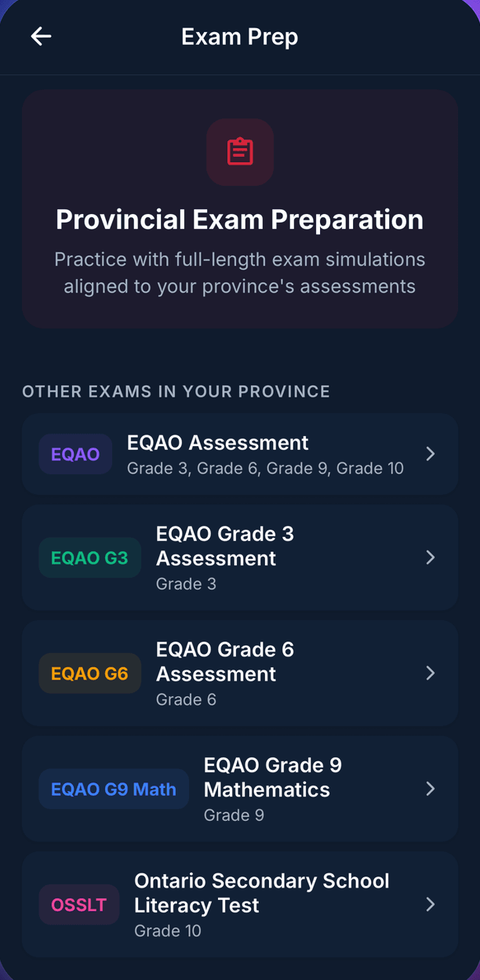
Common questions
Can MapleMind help me with English Language Arts, Grade 9?
Yes. MapleMind's AI tutor covers all 47 skills in Manitoba's English Language Arts, Grade 9 — you pick the exact skill, and the tutor teaches it step by step: a short lesson, a worked example, solving together, then a skill check to show it stuck.
Is MapleMind aligned to Manitoba's official curriculum?
Yes. Every skill in this course maps to an official outcome code from Manitoba's Grade 9 English Language Arts curriculum, and the ministry's own wording is quoted under each unit on this page — with the official government source linked so you can check it yourself.
What does MapleMind cost?
It's free to start — 5 tutoring chats and a practice quiz every day, no credit card. A Pro subscription ($9.99/month or $49.99/year CAD, 7-day free trial) unlocks unlimited tutoring, practice, and exam simulations.
What if I'm stuck on just one topic?
That's the point of skill-level tutoring: open English Language Arts, Grade 9 in the app, tap the exact skill from the list on this page, and the tutor teaches just that — no wading through lessons you don't need.
Does MapleMind work in French or other languages?
Yes — 14 languages, including French. Both the app and the tutor's explanations switch to the language you choose.
Where can I see the official Manitoba curriculum for English Language Arts, Grade 9?
The official source is linked on this page — Manitoba's official curriculum. The outline here follows it: every MapleMind skill carries its official outcome code, and the ministry's own wording is quoted under each unit.
Keep exploring
Ready when you are
Pick a skill from this page and see it taught properly — free, in the browser, in under a minute.