Get help with Essential Mathematics, Grade 10 (20S)
Most tutoring makes you sit through material you already know. MapleMind flips that: pick the exact skill that's causing trouble — any of the 27 below — and the tutor teaches just that one, step by step, as many times as it takes. Ask questions in plain words, any time of day, in English, French, or 12 other languages.
The official Manitoba Essential Mathematics, Grade 10 (20S) curriculum
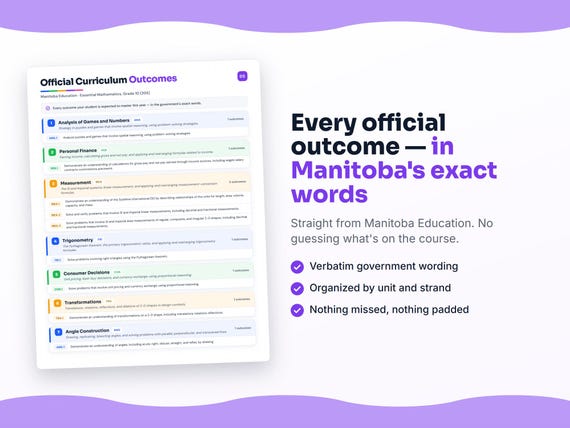
Manitoba defines Essential Mathematics, Grade 10 (20S) by strands and outcomes. MapleMind teaches the same curriculum reorganized for one-skill-at-a-time tutoring — the table shows exactly where every official strand lands, and the ministry's own wording is quoted under each unit below.
Official source Manitoba's official curriculumRead it on the government site — edu.gov.mb.ca ↗| Official strand | Outcomes | Where MapleMind teaches it |
|---|---|---|
| Strand A | 2 | Analysis of Games and Numbers |
| Strand P | 2 | Personal Finance |
| Strand M | 6 | Measurement |
| Strand TG | 3 | Trigonometry |
| Strand C | 1 | Consumer Decisions |
| Strand TF | 1 | Transformations |
| Strand AC | 2 | Angle Construction |
Every skill below, taught one on one.
 Try the first session free
How MapleMind teaches Essential Mathematics, Grade 10 (20S) — every unit, lesson, and skill
Every skill below runs as a short session: a plain-words lesson, a worked example, solving it together, then a five-question skill check that earns up to three stars. Guided Mode keeps it teaching instead of answer-handing — turning it off needs a parent's password.
Unit 1Analysis of Games and NumbersOfficial strand · Strand A
Strategy in puzzles and games that involve spatial reasoning, using problem-solving strategies.
Puzzles and Games with Spatial Reasoning
- Winning strategies for spatial puzzles10E1.A.1 — Analyze puzzles and games that involve spatial reasoning, determining, explaining, and verifying a strategy to solve a puzzle or win a game.
- Inventing and adapting a spatial puzzle10E2.A.1 — Create a variation on a spatial puzzle or game and describe a strategy for solving or winning it, applying spatial reasoning to a new context.
The official wording — 2 outcomes in this unit
- 10E1.A.1
Analyze puzzles and games that involve spatial reasoning, using problem-solving strategies.
- 10E2.A.1
Analyze puzzles and games that involve spatial reasoning, using problem-solving strategies.
Unit 2Personal FinanceOfficial strand · Strand P
Earning income, calculating gross and net pay, and applying and rearranging formulas related to income.
Earning Income and Pay
- Ways of earning income10E1.P.1 — Describe various methods of earning income — wages, salary, contracts, commissions, and piecework — and their advantages and disadvantages.
- Calculating gross pay10E1.P.1 — Determine gross pay from various income methods, including base hourly wage with tips, overtime at time-and-a-half or double time, commission, and piecework.
- Deductions and net pay10E1.P.1 — Explain why gross and net pay differ, and determine net pay by subtracting CPP, EI, income tax, and other deductions from gross pay.
- Rearranging income formulas10E1.P.2 — Solve problems that require applying and rearranging formulas related to income, including finding a rate of pay given regular pay and hours worked.
The official wording — 2 outcomes in this unit
- 10E1.P.1
Demonstrate an understanding of calculations for gross pay and net pay earned through income sources, including wages salary contracts commissions piecework
- 10E1.P.2
Solve problems that require the manipulation and application of formulas related to income.
Unit 3MeasurementOfficial strand · Strand M
The SI and imperial systems, linear measurement, and applying and rearranging measurement-conversion formulas.
The SI and Imperial Systems
- The SI system and its units10E1.M.1 — Demonstrate an understanding of the SI system by describing relationships among the units for length, area, volume, capacity, and mass, and matching prefixes to powers of ten.
- Converting within SI10E1.M.1 — Convert one SI unit into another SI unit, and provide an approximate SI measurement for a measurement given in imperial units.
- The imperial system10E1.M.2 — Demonstrate an understanding of the imperial system by describing relationships among its units for length, area, volume, capacity, and mass, and comparing American and British imperial units for capacity.
- Converting between imperial and SI10E1.M.2 — Apply strategies including proportional reasoning to convert measurements between imperial and SI units, and provide an approximate imperial measure for an SI measurement.
Linear Measurement and Formulas
- Measuring with SI and imperial tools10E1.M.3 — Estimate and measure inside and outside diameters, lengths, and widths of objects using referents and instruments such as rulers, tape measures, and calipers, in SI and imperial units.
- Solving linear measurement problems10E1.M.3 — Solve and verify linear-measurement problems including perimeter, circumference, and shipping dimensions, and determine the midpoint of a linear measurement.
- Applying and rearranging conversion formulas10E1.M.4 — Solve problems that require applying and rearranging formulas related to converting measurement, including converting temperatures between Fahrenheit and Celsius.
2-D Area and Perimeter
- Area of regular and composite shapes10E1.G.1 — Solve problems that involve SI and imperial area measurements of regular, composite, and irregular 2-D shapes, using referents, grids, and area formulas including circles.
- Changing dimensions and unit conversion10E1.G.1 — Convert an area measurement between squared units using proportional reasoning, and explain the effect of changing dimensions on the area and perimeter of rectangles.
- Rearranging perimeter and area formulas10E1.G.2 — Solve problems that require applying and rearranging formulas related to perimeter and area, and verify that different forms of the same formula are equivalent.
The official wording — 6 outcomes in this unit
- 10E1.M.1
Demonstrate an understanding of the Système International (SI) by describing relationships of the units for length, area, volume, capacity, and mass.
- 10E1.M.2
Demonstrate an understanding of the imperial system by describing the relationships of the units for length, area, volume, capacity, and mass comparing the American and British imperial units for capacity
- 10E1.M.3
Solve and verify problems that involve SI and imperial linear measurements, including decimal and fractional measurements.
- 10E1.M.4
Solve problems that require the manipulation and application of formulas related to converting measurement.
- 10E1.G.1
Solve problems that involve SI and imperial area measurements of regular, composite, and irregular 2-D shapes, including decimal and fractional measurements.
- 10E1.G.2
Solve problems that require the manipulation and application of formulas related to perimeter area
Unit 4TrigonometryOfficial strand · Strand TG
The Pythagorean theorem, the primary trigonometric ratios, and applying and rearranging trigonometry formulas.
Right Triangles and Trigonometry
- The Pythagorean theorem10E2.TG.1 — Solve problems involving right triangles using the Pythagorean theorem, and determine whether a triangle is a right triangle.
- Sine, cosine, and tangent ratios10E2.TG.2 — Demonstrate an understanding of the primary trigonometric ratios (sine, cosine, tangent) by applying similarity to right triangles and generalizing the ratios from similar right triangles.
- Solving with trig ratios10E2.TG.2 — Solve contextual problems involving right triangles using the primary trigonometric ratios for indirect measurement of angles and lengths.
- Rearranging Pythagorean and trig formulas10E2.TG.3 — Solve problems that require applying and rearranging formulas related to the Pythagorean theorem and the primary trigonometric ratios.
The official wording — 3 outcomes in this unit
- 10E2.TG.1
Solve problems involving right triangles using the Pythagorean theorem.
- 10E2.TG.2
Demonstrate an understanding of primary trigonometric ratios (sine, cosine, tangent) by applying similarity to right triangles generalizing patterns from similar right triangles
- 10E2.TG.3
Solve problems that require the manipulation and application of formulas related to the Pythagorean theorem primary trigonometric ratios
Unit 5Consumer DecisionsOfficial strand · Strand C
Unit pricing, best-buy decisions, and currency exchange, using proportional reasoning.
Smart Shopping and Currency
- Unit pricing and best buys10E2.C.1 — Solve problems that involve unit pricing using proportional reasoning, determine the best buy, and find sale prices and percent increase or decrease.
- Currency exchange10E2.C.1 — Solve problems that involve currency exchange using proportional reasoning, and explain the difference between the selling and purchasing rate.
The official wording — 1 outcome in this unit
- 10E2.C.1
Solve problems that involve unit pricing and currency exchange, using proportional reasoning.
Unit 6TransformationsOfficial strand · Strand TF
Translations, rotations, reflections, and dilations of 2-D shapes in design contexts.
Transforming 2-D Shapes
- Translations, rotations, and reflections10E2.TF.1 — Demonstrate an understanding of translations, rotations, and reflections on a 2-D shape, drawing images from single and combined transformations and creating designs.
- Dilations and similarity10E2.TF.1 — Determine and draw a dilation image of a 2-D shape using the concept of similarity, and explain how the original shape and its image are proportional.
The official wording — 1 outcome in this unit
- 10E2.TF.1
Demonstrate an understanding of transformations on a 2-D shape, including translations rotations reflections
Unit 7Angle ConstructionOfficial strand · Strand AC
Drawing, replicating, bisecting angles, and solving problems with parallel, perpendicular, and transversal lines.
Angles and Lines
- Drawing and measuring angles10E2.AC.1 — Draw, sketch, estimate, and measure acute, right, obtuse, straight, and reflex angles using referents and a protractor.
- Replicating and bisecting angles10E2.AC.1 — Replicate and construct angles and bisect an angle using a variety of methods, such as a compass and straightedge or a carpenter's square.
- Parallel lines and transversals10E2.AC.2 — Solve problems that involve parallel, perpendicular, and transversal lines and the pairs of angles formed between them.
The official wording — 2 outcomes in this unit
- 10E2.AC.1
Demonstrate an understanding of angles, including acute, right, obtuse, straight, and reflex, by drawing
- 10E2.AC.2
Solve problems that involve parallel, perpendicular, and transversal lines, and pairs of angles formed between them.
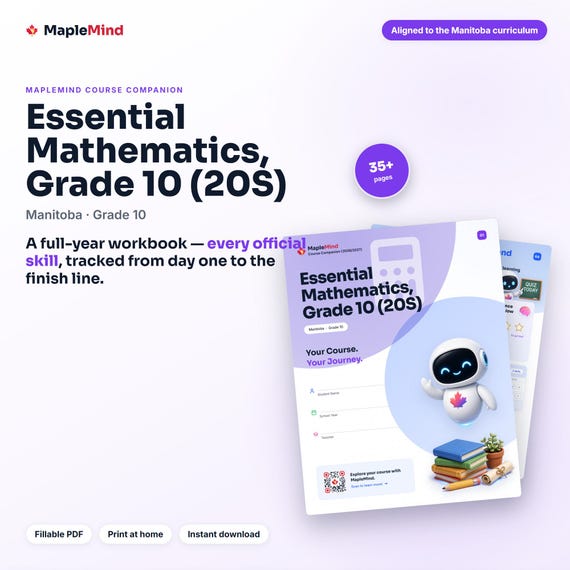
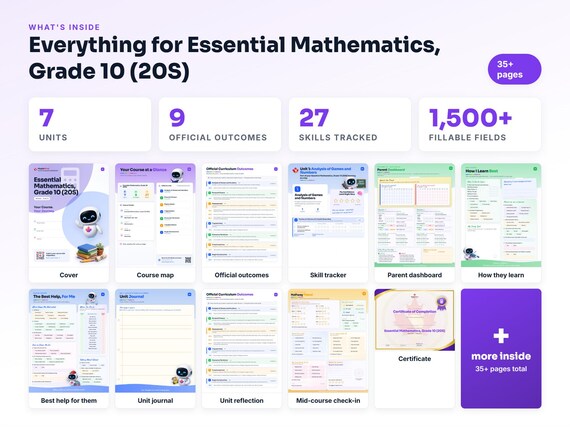

Printable workbook · A keepsake of the year
A Essential Mathematics, Grade 10 (20S) workbook worth keeping
Built from the same official curriculum as this page. Before and after each skill above, your student colours in how sure they feel — so the two of you can see, on one page, what's clicking and what needs another look. It's a quiet way to follow how the year is really going.
By June it's full of their own handwriting: units worked through, confidence grown, a mid-year check-in, notes from parent-teacher night, and a certificate at the end. Less a worksheet, more a record of the year worth keeping on the shelf.
Instant download · see every page, reviews and the full description · five or more workbooks are $2.99 each
What it looks like in the app



Common questions
Can MapleMind help me with Essential Mathematics, Grade 10 (20S)?
Yes. MapleMind's AI tutor covers all 27 skills in Manitoba's Essential Mathematics, Grade 10 (20S) — you pick the exact skill, and the tutor teaches it step by step: a short lesson, a worked example, solving together, then a skill check to show it stuck.
Is MapleMind aligned to Manitoba's official curriculum?
Yes. Every skill in this course maps to an official outcome code from Manitoba's Grade 10 Mathematics curriculum, and the ministry's own wording is quoted under each unit on this page — with the official government source linked so you can check it yourself.
What does MapleMind cost?
It's free to start — 5 tutoring chats and a practice quiz every day, no credit card. A Pro subscription ($9.99/month or $49.99/year CAD, 7-day free trial) unlocks unlimited tutoring, practice, and exam simulations.
What if I'm stuck on just one topic?
That's the point of skill-level tutoring: open Essential Mathematics, Grade 10 (20S) in the app, tap the exact skill from the list on this page, and the tutor teaches just that — no wading through lessons you don't need.
Does MapleMind work in French or other languages?
Yes — 14 languages, including French. Both the app and the tutor's explanations switch to the language you choose.
Where can I see the official Manitoba curriculum for Essential Mathematics, Grade 10 (20S)?
The official source is linked on this page — Manitoba's official curriculum. The outline here follows it: every MapleMind skill carries its official outcome code, and the ministry's own wording is quoted under each unit.
Keep exploring
Ready when you are
Pick a skill from this page and see it taught properly — free, in the browser, in under a minute.